2027 Most Affordable Online BSN to MSN Bridge Programs

Co-Founder and Chief Data Scientist
Choosing an affordable online BSN to MSN program is not just a tuition question. For registered nurses who already hold a Bachelor of Science in Nursing (BSN), the decision affects clinical eligibility, certification options, work-life balance, long-term salary potential, and how much debt is realistic to take on. The National Center for Health Workforce Analysis reports that more than 40% of the nursing workforce has completed education beyond initial licensure, showing that many RNs see additional credentials as a practical route to advancement.
This guide is written for BSN-prepared RNs comparing online Master of Science in Nursing (MSN) options for 2027. It explains what BSN to MSN bridge programs include, which affordable online programs stand out, how to compare costs beyond tuition, what specializations lead to which careers, and what questions to ask before applying.
Quick Answer: What is the cheapest practical path from BSN to MSN online?
The most affordable online BSN to MSN program is usually the one that combines low tuition, nursing accreditation, a specialization that matches your career goal, reasonable clinical placement expectations, and a schedule you can finish without pausing your income. A low per-credit rate is helpful, but it does not tell the full story. Total credits, fees, clinical travel costs, state authorization, certification eligibility, and employer reimbursement can change the real price.
Why nurses choose an online BSN to MSN bridge program
- Career mobility: MSN graduates may qualify for advanced roles such as nurse practitioner (NP), nurse midwife, nurse anesthetist, clinical nurse leader, nurse educator, or nurse administrator, depending on the program track and licensure requirements.
- Higher earning potential: According to the US Bureau of Labor Statistics (BLS), nurse anesthetists, nurse midwives, and NPs earned a median annual wage of $132,050 in May 2024.
- Flexible access: Online coursework can make graduate study more realistic for nurses who need to keep working, manage family responsibilities, or avoid relocating for school.
What can I expect from an online BSN to MSN bridge program?
An online BSN to MSN bridge program is a graduate pathway for licensed RNs who already have a BSN and want to move into advanced clinical, educational, leadership, or administrative nursing roles. Most programs take 18 to 36 months, though the exact timeline depends on the specialization, credit load, clinical hour requirements, and whether you study full-time or part-time.
Expect graduate-level coursework in advanced health assessment, pharmacology, pathophysiology, research, evidence-based practice, healthcare policy, leadership, and population health. Clinical tracks, such as family nurse practitioner, add supervised practice requirements tied to certification and state licensure. Nonclinical tracks, such as nursing education or nursing administration, may include practicums, capstones, leadership projects, or teaching experiences.
“Online” does not mean entirely hands-off or fully self-directed. Many programs deliver lectures, assignments, discussions, and exams online, but students often complete clinical experiences in approved healthcare settings near where they live. Before enrolling, confirm whether the school helps secure clinical placements or expects students to find preceptors independently.
Where can I work after completing a BSN to MSN bridge program?
BSN to MSN graduates work across clinical care, management, education, community health, and healthcare operations. The right setting depends heavily on the MSN concentration. An FNP track can lead toward primary care roles, while a nurse educator track is more aligned with teaching, staff development, or academic instruction. Nurse leadership and administration tracks often prepare graduates for management, quality improvement, and operational roles.
Common workplaces include hospitals, outpatient clinics, private practices, community health centers, long-term care facilities, surgical centers, birthing centers, public health departments, universities, and hospital education departments. Some MSN-prepared nurses also move into telehealth, utilization review, clinical informatics, healthcare consulting, nonprofit health programs, or government agencies.
How much can I make after completing a BSN to MSN bridge program?
An MSN can improve salary potential, but earnings vary by specialty, state, employer, certification, experience, and scope of practice rules. As of May 2024, BLS reports that nurse anesthetists, nurse midwives, and NPs had a median annual salary of $132,050. Nurse anesthetists tend to be on the higher end of the pay scale, often earning more than $200,000 annually, while nurse educators typically earn between $85,000 and $105,000.
Salary should not be treated as guaranteed ROI. A nurse entering a high-demand advanced practice specialty in a metropolitan area may see different outcomes than a nurse moving into education or administration in a lower-cost region. When comparing programs, ask schools for specialty-specific employment outcomes, certification pass rates, and graduate placement data rather than relying only on national salary averages.
- Most Affordable Online BSN to MSN Bridge Programs for 2027
- How long does an online BSN to MSN bridge program take?
- Online vs. on-campus BSN to MSN bridge programs
- Typical cost of an online BSN to MSN bridge program
- Financial aid options for online BSN to MSN students
- Common admission requirements for BSN to MSN programs
- Courses usually included in an online BSN to MSN curriculum
- BSN to MSN specializations and how to choose one
- How to choose an affordable, high-quality online BSN to MSN program
- Career paths after an online BSN to MSN program
- How online BSN to MSN programs prepare nurses for advanced practice
- Direct-entry NP programs for people who are not nurses
- Job market for online BSN to MSN graduates
- How to evaluate online BSN to MSN quality
- Which BSN to MSN program format fits your schedule?
- Key insights
Most Affordable Online BSN to MSN Bridge Programs for 2027
How this ranking was developed
An MSN is a major financial and professional commitment, so affordability must be evaluated with more than advertised tuition. This ranking focuses on online BSN to MSN options that combine accessible pricing with recognized nursing accreditation, practical program structures, and tracks that support common graduate nursing goals.
Research.com’s higher education team reviewed publicly available education data from the IPEDS database, Peterson’s Distance Learning Licensed Data Set, the College Scorecard database, and the National Center for Education Statistics. For a fuller explanation of ranking criteria, including tuition, online availability, accreditation, and program design, see the Research.com methodology page.
The following institutions offer affordable online BSN to MSN bridge programs for 2027. Use the list as a starting point, then verify current tuition, fees, state authorization, clinical placement policies, and certification eligibility directly with each school.
| Rank | School | Online MSN tracks | Program length | Cost information | Credits | Accreditation |
| 1 | University of Central Missouri | Nurse Educator, Nurse Leader | Two to three years | $360 per credit | 44 to 47 | Commission on Collegiate Nursing Education (CCNE) |
| 2 | Fort Hays State University | Nursing Administration, Nursing Education | Two and a half to three years | $319 per credit | 36 | CCNE |
| 3 | Western Governors University | Nursing Education, Nursing Leadership & Management | As little as 18 months | Flat-rate $4,795 per 6-month term | 36 to 41 | CCNE |
| 4 | Texas Tech University Health Sciences Center | Nursing Administration, FNP | Two to three years | $265 in-state per credit; $673 out-of-state per credit | 48 to 54 | CCNE |
| 5 | Georgia Southwestern State University | Nursing Education, Nursing Leadership | Two years | $257 per credit | 36 | CCNE |
| 6 | University of Texas at Tyler | Education, Administration, FNP | Two to three years | $300 in-state per credit | 36 to 45 | CCNE |
| 7 | Lamar University | Nursing Administration, Nursing Education | Two years | $314 per credit | 37 | CCNE |
| 8 | University of North Alabama | Teaching-Learning, Leadership | Two to two and a half years | $340 per credit | 31 to 39 | CCNE |
| 9 | McNeese State University | Nurse Educator | Two years | $375 per credit | 35 | Accreditation Commission for Education in Nursing (ACEN) |
| 10 | University of South Alabama | AGACNP, FNP, PMHNP, Nurse Administrator, Nurse Educator | Two to three years | $348 per credit | 39 to 60 | CCNE |
Program notes for each ranked school
- University of Central Missouri: UCM’s online BSN to MSN option, launched in 2014, is structured for working RNs interested in nurse educator or nurse leader preparation. Asynchronous coursework and limited synchronous requirements can help students balance graduate school with employment.
- Fort Hays State University: Fort Hays State has offered online nursing education since 2001 and focuses on flexible access for nurses, including those serving rural and underserved communities.
- Western Governors University: WGU uses a competency-based model that allows motivated students to complete more coursework within each term, which can lower total cost for students who progress quickly.
- Texas Tech University Health Sciences Center: Texas Tech’s online pathway, established online in 2005, combines distance coursework with clinical requirements that must be coordinated in approved practice settings.
- Georgia Southwestern State University: GSW’s online program, started in 2012, is a budget-conscious option for nurses pursuing education or leadership roles.
- University of Texas at Tyler: UT Tyler has more than 15 years of online nursing education experience and offers tracks for nurses interested in education, administration, or FNP preparation.
- Lamar University: Lamar’s online BSN to MSN program, active since 2013, emphasizes leadership, policy, ethics, and evidence-based practice for RNs moving into administration or education.
- University of North Alabama: UNA’s online nursing programs date back to 2008, and the BSN to MSN pathway offers leadership and teaching-learning options with local clinical arrangements.
- McNeese State University: McNeese State offers an online nurse educator pathway that may appeal to Louisiana-based nurses seeking a focused MSN with a lower total credit requirement.
- University of South Alabama: South Alabama’s online MSN program, launched in 2003, offers several clinical and nonclinical concentrations, making it one of the broader options on this list.
How long does an online BSN to MSN bridge program take?
Most online BSN to MSN bridge programs take 18 months to three years. The fastest timelines are usually tied to accelerated formats, year-round enrollment, fewer required credits, or competency-based pacing. Longer timelines are common for part-time students, clinical NP tracks, or programs with heavier practicum requirements.
If your goal is to move quickly into advanced practice, compare each school’s course sequence carefully. Some accelerated NP programs online are designed for nurses who already know which patient population they want to serve and can handle an intensive schedule. If you are working full-time, a slower part-time plan may be more sustainable and may reduce the risk of withdrawing or extending your degree.
| Student situation | Likely timeline | Best-fit program feature |
| Full-time RN with limited study hours | Often closer to three years | Part-time enrollment, asynchronous courses, predictable clinical schedule |
| Nurse who can reduce work hours | Often two to three years | Structured online cohort with clear term-by-term plan |
| Highly self-directed learner | As little as 18 months in some programs | Accelerated or competency-based format |
| Student in a clinical NP concentration | Varies by required credits and clinical hours | Strong preceptor and clinical placement support |
How does an online BSN to MSN bridge program compare to an on-campus bridge program?
Online and campus-based BSN to MSN programs can lead to the same degree, but the learning experience differs. The better option depends on your schedule, location, learning style, clinical placement needs, and access to campus resources.
| Factor | Online BSN to MSN | On-campus BSN to MSN |
| Scheduling | Often more flexible; may include asynchronous coursework | Usually requires set class times and campus attendance |
| Location | Designed for students who cannot relocate or commute regularly | Works best for students near the campus |
| Clinical experience | Typically completed in approved local settings | May use established regional clinical partners |
| Faculty interaction | Virtual office hours, discussion boards, video sessions, email advising | In-person meetings, labs, campus events, direct access to facilities |
| Best for | Working nurses, rural learners, military spouses, caregivers, self-directed students | Students who prefer face-to-face instruction and campus-based support |
Flexibility and access
Online programs are often the stronger fit for nurses who work rotating shifts, live far from a university, or need to maintain income while studying. They can also reduce commuting and relocation expenses, although they may still require travel for orientations, intensives, simulations, or clinical requirements.
Academic quality
A properly accredited online program should meet the same graduate nursing standards as an on-campus program. What matters is not the delivery mode alone, but whether the program is accredited, whether faculty are qualified, whether clinical training is supervised, and whether the curriculum aligns with certification and licensure expectations.
Student engagement
Campus programs provide in-person access to peers and instructors. Online programs may offer more frequent digital interaction through discussion forums, video conferences, group projects, and one-on-one virtual advising. If you learn best through live discussion, check whether online classes are synchronous, asynchronous, or blended.
Nurses who are still finishing their undergraduate pathway may want to compare affordable RN to BSN online programs before committing to an MSN plan.
What is the average cost of an online BSN to MSN bridge program?
Online BSN to MSN costs vary widely based on public or private status, residency rules, total credits, clinical fees, technology fees, books, travel, and whether tuition is charged per credit or by term. According to Data USA, the median cost for a nursing school education is $9,489 for in-state students attending public institutions and $38,312 for out-of-state students at private colleges.
Using that data as a reference point, BSN to MSN bridge program costs may differ in the following ways:
- Median out-of-state cost for public institutions may fall between $15,000 and $22,000, depending on program length and tuition structure.
- Median in-state cost for private institutions could be roughly $30,000 to $35,000, especially after clinical fees, books, and technology charges are included.
When calculating affordability, use total program cost rather than tuition alone. A program with a lower per-credit rate may cost more overall if it requires significantly more credits, charges higher fees, or offers limited clinical placement support. If you are weighing shorter healthcare career options before committing to graduate nursing, you can also review the steps to become a travel LPN.
What are the financial aid options for students enrolling in an online BSN to MSN bridge program?
Graduate nursing students often combine several funding sources. Start by completing required financial aid forms, then ask your employer and target schools about nursing-specific support before borrowing the full amount.
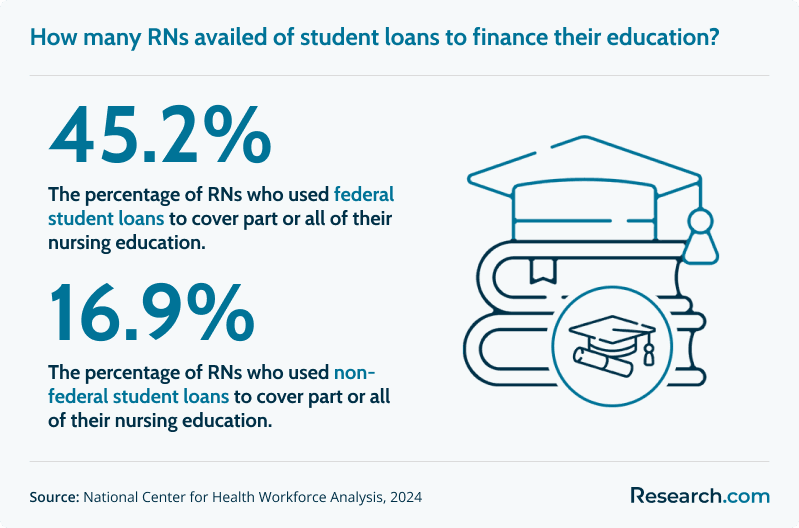
- Federal student loans: The National Center for Health Workforce Analysis reports that nearly 2.0 million RNs (45.2%) used federally assisted student loans to pay for part or all of their initial nursing degree.
- Private or non-federal loans: About 16.9% of RNs reported using non-federal loans for education expenses.
- Employer tuition reimbursement: Hospitals and healthcare systems may help pay for graduate nursing education, especially for hard-to-fill advanced practice, education, or leadership roles.
- Scholarships and grants: Funding may come from schools, state programs, professional organizations, nonprofit groups, or nursing scholarships.
- Work-study and assistantships: Some universities offer graduate assistantships, work-study opportunities, or campus-based employment options that may also be available to online learners.
Before accepting loans, estimate monthly repayment and compare it with realistic salary expectations for your chosen MSN track. If you are earlier in your nursing pathway and want to become an RN first, compare affordable online associate degree in nursing programs.
What are the prerequisites for enrolling in an online BSN to MSN bridge program?
Admission requirements vary by school and specialization, but online BSN to MSN programs generally expect applicants to show both academic readiness and professional nursing preparation. Clinical NP tracks may be more selective than education or leadership tracks because they must meet certification and licensure expectations.
- A current, unencumbered RN license
- A completed BSN degree
- A minimum undergraduate GPA, often 3.0 or higher
- Professional nursing experience, commonly one to two years depending on the program
- Letters of recommendation and a personal statement
If you are still comparing nursing credentials, it can help to review the difference between RN and BSN pathways before choosing a graduate route.
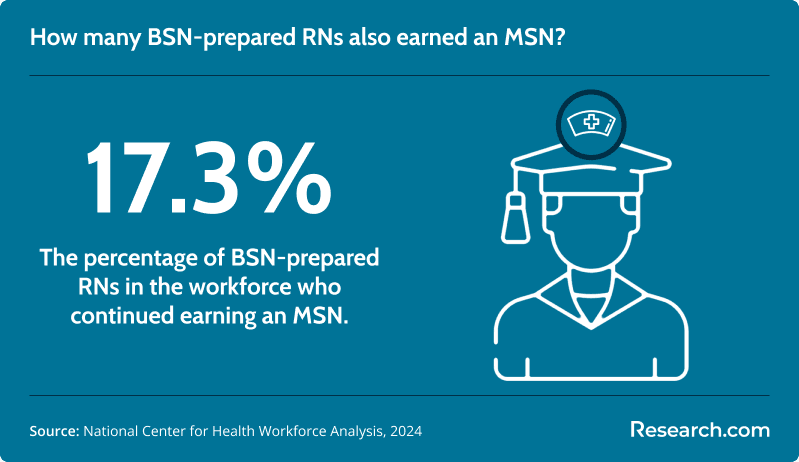
The National Center for Health Workforce Analysis reports that among the nearly 2.0 million RNs who entered the workforce with a bachelor's degree, 342,678 (17.3%) later earned a master's degree, and 56,464 (2.9%) earned a doctorate. That progression reflects how often BSN-prepared nurses use graduate education to expand their practice options.
What courses are typically in an online BSN to MSN bridge program?
Most BSN to MSN programs combine advanced nursing science, research, systems leadership, and specialty coursework. The exact curriculum depends on whether the student chooses a clinical advanced practice track, an educator track, or an administrative leadership track.
| Course area | What students usually learn | Why it matters |
| Advanced Health Assessment | Comprehensive patient evaluation, diagnostic reasoning, and physical assessment skills | Supports advanced clinical decision-making and specialty practice |
| Pathophysiology | How disease processes affect body systems | Builds the clinical foundation for diagnosis, treatment planning, and patient education |
| Pharmacology | Medication safety, therapeutic use, interactions, and advanced prescribing concepts where applicable | Essential for NP and other advanced clinical roles |
| Evidence-Based Practice and Research | Research appraisal, quality improvement, and translation of evidence into care | Helps nurses improve outcomes and evaluate clinical practices |
| Healthcare Policy and Leadership | Systems thinking, advocacy, ethics, regulation, and organizational leadership | Prepares graduates for management, policy, and change leadership |
Specialty courses and practicum requirements differ by concentration. For example, FNP students complete population-focused primary care coursework, while nurse educator students study curriculum design, teaching methods, and assessment. If you want a faster entry-level healthcare credential rather than graduate nursing, compare affordable online home health aide certification programs.
What types of specializations are available in online BSN to MSN bridge programs?
Your specialization is one of the most important decisions in a BSN to MSN program because it affects clinical eligibility, certification exams, practicum placements, salary potential, and day-to-day work. Do not choose a concentration only because it pays well; choose one that fits the patient population, schedule, scope of practice, and work environment you want.
| Specialization | Best fit for nurses who want to... | Important consideration |
| FNP | Provide primary care across the lifespan, from pediatrics through geriatrics | Requires strong clinical placement planning and certification preparation |
| Adult-Gerontology NP (AGNP) | Focus on adult and older adult patients | Good fit for nurses interested in aging populations; review how to become a gerontology nurse practitioner |
| Pediatric NP (PNP) | Care for infants, children, and adolescents | Clinical sites must support pediatric patient experience |
| Psychiatric-Mental Health NP (PMHNP) | Assess and treat mental health and psychiatric conditions | Demand can be strong, but licensure and clinical supervision requirements must be checked carefully |
| Nurse Educator | Teach nursing students, train staff, or develop clinical education programs | May be less clinically autonomous than NP roles but can suit nurses drawn to teaching |
| Nurse Leadership or Administration | Lead teams, manage units, oversee quality initiatives, or move into healthcare operations | Best for nurses who want organizational influence more than direct advanced practice care |
Some nurses who want a research-intensive route may decide that a doctoral pathway fits better than an MSN. In that case, compare affordable online BSN to PhD bridge programs.
Data USA notes that NPs and nurse midwives need a broad skill set, with active listening, reading comprehension, and social perceptiveness among the emphasized competencies. These skills are especially important in patient-centered graduate nursing tracks.
How do you choose the most affordable online BSN to MSN bridge program?
The best affordable program is the one you can complete, qualify for, and use professionally. A low-cost program is not a bargain if it lacks the right accreditation, does not meet your state’s requirements, offers weak clinical placement support, or forces you into a concentration that does not match your goals.
- Confirm nursing accreditation: Check whether the program is accredited by CCNE or ACEN. You can also review what nursing accreditation means through nursing accreditation resources.
- Calculate total cost: Add tuition, fees, books, technology charges, clinical travel, background checks, immunizations, exam fees, and lost work hours.
- Check state authorization: Make sure the school can enroll students in your state and that the program aligns with your state’s licensure requirements.
- Ask about clinical placement: Determine whether the school finds sites, provides a list of approved preceptors, or requires students to secure their own placements.
- Compare course delivery: Synchronous courses offer structure, while asynchronous courses offer flexibility. Hybrid formats may require travel.
- Review outcomes: Ask for graduation rates, certification pass rates, employment outcomes, and student support data by track when available.
| Common mistake | Why it can be costly | Better approach |
| Choosing only by per-credit tuition | Total credits and fees can make the final bill higher than expected | Compare the full estimated cost to graduation |
| Ignoring accreditation | It may affect financial aid, transfer credits, certification, and employer recognition | Verify CCNE or ACEN accreditation before applying |
| Assuming online means no campus or clinical travel | Some programs require intensives, simulations, or in-person assessments | Ask for all residency and clinical requirements in writing |
| Picking a specialization too quickly | The wrong track can limit licensure or career fit | Match the concentration to your target role and patient population |
| Overlooking clinical placement support | Finding preceptors independently can delay graduation | Ask how many students receive placement help and where sites are located |
What career paths are available for graduates of online BSN to MSN bridge programs?
Online BSN to MSN graduates can pursue several advanced nursing roles, but eligibility depends on the specialization, certification, licensure, and state scope of practice. Online graduates from accredited programs are generally evaluated by employers based on the same professional criteria as campus graduates: license status, clinical competence, certification, experience, and fit for the role.
- NP: Provides primary or specialty care, often assessing patients, ordering or interpreting tests, developing treatment plans, and coordinating care with other clinicians.
- Nurse Midwife: Delivers prenatal, childbirth, postpartum, and women’s health services.
- Nurse Anesthetist: Administers anesthesia for surgical, diagnostic, and outpatient procedures and is among the highest-paid nursing roles.
- Nurse Educator: Teaches nursing students, trains clinical staff, designs curricula, and supports professional development.
- Nurse Administrator or Leader: Oversees teams, budgets, quality improvement projects, compliance initiatives, and healthcare operations.
For nurses exploring high-acuity roles that do not always require the same graduate pathway, flight nursing may also be worth comparing. Research.com’s guide to flight nurse salary and career paths explains that option in more detail.
According to BLS, NPs, nurse midwives, and nurse anesthetists earn around $128,000 to $223,000 per year. Actual pay depends on specialization, employer type, experience, geography, and work setting.
How do online BSN to MSN programs prepare nurses for advanced practice roles?
Online BSN to MSN programs bridge the move from generalist RN practice to advanced nursing roles by combining graduate science courses, role-specific clinical preparation, evidence-based practice, and supervised field experiences. For NP students, the bridge is especially important because coursework must support certification readiness and clinical judgment for a defined population focus.
A strong program should show a clear progression: foundational graduate nursing courses, advanced assessment and pharmacology, specialty content, clinical experiences, and preparation for certification or role transition. Nurses who want a route into advanced practice should compare tracks carefully and confirm whether the program aligns with the licensure and certification requirements in the state where they plan to practice. Those comparing alternative advanced practice routes can review direct entry master's nurse practitioner options.
Are direct-entry nurse practitioner programs a viable alternative for non nurses?
Direct-entry nurse practitioner programs are designed for people who hold a bachelor’s degree in another field and want to enter nursing without first completing the traditional RN-to-BSN-to-MSN sequence. These programs usually combine foundational nursing preparation with graduate-level advanced practice coursework.
They can be efficient for career changers, but they are not the same as BSN to MSN programs for licensed nurses. Applicants should examine admission standards, clinical hour expectations, licensure outcomes, program intensity, and whether the curriculum prepares them for both RN licensure and advanced practice certification. If you do not have a nursing background, compare the best direct-entry nurse practitioner programs for non nurses.
What is the job market for graduates who completed an online BSN to MSN bridge program?
The job market for MSN-prepared nurses is strong, especially for advanced practice roles tied to primary care, anesthesia, midwifery, mental health, and care for older adults. Employers typically care most about whether the graduate completed an accredited program, holds the required license and certification, and has appropriate clinical preparation.
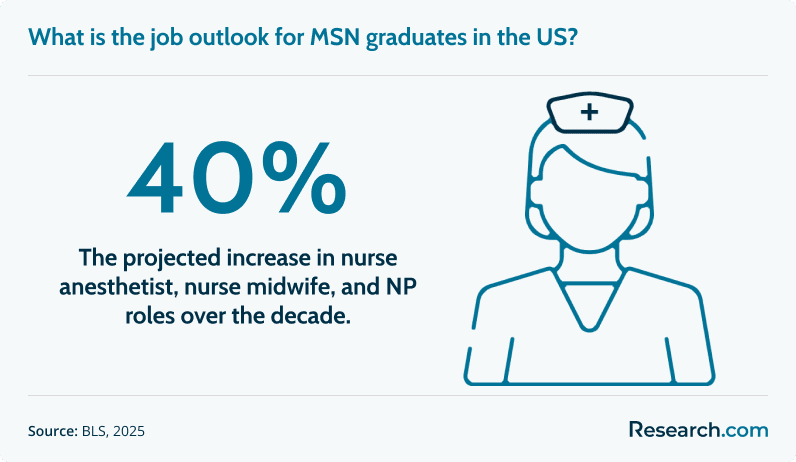
BLS projects employment for nurse anesthetists, nurse midwives, and NPs to grow 40% from 2023 to 2033, much faster than the average for all occupations. Demand is influenced by expanded healthcare access, an aging population with complex care needs, and wider use of advanced practice nurses in both rural and urban settings.
Graduates may find opportunities in hospitals, outpatient practices, urgent care centers, telehealth, long-term care, community health, academic settings, and healthcare organizations. However, competition and scope of practice vary by state and specialty, so students should research local demand before choosing a concentration.
If you are reconsidering healthcare entirely but still want a science-oriented career, you may also compare affordable online aerospace engineering degree programs as a very different long-term option.
What should nurses do if they don’t meet the prerequisites for a BSN to MSN bridge program?
If you are an RN but do not yet meet BSN to MSN admission requirements, the most direct next step is usually to complete the missing prerequisite rather than applying too early. For nurses without a BSN, an RN to BSN program can help satisfy graduate admission requirements and strengthen academic readiness for MSN-level work.
Some nurses are delayed by GPA requirements, missing statistics or health assessment coursework, limited work experience, or clinical documentation. Ask admissions advisors whether the school offers conditional admission, prerequisite courses, academic remediation, or a pathway from RN to BSN into MSN study. If clinical barriers are your main concern, compare RN to BSN online programs without prerequisites to see whether a more flexible undergraduate completion route fits your situation.
How can I evaluate the quality of an online BSN to MSN bridge program?
Program quality is measured by outcomes, support, accreditation, and fit—not by online delivery alone. Before enrolling, verify that the institution and nursing program meet recognized standards and that the MSN track supports your intended role.
- Accreditation: Confirm institutional accreditation and nursing program accreditation through CCNE or ACEN.
- Licensure alignment: Ask whether the program meets requirements in your state, especially for NP, midwifery, and anesthesia pathways.
- Certification pass rates: Request track-specific pass rate data when available.
- Clinical support: Find out who secures preceptors, how sites are approved, and what happens if a placement falls through.
- Faculty qualifications: Review whether faculty have graduate credentials, clinical experience, and specialty expertise.
- Student services: Look for graduate advising, writing support, library access, career services, and technology help.
- Transparency: A strong program should clearly publish tuition, fees, course sequences, practicum requirements, and state authorization information.
For a broader comparison of nursing education options and cost considerations, review Research.com’s guide to affordable online nursing programs.
Which BSN to MSN program format fits your schedule?
The right format depends on how much structure you need and how predictable your work schedule is. Nurses working rotating shifts often prefer asynchronous programs, while students who benefit from live discussion may prefer scheduled online classes. Competency-based formats can be cost-effective for disciplined students but may be difficult for learners who need frequent deadlines.
| Format | Best for | Possible drawback |
| Asynchronous online | Nurses with variable shifts or family responsibilities | Requires strong self-management |
| Synchronous online | Students who want live lectures and real-time discussion | Less flexible for night-shift or rotating-shift nurses |
| Hybrid | Learners who want online coursework plus occasional in-person learning | Travel may add cost and scheduling pressure |
| Competency-based | Self-paced students who can move quickly through familiar material | May feel less structured than term-based programs |
| Part-time | Working nurses who need a manageable pace | Extends time to graduation |
| Accelerated | Students who can dedicate substantial time to school | Higher workload and less room for schedule disruptions |
Questions to ask before applying to an online BSN to MSN program
- Is the nursing program accredited by CCNE or ACEN?
- Does the program meet licensure and certification requirements in my state?
- How many total credits are required, and what is the full estimated program cost?
- Are tuition rates different for in-state and out-of-state online students?
- Does the school arrange clinical placements, or am I responsible for finding preceptors?
- Are there campus visits, intensives, simulations, or travel requirements?
- What are the graduation rates and certification pass rates for my intended track?
- Can I study part-time, pause enrollment, or change pace if my work schedule changes?
- What financial aid, scholarships, employer partnerships, or payment plans are available?
- What career services are offered to online graduate nursing students?
Key Insights
- Affordability is more than tuition. Compare total credits, fees, clinical costs, travel, time away from work, and employer reimbursement before choosing a BSN to MSN program.
- Accreditation is nonnegotiable. CCNE or ACEN accreditation can affect financial aid, certification eligibility, transfer options, and employer confidence.
- The MSN specialization determines your career path. FNP, AGNP, PMHNP, nurse educator, and leadership tracks prepare students for different roles and requirements.
- Online programs can be a strong option for working nurses, but most still require supervised clinical or practicum experiences in approved settings.
- BLS reported a median annual wage of $132,050 for nurse anesthetists, nurse midwives, and NPs in May 2024, but individual earnings vary by specialty, location, certification, and experience.
- Nearly 2.0 million RNs (45.2% of the workforce) used federally assisted student loans for at least part of their initial nursing degree, so debt planning should be part of every MSN decision.
- The strongest program choice is the one that matches your state requirements, target role, learning style, budget, and realistic completion timeline.
References
- BLS. (2025, April 18). Nurse anesthetists, nurse midwives, and nurse practitioners. BLS.
- Data USA. (n.d.). Nurse practitioners & nurse midwives. Data USA.
- Data USA. (n.d.). Nursing School. Data USA.
- National Center for Health Workforce Analysis (2024, March). Nursing Education and Training: Data from the 2022 NSSRN. bhw.hrsa.gov.
Other Things You Should Know About the Most Affordable Online BSN to MSN Bridge Programs
Yes. Most BSN to MSN bridge programs require supervised clinical practice, usually 500 to 1,000 hours depending on the MSN track and state rules. Students must complete placements in approved healthcare sites, and some programs require a preceptor who holds an active RN or APRN license.
Many 2027 online BSN to MSN bridge programs require a valid RN license, a BSN degree from an accredited institution, and a minimum GPA, often around 3.0. Some programs may also expect relevant work experience in nursing or completion of certain undergraduate courses.