
2027 Most Affordable BSN to PhD Online Bridge Programs

Co-Founder and Chief Data Scientist
If you are a BSN-prepared registered nurse considering doctoral study, the biggest question is usually not whether a PhD can open doors. It is whether an online BSN to PhD bridge program is affordable, credible, realistic while working, and aligned with the career you actually want. This guide is designed for nurses comparing research-focused doctoral programs, especially those who want to move into nursing science, faculty roles, health policy, research leadership, or executive-level healthcare work without completing a separate MSN first.
A BSN to PhD bridge program is not the same as a DNP pathway. A PhD in nursing is built around original research, theory development, data analysis, scholarly writing, and dissertation work. A DNP is usually practice-focused and prepares nurses for advanced clinical leadership or systems improvement. Choosing the wrong doctoral route can cost years of time and a substantial amount of money, so it is important to compare outcomes, program format, faculty fit, total cost, accreditation, and career goals before enrolling.
This guide explains what online BSN to PhD bridge programs include, how affordable programs compare, what admissions committees look for, how much graduates may earn, and how to judge whether a program is worth the investment. It also highlights common mistakes, funding options, student support, job market conditions, and current trends affecting PhD-prepared nurses.
Quick Answer: What Is an Online BSN to PhD Bridge Program?
An online BSN to PhD bridge program allows a nurse with a Bachelor of Science in Nursing and an active RN license to enter doctoral-level nursing study without first completing a standalone MSN. These programs usually combine graduate-level nursing foundations with PhD coursework in research methods, statistics, nursing theory, scholarship, and dissertation development. Most programs are designed for nurses who want careers in academia, research, policy, healthcare leadership, or scientific inquiry rather than primarily advanced clinical practice.
The strongest online programs are accredited, transparent about total costs, clear about campus residency requirements, and supported by faculty whose research interests match the student’s goals. Program length commonly ranges from 3 to 6 years, depending on curriculum design, enrollment pace, dissertation progress, and whether the student studies full time or part time.
Who Should Consider a BSN to PhD Online Bridge Program?
This pathway is best for nurses who want to produce new knowledge, teach future nurses, lead research teams, influence healthcare policy, or advance evidence-based practice through scholarship. It is less suitable for nurses whose main goal is to become a nurse practitioner, nurse anesthetist, nurse midwife, or another advanced practice provider unless the program includes the required clinical preparation and licensure pathway.
| Choose a BSN to PhD bridge program if... | Consider another pathway if... |
| You want to become a nurse scientist, faculty member, researcher, policy analyst, or doctoral-level scholar. | You primarily want advanced clinical practice authority, prescriptive authority, or direct APRN preparation. |
| You are ready for intensive writing, statistics, theory, and dissertation research. | You prefer clinically focused coursework and practice hours over original research. |
| You already have a focused research interest or are ready to develop one with faculty mentorship. | You are unsure whether you want research, education, leadership, or clinical specialization. |
| You can commit several years to doctoral work while managing employment and personal responsibilities. | You need the fastest possible route to a new clinical credential or licensure outcome. |
What Are the Benefits of Earning an Online BSN to PhD Bridge Qualification?
- Access to research and academic careers: A nursing PhD prepares graduates for faculty appointments, nurse scientist roles, research leadership, postdoctoral training, and policy-focused work that typically requires doctoral research preparation.
- Broader leadership options: PhD-prepared nurses may move into senior roles in universities, healthcare systems, research organizations, government agencies, nonprofit organizations, and consulting environments.
- Higher earning potential in selected roles: According to Payscale and Research.com, average annual salaries for PhD-prepared nurses can range from $99,000 to over $126,000, while specialized leadership roles such as Chief Nursing Officer may exceed $246,000 annually.
- Flexible access for working nurses: Online and hybrid formats can make doctoral education more realistic for nurses who cannot relocate or stop working, although many programs still require residencies, intensives, or campus visits.
- Direct doctoral progression: A bridge pathway can reduce duplication by allowing BSN-prepared nurses to move toward the PhD without completing a separate master’s degree first.
What Can I Expect From an Online BSN to PhD Bridge Program?
Online BSN to PhD bridge programs are academically demanding and research-centered. Students should expect advanced graduate study in nursing science, theory, statistical analysis, research design, ethics, scholarly communication, and dissertation development. The online format may increase flexibility, but it does not reduce the level of rigor.
- Research-heavy coursework: Programs commonly emphasize quantitative, qualitative, and mixed-methods research, along with advanced statistics and data interpretation.
- Dissertation requirement: The dissertation is the central milestone. Students must design, conduct, write, and defend original research that contributes to nursing knowledge.
- Fewer traditional clinical hours than DNP programs: Because PhD programs are research-focused, they generally do not center on direct clinical practice hours in the same way DNP or APRN pathways do.
- Online plus possible in-person components: Many “online” programs include synchronous classes, required residencies, campus intensives, research presentations, dissertation defenses, or colloquia.
- Long-term commitment: BSN to PhD study often takes 4 to 6 years full time and may take longer for part-time students, particularly during dissertation research.
- Mentorship matters: Faculty fit is one of the most important success factors because dissertation progress depends heavily on research alignment and advisor support.
Where Can I Work With an Online BSN to PhD Bridge Qualification?
A PhD in nursing is most valuable in roles that require research expertise, advanced scholarship, teaching ability, policy analysis, or executive leadership. Graduates may work in settings that shape nursing education, healthcare systems, public health, and evidence-based practice.
- Colleges and universities: PhD-prepared nurses often become faculty members, researchers, doctoral mentors, curriculum leaders, or academic administrators.
- Research centers and institutes: Graduates may design and lead studies in clinical outcomes, population health, health equity, healthcare delivery, or nursing workforce issues.
- Hospitals and healthcare systems: Opportunities may include research director, quality improvement leader, evidence-based practice specialist, or executive nursing leader.
- Government and public health agencies: PhD nurses may contribute to health policy, public health research, workforce planning, and national health initiatives.
- Consulting and industry: Some graduates advise organizations on program evaluation, healthcare strategy, clinical research operations, data-informed practice, or policy implementation.
How Much Can I Make With an Online BSN to PhD Bridge Qualification?
Earnings depend on role, location, employer type, years of experience, research productivity, administrative responsibility, and specialty area. A PhD can increase access to higher-level positions, but it does not guarantee a specific salary.
- Early-career PhD-prepared nurses: Individuals with a PhD in nursing can expect an average annual salary of around $99,000, though actual pay varies by employer and region.
- Experienced doctoral-level professionals: Salaries may rise to $110,000 - $126,000+ annually in more senior research, academic, administrative, or leadership roles.
- Specialized high-paying roles: Certified Nurse Anesthetists with a PhD may earn upwards of $200,000 - $240,000, and Chief Nursing Officers with doctoral preparation may exceed $240,000.
- Regional and sector differences: Compensation can differ significantly across states, metropolitan areas, universities, hospitals, government employers, and private organizations.
- Most Affordable BSN to PhD Online Bridge Programs for 2027
- How to Choose the Right BSN to PhD Online Bridge Program
- Prerequisites and Application Requirements
- Skills You Build in a BSN to PhD Online Bridge Program
- Career Options After a BSN to PhD Bridge Program
- Program Costs and Financing Options
- Salary Potential After a BSN to PhD Bridge Program
- Online vs. Campus-Based BSN to PhD Programs
- Student Support and Academic Resources
- How to Check Program Credibility
- Challenges to Expect
- Subspecialties and Career Paths
- Job Market for BSN to PhD Graduates
- Industry Trends and Future Outlook
- Regional Differences in Opportunity and Pay
Most Affordable BSN to PhD Online Bridge Programs for 2027
How We Rank Schools
Doctoral nursing education is a major financial and professional commitment, so affordability rankings should be based on transparent and comparable data rather than tuition claims alone. Our ranking methodology uses recognized education data sources to evaluate institutions and programs.
- the IPEDS database
- Peterson's database, including its Distance Learning Licensed Data Set
- the College Scorecard database
- the National Center for Education Statistics
When reviewing the schools below, do not compare tuition alone. Also check required credits, residency expenses, technology fees, travel costs, dissertation fees, enrollment pace, and whether the program’s research faculty match your area of interest.
| School | Program Length | Credits or Courses | Tuition Cost Listed | Accreditation |
| Duquesne University | 3 to 4 years | 38-56 credits depending on track | $1,840 per credit | Commission on Collegiate Nursing Education (CCNE) |
| Florida International University | Typically 4-5 years | 94-97 credits | Resident: $45,108; Non-resident: $99,167 | Commission on Collegiate Nursing Education (CCNE) |
| Mercer University | Approximately 4 years | 73 minimum | Approximately $1,224 per credit | Commission on Collegiate Nursing Education (CCNE) |
| Texas Woman's University | 4 to 5 years | 42 credits | Resident: $323.00; Non-Resident: $733.00 per credit | Commission on Collegiate Nursing Education (CCNE) |
| The University of Texas at Tyler | Varies, typically 4-5 years | 18 courses | $42,050 total | Commission on Collegiate Nursing Education (CCNE) |
| University of Texas Health Science Center at Houston | 11 to 16 semesters | 90 credits | Resident: $378.00/credit; Non-resident: $1,188.00/credit | Commission on Collegiate Nursing Education (CCNE) |
| University of Texas at Austin | Approximately 4.5 years | 65 credits | Approximately $30,000 total | Commission on Collegiate Nursing Education (CCNE) |
| Walden University | Approximately 4 years | 106 quarter credits | $87,430 total program cost (3.5 years) | Commission on Collegiate Nursing Education (CCNE) |
1. Duquesne University
Duquesne University offers a BSN to PhD pathway for nurses who want to become scholars, researchers, and contributors to nursing science. The program emphasizes nursing theory, research methods, statistics, and the development of a dissertation project. Students complete three on-campus residencies, which provide structured opportunities to interact with faculty, refine research ideas, and build academic community. An optional study abroad experience may also support a broader understanding of global nursing issues.
The program’s 3 to 4 year structure may appeal to nurses seeking an accelerated doctoral route, although the actual timeline depends on course sequencing and dissertation progress. Students should closely evaluate faculty research areas before applying because mentor alignment can shape the quality and feasibility of the dissertation experience. Graduates are prepared for academic, research, healthcare policy, and leadership roles that require advanced scholarship and evidence-based inquiry.
- Program Length: 3 to 4 years
- Tracks/Concentrations: Nursing Science, Research
- Tuition Cost: $1,840 per credit (uniform rate)
- Required Credits to Graduate: 38-56 credits depending on track
- Accreditation: Commission on Collegiate Nursing Education (CCNE)
2. Florida International University (FIU)
Florida International University (FIU)’s Nicole Wertheim College of Nursing & Health Sciences offers a BSN to PhD bridge program that incorporates MSN-level coursework into doctoral study. The program requires 94-97 credits and is designed for nurses preparing for roles as nurse scientists, educators, researchers, and healthcare leaders. Coursework includes nursing theory, research methods, leadership development, grantsmanship, and doctoral-level scholarship.
FIU’s structure may be especially relevant for students who want a bridge model that includes advanced nursing coursework alongside PhD preparation. Available options include nurse practitioner and nurse educator components, so applicants should confirm how each track fits their licensing, practice, and research goals. The program is primarily online, but students should expect some on-campus requirements for collaboration, mentorship, and research engagement.
- Program Length: Typically 4-5 years
- Tracks/Concentrations: Adult-Gerontology Primary Care NP, Family NP, Pediatric Primary Care NP, Psychiatric-Mental Health NP, Nurse Educator
- Tuition Cost: Resident: $45,108; Non-resident: $99,167
- Required Credits to Graduate: 94-97 credits
- Accreditation: Commission on Collegiate Nursing Education (CCNE)
3. Mercer University
Mercer University provides a fully online BSN to PhD option that blends MSN-level coursework with doctoral preparation. The program is built for nurses who want to conduct independent research, contribute to nursing education, and advance evidence-based practice through scholarship. Students study nursing theory, research methods, statistics, and dissertation development while receiving faculty guidance throughout the process.
Mercer requires completion of a graduate-level statistics course before doctoral coursework begins, which is important for applicants to plan around. The university participates in the State Authorization Reciprocity Agreement (SARA), but prospective students should still confirm whether enrollment is permitted from their state. This program may fit working nurses who need online delivery but still want a structured research-focused doctoral pathway.
- Program Length: Approximately 4 years
- Tracks/Concentrations: Nursing Science and Research
- Tuition Cost: Approximately $1,224 per credit
- Required Credits to Graduate: 73 minimum
- Accreditation: Commission on Collegiate Nursing Education (CCNE)
4. Texas Woman's University (TWU)
Texas Woman's University (TWU) offers a DNP to PhD Bridge program for nurses who already have practice-focused doctoral preparation and want deeper research training. Students can choose a 100% online option through the Denton campus or a hybrid format through the Houston campus. Full-time and part-time enrollment options provide flexibility for nurses balancing doctoral work with employment and other responsibilities.
The 42-credit curriculum includes nursing philosophy, qualitative research, quantitative research, and dissertation development. Students also participate in an annual in-person colloquium, which supports scholarly exchange and connection with faculty and peers. Graduation requires six credits of dissertation work, a successful proposal defense, and completion of academic standards tied to independent research.
- Program Length: 4 to 5 years
- Tracks/Concentrations: Nursing Science, Research
- Tuition Cost: Resident: $323.00; Non-Resident: $733.00 per credit
- Required Credits to Graduate: 42 credits
- Accreditation: Commission on Collegiate Nursing Education (CCNE)
5. The University of Texas at Tyler
The University of Texas at Tyler offers a BSN to PhD in Nursing program that allows eligible students to enter doctoral study directly from the bachelor’s level. This structure can help students bypass a separate master’s degree and move more directly into nursing science, research, teaching, and leadership preparation. The curriculum includes nursing theory, research design, statistics, and dissertation-focused coursework.
The program is designed for students who want a streamlined route into doctoral research but still need the support of faculty mentorship and academic resources. Applicants should ask about online course delivery, any required campus visits, faculty research areas, and dissertation support. The program emphasizes scholarly inquiry, ethical research, critical thinking, and evidence-based nursing practice.
- Program Length: Varies, typically 4-5 years
- Tracks/Concentrations: Nursing Science, Research
- Tuition Cost: $42,050 total
- Required Credits to Graduate: 18 courses
- Accreditation: Commission on Collegiate Nursing Education (CCNE)
6. University of Texas Health Science Center at Houston
The University of Texas Health Science Center at Houston (UTHealth Houston) offers a BSN to PhD program through the Cizik School of Nursing. The program requires 90 credits and combines online and on-campus coursework. It is designed to prepare nurse scientists for academic, research, and leadership roles that depend on advanced inquiry and evidence generation.
Students complete advanced study in nursing theory, research methodologies, biostatistics, and dissertation development. Full-time and part-time options may help students plan around professional obligations, but applicants should confirm expected time commitments for each enrollment pace. The university’s research environment can be especially important for students seeking interdisciplinary collaboration and access to scholarly resources.
- Program Length: 11 to 16 semesters
- Tracks/Concentrations: Nursing Science, Research
- Tuition Cost: Resident: $378.00/credit; Non-resident: $1,188.00/credit
- Required Credits to Graduate: 90 credits
- Accreditation: Commission on Collegiate Nursing Education (CCNE)
7. University of Texas at Austin
The University of Texas at Austin offers an Alternate Entry PhD (AE-PhD) program for baccalaureate or graduate degree holders outside nursing as well as BSN-prepared nurses. The program is approximately 4.5 years full time and includes RN licensure preparation alongside doctoral nursing research training. Students begin with an intensive foundation year of accelerated coursework that prepares them for the NCLEX-RN exam.
After passing the exam and becoming licensed in Texas, students progress into doctoral coursework and research specialization. The program ends with a dissertation and is intended to prepare graduates for nursing research, academic roles, and scientific leadership. Applicants should carefully review licensure implications, residency expectations, and how the alternate-entry structure differs from traditional BSN to PhD pathways.
- Program Length: Approximately 4.5 years
- Tracks/Concentrations: Nursing Science, Research
- Tuition Cost: Approximately $30,000 total
- Required Credits to Graduate: 65 credits
- Accreditation: Commission on Collegiate Nursing Education (CCNE)
8. Walden University
Walden University offers a BSN to PhD track for nurses who want a fully online route into doctoral nursing scholarship. The program is designed for students who want to advance research, academic, leadership, and healthcare innovation goals without completing a separate MSN first. Coursework emphasizes nursing theory, research methods, leadership, population health perspectives, and dissertation research.
Walden’s asynchronous online structure may suit working nurses who need scheduling flexibility. Students should still evaluate total cost, dissertation support, faculty availability, and how the program’s concentrations match their long-term goals. The program highlights social change, ethical research, evidence-based practice, and online academic support.
- Program Length: Approximately 4 years
- Tracks/Concentrations: Healthcare Administration, Interdisciplinary Health, Leadership, Nursing Education, Population Health
- Tuition Cost: $87,430 total program cost (3.5 years)
- Required Credits to Graduate: 106 quarter credits
- Accreditation: Commission on Collegiate Nursing Education (CCNE)
How to Choose the Best BSN to PhD Online Bridge Program for Your Goals
The best BSN to PhD program is not automatically the cheapest or the shortest. It is the program that offers credible accreditation, manageable total cost, faculty alignment, a realistic format, and outcomes that fit your intended career. Before applying, compare programs using decision factors that affect both completion and return on investment.
| Selection Factor | Why It Matters | Questions to Ask |
| Faculty research fit | Your dissertation depends on having an advisor who understands and supports your research area. | Which faculty members are accepting doctoral students, and what are their current research projects? |
| Accreditation | Accreditation supports academic credibility, employer recognition, and eligibility for some forms of aid or professional advancement. | Is the nursing program accredited by CCNE or ACEN, and is the institution regionally accredited? |
| Total cost | Per-credit tuition can hide costs for residencies, fees, dissertation continuation, travel, and required software. | What is the full estimated cost from enrollment through dissertation defense? |
| Online format | Some programs are fully online; others require campus intensives, colloquia, or hybrid coursework. | How often must students come to campus, and what costs are not included in tuition? |
| Dissertation support | Poor dissertation support can extend time to completion and increase cost. | What milestones, writing support, statistical consulting, and committee support are available? |
| Career outcomes | Graduate placement helps you understand whether the program supports your intended path. | Where do graduates work, and how many pursue faculty, research, leadership, or postdoctoral roles? |
- Match the program to your research question: A strong school on paper may be a poor choice if no faculty member can supervise your topic.
- Confirm accreditation early: Look for recognized nursing accreditation such as CCNE or ACEN. Nurses comparing earlier graduate pathways may also want to review accredited online MSN programs to understand how program quality is evaluated across nursing education levels.
- Compare delivery models honestly: A hybrid program can be valuable for networking, but required travel may affect affordability and scheduling.
- Look beyond admission promises: Ask about attrition, average time to dissertation completion, faculty workload, and advising expectations.
- Consider whether you need a different bridge first: Nurses earlier in their pathway may benefit from affordable online CNA to RN programs before eventually moving toward BSN, RN licensure, and doctoral study.
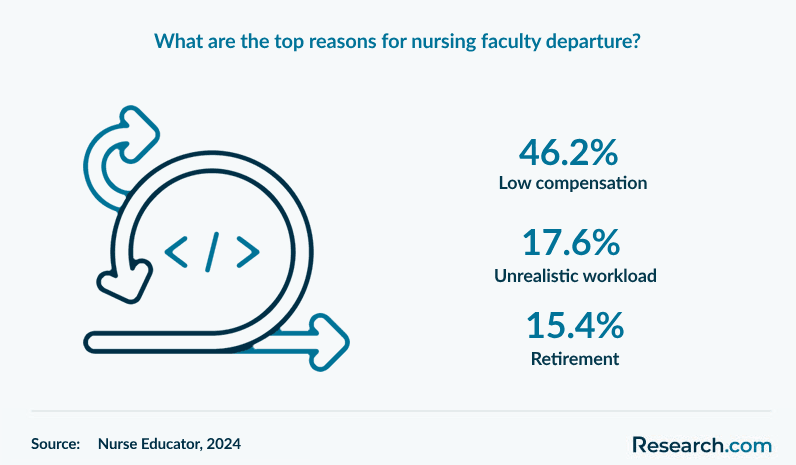
Faculty labor conditions also affect doctoral education. According to a July/August 2024 report in Nurse Educator, low compensation was the leading reason nursing faculty considered leaving their positions. Among current faculty, 46.2% cited low compensation as the top reason they might depart, followed by unrealistic workload at 17.6% and retirement at 15.4%. Among faculty who had already left, 25.8% cited low compensation as the top reason, while personal or family issues accounted for 20.0% and being offered another position accounted for 14.9%.
The graphic below summarizes these faculty departure factors. For prospective PhD students, the takeaway is practical: faculty stability, workload, and mentoring capacity are not abstract issues. They can affect course availability, dissertation supervision, time to completion, and the overall doctoral experience.
Prerequisites and Application Process for BSN to PhD Online Bridge Programs
Admission to BSN to PhD online bridge programs is selective because doctoral study requires strong academic preparation, research readiness, writing ability, and a clear fit with faculty expertise. Requirements vary by institution, but most applications include several common components.
- BSN from an accredited program: Applicants usually need a Bachelor of Science in Nursing. RNs who have not yet completed the bachelor’s degree may first need to compare the cheapest RN to BSN online options.
- Minimum GPA: Many programs expect a GPA of 3.0 or higher on a 4.0 scale, while more competitive programs may prefer stronger academic records.
- Active RN license: Most programs require a current, unencumbered Registered Nurse license in the United States.
- GRE scores: Some schools still request GRE results, often from within the last five years, while others waive or no longer require them.
- Recommendation letters: Strong letters from faculty, doctoral-prepared nurses, supervisors, or research mentors can help demonstrate readiness for doctoral work.
- CV or resume: Applicants should document nursing experience, education, leadership, research exposure, publications, presentations, certifications, and professional service.
- Statement of purpose: The essay should explain research interests, career goals, why the PhD is the right degree, and why the specific program is a good fit.
- Interview: Many programs use interviews to assess research alignment, communication skills, motivation, and fit with available faculty mentors.
- Prerequisite courses: Some programs require graduate-level statistics, research methods, or similar coursework before or early in the doctoral sequence.
Applicants coming from another healthcare role may need several educational steps before doctoral study. For example, medical assistants can explore affordable medical assistant to RN programs online, then complete BSN and RN requirements before pursuing PhD admission.
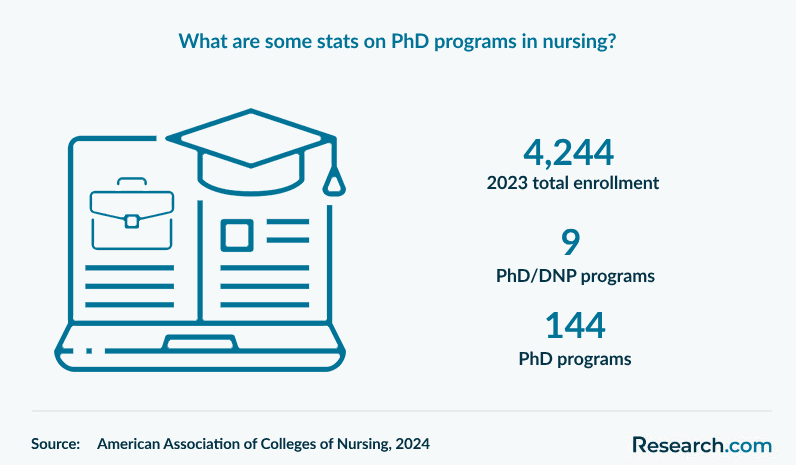
AACN’s latest survey provides useful context for the doctoral nursing pipeline. In 2023, there were 144 PhD programs, 1 doctor of nursing science program, 5 EdD programs, and 9 PhD/DNP programs. Total enrollment across these doctoral programs was 4,244 students. There were 2,518 completed applications, 1,796 applicants who met admission requirements, and 236 qualified applicants who were turned away. In the same year, 742 students graduated.
The graphic below illustrates enrollment, application, and graduation trends. The fact that 236 qualified applications were turned away shows that doctoral nursing education has capacity limits, often tied to faculty availability, clinical placement constraints, classroom space, and other institutional resources.
Essential Skills You Learn in a BSN to PhD Online Bridge Program
A BSN to PhD bridge program develops nurses into researchers, scholars, educators, and leaders who can ask important questions and produce evidence. The skills are different from those emphasized in bedside practice or clinically focused graduate programs.
| Skill Area | What You Learn | Why It Matters |
| Research design | How to build quantitative, qualitative, and mixed-methods studies. | Strong design is necessary for credible, publishable nursing research. |
| Statistics and data analysis | How to work with complex datasets, statistical tools, and interpretation methods. | Nurse scientists must evaluate evidence and generate reliable findings. |
| Theory development | How to critique, apply, and build theoretical frameworks in nursing science. | Theory guides research questions, methods, and interpretation. |
| Grant writing | How to identify funding opportunities and develop competitive research proposals. | Funding skills support independent research careers. |
| Scholarly writing | How to write manuscripts, abstracts, conference papers, and dissertation chapters. | Publication and dissemination are central to academic and research advancement. |
| Research ethics | How to protect participants, maintain integrity, and follow ethical research standards. | Ethical conduct is required for human subjects research and scientific trust. |
| Health policy analysis | How to evaluate policy effects on care delivery, workforce issues, and outcomes. | PhD nurses often influence systems beyond individual patient care. |
| Interdisciplinary collaboration | How to work with clinicians, statisticians, policymakers, educators, and scientists. | Complex healthcare problems require multi-field research teams. |
For nurses who are still completing earlier degree requirements, RN to BSN without clinicals programs may offer a faster academic bridge in some situations, but students must verify state licensing and clinical practice requirements before choosing that type of program.
Career Prospects After Completing a BSN to PhD Online Bridge Program
A BSN to PhD bridge program prepares graduates for careers where research, evidence, education, and leadership are central. Some roles are academic, while others are located in healthcare systems, public agencies, nonprofits, or private-sector research organizations.
- University professor or nursing faculty member: Teach nursing students, mentor graduate learners, design curricula, conduct research, and contribute to academic service.
- Nurse scientist or researcher: Lead studies focused on patient outcomes, workforce issues, health equity, care delivery, chronic disease, or nursing practice.
- Postdoctoral fellow: Complete advanced research training under senior scholars before pursuing independent research or faculty appointments.
- Director of research: Guide research programs in hospitals, universities, healthcare systems, or private research settings.
- Health policy analyst or consultant: Use research evidence to advise agencies, policymakers, nonprofits, or healthcare organizations.
- Chief Nursing Officer or executive leader: Apply doctoral-level evidence, strategy, and leadership to organization-wide nursing and patient care priorities.
- Clinical research coordinator or manager: Oversee research operations, protocols, regulatory compliance, and study implementation.
- Program evaluator: Assess whether health programs, interventions, or policies are producing measurable results.
Not every advanced nursing career requires a PhD. Nurses who want graduate preparation but prefer a shorter or more clinically oriented route may want to compare the cheapest BSN to MSN online programs before committing to doctoral research training.
How Much Do BSN to PhD Online Bridge Programs Cost, and How Can You Pay?
Costs vary widely because programs differ in credit requirements, tuition rates, residency expectations, dissertation fees, and enrollment length. A program with low per-credit tuition may still be expensive if it requires many credits or repeated dissertation enrollment. A program with higher tuition may be more manageable if it offers funding, assistantships, or a shorter completion structure.
- Tuition: Per-credit charges may range from approximately $400 to over $1,500 per credit.
- Total program cost: Overall cost can range from $20,000 to $120,000 or more depending on school, credits, fees, and time to completion.
- Residency and travel expenses: Required intensives, colloquia, dissertation defenses, or campus visits can add airfare, lodging, meals, parking, and time away from work.
- Technology and learning materials: Budget for software, textbooks, statistical tools, library access fees, equipment, and online learning platforms.
- Federal student aid: Students can begin by submitting the Free Application for Federal Student Aid (FAFSA) to determine eligibility for federal aid options.
- Scholarships, fellowships, and assistantships: Some universities provide doctoral funding through teaching, research, or institutional awards.
- Nurse Faculty Loan Program: The Nurse Faculty Loan Program may provide partial loan forgiveness for eligible graduates who become nurse faculty.
- Professional scholarships: Nursing associations, foundations, and specialty organizations may fund doctoral students.
- Employer tuition assistance: Hospitals and healthcare systems may offer tuition reimbursement, especially when the degree supports leadership, education, or research needs.
Licensed vocational nurses who are earlier in the pathway can compare the cheapest online LVN to BSN programs as one possible step toward RN licensure, BSN completion, and eventual doctoral eligibility.
How to Estimate the True Cost Before Enrolling
- Multiply tuition by the total number of required credits or courses.
- Add mandatory university, technology, nursing program, graduation, and dissertation fees.
- Estimate travel and lodging for every required campus visit.
- Ask whether dissertation continuation credits are required after coursework ends.
- Confirm whether part-time enrollment changes tuition, fees, or time limits.
- Subtract confirmed grants, scholarships, assistantships, tuition reimbursement, or loan forgiveness programs.
- Compare the remaining cost with realistic salary outcomes for your intended role.
How Much Can You Earn After a BSN to PhD Online Bridge Program?
A PhD in nursing can improve access to specialized research, academic, and leadership roles, but salary outcomes are not automatic. Academic salaries, hospital executive compensation, private research roles, and government positions can differ substantially.
- Average PhD nurse salary: The average annual salary for a PhD-prepared nurse in the USA typically ranges from $99,000 to $126,000.
- Nurse educator: Academic nurse educator salaries average around $81,000 to $87,000 annually, depending on institution, rank, location, and experience.
- Clinical research scientist: Professionals in this role can expect to earn around $95,000 per year.
- Health services administrator: Healthcare facility or department leadership roles average around $112,000 annually.
- Chief Nursing Officer: CNO roles can exceed $240,000 because they involve executive-level responsibility.
- Certified Nurse Anesthetist: CRNAs with a PhD may earn among the highest nursing salaries, often exceeding $200,000 - $239,000 annually.
- Location effects: Salaries can be higher in regions with higher cost of living, stronger demand, or more competitive healthcare labor markets.
- Experience and rank: Senior faculty, funded researchers, administrators, and executives usually earn more than early-career graduates.
According to Payscale.com data for 2025, a doctor of philosophy (PhD) in nursing has an average salary of $100,000 nationally. For comparison, a nursing professor earns an average of $98,666, a medical scientist averages $95,310, and a registered nurse with a Bachelor of Science in Nursing (BSN) earns an average of $92,560. A nurse anesthetist has an average salary of $123,780.
Experience also affects academic earnings. A professor of nursing earns an average of $65,000 in the early career stage, around $90,004 at mid-career, and up to $176,000 with more experience. Geography can also shift earnings: registered nurses with a PhD average $139,250 in California, $119,560 in Hawaii, $112,410 in Oregon, $111,530 in Massachusetts, $108,110 in Alaska, $107,670 in Washington, $102,410 in New York, $102,090 in the District of Columbia, $102,080 in Nevada, $101,100 in New Jersey, and $98,990 in Connecticut.
The graph below presents these salary comparisons and regional differences. Use the data as a planning benchmark, not a guarantee, because individual compensation depends on employer, role, credentials, market conditions, and negotiation.
Online vs. In-Person BSN to PhD Bridge Programs
Online and campus-based BSN to PhD programs can both lead to a rigorous doctoral education. The better choice depends on your schedule, learning style, research needs, family responsibilities, location, and budget.
| Format | Advantages | Trade-Offs | Best For |
| Online | Greater scheduling flexibility, no relocation, easier access for working nurses, and often asynchronous coursework. | Requires self-discipline, strong writing habits, comfort with virtual collaboration, and careful planning for any residencies. | Nurses who need to keep working or cannot move near a campus. |
| Hybrid | Combines online coursework with in-person intensives, faculty interaction, and peer networking. | Travel costs and time away from work can reduce affordability. | Students who want flexibility but still value periodic face-to-face research engagement. |
| In-person | Regular campus access, easier informal networking, structured routines, and direct access to faculty and research facilities. | May require relocation, commuting, schedule changes, or reduced work hours. | Students who benefit from high structure and can live near the institution. |
Online doctoral study works best for students who can manage long-term deadlines, communicate proactively, and seek support before problems escalate. Campus-based study may be better for students who need frequent face-to-face accountability or whose research requires local lab, clinical, or community access.
What Student Support and Academic Resources Are Available?
Support services can determine whether an online doctoral student stays on track. Strong BSN to PhD programs provide more than a learning platform; they offer structured advising, accessible faculty, library support, writing help, research tools, and dissertation guidance.
- Doctoral advising: Regular advising helps students plan coursework, milestones, comprehensive exams, proposal defense, and dissertation timelines.
- Faculty mentorship: Research mentorship is essential for shaping feasible dissertation questions and developing scholarly identity.
- Online library access: Doctoral students need databases, journals, interlibrary loan, citation tools, and research librarian support.
- Writing and statistics support: Dissertation writing, manuscript preparation, statistical analysis, and research design often require specialized assistance.
- Technology support: Reliable help with learning platforms, video conferencing, statistical software, and data tools is especially important in online programs.
- Career and networking resources: Programs may provide academic job preparation, CV review, conference guidance, publication support, and connections to faculty or research communities.
Students comparing doctoral nursing options may also review DNP online programs to understand how clinical doctoral support differs from research doctoral support.
How Can I Assess the Credibility of a BSN to PhD Online Bridge Program?
Credibility should be verified before you apply, not after you enroll. A legitimate program should be transparent about accreditation, faculty qualifications, doctoral milestones, research expectations, student outcomes, and total costs.
- Check institutional accreditation: Confirm that the university holds recognized institutional accreditation.
- Check nursing accreditation: Verify whether the nursing program is accredited by CCNE or ACEN, where applicable.
- Review faculty research: Look for active publications, funded projects, dissertation supervision experience, and alignment with your interests.
- Ask about student outcomes: Request information on graduation, time to completion, dissertation completion, faculty placement, postdoctoral placement, and research roles.
- Confirm state authorization: Online programs may not be available in every state, even when they are nationally visible.
- Read policies carefully: Review transfer credit rules, residency requirements, dissertation fees, academic progression standards, and maximum time limits.
- Compare related nursing programs: Students earlier in their academic journey can use resources such as the easiest online RN to BSN programs to understand how flexibility, quality, and accreditation should be evaluated.
What Challenges Should I Anticipate in a BSN to PhD Online Bridge Program?
Online PhD study can be flexible, but it is rarely easy. Students must manage advanced research coursework, employment, family responsibilities, writing-intensive assignments, independent reading, and long dissertation timelines.
- Time pressure: Working nurses may underestimate weekly reading, writing, statistics, and research commitments.
- Dissertation delays: Topic changes, advisor availability, data access, IRB approval, recruitment, and analysis can extend completion time.
- Isolation: Online students may need to intentionally build relationships with faculty, classmates, and research communities.
- Financial strain: Technology, software, travel, dissertation continuation credits, and reduced work hours can add pressure beyond tuition.
- Research skill gaps: Students who have not recently taken statistics or research methods may need extra preparation.
- Role confusion: Some nurses enter PhD programs expecting clinical advancement when the degree is primarily research-focused.
Students still exploring nursing mobility options may also compare flexible bridge paths such as a 6 month LPN to RN program online, especially if they are earlier in the nursing education ladder.
Common Mistakes to Avoid When Choosing a BSN to PhD Online Bridge Program
| Mistake | Why It Can Hurt You | Better Approach |
| Choosing only by tuition price | Low tuition may be offset by high fees, travel, long completion time, or weak dissertation support. | Calculate total cost through graduation, including residencies and dissertation expenses. |
| Ignoring faculty fit | Without the right advisor, dissertation progress can slow or become difficult. | Contact potential mentors and compare research interests before applying. |
| Assuming “online” means no campus visits | Required intensives can create travel costs and scheduling conflicts. | Ask for a complete list of in-person requirements before enrolling. |
| Confusing PhD and DNP outcomes | A PhD may not prepare you for the clinical role you want. | Choose PhD for research and scholarship; choose DNP or APRN pathways for practice-focused goals. |
| Overlooking accreditation | Weak accreditation can affect recognition, transfer, aid, and employment options. | Verify institutional and nursing accreditation using official sources. |
| Relying only on rankings | A highly ranked program may not match your research area, budget, or schedule. | Use rankings as a starting point, then evaluate fit, support, outcomes, and cost. |
Subspecialties and Career Paths for BSN to PhD Online Bridge Graduates
Nursing PhD students usually develop a focused research identity. The best subspecialty depends on personal interest, faculty expertise, funding opportunities, data access, and long-term career plans.
- Nursing education research: Study teaching strategies, curriculum design, simulation, faculty development, student outcomes, and academic progression.
- Health systems and outcomes research: Examine quality, safety, efficiency, patient outcomes, and care delivery models.
- Population health research: Investigate community health, health disparities, social determinants of health, and public health interventions.
- Biobehavioral nursing research: Explore the biological, behavioral, psychological, and social factors that influence health and illness.
- Nursing informatics research: Study health technologies, data systems, clinical decision support, telehealth, and digital tools that affect nursing practice.
- Palliative care research: Focus on serious illness, symptom management, communication, quality of life, and family support.
- Gerontology nursing research: Study aging, chronic disease, long-term care, healthy aging, dementia care, and older adult health needs.
- Women’s health research: Examine reproductive health, maternal-child health, gender-related disparities, and women’s health across the lifespan.
If your primary interest is advanced clinical practice rather than research, the cheapest BSN to MSN online programs may be a more practical intermediate step than a PhD.
Duke University Graduate School’s 2025 nursing PhD career outcomes data shows a strong connection between PhD preparation and academic careers. In the reported outcomes, 20 graduates secured tenure-track faculty positions, 5 became non-tenure-track faculty, 4 held tenured faculty roles, and 1 entered an academic administration or staff role.
Graduates also entered other sectors: 4 moved into business or industry, 1 joined a nonprofit organization, and 3 pursued public-sector work. Another 20 pursued postdoctoral positions, 1 entered other further training, and 8 were listed under other career paths. The graph below shows how PhD nursing graduates move into academia, postdoctoral training, and other professional sectors.
Job Market for BSN to PhD Online Bridge Program Graduates
The market for PhD-prepared nurses is shaped by demand for nurse faculty, research leadership, evidence-based practice, healthcare innovation, and policy expertise. The strongest opportunities are often found in universities, research-intensive healthcare systems, public agencies, and organizations focused on quality, outcomes, and workforce development.
- Nurse faculty demand remains significant: Nursing schools need doctorally prepared faculty to teach, mentor, conduct research, and expand enrollment capacity.
- Research roles continue to matter: Healthcare organizations increasingly rely on evidence, outcomes data, and quality improvement research to guide decisions.
- Leadership opportunities are broader: PhD-prepared nurses may move into roles that connect research, strategy, policy, education, and systems change.
- Policy and public health needs are growing: Nurses with research training can help interpret evidence and shape policy responses to workforce, access, equity, and care delivery issues.
- Employment settings are diverse: Graduates work in universities, hospitals, research organizations, government agencies, nonprofits, and private industry.
The broader nursing pipeline also affects doctoral demand. Expanding nursing education capacity often depends on having enough qualified faculty, which is one reason states and institutions continue to promote pathways such as affordable accelerated nursing programs.
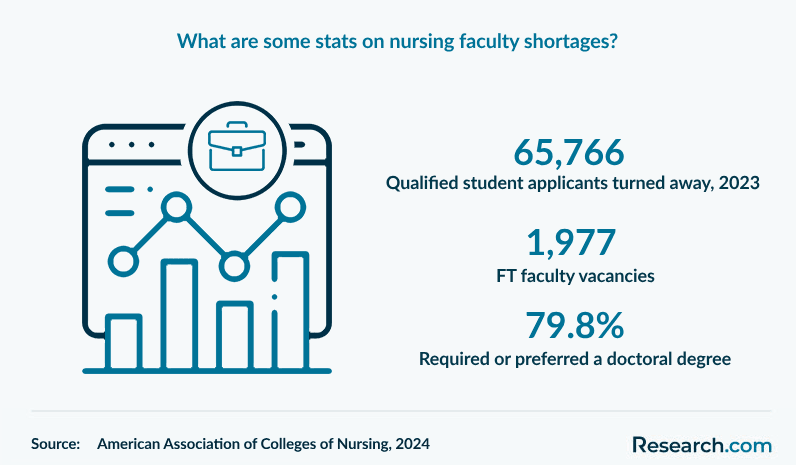
According to AACN’s 2023-2024 report on enrollment and graduations, U.S. nursing schools turned away 65,766 qualified applications from baccalaureate and graduate nursing programs in 2023. Reported barriers included insufficient faculty, limited clinical sites and classroom space, limited clinical preceptors, and budget constraints.
AACN’s October 2023 special survey identified 1,977 full-time faculty vacancies across 922 nursing schools with baccalaureate and/or graduate programs, based on an 84.6% response rate. Schools also reported a need for 103 additional faculty positions. The national nurse faculty vacancy rate was 7.8%, and 79.8% of vacancies required or preferred a doctoral degree. The graphic below shows why PhD-prepared nurses remain central to nursing education capacity.
Current Industry Trends and Future Outlook for BSN to PhD Graduates
Several trends are shaping the value of a nursing PhD. These trends do not guarantee employment, but they do explain why research-trained nurses remain important to healthcare systems, universities, and policy organizations.
- Evidence-based practice is still a core priority: Healthcare leaders need researchers who can evaluate interventions, interpret data, and translate findings into practice.
- AI, informatics, and telehealth are creating new research questions: Nurse scientists can study how digital tools affect safety, access, equity, workflow, outcomes, and patient experience.
- Health equity remains a major research focus: PhD-prepared nurses are well positioned to study disparities, social determinants of health, community interventions, and policy solutions.
- Interprofessional research is becoming more important: Complex healthcare problems require collaboration among nurses, physicians, data scientists, public health experts, economists, and policymakers.
- Faculty shortages affect the entire nursing workforce: Without enough doctorally prepared faculty, schools may struggle to expand nursing program capacity.
- Aging and chronic disease create ongoing research needs: Gerontology, palliative care, chronic illness management, caregiver support, and care coordination remain important areas for nursing science.
- Alternative nursing entry pathways are expanding: Some states and schools are encouraging more students to enter nursing through options such as online nursing programs for non nurses.
How Regional Differences Affect Career Opportunities and Compensation
Location can influence both job availability and pay for BSN to PhD graduates. States with large healthcare systems, research universities, academic medical centers, strong public health infrastructure, or higher cost of living may offer different opportunities than rural or lower-cost markets. Regional funding priorities, faculty shortages, union environments, state regulations, and employer competition can also affect compensation.
Before relocating or choosing a program based on salary potential, compare local demand, academic job openings, research funding, cost of living, state authorization rules, and long-term career fit. Research.com’s guide to the best paying states for nurses can help nurses think about how location affects compensation, although PhD-specific roles may follow different patterns than general RN employment.
What Graduates Say About BSN to PhD Online Bridge Programs
-
: "
I did not think a nursing PhD was financially possible for me until I found a lower-cost online bridge option. Being able to keep working while studying helped me manage the expense and stay connected to the research questions I care about. Anika
"
-
: "
Moving from EMT to RN through an online bridge pathway changed my career direction. The courses were practical, the faculty were supportive, and I entered critical care with stronger confidence and better compensation. Rose
"
-
: "
Completing doctoral study online after my BSN was especially meaningful as a first-generation college student. My advisor’s support and the program’s affordability made the process feel challenging but achievable. Nicole
"
Key Insights
- A BSN to PhD bridge is best for research-focused nurses: Choose this path if your goal is nursing science, faculty work, policy, research leadership, or scholarship—not primarily advanced clinical practice.
- Affordability requires full-cost comparison: Tuition is only one part of the price. Include credits, fees, travel, residencies, dissertation continuation, software, and time away from work.
- Faculty fit is a make-or-break factor: Your dissertation progress depends heavily on whether the program has faculty who can mentor your topic.
- Doctoral nursing programs are competitive: In 2023, there were 144 PhD nursing programs, 4,244 enrolled students, 2,518 completed applications, 1,796 applicants meeting requirements, 236 qualified applicants turned away, and 742 graduates.
- Faculty shortages support demand for PhD nurses: AACN reported 1,977 full-time faculty vacancies across 922 nursing schools in October 2023, with a 7.8% national nurse faculty vacancy rate and 79.8% of vacancies requiring or preferring a doctoral degree.
- Salary outcomes vary by role and region: Payscale.com data for 2025 reports an average salary of $100,000 for a PhD in nursing, while selected executive or specialized roles may pay substantially more.
- Online does not always mean fully remote: Many online PhD programs still require residencies, intensives, colloquia, proposal defenses, or dissertation-related campus visits.
- Do not confuse PhD and DNP pathways: A PhD prepares nurse researchers and scholars; a DNP is generally designed for practice leadership and clinical systems improvement.
References
- American Association of Colleges of Nursing. (2024). 2023–2024 enrollment and graduations in baccalaureate and graduate programs in nursing. American Association of Colleges of Nursing.
- American Association of Colleges of Nursing. (2024). The impact of education on nursing practice. American Association of Colleges of Nursing.
- American Association of Colleges of Nursing. (2025). PhD in nursing. American Association of Colleges of Nursing.
- American Association of Colleges of Nursing. (2023). Special survey on vacant faculty positions: 2023 summary report. American Association of Colleges of Nursing.
- Anderson, M., Taylor, N., Rowley, T., Owens, C., & Iacob, E. (2024). Understanding factors influencing nursing faculty departure and intentions. Nurse Educator, 49(4), 222–226.
- Duke University Graduate School. (2025). Nursing: PhD career outcomes statistics. Duke University Graduate School.
- NursingProcess.org. (2025). Bachelor of Science in Nursing (BSN) Salary: How Much Does a BSN Nurse Make in 2025? NursingProcess.org.
- PayScale. (2025). Doctor of Philosophy (PhD), Nursing Salary. PayScale.
- PayScale. (2025). Nurse Anesthetist Salary. PayScale.
- PayScale. (2025). Nursing Faculty Salary. PayScale.
- PayScale. (2025). Occupational Health and Safety Specialist Salary. PayScale.
- PayScale. (2025). Professor of Nursing Salary. PayScale.
- PayScale. (2025). Registered Nurse Salary by State. PayScale.
- PayScale. (2025). Registered Nurse (RN) Salary in Alaska. PayScale.
- PayScale. (2025). Registered Nurse (RN) Salary in California. PayScale.
- PayScale. (2025). Registered Nurse (RN) Salary in Connecticut. PayScale.
- PayScale. (2025). Registered Nurse (RN) Salary in District of Columbia. PayScale.
- PayScale. (2025). Registered Nurse (RN) Salary in Hawaii. PayScale.
- PayScale. (2025). Registered Nurse (RN) Salary in Massachusetts. PayScale.
- PayScale. (2025). Registered Nurse (RN) Salary in Nevada. PayScale.
- PayScale. (2025). Registered Nurse (RN) Salary in New Jersey. PayScale.
- PayScale. (2025). Registered Nurse (RN) Salary in New York. PayScale.
- PayScale. (2025). Registered Nurse (RN) Salary in Oregon. PayScale.
- PayScale. (2025). Registered Nurse (RN) Salary in Washington. PayScale.
Other Things You Should Know About the Most Affordable BSN to PhD Online Bridge Programs
To enroll in the 2027 most affordable BSN to PhD online bridge programs, candidates typically need a Bachelor of Science in Nursing (BSN) and a valid RN license, along with meeting GPA and prerequisite coursework criteria. Some programs may also require clinical experience or GRE scores, though this varies by institution.
No. BSN to PhD bridge programs admit registered nurses with a BSN and do not require a separate master’s degree first. Applicants usually need an active RN license, a minimum BSN GPA near 3.0, official transcripts, letters of recommendation, and a statement of purpose.
Yes, scholarships for 2027 BSN to PhD online bridge programs can significantly reduce costs. Schools often offer need-based or merit-based scholarships. Check individual programs for specific opportunities and application deadlines, typically available during the admission process or directly through the school's financial aid office.


