
World Online Ranking of Best Neuroscientists – 2026 Report

Co-Founder and Chief Data Scientist
On April 23, 2026, Research.com released the 5th edition of the world online ranking of best neuroscientists. This report highlights the most influential researchers advancing the field of neuroscience today. By showcasing their contributions and global impact, the ranking strengthens recognition for experts shaping modern brain science.
This annual report aims to connect the global academic community with leading neuroscientists from top universities, laboratories, and institutions. It promotes collaboration, supports knowledge sharing, and brings visibility to groundbreaking discoveries that continue to push neuroscience forward.
For the 2026 edition, data from approximately 9,600 scientist profiles were analyzed using trusted bibliometric sources such as OpenAlex and CrossRef. Rankings are determined primarily by the D-index, a discipline-specific metric that measures research impact strictly within neuroscience, ensuring accurate and field-focused evaluation.
To qualify, researchers must have a minimum D-index of 30, with most of their work clearly aligned with neuroscience. Additional factors, such as awards and discipline-specific achievements, are also considered. Each profile undergoes manual verification to ensure accuracy, reinforcing the credibility and rigor behind the final rankings.
The key findings for the 5th edition of the best neuroscientists ranking
- The United States ranks as the leading country in the top 1,000 ranking with 505 scientists They are followed by the United Kingdom with 114 scientists and Germany ranks third with 83 researchers.
- Among the top 20 neuroscience institutions, University College London leads with 34 researchers, followed by Harvard University with 28 scientists, while the University of Oxford contributes 23 scholars in the global top 1,000.
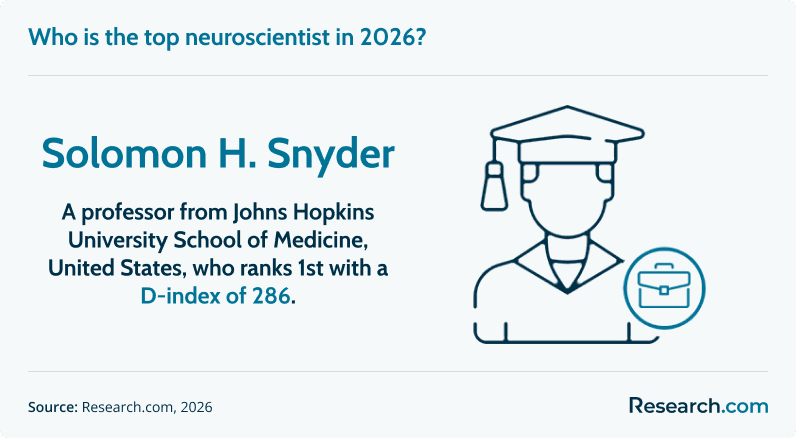
- The leading neuroscientist is Solomon H. Snyder from Johns Hopkins University School of Medicine, who ranks #1 worldwide with a D-index of 286.
- For the top 1% of scientists in the top 1,000 ranking, the average discipline H-index is 261.0, demonstrating exceptional research impact.
- On average, top-performing scientists have 267,376.86 citations and 1,283 publications, significantly higher than the overall averages of 62,395.06 citations and 507.83 publications across all ranked researchers.
The full ranking for the 2026 list of the best neuroscientists can be found here:
WORLD’S BEST NEUROSCIENTISTS RANKING
Latest discoveries in neuroscience research
Recent years have brought significant progress in neuroscience, with discoveries reshaping how researchers understand the brain, treat disorders, and develop new technologies.
One major advancement is in brain-computer interfaces (BCIs), where researchers achieved faster and more precise neural signal processing using miniaturized implantable devices. These systems can now transmit signals in under 100 milliseconds, opening the door to restoring speech, movement, and communication for patients with neurological impairments .
Neuroscience is also expanding into interdisciplinary innovation. A recent study demonstrated that living brain cells can perform machine-learning computations, bridging biology and artificial intelligence. This discovery suggests that future computing systems may be powered by biological neural networks rather than traditional silicon-based hardware.
In the field of neurodegenerative disease research, new findings are challenging long-standing assumptions. While anti-amyloid drugs can remove plaque buildup in Alzheimer’s patients, recent large-scale reviews suggest their clinical benefits may be limited, prompting scientists to explore alternative targets such as synaptic health and tau proteins .
Finally, emerging research highlights the growing role of AI and neurotechnology, including high-resolution brain mapping and data-driven analysis. These tools are accelerating discoveries in cognition, behavior, and mental health, signaling a shift toward more personalized and predictive neuroscience.
Countries with the Highest Number of Leading Neuroscientists
The 2026 world online ranking of best neuroscientists shows that the United States remains the global leader, with 505 scientists in the top 1,000. However, this reflects a noticeable decline from 526 in the 2025 report, continuing a gradual downward trend in representation. Despite the drop, the U.S. still maintains a dominant lead over all other countries, underscoring its continued strength in neuroscience research output.
The United Kingdom holds second place with 114 scientists, rising from 111 last year, showing steady growth in global research influence. Germany remains third with 83 scientists, also improving slightly from 81 in 2025, reinforcing its stable position among Europe’s leading contributors. Canada ranks fourth with 50 scientists, down from 52, while Italy holds fifth place with 32 scientists, showing a modest increase compared to 31 previously.
Further down the ranking, the Netherlands and France are closely matched, with 32 and 31 scientists respectively, both showing slight shifts compared to last year, where France was marginally ahead. Australia continues to strengthen its position with 23 scientists, maintaining its presence in the top 10. Sweden holds ninth place with 20 scientists, while Switzerland rounds out the list with 18, both showing relatively stable performance compared to previous editions.
Please note that the country associated with a scientist is based on the affiliated research institution according to MAG, not on their actual nationality.
Institutions with the Highest Number of Leading Neuroscientists
In the 2026 ranking edition, University College London (UCL) leads the list with 34 scientists in the top 1,000, rising from 31 in 2025 and strengthening its position as the top neuroscience institution globally. Harvard University follows in second place with 28 scientists, slightly down from 29 last year, but still maintaining a strong global presence. The University of Oxford holds third place with 23 scientists, showing no change in its ranking position but a modest improvement in output compared to previous stability.
The National Institutes of Health (NIH) ranks fourth with 22 scientists, continuing a gradual decline from 25 in 2025, though it remains one of the most influential non-university research bodies. Stanford University is in fifth place with 20 scientists, unchanged from last year, reflecting consistent performance among top-tier U.S. institutions. Meanwhile, the University of Cambridge and UC San Francisco are tied with 18 scientists each, with Cambridge showing slight growth compared to 17 in 2025.
The University of California system remains highly competitive, with UC San Diego also holding 18 scientists, while UCLA ranks ninth with 17, slightly down from 18 last year. Yale University completes the top 10 with 16 scientists, showing a decline from 18 in 2025, but still retaining its position among elite neuroscience hubs.
Compared to the 2025 report, the 2026 rankings show relative stability at the top, with UCL strengthening its lead and Harvard and NIH experiencing slight declines. The data continues to highlight a strong concentration of leading neuroscience research in the United States and the United Kingdom, while also reflecting increasing balance among top-tier global institutions.
Strengthening neuroscience research through online universities
Online universities are playing a growing role in supporting neuroscience education and research. As access to online learning expands, more students can study biology, biomedical sciences, and neuroscience-related fields from anywhere in the world. According to recent projections from the National Center for Education Statistics, postsecondary enrollment is expected to reach over 22 million by 2026, reflecting continued demand for higher education pathways. This shows a strong interest in subjects that form the foundation of neuroscience.
Online universities help meet this demand by offering flexible, affordable pathways to these degrees. Students who may not have access to top research institutions can still build a strong academic foundation through online programs. This creates a broader pool of future neuroscientists who can contribute to discoveries and help drive innovation in the field.
As online learning platforms grow more advanced, some even provide access to virtual labs, simulations, and collaborative research projects. These tools make it easier for students to gain practical experience and prepare for graduate-level studies or careers in neuroscience. With the continued rise of online learning, the academic pipeline into neuroscience is expanding, helping ensure that talent and opportunity are not limited by geography or financial barriers.
H-index ranking—leaders, averages, and distribution
In North America, Professor Solomon H. Snyder from Johns Hopkins University School of Medicine, United States leads the region and ranks 1st globally with a D-index of 286, the highest recorded in the 2026 ranking.
In Europe, Professor Karl J. Friston of University College London, United Kingdom remains the top neuroscientist, ranking 2nd globally with a D-index of 283, reinforcing his long-standing influence in brain imaging and computational neuroscience.
In Oceania, Professor John R. Hodges from the University of Sydney, Australia leads the region and ranks 43rd globally with a D-index of 182, showing continued strength among Australian researchers.
In Asia, Professor Michael Maes from the University of Electronic Science and Technology of China ranks among the region’s leaders with a D-index of 151, maintaining a strong global presence in cognitive neuroscience research.
In South America, Professor Ivan Izquierdo from Pontifical Catholic University of Rio Grande do Sul in Brazil remains one of the most recognized figures, previously ranking 635th globally with a D-index of 106, reflecting his lasting impact on memory research.
In Africa, Professor Paul R. Manger from South Africa's University of the Witwatersrand continues to represent the continent, previously ranked 3524th globally with a D-index of 62, highlighting the emerging but growing research presence in the region.
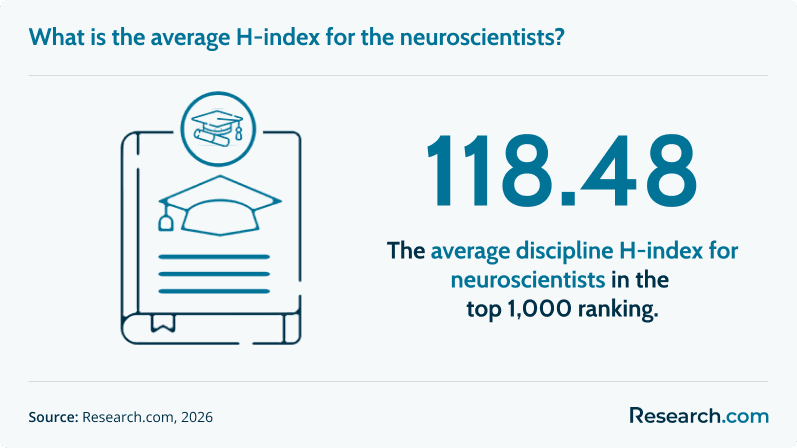
The average D-index for the top 1% of scientists in the top 1,000 is 261.0, while the overall average for all ranked neuroscientists is 118.48, highlighting a substantial gap between elite researchers and the broader field.
The average number of discipline publications for the top 1% is 1,283.0, compared to 507.83 for all scientists in the top 1,000, reflecting significantly higher research productivity among leading experts.
On average, the top 1% of scientists have received 267,376.86 citations, while the overall average is 62,395.06 citations, underscoring the strong influence and visibility of top-tier neuroscientists.
The lowest D-index among those who qualified for this year’s ranking is 30, which serves as the minimum threshold for inclusion in the neuroscience ranking.
You can learn more about the methodology used to create this report here.
About Research.com
All research was coordinated by Imed Bouchrika, Ph.D., a computer scientist with a well-established record of collaboration on a number of international research projects with different partners from the academic community. His role was to make sure all data remained unbiased, accurate, and up-to-date.
Research.com is the number one research portal for science and educational rankings. Our mission is to make it easier for professors, research fellows, and students to progress with their research and find the top experts in a wide range of scientific disciplines. Research.com is also a leading educational platform that helps students find the best colleges, academic opportunities, and career paths.


