World Online Ranking of Best Molecular Biology Scientists – 2024 Report

Co-Founder and Chief Data Scientist
Research.com published the 3rd edition of its annual ranking of leading molecular biology scientists on May 20, 2024. The report is designed for researchers, students, university leaders, policymakers, and industry teams who need a clearer view of influential experts, major research centers, and geographic patterns in molecular biology.
This guide explains what the ranking measures, what the 2024 results show, how to interpret D-index-based comparisons, and how the findings can help readers make better academic, hiring, collaboration, funding, or graduate-study decisions. It also highlights current research directions, including AI-supported drug discovery, GLP-1-related therapeutics, interdisciplinary training, and international research collaboration.
Quick answer: What does the 2024 molecular biology scientists ranking show?
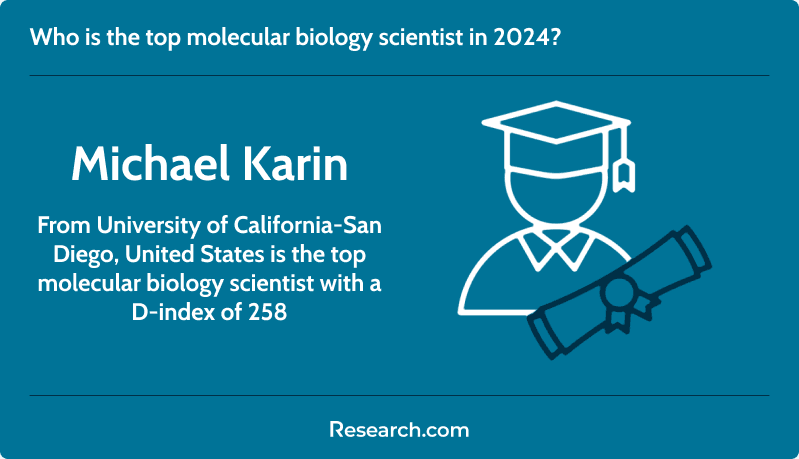
The 2024 Research.com ranking identifies highly influential molecular biology scientists based on bibliometric data and research impact indicators. The United States has the largest presence in the ranking, with 535 scientists, or 53.5% of all listed researchers. The National Institutes of Health leads institutions with 39 affiliated scientists, and Michael Karin of the University of California, San Diego ranks first globally with a D-index of 258.
The complete 2024 ranking is available here: best molecular biology scientists ranking.
How the 2024 molecular biology ranking was developed
To prepare the 2024 report, the Research.com team reviewed more than 2,200 scientist profiles using OpenAlex, CrossRef, and other bibliometric sources. The evaluation considered research publications, awards, achievements, and discipline relevance. A scientist needed a D-index threshold of 40 when most of their published work fell within molecular biology.
The purpose of the ranking is not to reduce scientific value to a single number. Instead, it gives readers a structured starting point for identifying highly cited researchers, active institutions, and countries with strong molecular biology research output. Readers should use the ranking alongside additional context such as research specialty, recent publications, collaboration history, grant activity, and institutional resources.
What is the D-index?
The D-index is a discipline-specific bibliometric indicator used to assess research influence within a particular field. In this report, it helps compare scientists whose core publication activity is primarily connected to molecular biology. Like all metrics, it has limits: it can reflect publication volume and citation patterns, but it does not capture every form of scientific contribution, mentorship, translational impact, public health relevance, or emerging work that has not yet accumulated citations.
| Ranking element | How readers should interpret it | What to check before acting on it |
| D-index | A field-specific indicator of research influence in molecular biology. | Review the scientist’s recent work, specialty area, and citation context. |
| Institutional affiliation | A snapshot of where ranked scientists are connected according to the data source. | Confirm current affiliation on the researcher’s official profile or institutional page. |
| Country representation | An indicator of where major research activity is concentrated. | Remember that country is tied to institutional affiliation, not nationality. |
| Publication and citation averages | Useful for comparing broad patterns across ranked groups. | Avoid assuming that higher volume always means greater relevance to a specific project. |
Current research directions shaping molecular biology
Molecular biology is moving quickly because laboratory methods, computational tools, pharmaceutical research, and large-scale biological datasets are increasingly connected. For readers evaluating research partners, graduate programs, or career paths, it is important to understand not only who ranks highly, but also which research areas are gaining momentum.
One important development is the use of machine learning for drug repurposing. Instead of starting every therapeutic search from scratch, researchers can use AI-driven models to examine molecular data and identify existing drugs that may work against different disease targets. This approach can support faster hypothesis generation and may help researchers prioritize experiments more efficiently.
Another active area is the development and study of glucagon-like peptide-1 therapies. GLP-1 is a hormone involved in appetite and blood sugar regulation, and researchers have developed synthetic GLP-1 analogues that imitate some of its biological effects. The ongoing interest in GLP-1-related treatments shows how molecular biology, endocrinology, pharmacology, and clinical research can converge around major public health challenges such as obesity and metabolic disease.
Key findings from the 3rd edition of the molecular biology scientists ranking
- Researchers affiliated with universities and institutions in the United States account for 535 entries, representing 53.5% of the full ranking.
- Although the United States has the largest overall share, the top 1% is not exclusively U.S.-based; six out of ten scientists in that group are affiliated with U.S. institutions.
- The National Institutes of Health has the strongest institutional showing in the 2024 report, with 39 affiliated scientists.
- Michael Karin of the University of California, San Diego in the United States ranks first in molecular biology with a D-index of 258.
- The top 20 universities and institutions in the field include organizations from North America, Europe, and Asia.
- The top 1% of scientists have an average D-index of 228.2, compared with 95.03 for all scientists included in the ranking.
How to use this ranking for research, study, or collaboration decisions
The ranking is most useful when it is treated as a research-discovery tool rather than a final verdict. A highly ranked scientist may be an excellent potential collaborator, advisor, speaker, reviewer, or benchmark for a literature review. However, the best match depends on your specific question: gene regulation, cancer biology, structural biology, plant molecular biology, virology, molecular therapeutics, or another subfield.
| If your goal is... | Use the ranking to... | Also verify... |
| Choose a graduate research direction | Identify leading scientists and institutions in areas that interest you. | Current lab openings, funding, mentorship style, and program requirements. |
| Find possible collaborators | Shortlist researchers with strong impact in a relevant subfield. | Recent publications, available facilities, and history of cross-institution work. |
| Benchmark institutional strength | Compare universities and research centers with multiple ranked scientists. | Department-level resources, grant support, and research infrastructure. |
| Build a literature review | Locate influential researchers whose publications may anchor the field. | Recent review articles, preprints, methods papers, and newly emerging groups. |
| Plan a career transition | Understand where research leadership is concentrated. | Required credentials, lab skills, computational skills, and industry demand. |
Can accelerated online doctorate programs support molecular biology research careers?
Accelerated doctoral study can be useful for some professionals, but it is not automatically the right route for every molecular biology researcher. Laboratory-based research often requires access to specialized equipment, supervised experimentation, and direct collaboration with faculty and research teams. For that reason, students considering online doctorate programs should examine whether the program includes credible research supervision, appropriate residency or lab requirements, dissertation support, and alignment with their intended scientific field.
An accelerated option may make sense for experienced professionals who already work in research, biotechnology, healthcare, or academia and need a flexible way to complete advanced training. It may be less suitable for students who still need extensive wet-lab development, in-person mentorship, or access to high-level molecular biology facilities.
Can short-term certification programs strengthen molecular biology skills?
Short certificate programs can help researchers add targeted skills, especially in areas such as bioinformatics, data analysis, regulatory practices, laboratory quality systems, scientific writing, or specialized techniques. They are not substitutes for a full research degree, but they can close practical skill gaps and make a scientist more competitive for specific projects or roles.
Professionals comparing short certificate programs that pay well should focus on program content, instructor expertise, employer recognition, hands-on components, and whether the credential connects to a real career or research need. A certificate is most valuable when it builds a skill you can immediately apply in a lab, research group, biotechnology company, or graduate program.
Countries with the highest number of leading molecular biology scientists
The United States has the largest representation in the 2024 ranking, with 535 scientists, equal to 53.5% of the list. That figure is an increase of two scientists since 2023. Within the top 1% of the report, six out of ten scientists are affiliated with universities or institutes in the United States.
Japan is second with 83 scientists, holding the same position it had last year. The United Kingdom remains third with 79 scientists. Germany follows closely in fourth place with 74 scientists, while Canada moves to fifth from seventh, with 29 scientists.
France stays in sixth place with 28 scientists. Australia, which previously ranked fifth, is now seventh with 28 scientists. The Netherlands follows with 21 scientists.
Sweden and Switzerland round out the top ten, with 17 and 16 scientists, respectively.
The country assigned to a scientist reflects the affiliated research institution listed in MAG. It should not be interpreted as the scientist’s nationality.
Institutions with the highest number of leading molecular biology scientists
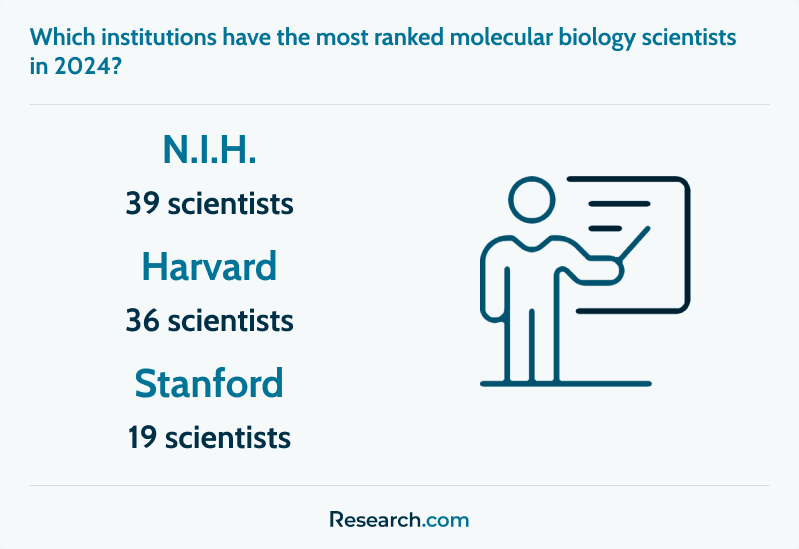
In the 2024 report, the National Institutes of Health has the most ranked molecular biology scientists, with 39 affiliated researchers.
Harvard University is listed in second place with 3624 scientists featured in the ranking.
Stanford University ranks third with nineteen scientists. MIT and the University of California-San Francisco each have 15 scientists and are listed in the 5th and 6th positions among the top 10 institutions.
The remaining top 10 institutions show that molecular biology research leadership is distributed across several regions. North America is represented by the University of California-Berkeley, Europe by Max Planck and the University of Cambridge, and Asia by Osaka University and Kyoto University.
| Institutional factor | Why it matters for molecular biology | Question to ask |
| Number of leading scientists | A larger concentration of influential researchers can indicate a strong research ecosystem. | Are these scientists active in the specific subfield you want to study or collaborate in? |
| Research infrastructure | Molecular biology may require sequencing platforms, imaging tools, cell culture facilities, animal models, or computational resources. | What facilities are available to students, postdocs, or visiting researchers? |
| Funding environment | Stable funding can affect project continuity, lab staffing, and research opportunities. | Do labs have current grants or industry partnerships related to your area? |
| Interdisciplinary access | Modern molecular biology often overlaps with medicine, chemistry, computer science, and bioengineering. | Can researchers collaborate across departments or institutes? |
How can molecular biology researchers improve their chances of securing funding?
Funding is one of the most important constraints in molecular biology because experiments can require specialized materials, staff, instrumentation, animal facilities, sequencing services, computational capacity, and long project timelines. Researchers can strengthen proposals by connecting a clear scientific question to a feasible method, credible preliminary evidence, a realistic budget, and a strong explanation of potential impact.
A practical funding strategy should include more than one source. Researchers may consider government grants, foundation support, institutional seed funding, industry partnerships, disease-focused organizations, and international research consortiums. Early-career scientists should also build a publication record, seek experienced mentors, and develop collaborations that add technical or clinical depth to a proposal.
Professionals outside traditional research tracks who are evaluating broader career and financial options can also compare short careers that pay well, but molecular biology research funding itself usually depends on scientific merit, project design, institutional support, and the investigator’s ability to execute the work.
Can accelerated online bachelor degree programs prepare students for molecular biology research?
An accelerated bachelor’s program can help motivated students move more quickly toward entry-level scientific work or graduate study, but molecular biology preparation must include the right prerequisites. Students should look for biology, chemistry, genetics, biochemistry, statistics, and laboratory coursework. If the program is online, it is especially important to confirm how laboratory requirements are completed.
Students exploring accelerated online bachelor degree programs should ask whether credits transfer to graduate programs, whether the school is accredited, whether lab courses are accepted by future employers or graduate admissions committees, and whether faculty have relevant scientific backgrounds. Speed should not come at the expense of scientific preparation.
Strengthening molecular biology research through online and cross-institution collaboration
Many molecular biology questions are too large for one lab to solve alone. Researchers may need shared datasets, complementary techniques, clinical samples, computational infrastructure, or access to specialized models. Collaboration allows one group’s strength in genetic sequencing, for example, to be paired with another group’s expertise in protein analysis, disease modeling, or data interpretation.
International research consortia are especially important in complex disease research because they allow scientists to share protocols, compare findings, and analyze larger datasets. The International Cancer Genome Consortium (ICGC) is one example of a global effort focused on analyzing cancer genomes. These collaborative models help move molecular biology from isolated findings toward broader biological and clinical understanding.
How can online pharmacy schools connect with molecular biology research?
Pharmacy, pharmacology, and molecular biology increasingly overlap in drug discovery, pharmacogenomics, toxicology, biomarker research, and precision medicine. Researchers who understand both molecular mechanisms and therapeutic development may be better positioned to translate lab findings into clinical applications.
Students and professionals comparing online pharmacy schools should understand the difference between clinical pharmacy education and research training. A pharmacy doctorate may support work in therapeutics, patient care, regulatory science, or translational research, but molecular biology research careers may still require additional laboratory experience, graduate research credentials, or postdoctoral training depending on the role.
Can molecular biology career advancement lead to high salary opportunities?
Molecular biology can lead to strong career opportunities in academia, biotechnology, pharmaceuticals, diagnostics, healthcare research, government labs, and science leadership. However, compensation varies by role, degree level, location, employer type, specialization, and experience. No ranking or degree can guarantee a specific salary outcome.
Professionals aiming for higher-paying scientific or technical roles should focus on marketable expertise: advanced experimental design, bioinformatics, leadership, regulatory knowledge, project management, grant writing, and experience with high-demand research platforms. Those comparing education options with income goals may find it useful to review the best degrees to make 100k, while still evaluating whether each path fits their scientific interests and long-term career plans.
How can accessible online education expand the molecular biology talent pipeline?
Online education can reduce barriers for students and working professionals who cannot relocate or attend a traditional campus full time. In molecular biology, however, accessibility must be balanced with scientific rigor. A strong program should offer credible instruction, clear learning outcomes, qualified faculty, and a realistic plan for laboratory or applied training.
Students looking for affordable online options should confirm institutional accreditation, financial aid eligibility, transfer policies, lab requirements, and graduate-school acceptance. Resources on educational online programs can help cost-conscious learners compare schools, but price should be weighed alongside quality, support services, and relevance to future research or career goals.
Common mistakes when interpreting molecular biology rankings
| Mistake | Why it can mislead you | Better approach |
| Assuming a ranking alone identifies the best advisor or collaborator | A scientist may be highly ranked but not aligned with your topic, methods, or career needs. | Read recent publications and evaluate fit by subfield, mentorship, and project relevance. |
| Ignoring affiliation rules | Country assignment is based on institutional affiliation in MAG, not nationality. | Use country data as a research-location indicator, not a demographic measure. |
| Focusing only on D-index | Metrics do not capture every dimension of impact, including mentorship, patents, clinical translation, or emerging work. | Combine bibliometrics with qualitative review of scientific contributions. |
| Choosing a degree program only because it is fast or online | Molecular biology often requires supervised lab experience and strong foundational coursework. | Verify accreditation, lab access, faculty expertise, and graduate-school or employer recognition. |
| Assuming salary outcomes are guaranteed | Income depends on role, region, employer, skills, and experience. | Compare real job descriptions and required qualifications before selecting a program. |
| Overlooking funding and infrastructure | Even strong researchers need resources to run advanced molecular biology projects. | Check grants, facilities, core labs, and institutional support before committing to a lab or collaboration. |
D-index leaders, regional results, and ranking distribution
In North America, Professor Michael Karin of the University of California, San Diego leads the molecular biology ranking with a D-index of 258. He is also the top-ranked scientist in the 2024 global list.
In Europe, Professor Pierre Chambon of Collège de France holds the leading position with a D-index of 250. He ranks second worldwide in the 2024 report.
In Asia, Professor Kazuo Shinozaki of RIKEN in Japan ranks first regionally and 15th globally, with a D-index of 194.
In Oceania, Professor Edward C. Holmes of the University of Sydney in Australia is the region’s leading molecular biology scientist. He ranks 57th in the report and has a D-index of 148.
The top 1% of scientists in the ranking have an average D-index of 228.2, while the average across all included scientists is 95.03.
The lowest D-index among scientists included in the 2024 ranking is 67.
The top 1% of ranked scientists average 866.9 published articles, compared with an average of 292.0 for all scholars in the ranking.
The average citation count for the top 1% is 223061.9, compared with 41826.37 for all ranked scholars.
You can review additional details about how Research.com prepares its rankings in the methodology section here.
Questions to ask before using the ranking for a major decision
- Does the scientist’s current research match the exact molecular biology topic I care about?
- Are the researcher’s most influential publications recent, foundational, or both?
- Is the affiliated institution equipped with the facilities needed for this type of research?
- Does the ranking reflect the researcher’s current affiliation and active lab status?
- If I am choosing a degree program, does it provide the laboratory, computational, and mentorship support required for my goals?
- If I am seeking collaboration, does the researcher or institution have a record of working across disciplines or borders?
- If I am evaluating career options, have I compared job requirements rather than relying only on degree titles or rankings?
Key insights
- The 2024 Research.com molecular biology ranking is a useful starting point for identifying influential scientists, leading institutions, and major research regions, but it should be paired with a closer review of subfield fit and recent work.
- The United States has the largest presence in the ranking, with 535 scientists, or 53.5% of the total list, while Japan, the United Kingdom, Germany, and Canada also show strong representation.
- The National Institutes of Health leads institutional representation with 39 affiliated scientists, and Michael Karin ranks first globally with a D-index of 258.
- D-index values help compare research influence, but they do not capture every important contribution, including mentorship, translational impact, emerging discoveries, or collaboration quality.
- AI-assisted drug repurposing, GLP-1-related therapeutics, international consortia, and interdisciplinary education are important forces shaping molecular biology research.
- Students considering online, accelerated, or certificate-based education should verify accreditation, lab requirements, faculty expertise, transfer policies, and whether the program supports their intended research or career path.
- The best use of the ranking is decision support: shortlist experts, compare institutions, guide literature reviews, identify possible collaborators, and ask better questions before committing to a research direction or academic program.
About Research.com
All research for this report was coordinated by Imed Bouchrika, Ph.D., a computer scientist with extensive experience collaborating on international research projects with academic partners. His responsibility was to help ensure that the data used in the report remained unbiased, accurate, and up to date.
Research.com is a research and education portal focused on scientific and academic rankings. Its mission is to help professors, research fellows, and students advance their work and identify leading experts across scientific fields. Research.com also supports learners by providing information on colleges, academic opportunities, and career pathways.