
World Online Ranking of Best Animal & Veterinary Scientists – 2024 Report

Co-Founder and Chief Data Scientist
Research.com’s 2024 ranking of leading animal and veterinary science researchers was published on May 15 to help scholars, institutions, students, and research stakeholders identify influential experts in the field. Animal and veterinary science affects food systems, companion animal care, livestock health, zoonotic disease preparedness, biomedical discovery, and public health, so understanding where high-impact research is being produced can help readers make better academic, hiring, collaboration, and funding decisions.
This guide explains what the 2024 ranking shows, how to interpret the results, which countries and institutions are most represented, and what the findings mean for researchers, graduate students, and organizations looking for expertise in animal and veterinary science.
Quick answer: What does the 2024 animal and veterinary science ranking show?
The 2024 Research.com ranking identifies leading animal and veterinary science scientists based on discipline-specific research impact indicators, including the D-index, the share of a scholar’s work within the field, and recognized achievements. More than 2,300 scientist profiles gathered from sources such as OpenAlex and CrossRef were reviewed for this edition.
The United States has the largest representation, with 319 scientists, or 31.9% of the ranked scholars. The University of Guelph leads all institutions with 24 affiliated scientists. The highest-ranked scientist is Professor Guoyao Wu of Texas A&M University, with a D-index of 131.
How to use this ranking
This ranking is most useful when readers treat it as a research-impact guide rather than a simple reputation list. It can help prospective graduate students identify strong research environments, help universities benchmark disciplinary strengths, and help funders or industry partners find scientists with a substantial record of publication and influence.
However, no ranking should be used in isolation. A scientist’s placement does not automatically indicate availability for supervision, fit for a specific project, teaching quality, clinical expertise, or institutional affordability. Readers should compare ranking data with current faculty profiles, active grants, laboratory facilities, publication topics, and program requirements before making academic or professional decisions.
Ranking methodology in brief
For the 2024 edition, Research.com reviewed more than 2,300 scientist profiles compiled from multiple data sources, including OpenAlex and CrossRef. Several metrics were considered before a scholar was included in the final ranking.
The D-index threshold for consideration was set at 20 when most of the scientist’s publications were in animal and veterinary sciences. Inclusion was based on a combination of discipline-specific D-index, the proportion of the scholar’s work produced in the field, and the scientist’s awards and accomplishments.
| Methodology factor | How it helps readers interpret the ranking |
| Discipline D-index | Shows research influence within animal and veterinary science rather than across all academic areas. |
| Field contribution share | Helps distinguish scholars whose work is primarily connected to animal and veterinary science from those with only partial overlap. |
| Awards and achievements | Adds context beyond citation-based metrics by considering recognized scientific accomplishments. |
| Institutional affiliation | Indicates where ranked scientists are currently associated for ranking purposes, though it should not be confused with nationality. |
Key developments in animal and veterinary science research
Recent work in animal and veterinary science highlights how the field is moving beyond traditional clinical and agricultural research into advanced biomedical tools, respiratory disease prevention, microbiome science, data-driven diagnostics, and cross-disciplinary collaboration.
One example is research into spherical hydrogels, which are small gel-like particles designed to be inhaled and support the lungs’ natural protective mechanisms. This line of research may have relevance for animals affected by persistent respiratory conditions.
Another development involves new findings in feline biology. Research suggesting that the cat gallbladder may not have its own distinct microbiome challenges earlier assumptions and may open new questions about digestion and gut health in cats.
Key findings from the 3rd edition of the animal and veterinary scientists ranking
- The United States leads the ranking with 319 scientists, equal to 31.9% of the listed leading animal and veterinary science scholars.
- The next most represented countries are the United Kingdom with 83 scientists or 8.3%, Canada with 80 scientists or 8.0%, Australia with 62 scientists or 6.2%, and Spain with 52 scientists or 5.2%.
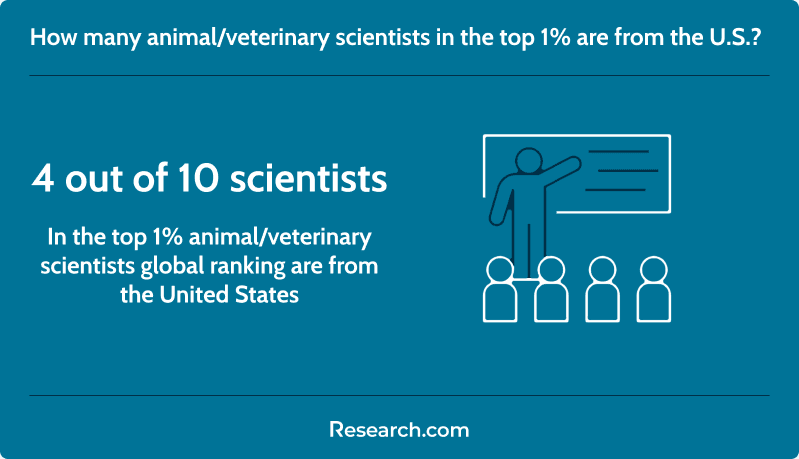
- Among the top 1%, four out of 10 scientists are affiliated with institutions in the United States, three are affiliated with Canadian institutions, and one each is affiliated with institutions in the Netherlands, Spain, and Australia.
- The top-ranked scientist is Guoyao Wu of Texas A&M University, whose D-index is 131.
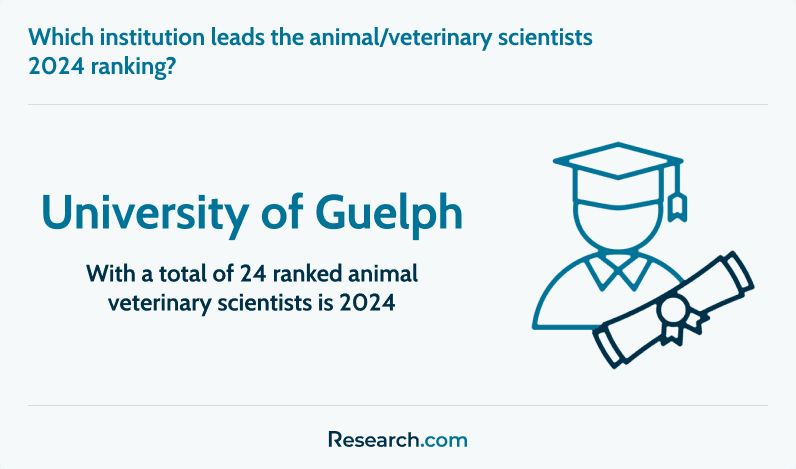
- The University of Guelph has the largest number of ranked scientists in 2024, with 24 affiliated researchers.
- American universities account for 50% of the top 10 leading institutions in animal and veterinary sciences.
- Prominent non-American institutions in the top group include the University of Guelph with 24 scientists, Wageningen University and Research with 22 scientists, Ghent University with 19 scientists, Swedish University of Agricultural Sciences with 17 scientists, and INRAE : Institut national de recherche pour l'agriculture, l'alimentation et l'environnement with 15 scientists.
- The average D-index among the top 1% of scientists is 102.9, compared with 47.54 for all scientists included in the ranking.
The complete 2024 ranking is available here:
Best animal and veterinary scientists ranking
Countries with the highest number of leading animal and veterinary scientists
The United States is the most represented country in the 2024 ranking, with 319 scientists, representing 31.9% of all ranked scholars. It also has four out of 10 scientists in the top 1%.
The United Kingdom follows with 83 scientists, while Canada ranks third with 80 scientists. Australia has 62 scientists, Spain has 52, Italy has 42, and France has 33.
The top five countries by number of ranked scientists kept the same positions they held in 2023. The United States increased from 316 scientists in 2023 to 319 in 2024. The United Kingdom has three fewer scientists than in the previous year, while Canada added five scientists in the 2024 edition.
Brazil returned to rank 10 in the 3rd edition with 31 scientists, replacing Denmark, which held the 10th position in the 2nd edition.
The country assigned to a scientist reflects the affiliated research institution listed according to MAG. It does not necessarily indicate the scientist’s nationality.
| Country | Number of ranked scientists | Share or ranking note |
| United States | 319 | 31.9% of all leading animal and veterinary science scientists |
| United Kingdom | 83 | 8.3% |
| Canada | 80 | 8.0% |
| Australia | 62 | 6.2% |
| Spain | 52 | 5.2% |
| Italy | 42 | Among the leading countries in the ranking |
| France | 33 | Among the leading countries in the ranking |
| Brazil | 31 | Returned to rank 10 in the 3rd edition |
What the country distribution means for students, researchers, and institutions
Country-level representation can help readers understand where the field has large concentrations of highly cited and discipline-focused researchers. For prospective doctoral students or postdoctoral researchers, this may point to countries with deeper research ecosystems, more potential supervisors, and broader collaboration networks.
For universities, the distribution offers a benchmarking tool. A country or institution with many ranked scientists may have strong research infrastructure, established laboratories, productive publication networks, or long-standing investment in animal and veterinary science. Still, applicants should look beyond national totals and evaluate the exact subfield they plan to enter, such as animal nutrition, infectious disease, veterinary epidemiology, parasitology, reproduction, animal welfare, or biomedical models.
Institutions with the highest number of leading scientists
The University of Guelph ranks first by institutional representation in 2024, with 24 affiliated scientists included in the ranking. Wageningen University and Research follows with 22 scientists, and Agricultural Research Service ranks third with 20 scholars.
American universities make up 50% of the top 10 institutions. Other major institutions in the top 10 include the University of Guelph in Canada, Wageningen University and Research, Ghent University, Swedish University of Agricultural Sciences, and INRAE : Institut national de recherche pour l'agriculture, l'alimentation et l'environnement.
The University of Florida moved from the sixth position in 2023 to rank 9 in 2024. Swedish University of Agricultural Sciences moved higher to spot 6, with 17 scientists.
Four out of 10 institutions represented in the top 1% are located in the United States. Other institutions represented in the top 1% include Agriculture and Agriculture-Food Canada and the University of British Columbia in Canada, Wageningen University & Research in the Netherlands, the University of Castilla-La Mancha in Spain, and Murdoch University in Australia.
Agriculture and Agri-Food Canada is reported with more than one representative in the top 1% of the ranking, with two scholars.
| Institution | Country or region note | Number of ranked scientists or ranking note |
| University of Guelph | Canada | 24 scientists; highest institutional total in 2024 |
| Wageningen University and Research | Netherlands | 22 scientists |
| Agricultural Research Service | United States | 20 scholars |
| Ghent University | Non-American institution in the top 10 | 19 scientists |
| Swedish University of Agricultural Sciences | Non-American institution in the top 10 | 17 scientists |
| INRAE : Institut national de recherche pour l'agriculture, l'alimentation et l'environnement | Non-American institution in the top 10 | 15 scientists |
| University of Florida | United States | Moved from sixth in 2023 to rank 9 in 2024 |
How online and digital collaboration support animal and veterinary science research
Digital tools have changed how animal and veterinary science teams collaborate. Shared databases, remote seminars, virtual research meetings, and online repositories make it easier for scientists in different countries to compare data, discuss protocols, and build multidisciplinary projects.
Universities with strong collaboration infrastructure can use these tools to connect veterinary clinicians, animal scientists, epidemiologists, microbiologists, nutrition researchers, and data specialists. This matters because many animal health challenges are too complex for a single laboratory or discipline to solve alone.
Online learning can also help working professionals build research skills, but it should be evaluated carefully. Readers comparing digital and campus-based study options should consider total cost, accreditation, research access, faculty mentorship, and whether the program includes laboratory, clinical, or fieldwork requirements. A broader cost discussion is available in Research.com’s guide on whether online college is cheaper.
Education pathways for future animal and veterinary science researchers
People entering animal and veterinary science research usually need a strong foundation in biological sciences, statistics, research methods, and the specific animal health area they plan to study. Some roles are open to graduates with master’s-level preparation, while independent academic research and senior research leadership often require doctoral training.
| Pathway | When it may make sense | What to check before enrolling |
| Master’s degree | Useful for building research skills, preparing for doctoral study, or moving into applied animal science roles. | Faculty expertise, thesis requirements, research facilities, cost, and graduate assistantship options. |
| Doctoral program | Best suited for students aiming for independent research, university faculty roles, or senior scientific leadership. | Advisor fit, funding, publication expectations, lab access, completion timeline, and placement outcomes. |
| Professional veterinary training plus research | Appropriate for students who want to combine clinical veterinary expertise with research. | Clinical requirements, research tracks, licensing implications, and time commitment. |
| Certificate or focused training | Helpful for professionals who need targeted skills in data analysis, laboratory methods, regulatory science, or related areas. | Credential recognition, practical content, instructor qualifications, and whether the certificate supports a clear career goal. |
Cost is a major factor for many graduate students. Readers seeking lower-cost graduate options can compare broader affordability resources such as Research.com’s guide to affordable online master’s degree programs. Those who plan to use federal financial aid should verify institutional eligibility and may find Research.com’s overview of online colleges that accept FAFSA useful as a starting point.
Can accelerated doctoral programs help future research leaders?
Accelerated doctoral options may appeal to researchers who want to move quickly into advanced research work, but speed should not be the only priority. Animal and veterinary science research often depends on laboratory training, field experience, publication development, and close mentorship, all of which take time to do well.
Students considering a faster doctorate should ask whether the program provides rigorous research supervision, realistic dissertation expectations, credible faculty expertise, and access to the facilities or datasets needed for their topic. Research.com’s guide to short online doctoral programs can help readers understand how accelerated formats are structured, but program fit and academic quality should remain central.
How interdisciplinary education expands research opportunities
Animal and veterinary science increasingly overlaps with pharmacology, biomedical research, data analytics, environmental science, food safety, public health, and ethics. Interdisciplinary preparation can help researchers design stronger studies and communicate across clinical, agricultural, and laboratory settings.
For example, professionals working at the intersection of veterinary medicine and drug development may benefit from understanding pharmacology and translational science. Readers exploring this direction can review Research.com’s resource on online Pharm D programs, while keeping in mind that pharmacy, veterinary medicine, and animal science programs serve different professional goals and may have different licensure or practice requirements.
Future trends and challenges in animal and veterinary science research
The field is being shaped by new diagnostic tools, artificial intelligence applications, digital data analysis, sustainability concerns, animal welfare expectations, and changing regulatory environments. These trends are likely to influence how research questions are framed, how data is collected, and how discoveries move from laboratories into farms, clinics, public health systems, and industry settings.
Future researchers may need stronger quantitative skills, familiarity with large datasets, and the ability to work in teams that include veterinarians, animal scientists, computer scientists, epidemiologists, and policy experts. Flexible education pathways, including options discussed in Research.com’s guide to online open enrollment colleges, may help some learners begin or continue their studies, but students should still verify academic standards, accreditation, and research relevance.
Do specialized certificates support career growth in animal and veterinary science?
Short certificate programs can be useful when they teach a specific skill that a researcher or professional can apply immediately, such as data analysis, laboratory quality systems, research compliance, bioinformatics basics, or project management. They are less useful when they are chosen only because they are quick or marketed as career-changing without evidence of employer value.
Professionals comparing short credentials can use Research.com’s guide to 6-month certificate programs that can lead to strong pay outcomes as a broad reference, but animal and veterinary science candidates should prioritize certificates that match their research area, employer expectations, and long-term academic plans.
D-index ranking: regional leaders, averages, and distribution
The ranking’s D-index data provides a way to compare research impact among leading scientists in animal and veterinary science. The top-ranked scientist globally and in North America is Professor Guoyao Wu of Texas A&M University in the United States, with a D-index of 131.
In Oceania, Professor R.C.A. Thompson of Murdoch University in Australia leads the region and ranks 10th worldwide.
In Europe, Professor José de la Fuente of the University of Castilla-La Mancha in Spain is the region’s highest-ranked scientist and is 9th globally, with a D-index of 93.
In Asia, Professor Yulong Yin of the Chinese Academy of Sciences in China leads the region with a D-index of 83 and a world ranking of 22.
In Africa, Professor Frans Jongejan of the University of Pretoria in South Africa is the highest-ranked scientist, with a world ranking of 78.
In South America, Professor Marcelo B. Labruna of Universidade de São Paulo in Brazil is the top-ranked scientist from the region, with a world ranking of 31.
The top 1% of scientists have an average D-index of 102.9, while the average for all ranked scientists is 47.54. The lowest D-index among scientists included in the 2024 ranking is 33.
The top 1% of ranked scientists average 521.5 published articles in animal and veterinary sciences, compared with an average of 214.48 articles among all scholars in the ranking.
| Region | Leading scientist | Institution | Ranking detail |
| North America | Professor Guoyao Wu | Texas A&M University | D-index of 131; ranked 1st overall |
| Oceania | Professor R.C.A. Thompson | Murdoch University | 10th in the world ranking |
| Europe | Professor José de la Fuente | University of Castilla-La Mancha | 9th worldwide; D-index of 93 |
| Asia | Professor Yulong Yin | Chinese Academy of Sciences | D-index of 83; world ranking of 22 |
| Africa | Professor Frans Jongejan | University of Pretoria | World ranking of 78 |
| South America | Professor Marcelo B. Labruna | Universidade de São Paulo | World ranking of 31 |
Questions to ask before choosing a research program or collaborator
- Does the faculty member’s recent work match the exact topic I want to study?
- Is the institution strong in my subfield, not just broadly represented in the ranking?
- Are laboratories, animal facilities, datasets, clinical partnerships, or field sites available for the type of research I plan to do?
- What funding, assistantships, or scholarships are available, and how competitive are they?
- Does the program support publication, conference participation, and professional networking?
- If the program is online or hybrid, how are laboratory, clinical, or field components handled?
- For professional practice paths, does the program meet relevant accreditation or licensure expectations?
Common mistakes when interpreting scientist rankings
| Mistake | Why it matters | Better approach |
| Assuming a high institutional count means every subfield is equally strong | An institution may be excellent in one area of animal and veterinary science but less active in another. | Review faculty publications, labs, and current projects in your specific area of interest. |
| Choosing a program based only on rankings | Rankings do not show mentorship quality, funding availability, course fit, or student outcomes. | Use rankings as one input alongside advisor fit, cost, facilities, and career goals. |
| Ignoring affiliation rules | Country totals are based on institutional affiliation according to MAG, not scientist nationality. | Interpret country data as a measure of institutional location, not personal background. |
| Overlooking cost and financial aid | Graduate research training can involve tuition, living expenses, research fees, and opportunity costs. | Compare total cost, funding packages, assistantships, and financial aid eligibility before enrolling. |
| Assuming online study always provides the same research access as campus study | Animal and veterinary science may require hands-on laboratory, clinical, or field experience. | Confirm how the program delivers practical research training before committing. |
Learn more about the ranking methodology
You can review the full Research.com ranking methodology here.
Key insights
- The 2024 animal and veterinary science ranking reviewed more than 2,300 scientist profiles from sources including OpenAlex and CrossRef.
- The United States leads by representation, with 319 scientists and 31.9% of the ranking.
- The University of Guelph has the highest institutional count in 2024, with 24 ranked scientists.
- Guoyao Wu of Texas A&M University ranks first overall, with a D-index of 131.
- The top 1% of scientists have an average D-index of 102.9, compared with 47.54 for all scientists in the ranking.
- Rankings are most useful when combined with program fit, advisor expertise, funding, research facilities, and career goals.
- Students considering online, accelerated, or certificate-based study should verify quality, accreditation, practical training, and relevance to animal and veterinary science before enrolling.
About Research.com
All research was coordinated by Imed Bouchrika, Ph.D., a computer scientist with extensive experience collaborating on international academic research projects. His responsibility was to help ensure that the data used in the ranking remained unbiased, accurate, and current.
Research.com is a research and education portal focused on science rankings, academic resources, and college and career guidance. Its mission is to help professors, research fellows, students, and education decision-makers identify leading experts, compare academic opportunities, and make informed choices about research, colleges, and career paths.


