
World Online Ranking of Best Mathematics Research Scientists – 2024 Report

Co-Founder and Chief Data Scientist
Mathematics rankings are most useful when they help readers answer a practical question: who is producing influential work, where are the strongest research networks located, and how can students, researchers, institutions, and employers use that information responsibly? On April 16, 2024, Research.com released the third edition of its annual ranking of top mathematics research scientists to make leading and emerging experts in the field easier to discover online.
This guide explains what the ranking measures, how to interpret the results, which countries and institutions are most represented, and what the findings can mean for graduate students, faculty candidates, research collaborators, university leaders, and organizations seeking mathematical expertise. It also explains the limits of ranking data so readers can use the report as a decision-support tool rather than as a single measure of research quality.
Quick answer: what does the 2024 mathematics scientist ranking show?
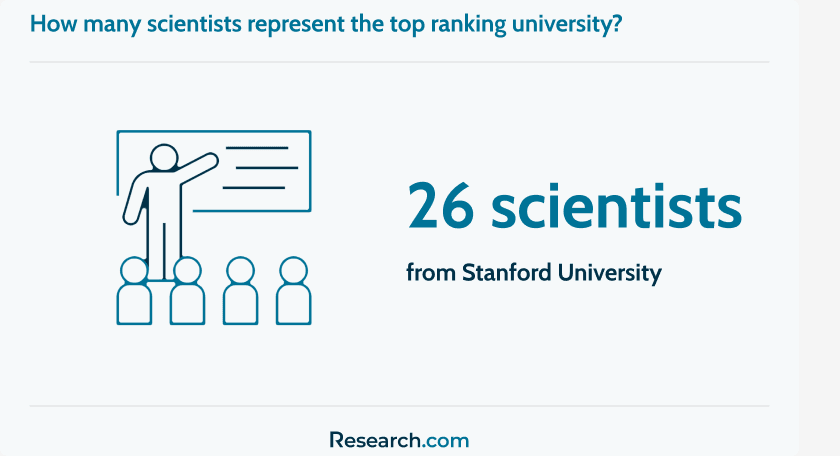
The 2024 Research.com ranking identifies 1,000 leading mathematics research scientists based on bibliometric indicators and discipline-specific criteria. The United States has the largest presence, with 473 scientists, or 47.3% of the ranking. Donald B. Rubin of Temple University in the United States holds the top position with a D-index of 132. Stanford University and the University of California, Berkeley have the strongest institutional representation, with 26 leading mathematics scientists each.
The ranking is designed for readers who need to identify influential researchers, compare institutional research strength, track global expertise, or find potential collaborators in mathematics and adjacent fields such as statistics, AI, combinatorics, and applied mathematics.
How the Research.com mathematics ranking was created
For the 2024 edition, the Research.com team reviewed more than 3,100 scientist profiles gathered from multiple bibliometric sources. The analysis was led by chief data scientist Imed Bouchrika, PhD, and used several indicators to decide which researchers qualified for inclusion.
The primary threshold was the D-index, or Discipline H-index, which was set at 30 for most mathematics publications. Researchers were also evaluated by the share of their work connected to the mathematics discipline, along with awards, achievements, and other indicators of scholarly influence.
| Ranking element | What it means for readers | How to use it carefully |
| D-index | Shows discipline-specific research impact based on publications and citations within mathematics. | Use it as one indicator of influence, not as a complete measure of teaching quality, mentorship, originality, or current project fit. |
| Country affiliation | Helps identify where highly cited mathematics researchers are currently connected institutionally. | The country reflects the affiliated research institution according to MAG, not the scientist’s nationality. |
| Institutional affiliation | Highlights universities and research centers with multiple highly ranked mathematics scientists. | Compare this with department fit, faculty availability, funding, research groups, and graduate outcomes before making decisions. |
| Awards and achievements | Adds context beyond publication metrics. | Different mathematics subfields have different award structures, citation patterns, and publication norms. |
Latest discoveries shaping mathematics research
Recent mathematics research continues to show why expert rankings matter: the field is advancing in areas that influence science, technology, engineering, finance, data analysis, and computing. One important area is the study of partial differential equations, including PDEs with free boundaries. Free boundary problems appear when the boundary of a system is itself unknown, as in certain models of water waves, materials, and physical interfaces. Better methods for analyzing these equations can improve how researchers model complex systems.
Another active area is Ramsey theory, a branch of combinatorics that studies the patterns and order that must appear inside apparently chaotic structures. Work in Ramsey-type problems can reveal links across mathematics and may also inform areas such as computer science, networks, and discrete systems.
How practical training can support advanced mathematical research
Strong mathematics research usually begins with theory, but it often becomes more valuable when researchers can translate abstract ideas into models, algorithms, simulations, software, or technical systems. Practical training can help mathematicians communicate with engineers, data scientists, computer scientists, statisticians, and industry teams that need mathematical tools for real-world problems.
Application-focused education is not a substitute for advanced mathematical training, but it can strengthen a researcher’s ability to work across disciplines. Students and professionals exploring technical pathways can compare options such as online trade school programs when they want hands-on preparation in technical fields that may intersect with applied mathematics, computing, manufacturing, or analytics.
How accessible online education can build future mathematics talent
Mathematics research depends on a steady pipeline of students who can access rigorous quantitative education early. Flexible and affordable online programs can help learners build the prerequisites they need before moving into bachelor’s, master’s, or doctoral study in mathematics, statistics, computer science, engineering, or related fields.
For students who are not yet ready for a four-year program, an affordable online associate degree can be one possible starting point. The best choice depends on transfer policies, course rigor, mathematics placement, faculty support, and whether the credits apply toward a later bachelor’s degree.
Key findings from the 3rd edition of the best mathematics scientists ranking
- Mathematics research scientists affiliated with institutions in the United States lead the report, with 473 scientists representing 47.3% of all ranked scientists.
- The next most represented countries are the United Kingdom with 70 scientists, or 7.0%; France with 51 scientists, or 5.1%; and Germany with 49 scientists, or 4.9%.
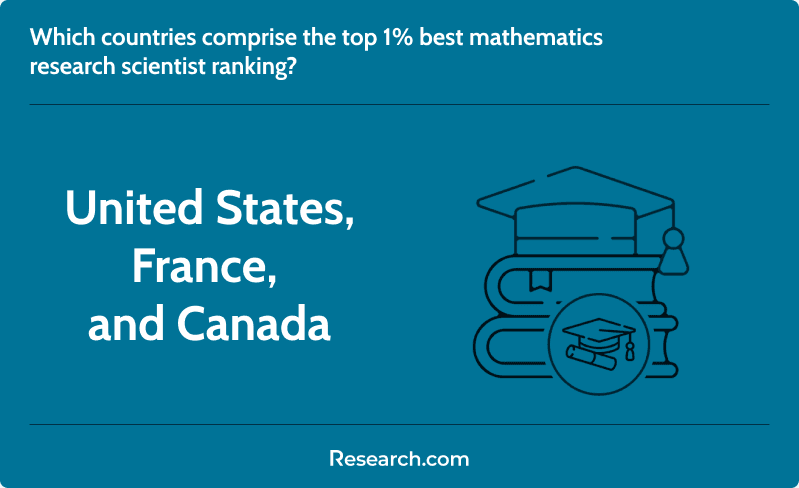
- Seven of the top 10 mathematics research scientists are based in the United States. The remaining top 10 scientists include two from France and one from Canada.
- Donald B. Rubin of Temple University in the United States ranks first in 2024, with a D-index of 132.
- Stanford University and the University of California, Berkeley have the largest number of leading mathematics research scientists, with 26 each.
- The average D-index among the top 1% of scientists is 123.7, compared with 63.46 across all 1,000 scientists in the ranking.
Readers who want to review the complete list can visit the full ranking here: Best Mathematics Research Scientists in 2024.
Can mathematics expertise lead to high-paying careers?
Advanced mathematics develops skills that many employers value: abstraction, modeling, proof-based reasoning, quantitative analysis, statistical thinking, and complex problem-solving. These skills can be useful in research universities, technology companies, finance, data science, AI, operations research, government laboratories, and scientific computing.
However, salary outcomes are not guaranteed by a mathematics background alone. Pay depends on the role, industry, location, degree level, programming ability, research specialization, and experience. Students comparing education pathways with strong earning potential can use resources on degree programs associated with $100k salary jobs as one reference point while also checking job postings and employer requirements in their target field.
| Career direction | Where mathematics helps | What students should add |
| Academic research | Proof, theory development, publishing, collaboration, and specialization in a subfield. | Graduate research experience, faculty mentorship, conference participation, and a strong publication record. |
| Data science and AI | Probability, statistics, optimization, linear algebra, and model evaluation. | Programming, machine learning tools, portfolio projects, and domain knowledge. |
| Finance and risk | Stochastic processes, statistics, modeling, and quantitative reasoning. | Financial systems knowledge, coding, regulatory awareness, and communication skills. |
| Scientific computing | Numerical analysis, PDEs, simulation, and algorithm design. | High-performance computing, software engineering, and applied science experience. |
How financial accessibility affects future mathematics research
Cost can strongly influence who is able to enter and remain in mathematics. Students with strong quantitative potential may delay or avoid advanced study if tuition, fees, relocation, or living costs are too high. More accessible programs, financial aid options, assistantships, and flexible study formats can widen participation in the research pipeline.
Students considering online options should verify accreditation, credit transfer rules, financial aid eligibility, and whether the program offers enough mathematics depth for their goals. One practical starting point is to compare online colleges that accept FAFSA, while remembering that low tuition alone does not guarantee a strong fit for mathematics preparation or research readiness.
Can shorter online doctoral pathways accelerate research careers?
Doctoral study can prepare researchers for advanced academic, industry, or leadership roles, but the right program depends on the learner’s goals. A shorter or more flexible doctoral format may appeal to working professionals who need to continue employment while completing advanced study. Still, prospective students should examine research expectations, dissertation requirements, faculty expertise, residency rules, accreditation, and whether the program is respected in their intended field.
Readers comparing time-to-completion options can review short online doctoral programs, but they should avoid choosing a doctorate based only on speed. In research-heavy fields such as mathematics, advisor fit and research quality often matter more than program length.
Does undergraduate preparation influence mathematics research success?
A strong undergraduate foundation is often the first serious step toward research in mathematics. Courses in proof writing, real analysis, abstract algebra, linear algebra, probability, statistics, numerical methods, and discrete mathematics help students develop the reasoning needed for graduate-level work.
Students should be cautious about choosing a major only because it appears easier. Those exploring easier bachelor’s degree options should still ask whether the curriculum builds enough quantitative depth for their long-term goals. For aspiring mathematics researchers, course rigor, faculty access, undergraduate research, and preparation for graduate admissions are usually more important than perceived difficulty.
Countries with the highest number of leading mathematics research scientists
The United States has the strongest representation in the 2024 mathematics scientist ranking, with 473 researchers. Within the top 1% of scientists, 7 researchers are affiliated with institutions in the United States, 2 scientists are affiliated with universities in Frances, and 1 university researcher is based in Canada.
The United Kingdom ranks second with 70 scientists, followed by France with 51 scientists, Germany with 49 scientists, and China with 45 scientists.
The remaining countries in the top 10 are Canada with 37 scientists, Australia with 28 scientists, Italy with 27 scientists, Switzerland with 19 scientists, and Austria with 17 scientists.
The country assigned to each scientist is based on the affiliated research institution listed in MAG. It does not necessarily represent the researcher’s nationality.
Institutions with the highest number of leading mathematics scientists
Stanford University and the University of California, Berkeley share the top institutional position, with 26 ranked scientists each. Princeton University follows with 23 scientists, while MIT has 19 scientists.
Other institutions in the top 10 are Columbia University with 15 scientists, Courant Institute of Mathematical Sciences with 14 scientists, University of Minnesota with 13 scientists, Harvard University with 12 scientists, Rutgers University with 12 scientists, and the University of Oxford with 11 scientists.
U.S. universities make up most of the top 10 institutions, with the University of Oxford as the only non-American institution in that group.
Among the 20 leading institutions, 17 are based in the United States. The other three are located in the United Kingdom, Switzerland, and Austria: University of Oxford, ETH Zurich, and University of Vienna.
How online universities and digital tools strengthen mathematics collaboration
Mathematics research increasingly depends on fast collaboration across locations. Video meetings, shared repositories, cloud storage, preprint platforms, and specialized mathematical software allow researchers to exchange proofs, data, code, visualizations, and drafts without waiting for in-person meetings.
A useful example is the recent attention around tiling problems. In 2023, researchers reported a notable discovery: a single tile, sometimes called the “Einstein Tile,” capable of producing a non-repeating pattern across an entire plane. Discussion spread quickly through online mathematics communities and university research networks, including involvement from researchers at the University of Washington who contributed analysis and validation.
This type of rapid exchange shows why digital connectivity matters. It does not replace deep mathematical expertise, but it can help researchers test ideas, find collaborators, and circulate results faster than traditional academic channels alone.
How advanced degrees influence research innovation
Advanced degrees can give mathematicians the time, mentorship, and structure needed to develop specialized expertise. Master’s and doctoral programs can also connect students with research seminars, faculty networks, funded projects, and interdisciplinary teams.
That said, not every advanced degree leads to a research career, and not every high-paying role requires the same credential. Students should compare programs by curriculum depth, faculty research areas, funding, placement outcomes, and opportunity cost. Those weighing graduate study against career outcomes can review master’s degrees with strong salary potential while also checking whether a program matches their mathematical interests.
How to use the mathematics scientist ranking responsibly
A ranking can help readers identify influential researchers and strong institutional clusters, but it should not be the only basis for academic, hiring, or collaboration decisions. Bibliometric indicators tend to favor established scholars, widely cited subfields, and researchers with long publication histories. Early-career researchers, niche theoretical areas, and interdisciplinary scholars may be underrepresented if readers look only at rank position.
| If your goal is... | Use the ranking to... | Also check... |
| Find a research collaborator | Identify highly visible experts in a specific mathematics area. | Recent publications, current projects, availability, coauthor networks, and methodological fit. |
| Choose a graduate program | See where influential mathematics researchers are affiliated. | Advisor accessibility, funding, placement results, course offerings, department culture, and research groups. |
| Benchmark an institution | Compare how many leading scientists are affiliated with a university or research center. | Faculty breadth, research funding, student support, publication trends, and interdisciplinary centers. |
| Evaluate expertise for industry | Locate researchers with strong influence in applied mathematics, statistics, AI, or related areas. | Consulting experience, practical deliverables, communication style, and timeline fit. |
Common mistakes when interpreting research rankings
- Assuming rank equals overall quality. A high rank reflects measurable scholarly influence, but it does not capture every dimension of teaching, mentoring, creativity, or collaboration.
- Ignoring subfield differences. Citation patterns vary widely across mathematics, statistics, AI, combinatorics, applied mathematics, and theoretical areas.
- Choosing a school only because it has ranked scientists. Students also need to know whether those faculty members are accepting students, teaching relevant courses, or advising in the student’s area of interest.
- Looking only at tuition when comparing programs. Fees, funding, assistantships, transfer credits, time to completion, and living costs can change the real cost of a degree.
- Assuming all online programs prepare students for the same outcomes. Program rigor, accreditation, faculty access, and research opportunities vary substantially.
- Overlooking early-career researchers. Some emerging scholars may be excellent collaborators or mentors even if they do not yet appear near the top of a citation-based ranking.
Questions to ask before using the ranking for a major decision
- Does the researcher’s recent work match the specific mathematics problem, method, or subfield I care about?
- Is the scientist currently affiliated with the institution shown in the ranking?
- For graduate study, is the faculty member accepting new students or serving on doctoral committees?
- Does the institution have multiple researchers in the same area, or is expertise concentrated in one person?
- How do the department’s courses, seminars, funding, and placement outcomes support my goals?
- Am I using bibliometric data alongside qualitative evidence such as publications, recommendations, research fit, and advising style?
D-index leaders, averages, and distribution
In North America, Professor Donald B. Rubin of Temple University in the United States leads the mathematics scientist ranking with a D-index of 132. His research focuses on Statistics.
In Europe, Professor Didier Dubois of Paul Sabatier University in France is the leading scientist, with a D-index of 128. His work centers on AI.
Professor Shing-Tung Yau of Tsinghua University in China is the leading scientist in Asia and ranks 12th worldwide.
In Oceania, Professor Jonathan M. Borwein of the University of Newcastle Australia in Australia leads the region and ranks 73rd globally.
Professor Noga Alon of Tel Aviv University in Israel is the leading scientist in the Middle East, with a D-index of 116. His research focuses on combinatronics.
The average D-index for the top 1% of scientists is 123.7, compared with an average of 63.46 for all 1,000 scientists included in the ranking.
For 2024, the top 1% of ranked scholars have an average of 561.4 published articles, compared with 299.76 for all scientists in the ranking.
The top 1% of scientists average 139,805.4 citations, while the average for all ranked scholars is 25,450.82.
You can read more about the ranking process and evaluation criteria in the Research.com methodology overview here.
Key insights
- The 2024 Research.com mathematics scientist ranking highlights 1,000 influential researchers, selected from more than 3,100 scientist profiles using discipline-specific bibliometric criteria.
- The United States has the largest representation, with 473 scientists, or 47.3% of the ranking.
- Donald B. Rubin of Temple University ranks first in 2024 with a D-index of 132.
- Stanford University and the University of California, Berkeley lead institutional representation with 26 mathematics scientists each.
- The ranking is most useful when combined with additional evidence such as recent publications, research fit, faculty availability, graduate funding, and institutional support.
- Students should not choose a degree program or university based only on rankings. Accreditation, cost, advisor fit, curriculum rigor, and career goals matter just as much.
- Digital collaboration, online education, and applied technical training can broaden access to mathematics research, but rigorous mathematical preparation remains essential for advanced research careers.
About Research.com
All research was coordinated by Imed Bouchrika, Ph.D., a computer scientist with an established record of collaboration on international academic research projects. His role was to help ensure that the data remained unbiased, accurate, and up to date.
Research.com is a research portal for science and educational rankings. Its mission is to help professors, research fellows, and students advance their work and identify leading experts across scientific disciplines. Research.com also helps students compare colleges, academic pathways, and career options.


