
World Online Ranking of Best Microbiology Scientists – 2024 Report

Co-Founder and Chief Data Scientist
Research.com published the third edition of its annual best microbiology scientists report on May 13, 2024. This guide explains what the ranking measures, which countries and institutions have the strongest representation, how to interpret the D-index, and how students, researchers, universities, and research leaders can use the results responsibly in 2026.
The report is designed for readers who need more than a list of names. Graduate students can use it to identify potential mentors and research hubs. Early-career scientists can study collaboration patterns and benchmark publication impact. University leaders and funding teams can use the data to understand where influential microbiology research is concentrated. The ranking is not a guarantee of future output, but it is a useful evidence-based starting point for evaluating research influence in microbiology.
For the 2024 edition, the Research.com team reviewed more than 4,700 scientist profiles using OpenAlex, CrossRef, and other bibliometric sources. Eligibility was assessed through indicators such as publications, awards, and achievements. Scientists were considered for inclusion when their D-index threshold was established at 40 and the majority of their publications were in microbiology.
Quick answer: what does the 2024 microbiology scientists ranking show?
The 2024 Research.com microbiology ranking identifies highly influential scientists based on bibliometric performance and field relevance. The United States has the largest representation, with 476 scientists, equal to 47.6% of the ranking. However, the top 1% is more internationally distributed: only 4 out of 10 scientists in that group are affiliated with U.S.-based institutions.
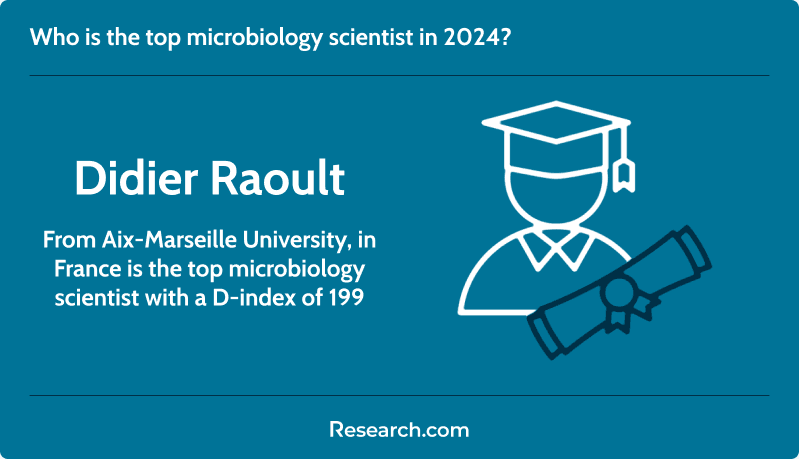
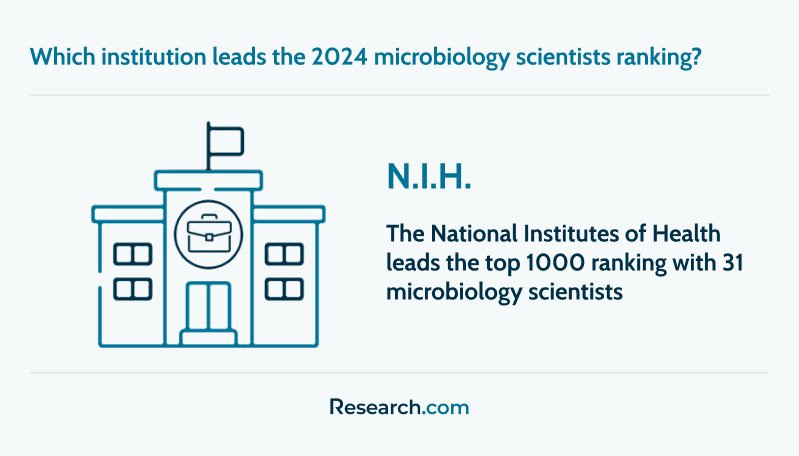
The National Institutes of Health has the highest institutional representation, with 31 scientists. Didier Raoult of Aix-Marseille University in France ranks first worldwide with a D-index of 199. The average D-index for the top 1% is 172.1, compared with 95.03 for all scientists included in the ranking.
The complete ranking is available here: Research.com best microbiology scientists ranking.
How to read this ranking without overinterpreting it
A scientist ranking can help readers find influential researchers, but it should be interpreted alongside context. Bibliometric indicators favor measurable research output, citation impact, and long-term scholarly visibility. They do not fully capture mentoring quality, teaching, team leadership, unpublished industry work, local public health impact, or contributions that are important but less frequently cited.
| What the ranking can help you do | What it should not be used for |
| Identify highly cited microbiology researchers and major research institutions | Assume one scientist, university, or country is “best” for every microbiology subfield |
| Find possible mentors, collaborators, reviewers, or keynote speakers | Judge teaching quality, student support, or lab culture from bibliometrics alone |
| Compare broad patterns in institutional and country-level research visibility | Treat rankings as a replacement for reading publications or evaluating current projects |
| Benchmark publication and citation influence among established scholars | Assume early-career researchers are less promising because they have had less time to publish |
Latest discoveries shaping microbiology research
Microbiology continues to affect medicine, public health, agriculture, biotechnology, and environmental science. One active area is the study of the gut microbiome and its relationship to human health. Researchers are investigating how gut bacteria may influence digestion, immunity, and mental health, while also exploring how microbiome-based tools could support diagnosis or treatment. A recent example is work on the connection between gut bacteria and human health.
Microbiology is also expanding understanding of ecosystems beyond the human body. Scientists have reported a cellular process through which plankton can increase photosynthesis by repurposing a membrane. Findings like this matter because microorganisms influence marine food webs, oxygen production, and broader environmental systems.
For students and professionals choosing a research direction, these examples show why microbiology remains interdisciplinary. Strong work in the field increasingly draws on molecular biology, genomics, bioinformatics, immunology, ecology, medicine, and data science.
How this ranking can support research career planning
The ranking is most useful when it helps readers make targeted decisions: whom to follow, where to apply, which labs to study, and which research areas are gaining visibility. Aspiring microbiologists can review leading scientists’ publication histories to understand what high-impact work looks like in subfields such as infectious disease, microbiome science, virology, microbial ecology, antimicrobial resistance, and molecular microbiology.
Early-career researchers can also use the ranking to identify institutions with strong research ecosystems. This may help when selecting doctoral programs, postdoctoral placements, visiting scholar opportunities, or grant collaborators. However, the best choice is not always the highest-ranked name. A strong fit depends on advisor availability, lab funding, research methods, publication expectations, mentorship style, location, and the student’s long-term career goals.
Some researchers may strengthen their interdisciplinary profile through additional professional education. For example, scientists working near clinical therapeutics, pharmacology, or translational research may find that online PharmD programs offer relevant clinical and medication-focused training. Others may compare online degrees that can lead to practical career paths if they are considering a broader transition beyond academic research.
Professional development options for microbiology researchers
Microbiology careers increasingly reward researchers who can combine laboratory expertise with computational skills, regulatory awareness, communication, and cross-disciplinary collaboration. Formal degrees are not the only path. Shorter training options can help researchers update specific skills without committing to a full doctoral or professional program.
| Option | When it may make sense | What to check before enrolling |
| Graduate certificate | You need focused training in a specific area such as data analysis, lab management, bioinformatics, or public health methods | Course content, faculty expertise, transferability, employer recognition, and cost |
| Online professional degree | You want structured advanced education while continuing to work | Accreditation, clinical or lab requirements, state authorization, and whether the program fits your career goal |
| Short technical course | You need a narrow skill quickly, such as a new software tool, sequencing workflow, or research compliance topic | Instructor qualifications, hands-on practice, assessment quality, and proof of completion |
| Postdoctoral or visiting research appointment | You need direct research immersion, publication opportunities, and access to specialized facilities | Funding, mentorship, authorship expectations, project scope, and career placement history |
Researchers who want targeted academic training may compare online graduate certificate programs to determine whether a shorter credential can fill a specific skill gap. The key is to choose training that directly supports a research plan, rather than collecting credentials without a clear purpose.
Key findings from the 3rd edition of the best microbiology scientists ranking
- Universities and research institutions in the United States account for 476 scientists, or 47.6% of the entire ranking.
- The top 1% is not dominated as heavily by U.S.-based affiliations: only 4 out of 10 scientists in that group are from the U.S.
- The National Institutes of Health has the largest institutional presence in the 2024 report, with 31 affiliated scientists.
- Didier Raoult of Aix-Marseille University in France ranks first overall with a D-index of 199.
- The top 20 universities and institutions leading microbiology research activity include organizations from North America, Europe, and Asia.
- The average D-index for the top 1% is 172.1, while the average for all ranked scientists is 95.03.
Countries with the highest number of leading microbiology scientists
The United States has the largest share of scientists in the 2024 microbiology ranking. Its 476 affiliated scientists represent 47.6% of the list, an increase of 22 scientists compared with 2023. Within the top 1%, 4 out of 10 scientists are affiliated with institutions in the United States.
The United Kingdom remains in second place with 93 scientists. France, home to the top-ranked scientist in this edition, stays third with 56 scientists. Germany follows closely in fourth place with 55 scientists, and the Netherlands ranks fifth with 51 scientists.
Japan moved from 8th place in 2023 to 6th place in 2024, with 30 scientists. Australia now ranks 7th with 28 scientists after previously holding the sixth position. Canada follows with 25 scientists.
Spain and Switzerland complete the top 10, with 25 scientists each.
The country listed for each scientist reflects the affiliated research institution according to MAG. It does not necessarily represent the scientist’s nationality.
Institutions with the highest number of leading scientists
The National Institutes of Health leads the 2024 institutional list for microbiology, with 31 scientists included in the ranking. This reflects the NIH’s broad role in biomedical and microbiological research.
The Centers for Disease Control and Prevention ranks second with 24 scientists, which is four more than the previous year’s total. Harvard University is third with 15 scientists.
Johns Hopkins University and Institut Pasteur share the fourth position among the top 10 institutions, with 14 scientists each. Other institutions in the top 10 include the University of Oxford, the University of Washington, the University of Hong Kong, Stanford University, and the University of North Carolina at Chapel Hill.
| Institution or group | 2024 ranking detail |
| National Institutes of Health | Most represented institution, with 31 scientists |
| Centers for Disease Control and Prevention | Second overall, with 24 scientists |
| Harvard University | Third overall, with 15 scientists |
| Johns Hopkins University and Institut Pasteur | Tied at number four among the top 10 institutions, with 14 scientists each |
| Top 10 institutional group | Includes institutions from North America, Europe, and Asia |
Online collaboration and the future of microbiology research
Digital research infrastructure has become important for microbiology because many projects require distributed expertise. Secure data platforms, virtual meetings, remote seminars, shared datasets, and collaborative analysis tools make it easier for scientists in different regions to work on related microbial systems, compare methods, and interpret results together.
Online collaboration is especially valuable when research teams need complementary strengths. One lab may specialize in a bacterial strain, another in genomic sequencing, and another in computational analysis. When these groups coordinate effectively, they can move faster than isolated teams. Research partnerships connected to public health institutions also show how collaboration can support applied microbiology; one example is the research environment described by Emory’s program page on collaboration with the CDC.
Online universities and distance-learning platforms can contribute to this ecosystem when they provide rigorous training, access to expert instructors, and opportunities to practice data-driven research methods. Still, microbiology is a laboratory-centered field, so students should verify how any online program handles lab requirements, research supervision, and hands-on competencies.
How researchers can use the ranking strategically
A ranking is most valuable when it informs a concrete plan. Researchers can use the list to identify potential collaborators, compare institutional strengths, study publication patterns, and strengthen the background sections of grant proposals. For example, citing the work of leading scientists can help frame a research problem, but applicants still need an original question, sound methodology, and a realistic execution plan.
Career planning should also include financial and professional goals. Scientists considering a transition into industry, leadership, healthcare, or applied research may compare educational pathways and salary-oriented career guides, including degree paths associated with $100,000 career opportunities. These resources should be used as planning tools, not as salary guarantees.
Choosing additional education: practical questions for microbiology professionals
Before enrolling in an online program, certificate, or doctoral pathway, microbiology professionals should connect the credential to a specific research or career outcome. A program may be flexible and affordable, but it still needs to improve the learner’s ability to perform better research, qualify for a role, manage teams, or enter a new specialization.
| Question to ask | Why it matters |
| Is the institution properly accredited? | Accreditation affects credit transfer, employer recognition, and eligibility for many forms of financial aid. |
| How are laboratory or applied research requirements completed? | Microbiology often requires hands-on skills that cannot be replaced by lectures alone. |
| Does the curriculum match my research direction? | A strong program for public health may not be the best fit for microbial ecology, genomics, or pharmaceutical research. |
| Can I afford the full cost, not just tuition? | Fees, travel, books, software, lab materials, and time away from work can change the real cost. |
| Will credits or credentials be recognized by employers, licensing bodies, or doctoral programs? | Some credentials are useful for skill-building but may not meet formal requirements for another goal. |
Professionals comparing low-cost options can review affordable online colleges that accept FAFSA, while those seeking a faster advanced pathway may examine short online doctoral program options. Senior scholars who want structured continuing education can also explore online degree options for older learners.
Common mistakes when using scientist rankings
- Relying only on rank position. A scientist’s placement is useful, but readers should also review recent publications, research focus, lab activity, and collaboration networks.
- Ignoring subfield fit. A leading virologist may not be the right mentor for a student focused on environmental microbiology or microbial genomics.
- Assuming institutional prestige guarantees mentorship quality. A highly ranked institution may have strong research output, but students still need to evaluate advisor availability, funding, supervision style, and lab culture.
- Comparing early-career and senior scientists unfairly. Bibliometric measures tend to reflect accumulated output, so newer researchers may be underrepresented even when their work is promising.
- Choosing an online program without checking requirements. Students should confirm accreditation, lab expectations, transfer policies, and whether the program supports their intended career path.
- Treating salary or career outcomes as guaranteed. Educational pathways and rankings can inform decisions, but individual results depend on experience, location, specialization, labor market conditions, and performance.
D-index leaders, regional representation, and publication impact
In Europe, Professor Didier Raoult of Aix-Marseille University in France is the highest-ranked scientist. He is also ranked no.1 globally, with a D-index of 199.
In North America, Professor Gabriel Núñez of the University of Michigan-Ann Arbor in the United States leads the region. He ranks fourth overall in the report and has a D-index of 173.
Professor Kwok-Yung Yuen of the University of Hong Kong in China is the top-ranked scientist in Asia and ranks 8th worldwide. His D-index is 164.
In Oceania, Professor Edward C. Holmes of the University of Sydney in Australia leads the region. He ranks ninth overall and has a D-index of 163.
Professor Paul D. van Helden of Stellenbosch University in South Africa is the highest-ranked scientist in Africa, with a world ranking of 429.
Professor Jean Swings of the Federal University of Rio de Janeiro in Brazil is the leading scientist from South America. His D-index is 116.
The average D-index for the top 1% is 172.1, while the average D-index for all scientists in the ranking is 95.03. The lowest D-index among scientists included in the 2024 ranking is 77.
The top 1% of scientists have an average of 1065.5 published articles, compared with 388.62 for all ranked scholars. Their average citation count is 136,451.4, compared with 37,252.29 for all scholars in the ranking.
| Metric | Top 1% of scientists | All ranked scientists |
| Average D-index | 172.1 | 95.03 |
| Average number of published articles | 1065.5 | 388.62 |
| Average number of citations | 136,451.4 | 37,252.29 |
Methodology and transparency
The 2024 report was built from more than 4,700 scientist profiles reviewed through OpenAlex, CrossRef, and other bibliometric sources. The Research.com team considered publications, awards, and achievements, and used a D-index threshold of 40 when most of a scientist’s publications were in microbiology.
Readers who want to understand how Research.com rankings are developed can review the methodology on the Research.com methodology page.
About Research.com
The research process was coordinated by Imed Bouchrika, Ph.D., a computer scientist with extensive experience collaborating on international research projects across the academic community. His role was to help ensure that the data remained unbiased, accurate, and current.
Research.com is a research and education portal focused on science rankings, academic discovery, college guidance, and career planning. The platform helps professors, research fellows, students, and professionals identify experts, compare academic opportunities, and make better-informed education and career decisions.
Key insights
- The 2024 microbiology scientists ranking is a research influence tool, not a complete measure of a scientist’s teaching, mentoring, or future productivity.
- The United States has the largest representation, with 476 scientists and 47.6% of the ranking, but the top 1% includes substantial representation from outside the U.S.
- The National Institutes of Health leads all institutions with 31 ranked scientists, followed by the Centers for Disease Control and Prevention with 24 scientists.
- Didier Raoult of Aix-Marseille University ranks first worldwide with a D-index of 199.
- Students and early-career researchers should use the ranking to identify research hubs, possible mentors, and publication patterns, then verify fit through recent work, lab culture, funding, and advisor availability.
- Additional online education or certificates can support a microbiology career when they build specific skills, but accreditation, lab requirements, cost, and career relevance should be checked before enrolling.



