
World Online Ranking of Best Materials Scientists – 2024 Report

Co-Founder and Chief Data Scientist
Research.com’s 3rd edition ranking of the best materials science scientists, released on April 15, 2024, is designed to help researchers, students, universities, funding bodies, and industry teams identify highly influential scholars in one of the most innovation-driven scientific fields. Materials science affects semiconductors, batteries, biomaterials, superconductors, polymers, nanomaterials, construction materials, advanced manufacturing, and many other areas where scientific discovery quickly becomes practical technology.
This guide explains what the 2024 ranking shows, how the list was developed, which countries and institutions have the strongest representation, and how readers should interpret D-index-based rankings. It also looks at current research directions, education pathways, and practical questions future materials scientists should ask before choosing a degree, research group, or career direction.
Quick answer: What does the 2024 materials science scientist ranking show?
The 2024 Research.com ranking identifies leading materials science researchers based on bibliometric indicators, discipline-specific contribution, awards, and achievements. For this edition, the research team reviewed nearly 11,000 scientist profiles from multiple bibliometric data sources. Scholars generally needed a D-index threshold of 40 when most of their publications were in materials science.
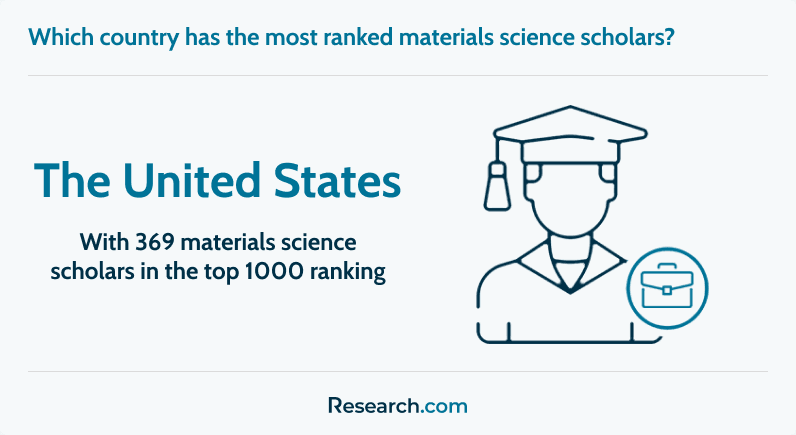
The United States remains the most represented country, with 369 scientists, or 36.9% of all leading materials scientists in the ranking. China follows with 254 scientists. Zhong Lin Wang of Georgia Institute of Technology remains the top-ranked scientist in the 2024 report with a D-index of 286, while the Chinese Academy of Sciences remains the leading institution with 41 ranked scientists.
What the materials science ranking measures
The ranking focuses on researchers whose publication record, citations, and field-specific influence show sustained contribution to materials science. The D-index is central to the evaluation because it measures a scholar’s citation impact within a discipline rather than treating all academic output as equally relevant.
However, the ranking is not meant to be the only measure of research value. Materials science includes basic science, applied engineering, commercialization, interdisciplinary collaboration, and emerging research areas that may not yet have had enough time to accumulate large citation counts. Readers should use the list as a strong starting point, not as a complete substitute for reviewing a researcher’s publications, laboratory focus, collaborations, patents, and real-world impact.
Latest discoveries in materials science research
Materials science is advancing through a mix of computation, experimental design, nanotechnology, and interdisciplinary engineering. One major direction is the development of AI-assisted metamaterials research. Metamaterials are engineered structures that can display properties not usually found in natural materials, and researchers are using new design methods to explore possibilities such as unusual mechanical behavior, advanced optics, and more efficient device performance.
Another active area is metal-organic frameworks research. Metal-organic frameworks, often called MOFs, are highly porous materials that can be designed for uses such as pollutant capture, sensing, storage, catalysis, and self-healing systems. Their molecular-level structure makes them especially important for researchers working on environmental applications, energy systems, and advanced functional materials.
How prospective materials scientists can find affordable, credible education pathways
Students who want to enter materials science should balance cost, research access, accreditation, and preparation for graduate study or technical employment. Online and hybrid study can help some learners complete prerequisites, engineering foundations, or related science coursework at a lower cost, especially when schools participate in federal financial aid programs. Research.com’s guide to the most affordable online colleges that accept FAFSA can help students compare lower-cost options before committing to a program.
Prospective students should verify that any program they consider fits their goal. A student planning to become a research scientist may need a strong laboratory-based bachelor’s program followed by a master’s or doctorate. A working professional seeking career mobility may benefit from targeted graduate coursework, research experience, or specialized training in computational materials, polymers, nanomaterials, or manufacturing.
How advanced degrees affect materials science career options
Materials science is research-intensive. Many higher-level roles in academic laboratories, national research facilities, semiconductor development, battery technology, biomaterials, and advanced manufacturing favor candidates with graduate training. A bachelor’s degree can support entry-level engineering, testing, quality assurance, or laboratory roles, but a master’s or doctorate is often more useful for independent research, technical leadership, and specialized R&D work.
Students comparing graduate options should look beyond the title of the degree. Faculty expertise, laboratory facilities, publication opportunities, industry partnerships, funded assistantships, and thesis or dissertation expectations usually matter more than whether the program is marketed broadly as materials science, materials engineering, chemical engineering, mechanical engineering, physics, or chemistry. Learners comparing high-return graduate fields can also review Research.com’s resource on the most valuable master’s degrees.
Key findings from the 3rd edition of the best materials science scientists ranking
- Scientists affiliated with institutions in the United States continue to have the largest presence, with 369 scientists representing 36.9% of all leading materials scientists.
- The other countries in the top 5 are China with 254 scientists, Germany with 64 scientists, the United Kingdom with 45 scientists, and Japan with 38 scientists.
- Seven out of 10 scientists in the top 1% are affiliated with institutions in the United States; the other represented countries are Switzerland, China, and Germany.
- Zhong Lin Wang of Georgia Institute of Technology in the United States remains ranked first in the 2024 report and has a D-index of 286.
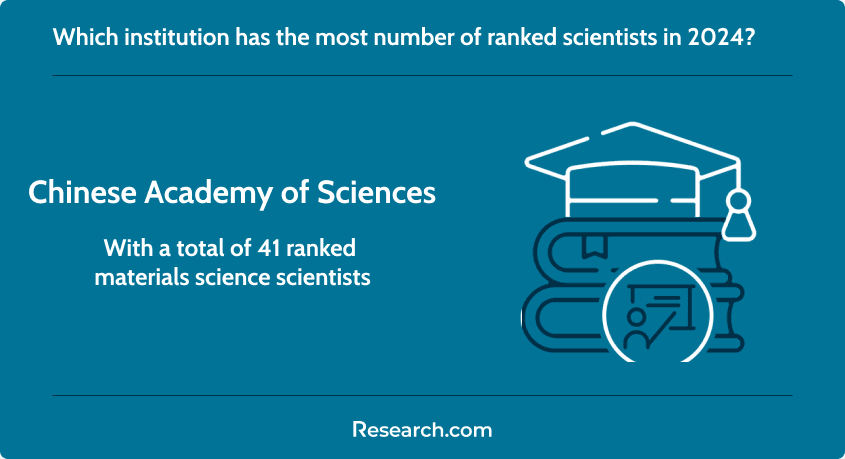
- The Chinese Academy of Sciences again leads all institutions in the 2024 edition, with 41 scientists included in the ranking.
- The average D-index for the top 1% of scientists is 245, compared with an average of 114 for all scientists included in the ranking.
The complete 2024 list is available here:
2024 best materials science scientists ranking
Countries with the highest number of leading materials science scientists
The United States has the largest number of leading materials science scientists in the 2024 ranking. Its total remains unchanged from the previous year at 369 scientists.
China ranks second with 254 scientists, an increase of 19 scientists in 2024. Germany ranks third with 64 scientists, down from 67 but still positioned among the top 5 countries.
The United Kingdom and Japan remain in fourth and fifth place, with 45 and 38 scientists, respectively. Both countries recorded fewer scientists in the 2024 ranking than in 2023, but they retained their previous ranking positions.
The rest of the top 10 includes Australia with 37 scientists, Singapore with 35 scientists, South Korea with 24 scientists, Canada with 18 scientists, and Switzerland with 15 scientists.
The country assigned to a scientist reflects the affiliated research institution listed according to MAG, not the scientist’s nationality.
| Rank group | Country | Number of leading materials science scientists in 2024 |
| 1 | United States | 369 |
| 2 | China | 254 |
| 3 | Germany | 64 |
| 4 | United Kingdom | 45 |
| 5 | Japan | 38 |
| 6 | Australia | 37 |
| 7 | Singapore | 35 |
| 8 | South Korea | 24 |
| 9 | Canada | 18 |
| 10 | Switzerland | 15 |
Emerging trends shaping materials science research
Several research themes are becoming increasingly important for materials scientists. Artificial intelligence and machine learning are being used to predict material behavior, reduce trial-and-error experimentation, and identify promising structures faster. Computational modeling also helps researchers screen materials before investing in expensive synthesis and testing.
Sustainability is another major theme. Materials scientists are working on materials for clean energy, recycling, lower-impact manufacturing, pollutant capture, and more durable products. Smart materials, adaptive materials, additive manufacturing, and nanoengineered structures are also changing how researchers design and test new systems.
For students, these trends mean that the most competitive preparation often combines traditional materials science fundamentals with data analysis, computation, laboratory training, and interdisciplinary collaboration. Learners who need flexible lower-cost starting points can compare options such as online colleges that accept FAFSA, while still confirming that the program supports their long-term research or engineering goals.
Can accelerated online doctoral programs support a materials science research career?
Doctoral study remains one of the clearest routes into independent materials science research, especially for academic, national laboratory, and advanced industrial R&D roles. Accelerated or flexible doctoral formats may help some professionals continue working while completing advanced coursework or research milestones, but students should examine these programs carefully.
Materials science often depends on laboratory access, instrumentation, faculty mentorship, and publishable research. Before choosing a faster or online-heavy doctorate, candidates should ask whether the program provides credible research supervision, access to required equipment, dissertation support, and a structure that employers or academic hiring committees will respect. Students exploring shorter doctorate formats can use Research.com’s guide to the quickest PhD options as a starting point, not as a substitute for program-specific due diligence.
Institutions with the highest number of leading materials science scientists
The Chinese Academy of Sciences in China has the highest number of ranked materials science scientists in 2024. With 41 scientists included, it retains the top institutional position from the previous year, although its total decreased from 45 last year.
Massachusetts Institute of Technology (MIT) moved ahead of Tsinghua University to become the second-ranked institution in 2024. MIT, based in the United States, has 24 affiliated scientists in this year’s ranking. Tsinghua University ranks third, also with 24 scientists.
The University of California-Santa Barbara ranks fourth with 20 scientists, followed by the National University of Singapore with 18 scientists.
Other institutions with strong representation include Northwestern University with 17 scientists, Nanyang Technological University with 15 scientists, City University of Hong Kong with 14 scientists, the University of Science and Technology of China with 14 scientists, and the Georgia Institute of Technology with 13 scientists.
Among the top 20 institutions, 10 are based in the United States, 5 are based in China, 2 are in Singapore, and one institution each is based in Germany, the United Kingdom, and Switzerland. The Singapore institutions are the National University of Singapore and Nanyang Technological University; the other represented institutions are Max Planck Society in Germany, University of Cambridge in the United Kingdom, and École Polytechnique Fédérale de Lausanne in Switzerland.
| Institution | Country or location noted in the ranking | Number of ranked scientists in 2024 |
| Chinese Academy of Sciences | China | 41 |
| Massachusetts Institute of Technology (MIT) | United States | 24 |
| Tsinghua University | China | 24 |
| University of California-Santa Barbara | United States | 20 |
| National University of Singapore | Singapore | 18 |
| Northwestern University | Noted among leading universities in the list | 17 |
| Nanyang Technological University | Singapore | 15 |
| City University of Hong Kong | Noted among leading universities in the list | 14 |
| University of Science and Technology of China | Noted among leading universities in the list | 14 |
| Georgia Institute of Technology | Noted among leading universities in the list | 13 |
How online collaboration is changing materials science research
Materials science research increasingly depends on collaboration across institutions, disciplines, and countries. While laboratory work remains essential, digital platforms make it easier for research teams to share data, coordinate modeling and experiments, hold remote seminars, and work across specialized facilities.
A useful example is the materials science research collaboration involving Texas A&M University, the University of California San Diego, and the Georgia Institute of Technology. The collaboration reflects how institutions can combine expertise to accelerate materials discovery.
The National Science Foundation materials research focus area also illustrates the importance of organized support for materials-related discovery. For students and early-career researchers, this means that the best opportunities may come from programs connected to multi-institution research networks, shared facilities, and interdisciplinary centers.
Can materials science expertise lead to high-value career transitions?
Materials science training can transfer into several fields because it blends chemistry, physics, engineering, computation, and problem-solving. Professionals may move into areas such as biomedical engineering, renewable energy, semiconductor manufacturing, quality systems, advanced manufacturing, nanotechnology, sustainability, or product development.
The best transition depends on the professional’s current education level, laboratory skills, programming or modeling experience, and industry exposure. Some technical roles may not require a long academic route, while research leadership positions often require graduate study. Readers comparing shorter career pathways outside traditional materials science research can review Research.com’s article on high-paying medical jobs with less schooling, but they should compare those routes carefully with the education requirements for materials-related careers.
Are materials science rankings a complete measure of research impact?
No ranking can capture every kind of scientific contribution. A D-index-based ranking is useful for identifying highly cited researchers with strong discipline-specific influence, but it may underrepresent newer scholars, emerging subfields, team-based applied research, technology transfer, patents, mentorship, open science contributions, or industry implementation.
Students and institutions should treat the ranking as one source of evidence. When evaluating a potential advisor, collaborator, or graduate program, it is also important to review recent publications, research funding, laboratory culture, student outcomes, dissertation topics, and alignment with the reader’s goals. Students who are still comparing graduate education options can also explore master’s programs with more accessible admissions pathways, while recognizing that research-intensive materials science programs may have different expectations.
D-index leaders, regional representation, averages, and distribution
In North America, Professor Zhong Lin Wang of Georgia Institute of Technology in the United States is the leading scientist. He is also ranked first globally and has a D-index of 286.
In Europe, Professor Michael Gratzel of École Polytechnique Fédérale de Lausanne in Switzerland ranks first in the region and second globally, with a D-index of 282.
In Asia, Professor Jiaguo Yu of the China University of Geosciences in China leads the region. Professor Yu has a D-index of 213 and ranks 8th in the report.
Professor Shi-Zhang Qiao of the University of Adelaide in Australia is the highest-ranked scientist in Oceania. He ranks 46th in the report and has a D-index of 168.
Professor Ado Jorio of the Universidade Federal de Minas Gerais in Brazil is the leading scientist from South America, with a D-index of 98.
The average D-index for the top 1% of scientists is 245, while the average for all scientists included in the ranking is 114.
The scholar with the lowest index value who made it to the ranking in 2023 has a D-index of 68.
The average number of published articles for the top 1% of scientists in the ranking is 1377.3, compared with an average of 675.78 for all ranking scholars.
The average number of citations for the top 1% of scientists is 260,412.2, compared with an average of 58,685.74 for all ranking scholars.
| Region or group | Leading scientist or metric | D-index or value |
| North America and global rank 1 | Zhong Lin Wang | 286 |
| Europe and global rank 2 | Michael Gratzel | 282 |
| Asia and global rank 8 | Jiaguo Yu | 213 |
| Oceania and global rank 46 | Shi-Zhang Qiao | 168 |
| South America | Ado Jorio | 98 |
| Top 1% of scientists | Average D-index | 245 |
| All scientists included in the ranking | Average D-index | 114 |
You can read more about how Research.com builds its rankings in the full Research.com methodology.
Is an advanced materials science degree worth the investment?
An advanced materials science degree may be worth the investment for students who want to work in research, technical leadership, product innovation, or specialized engineering roles. The strongest return is usually tied to program quality, funding, faculty mentorship, research output, and alignment with high-demand technical areas. The degree itself is not a guarantee of salary or employment.
Before enrolling, students should compare tuition, assistantship availability, laboratory access, graduation requirements, employer connections, and career outcomes. Those evaluating broader degree-to-career returns can review Research.com’s guide to the degree programs that can lead to $100k salary jobs, while remembering that individual earnings vary by role, location, experience, industry, and economic conditions.
How to use this ranking when choosing a research path
The ranking is most useful when combined with your own academic and career priorities. A top-ranked scientist may be an excellent potential advisor or collaborator, but fit still matters. Research focus, availability, mentorship style, funding, laboratory culture, and student placement can affect your experience as much as prestige.
- Start with your research interest. Identify whether you want to work in energy materials, biomaterials, semiconductors, polymers, nanomaterials, structural materials, computational materials, or another subfield.
- Use the ranking to identify influential scholars. Review scientists whose work aligns with your topic, then read their recent publications instead of relying only on their ranking position.
- Evaluate the institution, not just the individual. Look for facilities, centers, funding sources, graduate student support, and industry or government partnerships.
- Check degree requirements carefully. Materials science pathways may sit within engineering, physics, chemistry, or interdisciplinary departments, so prerequisites and expectations can vary.
- Consider long-term career fit. A student aiming for academia may need a different program than a student targeting semiconductor manufacturing, batteries, medical devices, or sustainability consulting.
Common mistakes to avoid when interpreting scientist rankings
| Mistake | Why it can mislead you | Better approach |
| Choosing a program only because it has a highly ranked scientist | The researcher may not be accepting students, may not work in your niche, or may not match your mentorship needs. | Confirm advisor availability, recent projects, lab culture, and student outcomes. |
| Treating D-index as the only measure of quality | Citation-based indicators may not fully reflect emerging fields, applied work, patents, teaching, or mentorship. | Review publications, grants, collaborations, dissertation topics, and real-world applications. |
| Ignoring affordability and funding | A strong program can still create financial strain if funding is limited or costs are unclear. | Compare tuition, assistantships, stipends, fees, health insurance, and cost of living. |
| Assuming online or accelerated formats are automatically equivalent | Materials science often requires laboratory work, specialized equipment, and close research supervision. | Verify research access, accreditation, dissertation support, and employer recognition. |
| Relying only on institutional prestige | A famous university may not have the strongest faculty or facilities in your specific subfield. | Match your research goals to faculty expertise and laboratory infrastructure. |
Questions students and researchers should ask before choosing a materials science program or advisor
- Does the faculty member’s recent research match the topic I want to study?
- Is the professor currently accepting graduate students, postdocs, or collaborators?
- What laboratory equipment, shared facilities, or computational resources are available?
- How are graduate students funded, and for how long is support typically available?
- What kinds of publications, patents, industry projects, or conference opportunities do students receive?
- Where do graduates work after completing the program?
- Does the program support interdisciplinary work across engineering, chemistry, physics, biology, or data science?
- How does the program help students build skills in computation, data analysis, and experimental methods?
About Research.com
The research was coordinated by Imed Bouchrika, Ph.D., a computer scientist with extensive experience collaborating on international academic research projects. His role was to help ensure that the data used in the ranking remained unbiased, accurate, and up to date.
Research.com is a research and education portal focused on scientific rankings, academic resources, and higher education guidance. Its mission is to help professors, researchers, students, and professionals identify leading experts, compare academic opportunities, and make better-informed decisions about education and career pathways.
Key Insights
- The 2024 materials science scientist ranking reviewed nearly 11,000 scientist profiles and used the D-index, field-specific contribution, awards, and achievements as part of the evaluation.
- The United States leads the ranking by country affiliation with 369 scientists, while China ranks second with 254 scientists.
- Zhong Lin Wang of Georgia Institute of Technology remains the top-ranked materials science scientist in the 2024 report with a D-index of 286.
- The Chinese Academy of Sciences remains the leading institution, with 41 ranked scientists in 2024.
- Rankings are most useful when paired with deeper evaluation of publications, research fit, mentorship, funding, facilities, and career outcomes.
- Students pursuing materials science should consider graduate education carefully, because advanced roles often depend on research experience, laboratory access, and specialization.
- AI-assisted discovery, MOFs, metamaterials, sustainability, computational modeling, and collaborative research networks are important forces shaping the field.


