
World Online Ranking of Best Law Scientists – 2024 Report

Co-Founder and Chief Data Scientist
If you are trying to identify influential law scholars, compare legal research institutions, or understand where major legal scholarship is concentrated, a ranking can be useful—but only if you know what the ranking measures and what it leaves out. Research.com’s law scholar ranking is designed for students, faculty members, research administrators, legal professionals, policy organizations, and institutions looking for recognized experts in legal research.
According to the original report record, Research.com published the third edition of its ranking of leading law researchers on April 29, 2014; the ranking discussed here reflects the 2024 list. This guide explains how the ranking was prepared, what the key findings show, which countries and institutions have the strongest representation, how D-index results are distributed, and how readers should use the list responsibly when evaluating scholars, programs, or research partnerships.
Quick answer: What does the 2024 law scholar ranking show?
The 2024 Research.com law scholar ranking highlights researchers with substantial publication and citation impact in legal scholarship. The United States has the largest presence, with 300 affiliated scholars on the list. Harvard University leads all institutions with 19 affiliated scholars, and Cass R. Sunstein of Harvard University ranks first overall with a D-index of 131.
The ranking was built after Research.com analyzed over 400 profiles from OpenAlex, CrossRef, and other bibliometric sources. To qualify, scholars whose primary publishing area is law must have a D-index score of at least 40. Ranking eligibility also considers the D-index score, the share of a scholar’s work connected to law, and recognized awards and accomplishments.
What the law scholar ranking measures
The ranking is intended to increase the visibility of established legal academics and researchers while helping readers discover potential collaborators, subject-matter experts, advisors, and institutional leaders in law. It can be especially useful for universities, research centers, legal organizations, policy groups, and students looking for scholars whose work has had measurable influence.
However, the ranking should not be treated as a complete measure of a scholar’s value. Bibliometric indicators can show publication and citation patterns, but they do not always capture teaching quality, mentorship, public service, legal practice influence, policy impact, or contributions that appear outside traditional academic publishing.
| Ranking element | What it helps readers understand | What to be careful about |
| D-index score | Shows discipline-specific research impact using a quantitative bibliometric measure. | It may favor scholars in areas with stronger citation cultures or broader publication coverage. |
| Discipline contribution | Helps distinguish scholars who publish primarily in law from those whose work only partly overlaps with law. | Interdisciplinary scholars may be harder to classify cleanly. |
| Awards and accomplishments | Adds context beyond publication volume and citation counts. | Recognition varies by country, institution, specialty, and career stage. |
| Institutional affiliation | Shows where highly cited legal scholars are currently connected academically. | Affiliation is not the same as nationality, and it may change over time. |
Latest studies in legal research
Two active areas of legal scholarship are especially important for readers evaluating the future direction of the field: artificial intelligence governance and climate-related legal accountability.
One major research stream examines how legal systems should respond when AI systems cause harm. A 2023 Stanford Law School analysis of AI liability rules discusses how responsibility could be assigned among the parties that design, deploy, or control AI systems. This topic matters because AI tools are increasingly used in business, public administration, healthcare, finance, education, and legal services, while liability rules are still developing.
Environmental and climate law is another high-impact research area. A 2022 Columbia Law School study on climate dispute resolution argues for an international tribunal focused on climate disputes. The proposal responds to concerns that current legal mechanisms may not be strong enough to enforce international climate commitments or hold countries accountable for violations.
How advanced online legal education can support research impact
Advanced legal education can help professionals build stronger analytical, writing, research design, and collaboration skills. For working adults who cannot relocate or pause their careers, online legal programs may provide a practical route to deeper legal training, especially when courses include case analysis, research methods, regulatory interpretation, and applied legal writing.
Programs such as affordable online master’s in legal studies programs can be useful for professionals who work with legal systems but do not necessarily plan to become practicing attorneys. These programs may support roles in compliance, policy, risk management, governance, contracts, public administration, or research support, depending on the curriculum and the student’s background.
How legal research skills create career advantages
Strong legal research skills are valuable beyond academia. Professionals who can interpret statutes, analyze regulations, compare legal authorities, and explain complex rules clearly are useful in policy advising, corporate governance, regulatory compliance, public affairs, risk management, and institutional research.
For students comparing fields of study, legal research should be evaluated alongside other career-oriented academic paths. Research.com’s guide to the highest-paying college majors can help readers compare law-adjacent education with broader degree options, but salary potential should never be the only factor in choosing a field. Career fit, graduate study requirements, licensing rules, employer demand, and long-term interest matter as well.
| Career direction | How legal research helps | Best fit for |
| Academic research | Supports publication, grant proposals, literature reviews, and scholarly argumentation. | Students planning doctoral study or faculty careers. |
| Compliance and regulation | Helps professionals interpret rules, monitor legal changes, and reduce organizational risk. | Professionals in finance, healthcare, technology, education, and government. |
| Policy analysis | Improves the ability to evaluate statutes, court decisions, administrative rules, and reform proposals. | People interested in think tanks, public agencies, nonprofits, or advocacy groups. |
| Corporate governance | Strengthens board support, ethics oversight, documentation, and legal risk review. | Professionals working with executives, legal departments, or compliance teams. |
Why cross-disciplinary expertise matters in legal scholarship
Many of today’s most complex legal questions sit at the intersection of law and another field. AI regulation connects law with computer science and ethics. Climate litigation connects law with environmental science and international relations. Healthcare law connects legal systems with medicine, insurance, privacy, and public policy.
For legal scholars, interdisciplinary work can expand research partnerships, increase policy relevance, and make scholarship more useful to institutions outside law schools. Readers comparing career pathways may also want to examine how other professional fields create high-value opportunities, including areas discussed in Research.com’s guide to the highest-earning medical bachelor’s degrees. The key point is not that law students should switch fields, but that legal expertise becomes more powerful when paired with domain knowledge.
Limitations of the ranking methodology
The ranking provides a structured way to compare research impact, but it relies heavily on bibliometric data. Citation-based measures can be affected by publication language, database coverage, regional research visibility, journal access, coauthorship patterns, and differences between legal specialties.
Readers should also recognize that some important forms of influence are difficult to measure. A scholar may shape legislation, advise courts, mentor future academics, lead institutional reforms, or influence public debate in ways that are not fully reflected in publication and citation counts.
| Common ranking limitation | Why it matters | How readers should respond |
| Bibliometric dependence | Citation data can privilege highly indexed journals and established research networks. | Review the scholar’s actual publications and areas of expertise, not only the rank. |
| Regional data variation | Some countries and institutions may have stronger database representation than others. | Use rankings as one source, especially when comparing scholars across regions. |
| Specialty differences | Some legal topics attract more citations than others. | Compare scholars within similar legal subfields when possible. |
| Non-publication impact | Policy work, mentorship, legal reform, and public scholarship may be undercounted. | Look for evidence of practice impact, advisory roles, and institutional leadership. |
How affordable online legal education can widen access to legal scholarship
Online legal education can reduce some barriers that have historically limited access to advanced study, including location, work schedules, and commuting requirements. For students who need financial support, program eligibility for aid and institutional accreditation are essential considerations.
Prospective students can begin by reviewing online accredited colleges that accept financial aid. Before enrolling, students should verify accreditation, total program cost, transfer credit rules, academic support services, and whether the program matches their career goals.
Key findings from the 3rd edition of the best law scholars ranking
- Scholars affiliated with United States institutions account for 300 profiles in the 2024 ranking.
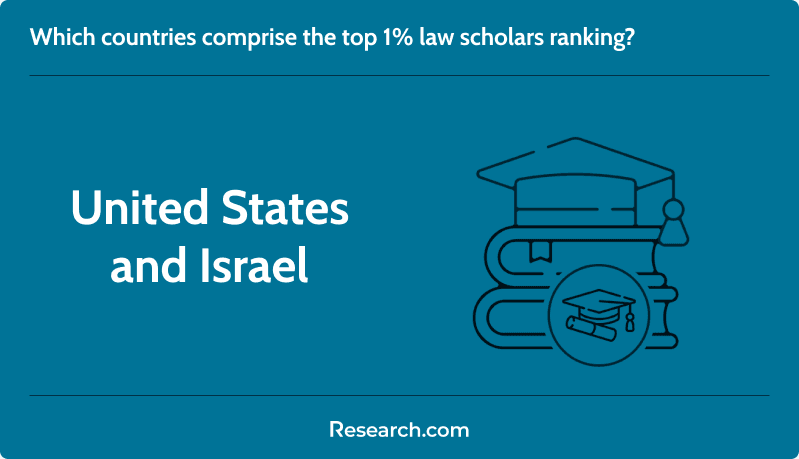
- Among scholars in the top 1%, 9 out of 10 are based at institutions in the United States.
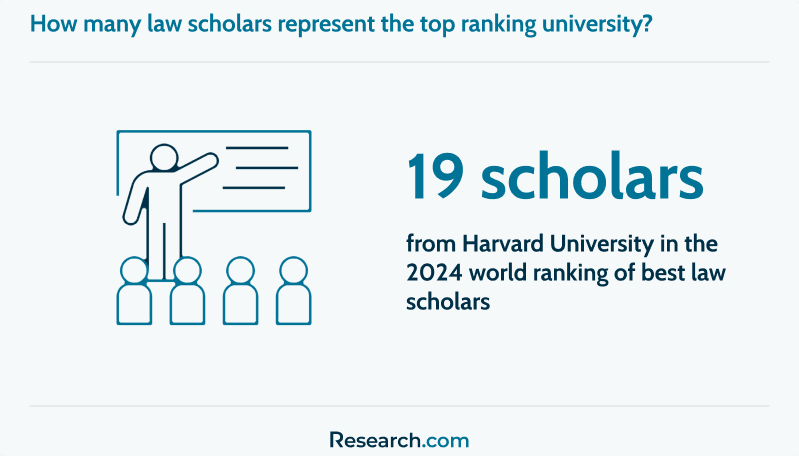
- Harvard University has the largest institutional presence in the 2024 report, with 19 affiliated scholars.
- Cass R. Sunstein of Harvard University, United States, ranks first overall with a D-index of 131.
- Of the top 10 institutions represented in law, eight are in the United States, one is in the UK, and one is in Canada.
- The top 1% of scholars have an average D-index of 89.7, compared with an average of 34.74 across all scholars in the ranking.
Readers can review the complete 2024 list here:
Can accessible online master’s programs strengthen legal research preparation?
Online master’s programs can help emerging legal professionals develop research discipline, improve legal writing, and build familiarity with databases, case analysis, regulatory frameworks, and interdisciplinary methods. Their value depends heavily on program quality, faculty expertise, curriculum depth, student support, and alignment with the learner’s goals.
Readers looking for flexible graduate options can compare online master’s degree programs with accessible formats. Ease of completion should not be confused with academic quality, however. A strong program should still require meaningful reading, writing, research, and applied analysis.
Countries with the highest number of leading law scholars
The United States has the strongest representation in the law ranking, with 300 scholars affiliated with U.S. institutions.
The United Kingdom follows with 56 scholars. Canada is next with 15 scholars, then Australia with 11 scholars and the Netherlands with 8 scholars.
The remaining countries in the top 10 are Germany with 6 scholars, Italy with 5 scholars, Switzerland with 3 scholars, Israel with 2 scholars, and Denmark with 2 scholars.
The country listed for each scholar is based on the scholar’s affiliated research institution according to MAG. It does not necessarily indicate the scholar’s nationality.
Institutions with the highest number of leading law scholars
Harvard University has the largest number of affiliated scholars in the 2024 report, with 19 scholars included in the ranking. Its position reflects both the institution’s visibility in legal scholarship and its continued presence among highly cited law researchers.
New York University ranks second with 17 scholars, while Yale University ranks third with 16 scholars.
Arizona State University is fourth with 13 scholars. Columbia University follows with 12 scholars. The University of California, Berkeley, and the University of Oxford each have 11 scholars.
Stanford University, the University of Toronto, and the University of Chicago are also among the top 10 institutions represented in the ranking.
| Institutional insight | What it suggests | How to use it |
| Large scholar count | The institution has multiple researchers with measurable publication and citation impact in law. | Useful when identifying research clusters, potential mentors, or institutional strengths. |
| Top 10 representation | The institution has broad visibility within the ranking. | Helpful for comparing research ecosystems, but not a substitute for program-level evaluation. |
| Individual scholar ranking | A specific researcher has a strong bibliometric profile. | Best used alongside the scholar’s publications, current projects, and field specialization. |
How online universities can support legal research collaboration
Legal researchers often rely on professional networks to develop ideas, test arguments, exchange drafts, and prepare work for publication. Traditionally, these connections have grown through law school departments, conferences, workshops, visiting appointments, and informal faculty collaboration.
Digital learning and research environments can extend those networks across institutions and borders. As shown by examples of international legal research collaboration, online tools can make it easier for scholars to meet, share materials, coordinate discussions, and work on joint projects without relying only on physical proximity.
Online universities and digitally enabled programs may also provide access to legal databases, shared workspaces, research management tools, and cloud-based drafting systems. These resources can make collaboration more efficient, especially for coauthors working across time zones.
Are accelerated online doctorates changing legal scholarship?
Accelerated online doctoral programs may appeal to working professionals who want advanced research training but need a more flexible structure. In legal and law-adjacent fields, these programs can support research planning, literature review development, methodology training, and interdisciplinary inquiry.
Students should evaluate these options carefully. A shorter format is only useful if the program still provides rigorous supervision, credible faculty expertise, strong research expectations, and enough time to complete high-quality scholarly work. Readers exploring advanced options can compare online doctoral programs for working professionals while paying close attention to accreditation, dissertation or capstone requirements, and faculty alignment.
D-index leaders, averages, and regional distribution
In North America, Cass R. Sunstein of Harvard University, United States, ranks first. He is also the top scholar in the global ranking, with a D-index of 131.
In the Middle East, David Weisburd of the Hebrew University of Jerusalem, Israel, leads the region. He ranks sixth globally with a D-index of 81.
In Oceania, John Braithwaite of the Australian National University, Australia, is the leading scholar. He ranks 13th in the global list with a D-index of 72.
In Europe, Jonathan Jackson of the London School of Economics and Political Science, United Kingdom, leads the region. His global rank is number 26, with a D-index of 59.
In Asia, Alec Stone Sweet of the University of Hong Kong, China, is the top-ranked law scholar in the region. He is listed at the 86th spot globally with a D-index of 39.
In Africa, Clifford Shearing of the University of Cape Town, South Africa, leads the region. He ranks 129th globally with a D-index of 34.
The average D-index for scholars in the top 1% is 89.7, while the average for all ranked scholars is 34.74.
The top 1% of scholars average 449.1 published articles, compared with 172.25 articles across all scholars in the ranking.
The average citation count for the top 1% is 51,844.5, compared with 9088.8 for all scholars.
| Region | Leading scholar | Institution | Global position and D-index |
| North America | Cass R. Sunstein | Harvard University, United States | Top scholar globally; D-index of 131 |
| Middle East | David Weisburd | Hebrew University of Jerusalem, Israel | Sixth globally; D-index of 81 |
| Oceania | John Braithwaite | Australian National University, Australia | 13th globally; D-index of 72 |
| Europe | Jonathan Jackson | London School of Economics and Political Science, United Kingdom | Number 26 globally; D-index of 59 |
| Asia | Alec Stone Sweet | University of Hong Kong, China | 86th globally; D-index of 39 |
| Africa | Clifford Shearing | University of Cape Town, South Africa | 129th globally; D-index of 34 |
You can review Research.com’s ranking methodology in more detail here.
How to use the law scholar ranking effectively
A ranking is most useful when it helps you ask better questions. Students can use it to identify possible mentors, research-active institutions, and legal specialties with strong scholarly communities. Universities can use it to understand institutional research visibility. Organizations can use it to locate experts for collaboration, advisory work, speaking engagements, or policy research.
- Start with the scholar’s field, not only the rank. A top researcher in criminal justice may not be the right expert for constitutional law, AI governance, or climate litigation.
- Read recent publications to confirm current research direction. Citation impact may reflect both current and earlier work.
- Check institutional context. A university with many ranked scholars may offer a strong research environment, but specific programs, faculty availability, and admissions fit still matter.
- Use multiple evidence sources. Combine rankings with publication records, faculty pages, research centers, course offerings, student outcomes, and professional reputation.
- For degree decisions, verify accreditation, cost, financial aid options, online learning support, and whether the program aligns with your career goal.
Common mistakes when interpreting scholar rankings
- Assuming rank equals overall quality. Rankings measure selected indicators. They do not fully measure teaching, mentorship, public service, or legal practice expertise.
- Ignoring specialization. Law is broad. A scholar’s citation profile is only useful if their expertise matches your question or research interest.
- Treating institutional affiliation as nationality. The country assignment reflects affiliated research institution data according to MAG, not the scholar’s personal nationality.
- Choosing a school based only on famous faculty. Students should confirm whether those faculty members teach, supervise students, accept advisees, or work in the student’s desired area.
- Overlooking accreditation and costs in online programs. Flexible legal education can be valuable, but students should confirm academic credibility, aid eligibility, total cost, and transfer policies before enrolling.
- Assuming career outcomes are guaranteed. Research training can strengthen opportunities, but salaries, job access, and advancement depend on location, experience, credentials, networking, and employer needs.
Questions to ask before using the ranking for a decision
| If your goal is... | Ask these questions |
| Finding a research collaborator | Does the scholar publish in my exact topic area? Are they currently active? Do they collaborate across institutions? |
| Choosing a graduate program | Are ranked scholars available to teach or supervise? Does the program offer research methods, writing support, and access to legal databases? |
| Evaluating an institution | Is the institution strong across multiple legal fields, or concentrated in one specialty? How does it support research centers and student scholarship? |
| Hiring an expert advisor | Does the scholar’s work align with the legal, policy, or regulatory problem at hand? Have they worked with public or private organizations before? |
| Comparing online legal education | Is the school accredited? What is the total cost? Does the curriculum match academic, compliance, policy, or research goals? |
About Research.com
All research was coordinated by Imed Bouchrika, Ph.D., a computer scientist with extensive experience collaborating on international research projects with academic partners. His role was to help ensure that the data used for the ranking remained unbiased, accurate, and up-to-date.
Research.com is a research and education portal focused on scientific rankings, academic resources, college guidance, and career information. Its mission is to help professors, research fellows, students, and professionals identify leading experts, compare educational opportunities, and make better-informed academic and career decisions.
Key insights
- The 2024 law scholar ranking is strongest as a research discovery tool, not as a complete judgment of academic quality.
- The United States dominates the list, with 300 affiliated scholars, and 9 out of 10 scholars in the top 1% are affiliated with U.S. institutions.
- Harvard University has the highest institutional count, with 19 scholars, and Cass R. Sunstein ranks first overall with a D-index of 131.
- D-index results are useful for comparing measurable research impact, but they do not fully capture mentorship, teaching, public policy influence, or legal practice contributions.
- Students and professionals should use the ranking alongside program accreditation, faculty availability, research fit, cost, online learning quality, and long-term career goals.


