
World Online Ranking of Best Environmental Scientists – 2024 Report

Co-Founder and Chief Data Scientist
Research.com published its third annual ranking of leading environmental science scientists on May 9, 2024. The report is designed for researchers, students, universities, funding organizations, employers, and policy stakeholders who need a clearer view of the scholars shaping environmental science through highly cited, discipline-focused work.
This guide explains what the 2024 ranking measures, who appears at the top, which countries and institutions have the strongest representation, and how readers can use the list responsibly. It also highlights recent environmental science research directions, explains how online and flexible education can support research careers, and summarizes the main takeaways from the ranking.
Quick answer: who leads the 2024 environmental science scientist ranking?
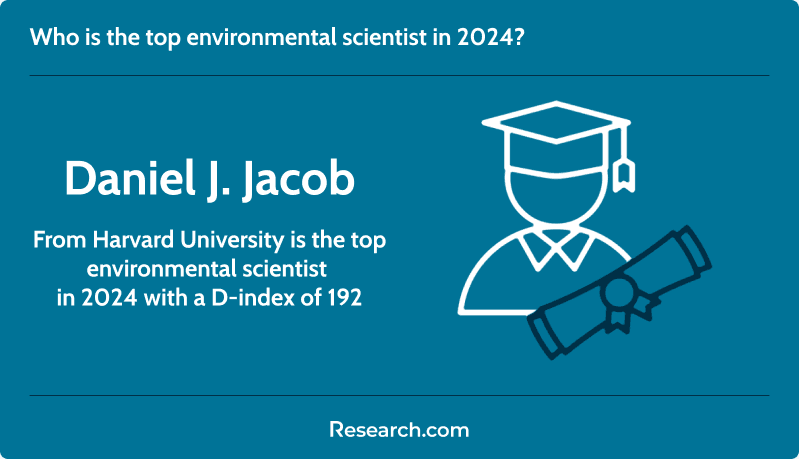
The top-ranked environmental science scientist in the 2024 Research.com report is Daniel J. Jacob of Harvard University, United States, with a D-index of 192. The United States has the largest number of ranked scholars, with 472 scientists affiliated with U.S. institutions. The National Center for Atmospheric Research remains the institution with the highest number of leading environmental scientists in the report.
The full ranking is available here:
Best Environmental Scientists Ranking
How Research.com compiled the 2024 environmental science ranking
For the 2024 edition, the Research.com team reviewed nearly 8800 scientist profiles using OpenAlex, CrossRef, and other bibliometric sources. The ranking considered multiple indicators, including the share of each scholar’s research output within environmental science and the scientist’s awards and achievements.
To be included, scholars needed a D-index of 30 or higher in environmental science and most of their publications had to fall within the discipline. This approach is intended to identify researchers whose influence is concentrated in environmental science rather than spread mainly across unrelated fields.
| Ranking element | What it means for readers |
| D-index threshold | Scientists were included if they had a D-index of 30 or more in environmental science. |
| Discipline fit | Most publications had to be in environmental science, helping keep the ranking focused on the field. |
| Data sources | The team evaluated nearly 8800 scientist profiles from OpenAlex, CrossRef, and other bibliometric sources. |
| Affiliation-based country assignment | Country data reflects the scientist’s affiliated research institution according to MAG, not necessarily nationality. |
Why the environmental science ranking matters in 2024
Environmental science sits at the center of urgent questions about climate change, ecosystem resilience, air and water quality, biodiversity, agricultural sustainability, and environmental policy. Rankings cannot capture every form of scientific contribution, but they can help readers identify researchers, laboratories, universities, and countries with strong publication impact in the field.
For students, the ranking can point to influential scholars and research institutions. For universities, it provides a benchmark for visibility and research concentration. For companies, NGOs, and public agencies, it can help identify experts for collaboration, consulting, advisory work, or interdisciplinary research partnerships.
Latest discoveries shaping environmental science research
Recent environmental science research shows both the scale of current environmental risks and the speed at which research tools are improving. One active area focuses on the resilience of vegetation during heatwaves. Understanding how plants respond to extreme temperatures can support better ecosystem protection strategies and help researchers evaluate how heat waves affect landscapes over time.
Researchers are also improving the technical methods used to study climate systems. A new algorithm called sequence acceleration is being applied to climate simulations. By reducing the time required for simulations to reach a stable state, the method can help scientists run models more efficiently and produce more timely climate projections.
Key findings from the 3rd edition of the best environmental science scientists ranking
- Scientists affiliated with U.S. universities and institutions make up the largest group in the ranking, with 472 scholars. Four more U.S.-affiliated scientists entered the top 1000 in 2024.
- The other countries in the top 5 are the United Kingdom with 89 scientists, Germany with 65, China with 65, and Australia with 37.
- The top 5 scientists for 2024 are affiliated with institutions in the U.S., Spain, Finland, and The Netherlands.
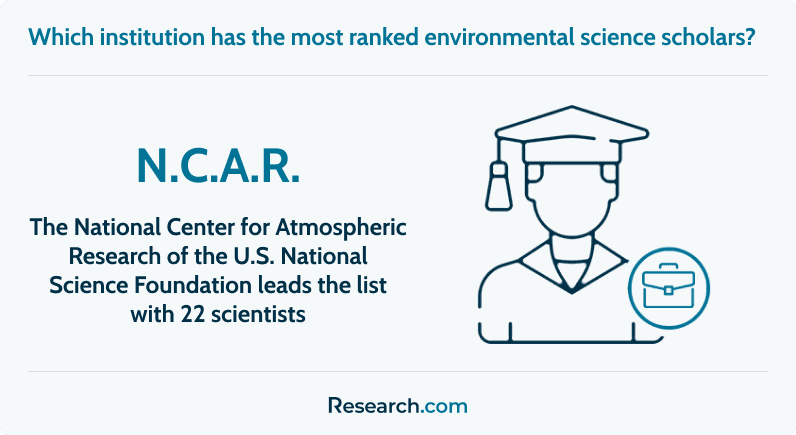
- The National Center for Atmospheric Research continues to rank first among institutions with the highest number of leading environmental scientists.
- Fourteen of the top 20 leading institutions are American universities or institutions. Other represented institutions are located in the U.K., China, France, and Switzerland.
- Daniel J. Jacob of Harvard University, United States, ranks first overall in environmental science with a D-index of 192.
- The average D-index for the top 1% of scientists is 163.1, compared with 87.16 for all scientists included in the ranking.
The complete 2024 ranking can be reviewed here:
Best Environmental Scientists Ranking
How to use this ranking without misreading it
A scientist ranking is most useful when it is treated as one evidence point, not as the only measure of research quality. Bibliometric indicators can show publication influence and field concentration, but they do not fully capture teaching quality, mentorship, public policy influence, fieldwork leadership, community impact, or the importance of newer researchers whose citation records are still developing.
| If you are... | Use the ranking to... | Also check... |
| A prospective graduate student | Identify active researchers, labs, and institutions with strong visibility in environmental science. | Advisor availability, funding, lab culture, publication opportunities, and program requirements. |
| A university or research office | Benchmark institutional research presence in environmental science. | Grant activity, interdisciplinary centers, faculty hiring priorities, and research infrastructure. |
| An employer or NGO | Find experts for collaboration, advisory roles, or applied environmental projects. | Project fit, regional expertise, prior partnerships, and applied research experience. |
| A policymaker or agency leader | Locate scholars with deep expertise in climate, ecosystems, water, air, or sustainability research. | Policy translation experience, stakeholder engagement, and evidence review methods. |
Countries with the highest number of leading environmental science scientists
The United States has the largest representation in the 2024 report, with 472 scientists affiliated with U.S. institutions. That total increased from 468 in the previous year.
The United Kingdom ranks second, with 89 scientists affiliated with U.K. institutions. This is three fewer than last year.
Germany remains in third place, with 65 scientists in 2024 compared with 70 in 2023.
China is also listed among the top countries, with 65 scientists. Australia has 37 scientists and is included in the top 5 summary for the 2024 report.
The source data also notes Switzerland with 37 scientists, followed by Canada with 35, France with 33, The Netherlands with 25, and Spain with 21.
The country linked to each scientist is based on the scholar’s affiliated research institution according to MAG. It should not be interpreted as the scientist’s nationality.
| Country or region | Number of ranked scientists reported | Reader note |
| United States | 472 | Largest national representation in the 2024 report. |
| United Kingdom | 89 | Second-highest number of affiliated scientists. |
| Germany | 65 | Maintains third place in the report narrative. |
| China | 65 | Listed among the top 5 countries in the report summary. |
| Australia | 37 | Included in the top 5 summary with 37 scientists. |
| Switzerland | 37 | Also reported with 37 scientists in the country breakdown. |
| Canada | 35 | Listed among the next leading countries. |
| France | 33 | Listed among the next leading countries. |
| The Netherlands | 25 | Listed among the next leading countries. |
| Spain | 21 | Listed among the next leading countries. |
Institutions with the highest number of leading scientists
The National Center for Atmospheric Research again holds the top institutional position in the 2024 report, with 22 affiliated scientists. Its total declined from 25 the previous year.
Goddard Space Flight Center moved into the second position with 20 scientists. The Chinese Academy of Sciences rose to third with 18 scientists, while the National Oceanic and Atmospheric Administration, which held the 2nd spot in 2023, is now fourth with 18 scientists.
Among the top 20 universities and institutions, fourteen are based in the U.S. Other represented institutions include the Chinese Academy of Sciences in China, ETH Zurich in Switzerland, the Spanish National Research Council in Spain, Centre national de la recherche scientifique, CNRS in France, Max Planck Society in Germany, and the University of Exeter in the U.K.
| Institution | 2024 report position or role | Number of affiliated scientists reported |
| National Center for Atmospheric Research | Top institution in the 2024 report | 22 |
| Goddard Space Flight Center | Second highest rank | 20 |
| Chinese Academy of Sciences | Third spot | 18 |
| National Oceanic and Atmospheric Administration | Fourth spot | 18 |
D-index leaders, regional standouts, averages, and distribution
In North America, Daniel J. Jacob of Harvard University, United States, leads the 2024 ranking. His D-index is 192.
In Europe, Damià Barceló of the Institute of Environmental Assessment and Water Research, Spain, is the leading scientist. He ranks third overall and has a D-index of 167.
In Asia, Yong Sik Ok of Korea University, South Korea, leads the region and ranks 20th in the overall list.
In Oceania, Jurg Keller of the University of Queensland, Australia, is the highest-ranked scientist in the region. He ranks 82nd overall and has a D-index of 114.
In South America, Professor Paulo Artaxo of Universidade de São Paulo, Brazil, remains the regional leader, with a world ranking of 57 and a D-index of 119.
In Africa, Professor Philip K. Thornton, affiliated with Climate Change, Agriculture and Food Security in Kenya, is the top-ranked scientist, with a world ranking of 303.
| Metric | Top 1% of scientists | All ranked scientists |
| Average D-index | 163.1 | 87.16 |
| Average number of published articles | 1035.2 | 377.06 |
| Average number of citations | 109,783.1 | 33,822.0 |
Current trends affecting environmental science research careers
Environmental science careers are becoming more data-intensive, more interdisciplinary, and more connected to policy and applied decision-making. Researchers increasingly work with climate models, remote sensing data, environmental monitoring systems, geospatial tools, and large datasets. At the same time, many environmental problems require collaboration across ecology, atmospheric science, hydrology, public health, agriculture, engineering, economics, and public policy.
Machine learning, climate modeling, big data analytics, and real-time environmental monitoring are especially important for scientists who want to work on complex systems. These tools do not replace core scientific training, but they can strengthen a researcher’s ability to analyze environmental change, compare scenarios, and communicate evidence to decision-makers.
Education pathways for environmental science research careers
There is no single route into environmental science research. Many research-focused roles require graduate education, especially for scientists who want to design studies, lead laboratories, publish independently, or compete for research funding. However, technical, field-based, and data-focused roles may also be accessible through shorter credentials, associate programs, bachelor’s degrees, or vocational training, depending on the employer and responsibilities.
| Pathway | When it may make sense | Important caution |
| Short-term credential or certificate | Useful for adding a specific skill such as GIS, data analysis, environmental sampling, or regulatory knowledge. | It may not be enough for independent research scientist roles. |
| Associate degree or technical program | Can support entry into technician, field support, lab support, or monitoring roles. | Students should confirm transfer options if they plan to continue to a bachelor’s degree. |
| Bachelor’s degree | Common preparation for environmental analyst, technician, consulting, field, or graduate school pathways. | Coursework, field experience, internships, and quantitative skills can strongly affect outcomes. |
| Master’s degree | Can help professionals specialize, move into applied research, or qualify for more advanced technical roles. | Program quality, faculty expertise, and research opportunities matter more than speed alone. |
| Doctorate | Often the strongest fit for academic research, principal investigator roles, and independent scholarly work. | Applicants should evaluate funding, advisor fit, publication expectations, and career placement carefully. |
Can short-term credentials lead to strong environmental science careers?
Short-term credentials can help environmental professionals build targeted skills quickly, especially when the training is connected to real workplace tasks. Examples include field methods, data management, environmental compliance, GIS, instrumentation, and monitoring technologies. These programs may be useful for career changers, working professionals, or students who want to test an area before committing to a longer degree.
However, short-term credentials should not be treated as automatic substitutes for advanced scientific training. Research scientist roles usually require deeper preparation in study design, statistics, discipline-specific methods, scientific writing, and peer-reviewed publication. Readers comparing efficient education options can review related pathways such as degree programs associated with $100k salary jobs, while keeping in mind that salary outcomes vary by role, employer, location, and experience.
How affordable online education can support environmental science researchers
Affordable online education can help students and working professionals update their skills without leaving a job, relocating, or pausing research work. Online courses and degree programs may be especially useful for learning data analysis, environmental policy, sustainability management, programming, GIS, or research methods.
Cost still matters. Students should compare total program price, fees, transfer credit rules, financial aid eligibility, and whether the credential is recognized by employers or graduate programs. Readers looking for lower-cost options can use Research.com’s guide to affordable online colleges as a starting point.
Strengthening environmental research through online universities
Online universities and digital learning platforms can expand access to environmental science education and collaboration. They reduce geographic barriers, making it easier for students and researchers in different regions to share ideas, participate in discussions, and connect across institutions. This kind of collaboration can support the cross-pollination of ideas and expertise that environmental science often requires.
Digital platforms can also improve access to shared datasets, virtual seminars, research repositories, and collaborative tools. When researchers can exchange data and methods more efficiently, they can compare findings across ecosystems and regions. The strongest online research environments combine flexibility with rigorous methods, faculty engagement, and clear expectations for research quality.
What role do online doctorate programs play in environmental research?
Online doctorate programs can support experienced professionals who need advanced research training but cannot relocate or attend a traditional campus-based program full time. In environmental science and related fields, doctoral study can build expertise in research design, advanced analysis, interdisciplinary problem-solving, and scholarly communication.
Prospective students should be careful when evaluating online doctorates. They should verify accreditation, faculty research fit, dissertation support, residency or fieldwork requirements, funding options, and whether the degree aligns with their career goals. Readers comparing flexible doctoral pathways can explore Research.com’s guide to online doctorate programs.
How vocational training supports practical environmental research work
Environmental science depends on skilled field and technical professionals, not only senior researchers. Vocational training can prepare workers for practical responsibilities such as sample collection, equipment handling, site monitoring, environmental testing support, and maintenance of monitoring systems.
This kind of training can be valuable for people who prefer hands-on work or want to enter the environmental workforce faster. It can also complement academic training by giving researchers stronger field awareness. Readers interested in technical career routes can compare options in Research.com’s guide to high-paying jobs for trade school graduates.
Is short-term online education useful for advanced environmental research careers?
Short-term online education can be useful when it fills a clear skill gap. For example, a student or early-career professional may use a focused online program to strengthen quantitative skills, learn a software tool, prepare for fieldwork, or build a foundation before entering a longer degree program.
The key is alignment. A short program should connect directly to a career goal, transfer plan, employer requirement, or research need. Students considering a fast starting point can compare options such as an online associate degree, while confirming whether the program’s credits, curriculum, and accreditation support their next step.
Can accelerated online master’s programs help environmental research innovation?
Accelerated online master’s programs may help working professionals gain advanced knowledge faster than traditional part-time study, especially when the curriculum includes research methods, environmental data analysis, policy applications, and discipline-specific electives. These programs can be useful for professionals who already have foundational preparation and need a more advanced credential for applied research or leadership roles.
Speed should not be the only deciding factor. A strong master’s program should offer qualified faculty, relevant coursework, research or capstone opportunities, student support, and transparent outcomes. Readers comparing faster graduate options can review accelerated online master’s programs.
How to choose an environmental science program or research pathway
Students and professionals should start with the role they want, then work backward to the education, experience, and research preparation required. A person aiming for a faculty research career will need a different path than someone preparing for environmental consulting, field monitoring, public policy, sustainability management, or laboratory support.
- Define the target role. Decide whether you want to work in research, consulting, government, nonprofit work, field operations, data analysis, or policy.
- Check the required credential. Review job postings and graduate admissions requirements to see whether a certificate, associate degree, bachelor’s degree, master’s degree, or doctorate is expected.
- Verify accreditation. Make sure the institution is properly accredited before enrolling, especially if you plan to transfer credits or pursue graduate study.
- Compare faculty expertise. For research-focused programs, look for faculty whose work matches your interests in climate, water, air quality, ecology, toxicology, sustainability, or environmental data science.
- Evaluate practical experience. Prioritize programs with fieldwork, lab work, internships, capstones, thesis options, or research assistantships when relevant.
- Review total cost. Compare tuition, fees, materials, travel or residency requirements, lost income, and financial aid options.
- Ask about outcomes. Request information about graduate school placement, employer connections, research publications, internships, and alumni roles.
Common mistakes to avoid when using rankings or choosing a program
| Mistake | Why it can hurt your decision | Better approach |
| Choosing a school only because a ranked scientist works there | A top researcher may not be accepting students or may not work in your exact area. | Confirm advisor availability, lab fit, funding, and mentoring expectations. |
| Assuming rankings measure teaching quality | Bibliometric rankings focus on research indicators, not classroom experience or advising quality. | Review program structure, student support, graduation requirements, and student outcomes. |
| Ignoring accreditation | Unaccredited programs may limit transfer, financial aid, employment, or graduate school options. | Verify institutional accreditation before applying or enrolling. |
| Focusing only on tuition | Fees, travel, equipment, field courses, and lost income can change the real cost. | Calculate the full cost of attendance and compare financial aid options. |
| Assuming fast programs are automatically better | Shorter timelines can reduce flexibility, research depth, or time for internships. | Choose speed only when the curriculum, support, and outcomes still match your goals. |
| Overlooking quantitative and technical skills | Environmental science careers increasingly require data, modeling, monitoring, and analytical tools. | Prioritize programs that build practical and technical competence. |
Questions to ask before contacting a scientist, applying to a program, or pursuing a collaboration
- Does the researcher’s recent work match the environmental topic I want to study or support?
- Is the scientist currently affiliated with the institution listed in the ranking?
- For graduate study, is the faculty member accepting new students?
- Does the program offer research funding, assistantships, fieldwork, or lab access?
- How does the program support students who study online or part time?
- Are credits transferable if I start with a shorter credential?
- What research tools, datasets, equipment, or software will I learn to use?
- What career outcomes do graduates typically pursue?
- How does the total cost compare with the likely professional benefit?
You can learn more about the methodology used to create this report here.
About Research.com
All research was coordinated by Imed Bouchrika, Ph.D., a computer scientist with a well-established record of collaboration on international research projects with academic partners. His role was to help ensure that the data remained unbiased, accurate, and current.
Research.com is the number one research portal for science and educational rankings. Its mission is to help professors, research fellows, and students advance their research and identify top experts across scientific fields. Research.com also serves as an educational platform for students comparing colleges, academic opportunities, and career pathways.
Key Insights
- The 2024 Research.com environmental science ranking reviewed nearly 8800 scientist profiles and included scholars with a D-index of 30 or higher whose work is primarily in environmental science.
- Daniel J. Jacob of Harvard University ranks first overall with a D-index of 192.
- The United States has the strongest representation in the report, with 472 ranked scientists affiliated with U.S. institutions.
- The National Center for Atmospheric Research remains the leading institution in the 2024 report, with 22 affiliated scientists.
- Rankings are useful for identifying influential researchers and institutions, but students and collaborators should also evaluate advisor fit, funding, research infrastructure, accreditation, and career goals.
- Environmental science research careers increasingly reward data skills, interdisciplinary collaboration, climate modeling knowledge, monitoring technologies, and practical field or lab experience.
- Online, accelerated, affordable, and vocational education options can support environmental science careers when they are aligned with a clear role, properly accredited, and connected to real research or technical skills.


