
World Online Ranking of Best Medicine Scientists – 2024 Report

Co-Founder and Chief Data Scientist
Research.com’s 3rd edition ranking of the best scientists in medicine, released on May 22, 2024, highlights researchers whose publication records and field-specific impact place them among the most influential contributors to medical science. For students, early-career researchers, universities, research institutions, healthcare leaders, and industry teams, the ranking offers a structured way to understand where major medical research influence is concentrated and which scholars are shaping the direction of the field.
This guide explains what the ranking measures, which countries and institutions are most represented, how to interpret D-index results, and how readers can use the list responsibly when evaluating research leadership, graduate study options, collaboration opportunities, and long-term medical research careers.
Quick answer: What does the 2024 medicine scientists ranking show?
The 2024 ranking shows a strong concentration of leading medicine scientists in the United States, which accounts for 587 ranked scholars, or 58.7% of the list. Harvard University has the highest institutional representation with 61 affiliated scientists, and Walter C. Willett of Harvard University ranks first overall with a D-index of 400. The ranking is based on a review of nearly 25,000 scientist profiles from OpenAlex, CrossRef, and other bibliometric databases, with inclusion determined by discipline-specific research impact, publication relevance to medicine, and recognized scholarly achievements.
| Ranking area | 2024 result | Why it matters |
| Leading country | United States, with 587 scientists | Shows where the largest share of highly cited medicine researchers are institutionally affiliated |
| Top institution | Harvard University, with 61 scientists | Indicates a major concentration of high-impact medical research output |
| No. 1 scientist | Walter C. Willett, Harvard University | Identifies the highest-ranked scholar by D-index in this edition |
| D-index threshold | 70 for scholars whose publications were mostly in medicine | Sets the minimum discipline-specific impact level used for ranking consideration |
| Profiles reviewed | Nearly 25,000 scientist profiles | Reflects the scale of the bibliometric screening process |
How the 2024 medicine scientists ranking was built
For the 2024 edition, Research.com examined nearly 25,000 scientist profiles using OpenAlex, CrossRef, and other bibliometric databases. The review considered several indicators before a scholar was approved for inclusion in the ranking.
The D-index threshold for consideration was set at 70 when most of a scholar’s publications were in medicine. The final inclusion criteria considered discipline h-index, the share of a researcher’s work that falls within medicine, and the scientist’s awards and professional achievements.
The result is not a general popularity list. It is a discipline-focused ranking intended to reflect sustained scholarly influence in medicine, based primarily on research output and citation impact within the field.
Why medicine research rankings matter in 2026
Medical research is moving quickly, and decision-makers need reliable ways to identify credible expertise. Rankings like this can help universities benchmark research strength, students identify potential mentors, funders understand institutional research concentration, and companies locate academic partners for translational research.
At the same time, rankings should be used carefully. A high position can signal exceptional research influence, but it does not automatically measure teaching quality, clinical skill, mentorship style, diversity of research topics, patient outcomes, or program fit. Readers should use the ranking as one evidence point alongside accreditation, faculty profiles, publications, lab resources, funding history, and career outcomes.
Medical research trends shaping this ranking’s context
Several areas of medicine are drawing significant attention because of their potential impact on diagnosis, treatment, and patient care. One major example is the use of mRNA therapies beyond traditional vaccine applications. In cancer research, mRNA-based approaches are being studied as a way to prompt cells to produce proteins that may help the immune system identify and attack cancer cells.
Artificial intelligence is also becoming more important in medical imaging and cancer detection. AI tools can support the analysis of complex scans and large datasets, which may help clinicians and researchers identify patterns that are difficult to detect manually. These tools do not replace medical judgment, but they are increasingly part of the research conversation in diagnostics, precision medicine, and clinical workflow improvement.
Another important development is the FDA approval of a drug for Alzheimer's disease. Although it is not a cure, the medication is designed to slow disease progression, which makes it significant for patients, families, clinicians, and researchers studying neurodegenerative conditions.
Gene editing is another major area to watch. Recent trials involving sickle cell disease patients point to the potential of editing disease-related genes as a possible one-time therapeutic approach. Together, these developments show why high-impact medical researchers are central to the future of healthcare innovation.
Main findings from the 3rd edition of the best medicine scientists ranking
- The United States has the largest presence in the 2024 ranking, with 587 scientists, equal to 58.7% of the list.
- The next most represented countries are the United Kingdom with 104 scientists or 10.4%, Germany with 47 scientists or 4.7%, the Netherlands with 36 scientists or 3.6%, Canada with 34 scientists or 3.4%, and Australia with 27 scientists or 2.7%.
- Nine out of 10 scientists in the top 1% are affiliated with institutions in the United States.
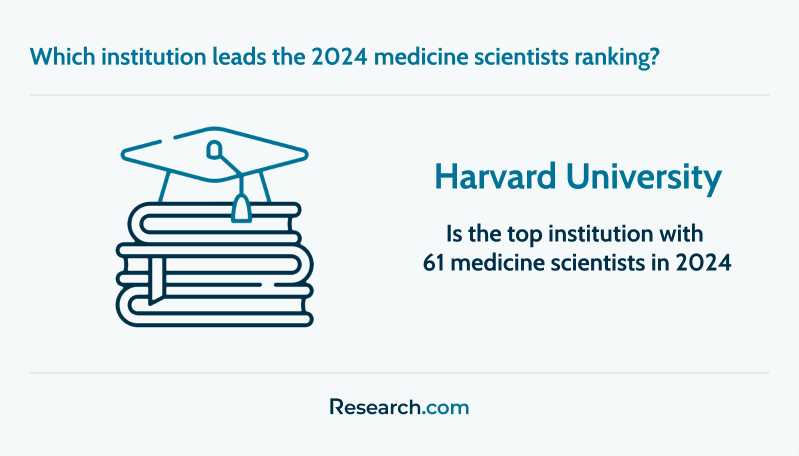
- Harvard University ranks first by institutional representation, with 61 affiliated scientists in the 2024 list.
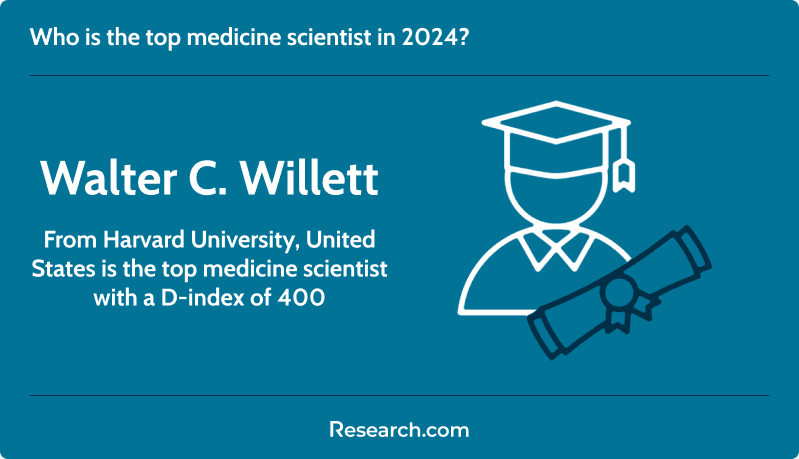
- Walter C. Willett of Harvard University is the highest-ranked medicine scientist, with a D-index of 400.
- American universities account for 90% of the 10 leading institutions, while one institution is based in the United Kingdom.
- The top 1% of scientists have an average D-index of 316.7, compared with an average of 171.44 across all ranked scientists.
The complete 2024 list is available here:
View the best medicine scientists ranking
Countries with the most leading medicine scientists
The United States is the clear leader in the 2024 ranking. It has 587 listed scientists, representing 58.7% of all ranked scholars. The United States also has nine out of 10 scientists in the top 1%.
The United Kingdom holds second place with 104 scientists, while Germany ranks third with 47 scientists. The Netherlands follows with 36 scientists, Canada has 34, Australia has 27, and France has 21.
The country distribution also changed slightly from the prior edition. The United States decreased from 597 ranked scientists in 2023 to 587 in 2024. The United Kingdom also declined, moving from 108 ranked scientists to 104.
Within the top 10 countries, Italy and France moved to the 7th and 8th positions. Sweden and Japan stayed in 9th and 10th place, with each gaining one additional scientist compared with the previous year.
The country assigned to each scientist reflects the scholar’s affiliated research institution, not the scientist’s nationality.
| Country | Ranked scientists in 2024 | Share or ranking note |
| United States | 587 | 58.7% of the ranking |
| United Kingdom | 104 | 10.4% of the ranking |
| Germany | 47 | 4.7% of the ranking |
| Netherlands | 36 | 3.6% of the ranking |
| Canada | 34 | 3.4% of the ranking |
| Australia | 27 | 2.7% of the ranking |
| France | 21 | Placed 8th among the top 10 countries |
How undergraduate preparation supports future medical research careers
A strong undergraduate foundation can make a meaningful difference for students who plan to enter medical research. Coursework in biology, chemistry, statistics, data science, public health, psychology, or biomedical engineering can help students build the scientific literacy and analytical skills needed for laboratory work, clinical research, epidemiology, and graduate-level study.
Students should not choose a bachelor’s program only because it appears fast or convenient. Instead, they should compare research opportunities, faculty mentorship, laboratory access, transfer policies, cost, and preparation for graduate or professional school. For students seeking a broad starting point, Research.com’s guide to the easiest bachelor degree options can be useful, but aspiring researchers should prioritize academic rigor and research exposure over ease alone.
Institutions with the highest number of leading medicine scientists
Harvard University leads the 2024 institutional ranking with 61 affiliated scientists. The U.S. National Institutes of Health ranks second with 34 scientists, which is four more than its 2023 count. Mayo Clinic holds third place with 25 scholars.
Among the 10 institutions with the highest representation, 90% are based in the United States. The University of Oxford is the only institution from the United Kingdom in that group.
The Icahn School of Medicine at Mount Sinai entered the top 10 in 2024 and placed fifth with 19 scientists. The University of Texas MD Anderson Cancer Center and the University of Pennsylvania also appear among the top 10 institutions in this edition.
Among institutions affiliated with the top 1% of leading scientists, only one out of 10 is outside the United States: McMaster University in Canada.
Harvard University had 62 ranked scientists in 2023 and 61 in 2024. The report also notes that the National Institutes of Health rose from 33 ranked scientists in 2023 to 37 in 2024.
| Institution | 2024 ranking detail | Interpretation |
| Harvard University | 61 affiliated scientists | Highest institutional representation in the ranking |
| U.S. National Institutes of Health | 34 scientists | Second-highest institutional representation |
| Mayo Clinic | 25 scholars | Third-highest institutional representation |
| Icahn School of Medicine at Mount Sinai | 19 scientists | Entered the top 10 in 2024 and placed fifth |
| University of Oxford | Only United Kingdom institution among the top 10 | Shows the U.K. presence among the leading institutions |
| McMaster University | Only non-U.S. institution affiliated with the top 1% | Represents Canada among institutions linked to the highest-ranked scientists |
How accreditation and financial aid affect online medical education choices
Students considering online or hybrid medical education should verify accreditation before enrolling. Accreditation helps confirm that a school or program meets recognized academic standards, which is especially important for health-related fields where licensure, clinical placement, graduate admission, and employer recognition may depend on program quality.
Cost also matters. A program with lower tuition is not always the least expensive option if it offers limited financial aid, weak transfer credit policies, or poor student support. Students comparing online programs should review total cost, fees, eligibility for federal aid, clinical or practicum requirements, and whether the program supports their intended career path. Research.com’s guide to cheap online schools that accept financial aid can help students begin that comparison.
Can accelerated degree programs help prepare students for medicine-related careers?
Accelerated programs can be useful for learners who already have a clear goal, transferable credits, or prior professional experience. In healthcare and medical research, however, speed should not come at the expense of scientific depth, supervised practice, or preparation for graduate study.
Shorter programs may help students move faster into support roles, applied health fields, or additional credentials, but students should check whether the curriculum includes the prerequisites required for medical school, graduate biomedical programs, clinical licensure, or research positions. A guide such as 1 year degrees that pay well can help identify condensed education options, but medical research careers often require longer academic timelines and advanced training.
How continuing education helps experienced professionals contribute to medical innovation
Experienced clinicians, administrators, pharmacists, nurses, researchers, and healthcare technology professionals can use continuing education to stay current with emerging tools, research methods, data analysis, regulatory expectations, and interdisciplinary collaboration. For senior professionals, flexible online learning can be especially useful when balancing work, mentoring, consulting, and research interests.
Not every online program is designed for the needs of established professionals. Senior learners should look for flexible scheduling, strong academic advising, relevant technology support, and coursework that connects to real healthcare or research problems. Research.com’s guide to an online degree program designed for seniors can help older learners compare options that may fit their schedules and goals.
How online universities and remote platforms support medical research collaboration
Medical research increasingly depends on teams that combine expertise from medicine, biology, engineering, computer science, public health, statistics, and ethics. A university with strong bioinformatics capacity, for example, may work with a hospital to examine large patient datasets and generate new insights into disease progression.
Online platforms can make this collaboration easier by allowing researchers to exchange data, meet across time zones, coordinate experiments, and share findings more quickly. They can also make participation more accessible for researchers at smaller institutions or in countries with fewer local research resources. The best collaborations still require clear data governance, ethical approval, secure systems, and strong project management.
Can affordable online doctorate programs strengthen medical research careers?
Affordable online doctorate programs may help some professionals gain advanced expertise without relocating or pausing their careers. This can be valuable for pharmacists, healthcare administrators, educators, clinical professionals, or applied researchers who need doctoral-level training connected to practice, policy, leadership, or specialized research.
Students should carefully verify whether an online doctorate matches their goals. A research-intensive academic career may require laboratory access, funded research assistantships, dissertation support, and publication opportunities that vary widely by program. For learners interested in pharmacy-related doctoral pathways, Research.com’s guide to an online pharmacy school can be a starting point for comparing affordability and structure.
How industry partnerships can accelerate medical breakthroughs
Collaboration between academic researchers and industry partners is a major force in medical innovation. Pharmaceutical companies, biotechnology firms, diagnostics companies, and medical technology providers can contribute funding, equipment, regulatory knowledge, commercialization expertise, and access to applied development pipelines.
These partnerships can help move promising discoveries from laboratory settings toward patient applications, but they also require transparency. Researchers and institutions must manage conflicts of interest, protect patient data, maintain scientific independence, and follow ethical standards. Students who want to work at the intersection of research and industry may benefit from advanced study in biomedical science, regulatory affairs, data science, public health, or healthcare management. A resource such as cheapest online masters can help prospective graduate students compare cost-conscious options.
Can medical research lead to high-paying careers?
Medical research can open doors to well-paid roles, especially for professionals with advanced training, strong quantitative skills, regulatory knowledge, clinical expertise, or experience translating discoveries into products, treatments, or policy. Career paths may include academia, biotechnology, pharmaceuticals, public health, government research, clinical trials, health data science, medical affairs, and research administration.
Pay varies widely by role, employer, location, degree level, funding environment, and experience. Students should avoid assuming that a research degree guarantees a specific salary. Instead, they should compare job postings, required credentials, local labor demand, and advancement pathways. Readers exploring compensation-focused paths can review Research.com’s guide to careers that pay 100k a year.
D-index results: regional leaders, averages, and publication patterns
Walter C. Willett of Harvard University ranks first in North America and first globally, with a D-index of 400.
Yusuke Nakamura of the Japanese Foundation For Cancer Research in Japan leads Asia, with a D-index of 205 and a world ranking of 96.
Nicholas J. Talley of the University of Newcastle Australia ranks first in Oceania, holds position 171 in the global ranking, and has a D-index of 193.
Douglas G. Altman of the University of Oxford in the United Kingdom is the top-ranked scientist in Europe and ranks 13 globally.
Dan J. Stein of the University of Cape Town in South Africa is the leading scientist in Africa, with a world ranking of 236.
Cesar G. Victora of Universidade Federal de Pelotas in Brazil is the highest-ranked scientist in South America, with a world ranking of 616.
The average D-index among the top 1% of scientists is 316.7. Across all scientists included in the ranking, the average D-index is 171.44.
The lowest D-index value among scholars included in the 2023 ranking is 145.
The top 1% of scientists have an average of 1860 published articles, while the average for all ranked scholars is 1088.78.
| Region | Top-ranked scientist named in the report | Institution and ranking detail |
| North America | Walter C. Willett | Harvard University; world ranking no. 1; D-index of 400 |
| Asia | Yusuke Nakamura | Japanese Foundation For Cancer Research; world ranking 96; D-index of 205 |
| Oceania | Nicholas J. Talley | University of Newcastle Australia; world ranking 171; D-index of 193 |
| Europe | Douglas G. Altman | University of Oxford; world ranking 13 |
| Africa | Dan J. Stein | University of Cape Town; world ranking 236 |
| South America | Cesar G. Victora | Universidade Federal de Pelotas; world ranking 616 |
How to use this ranking when making academic or career decisions
A medicine scientist ranking is most useful when it is treated as a research discovery tool, not as a single decision-making authority. It can help identify influential scholars, productive institutions, and countries with strong research concentration, but students and professionals should combine it with more specific evidence about programs, mentors, facilities, funding, and career fit.
| If your goal is to... | Use the ranking to... | Also check... |
| Find a potential graduate mentor | Identify scientists with strong field-specific influence | Current publications, lab openings, mentorship record, funding, and student outcomes |
| Compare research universities | See where leading medicine scientists are institutionally concentrated | Program accreditation, research facilities, degree requirements, assistantships, and tuition |
| Explore collaboration opportunities | Locate scholars and institutions active in your research area | Conflict-of-interest policies, data-sharing rules, institutional review requirements, and project fit |
| Plan a medical research career | Understand which fields and institutions have high-impact researchers | Required degrees, technical skills, publication expectations, and realistic job pathways |
Common mistakes to avoid when interpreting scientist rankings
- Assuming rank equals fit. A highly ranked scientist may not be the right mentor, collaborator, or program contact for your specific research interests.
- Looking only at institutional prestige. A famous university may not offer the best funding, supervision, laboratory access, or career support for every student.
- Ignoring methodology. Rankings based on bibliometric indicators should be interpreted differently from rankings based on teaching, admissions selectivity, or clinical outcomes.
- Confusing affiliation with nationality. In this ranking, country placement is based on the scientist’s affiliated institution, not personal nationality.
- Using rankings as salary predictors. Research influence does not guarantee a specific income, job title, or career outcome.
- Overlooking accreditation and licensure. Students pursuing medical, clinical, or health-related education should verify whether a program meets the requirements for their intended credential or jurisdiction.
- Relying on one data source. A strong decision usually requires reviewing faculty profiles, publications, program costs, student support, funding, and career placement information.
Questions to ask before choosing a medical research program or collaborator
- Does the faculty member’s current research match my specific interests?
- Are students or trainees regularly included in publications, conferences, grants, or lab projects?
- What funding, assistantships, fellowships, or tuition support are available?
- Is the program or institution properly accredited for my academic or career goal?
- Will the program provide access to laboratories, clinical data, research software, or field placements?
- How does the institution handle research ethics, patient data, intellectual property, and industry partnerships?
- What career outcomes do graduates pursue after completing the program?
- Does the program support interdisciplinary work in areas such as AI, genomics, epidemiology, or biotechnology?
Methodology and research coordination
You can review the ranking methodology to learn more about how Research.com creates its scientist rankings.
All research was coordinated by Imed Bouchrika, Ph.D., a computer scientist with an extensive record of collaboration on international academic research projects. His role was to help ensure that the data used in the ranking remained unbiased, accurate, and up-to-date.
Research.com is a research portal for science and educational rankings. Its mission is to help professors, research fellows, and students identify leading experts across scientific disciplines, advance their research, and explore colleges, academic opportunities, and career pathways.
Key Insights
- The 2024 medicine scientists ranking is led by the United States, which has 587 ranked scholars and represents 58.7% of the list.
- Harvard University has the strongest institutional presence, with 61 affiliated scientists, and Walter C. Willett ranks first overall with a D-index of 400.
- The ranking is based on discipline-specific impact, including D-index, medicine-related publication share, and recognized scholarly achievements.
- Readers should use the ranking as a research and comparison tool, not as a standalone measure of program quality, mentorship fit, clinical excellence, or career outcomes.
- Medical research is being reshaped by mRNA therapies, AI-supported diagnostics, Alzheimer’s disease therapies, gene editing, remote collaboration, and academic-industry partnerships.
- Students planning medical research careers should compare accreditation, cost, research access, faculty mentorship, funding, and long-term career requirements before choosing a program.


