
Interview With Nursing Experts: Answering Students' Questions About Nursing Trends

Co-Founder and Chief Data Scientist
Choosing nursing in 2026 means preparing for a career that is clinical, technical, people-centered, and increasingly data-driven. Nursing students are entering a healthcare system shaped by staffing pressure, electronic records, value-based care, telehealth, artificial intelligence tools, and a continued need for human judgment at the bedside. The challenge is not simply getting through nursing school; it is learning how to become the kind of nurse who can think clearly under pressure, communicate with compassion, use technology safely, and keep growing after graduation.
This guide is designed for nursing students, prospective nursing majors, career changers, military-affiliated learners, and working nurses considering certifications or advanced degrees. It explains the skills employers look for, the trends reshaping nursing practice, how clinical experience affects job readiness, what career paths are available, and how to evaluate education options without relying only on rankings or tuition price.
To strengthen this guide, the Research.com team interviewed two nursing experts: Dr. Anne Lynn Derouin, DNP, APRN, CPNP, PMHS, FAANP, of Duke University, and Dr. Lisa Grubb, DNP, MSN, BSN, RN, of Johns Hopkins University. Their insights are integrated throughout the article to help students connect classroom learning with real healthcare practice.
Quick Answer: What Should Nursing Students Focus on Most?
Nursing students should prioritize critical thinking, evidence-based practice, patient communication, clinical judgment, ethical decision-making, and comfort with healthcare technology. Employers need nurses who can interpret patient information, work well with interdisciplinary teams, document accurately in electronic health records, respond calmly in stressful situations, and provide compassionate care despite increasing technology use.
The strongest nursing career strategy is to build a solid RN foundation, seek high-quality clinical experiences, choose employers carefully, pursue certifications only when they match career goals, and consider advanced degrees when they clearly support a desired role such as nurse practitioner, educator, researcher, administrator, or nurse executive.
Experts We Interviewed
- Dr. Anne Lynn Derouin, DNP, APRN, CPNP, PMHS, FAANP: Clinical Professor, School of Nursing, Duke University
- Dr. Lisa Grubb, DNP, MSN, BSN, RN: Assistant Professor, School of Nursing, Johns Hopkins University
- Which skills matter most for nursing students entering today’s job market?
- What nursing industry trends should students understand?
- How is technology changing nursing practice?
- Why do clinical experiences, internships, and fellowships matter?
- How can nursing students move from school to professional practice?
- Which resources and learning habits help nursing students grow?
- What career paths are available for nursing majors?
- Can advanced nursing certifications support financial growth?
- What should students know before pursuing nursing certifications?
- When can accelerated programs help a nursing career?
- How can advanced nursing degrees affect career progression?
- How can military experience support a nursing career?
- How can an online PhD support nursing research and innovation?
- How can cross-disciplinary skills improve nursing career options?
Which skills matter most for nursing students entering today’s job market?
The most valuable nursing skills are not limited to technical procedures. Students need to connect science, patient assessment, communication, documentation, safety protocols, organizational priorities, and human compassion into real-time decisions. Nursing school introduces these areas separately, but professional practice requires nurses to use them together.
- Dr. Derouin’s insight: Nursing students should make critical thinking a central priority. She emphasized that students are often given large amounts of information in class and clinical settings, but the goal is not memorizing every detail in isolation. Nurses must learn how to synthesize information, recognize what matters for the patient in front of them, and make sound decisions under pressure. Employers often test this ability by asking new graduates to describe situations where they handled stress, adapted quickly, or thought through a difficult patient-care problem.
- Dr. Grubb’s insight: Students also need a strong understanding of research, evidence-based practice, and quality improvement. Dr. Grubb noted that these concepts affect healthcare from the boardroom to the bedside. Nurses who understand quality assurance, benchmarking, organizational goals, value-based purchasing, and resource allocation are better prepared to improve patient care and contribute to system-level performance.
Together, these perspectives show that successful nurses need both bedside judgment and systems thinking. A nurse must understand the patient’s immediate condition, the evidence supporting treatment decisions, and the healthcare organization’s quality and safety expectations.
| Skill Area | Why It Matters in Practice | How Students Can Build It |
| Critical thinking | Helps nurses prioritize care, recognize deterioration, and respond to complex patient needs. | Ask “why” during clinicals, review case studies, and practice explaining care decisions out loud. |
| Evidence-based practice | Connects current research and clinical guidelines to safer patient care. | Read nursing journals, compare interventions with clinical standards, and learn how research applies to bedside decisions. |
| Communication | Supports patient education, teamwork, handoffs, and conflict prevention. | Practice SBAR-style reporting, ask for feedback from preceptors, and observe strong nurse communicators. |
| Data and documentation | Accurate records affect patient safety, continuity of care, billing, quality measures, and legal protection. | Learn electronic health record workflows, document objectively, and understand how data are used in quality improvement. |
| Professional judgment | Helps nurses act ethically, avoid shortcuts, and protect patients even in busy settings. | Reflect after clinical shifts, seek mentors with strong standards, and learn facility policies before acting independently. |
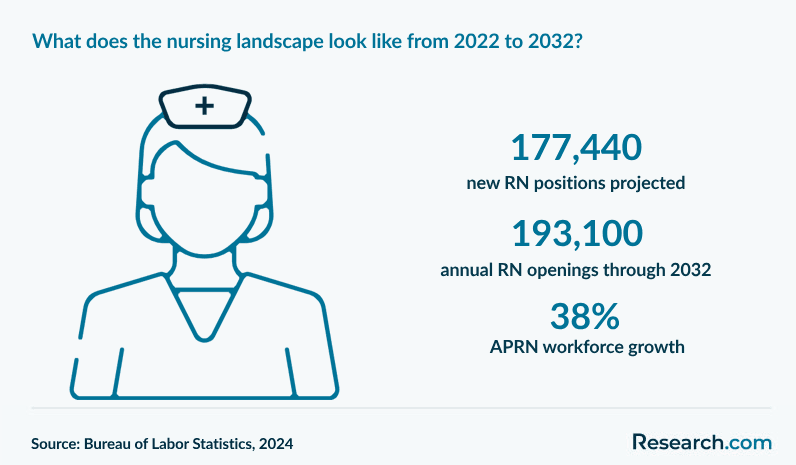
The labor market also explains why nursing preparation matters. The U.S. faces a growing shortage of registered nurses due to the aging population and limited nursing school capacity. According to Bureau of Labor Statistics employment projections, the RN workforce is expected to grow 6% from 2022 to 2032, reaching 3.3 million by 2032. The projections include 177,440 new RN positions over the decade and 193,100 RN openings estimated annually through 2032. The APRN workforce is projected to grow 38% from 2022 to 2032, with a need for 29,200 new APRNs annually through 2032.
Students who already have a bachelor’s degree in another field may want to compare traditional nursing pathways with the best online accelerated BSN programs, especially if they need a faster route into RN preparation.
What nursing industry trends should students understand?
Nursing students should pay attention to trends that affect patient care, reimbursement, staffing, technology, and health equity. These trends influence what employers value and what new nurses are expected to understand when they enter practice.
- Dr. Derouin’s insight: Nurses remain central to trust, connection, and advocacy in healthcare. She pointed to social determinants of health as a major area students must understand. Factors such as income, education, access to healthcare, transportation, housing, and health literacy can affect whether patients can follow treatment plans or access follow-up care. As healthcare uses more digital tools, she stressed that compassion, connection, and person-centered care remain essential.
- Dr. Grubb’s insight: Students should understand how payment models and performance measurement affect care delivery. She highlighted pay for improvement, value-based purchasing, the Quintuple Aim in Healthcare, Key Performance Indicators, and healthcare data. These frameworks shift attention from service volume alone toward quality, outcomes, costs, provider well-being, and health equity.
Key trends nursing students should be ready for
- Social determinants of health: Nurses increasingly assess barriers that affect treatment adherence, access, and outcomes.
- Value-based care: Healthcare organizations measure quality, safety, outcomes, patient experience, and cost efficiency.
- Health equity: The Quintuple Aim adds attention to reducing health disparities and improving the work lives of healthcare providers.
- Digital documentation and analytics: Nurses use electronic systems not only to document care but also to support quality improvement and risk identification.
- Human-centered care in technology-heavy settings: Patients still need clear explanations, reassurance, advocacy, and emotional support.
As of 2017, certified health IT adoption was widespread across hospital categories. Large hospitals had a 99% adoption rate, medium-sized hospitals had a 97% adoption rate, smaller urban hospitals had a 95% adoption rate, and both critical access and small rural hospitals reported a 93% adoption rate. This reflects the extent to which digital systems have become part of routine U.S. healthcare operations.
How is technology changing nursing practice?
Technology is changing how nurses document care, monitor patients, communicate across teams, identify risk, and participate in quality improvement. However, technology does not replace the nurse’s clinical reasoning or human presence. It makes strong judgment more important because nurses must interpret digital information correctly and act on it safely.
- Dr. Derouin’s insight: Nurses need confidence with technology so they can document safe and effective care. At the same time, she emphasized that communication and compassion remain the defining strengths of nursing. Technology may streamline work and provide data, but it cannot comfort a frightened patient, build trust with a family, or advocate with the same human judgment a nurse brings.
- Dr. Grubb’s insight: Data skills are increasingly important. Nurses who understand data can identify patient trends, anticipate risks, improve medication management, support evidence-based decisions, and contribute to quality improvement. Electronic Health Records are especially important because nurses use them to track progress, identify at-risk populations, prevent medication-related problems, support staffing decisions, and improve resource allocation.
| Technology Skill | Why Nurses Need It | Practical Ways to Learn |
| Electronic Health Records | Supports documentation, care coordination, medication safety, and continuity of care. | Practice accurate charting during clinicals and learn the logic behind required documentation fields. |
| Data literacy | Helps nurses interpret trends, spot risk, and participate in quality improvement. | Review dashboards, ask how unit metrics are used, and learn basic quality indicators. |
| Telehealth communication | Allows nurses to educate, assess, and support patients remotely when appropriate. | Practice clear verbal assessment, patient teaching, and documentation for virtual encounters. |
| Medication and safety systems | Reduces errors when used correctly and paired with clinical judgment. | Understand barcode scanning, medication reconciliation, allergy alerts, and escalation procedures. |
| Professional judgment with digital tools | Prevents overreliance on alerts, templates, or incomplete data. | Validate electronic information against patient assessment and ask for help when data conflict. |
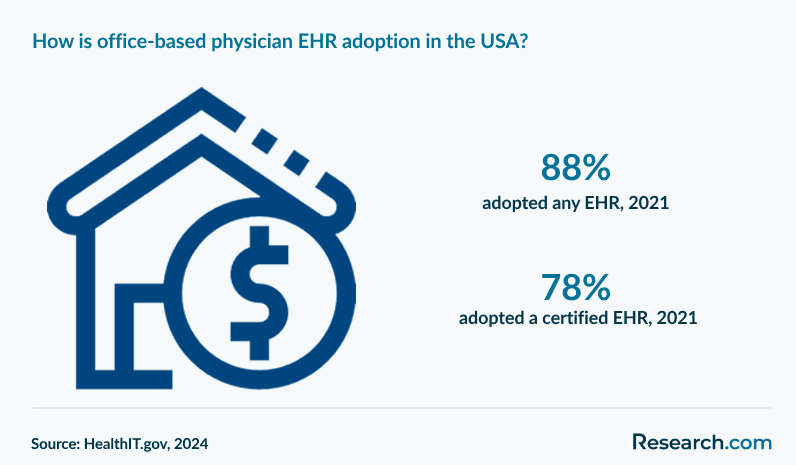
By 2021, a substantial majority of U.S. office-based doctors had adopted electronic health records. Specifically, 88% used some form of EHR system, and almost four out of five, or 78%, used a certified EHR. The trend has continued upward since 2015, reinforcing why nursing students should graduate comfortable with digital clinical environments.
Why do clinical experiences, internships, and fellowships matter?
Clinical experience is where nursing students learn to combine knowledge, judgment, communication, and patient care in real settings. Internships, practicums, residencies, and fellowships help students and new nurses move from textbook learning to professional competence.
- Dr. Derouin’s insight: Internships and fellowships can support onboarding, mentoring, and retention for novice nurses. She described them as a way to understand workplace culture, learn policies and communication norms, gain confidence, and develop specialty skills. These experiences are especially useful in areas such as Pediatrics, Women’s Health, the Emergency Department, Telemetry, and ICU settings, where students may not receive extensive clinical time during school.
- Dr. Grubb’s insight: The more students interact with patients and interdisciplinary teams, the easier it becomes to connect nursing education with practice. She emphasized that clinical experiences strengthen critical thinking, time management, communication, clinical judgment, and the ability to use the nursing process. They also help students explore specialties, identify interests, and build professional networks.
How to get more value from clinical experience
- Prepare before each shift. Review diagnoses, medications, common complications, and expected assessments.
- Ask focused questions. Instead of asking only what to do, ask why a decision was made and what signs would change the plan.
- Request feedback early. Do not wait until the final evaluation to learn what you need to improve.
- Observe team communication. Pay attention to handoffs, rounds, conflict resolution, and escalation of concerns.
- Track your growth. Keep a private list of skills practiced, cases encountered, and areas needing more confidence.
- Act professionally every day. Clinical sites often become references, job leads, and future employers.
| Clinical Opportunity | Best For | What to Watch For |
| Standard clinical rotation | Building core nursing skills across common care settings. | Limited time on each unit may require extra initiative to see varied cases. |
| Internship | Students who want deeper exposure before graduation. | Quality depends heavily on mentorship and the learning culture of the site. |
| New graduate fellowship or residency | New nurses entering specialty or high-acuity settings. | Ask about preceptor support, workload expectations, and how progress is evaluated. |
| Specialty clinical placement | Students considering pediatrics, emergency, ICU, telemetry, women’s health, or similar areas. | Competitive placements may require strong academic and clinical performance. |
How can nursing students move from school to professional practice?
The transition from nursing school to practice can be demanding because new nurses must manage real responsibility, patient complexity, time pressure, organizational policies, and emotional stress. A realistic mindset helps. New nurses are not expected to know everything immediately, but they are expected to ask for help, practice safely, learn continuously, and uphold ethical standards.
- Dr. Derouin’s insight: Students should expect the transition to be challenging and should accept that nursing requires lifelong learning. Each patient is different, and healthcare technology and science continue to evolve. She also noted that professional nursing brings deeply meaningful moments because nurses are often closest to patients and families during critical healthcare experiences.
- Dr. Grubb’s insight: New nurses should surround themselves with professionals who consistently do what is right for patients. She warned against learning from nurses who rely on shortcuts or skip important steps. She also advised new nurses to give themselves grace, noting that it can take five years to truly feel comfortable practicing as a nurse.
Questions to ask before accepting a first nursing job
- How long is the orientation period for new graduates?
- Will I have a consistent preceptor?
- How does the unit support nurses who are struggling or overwhelmed?
- What is the nurse-to-patient assignment expectation for new nurses?
- How are safety concerns escalated?
- What continuing education, certification support, or residency options are available?
- How does leadership respond to errors, near misses, and quality improvement opportunities?
Common mistakes new nurses should avoid
- Choosing the first offer without evaluating the unit culture. A supportive learning environment can matter as much as specialty preference.
- Trying to appear confident when help is needed. Safe practice requires asking questions and escalating concerns early.
- Learning shortcuts before learning standards. Efficiency should never replace patient safety.
- Ignoring emotional recovery. Nursing can involve grief, stress, and difficult cases. Healthy coping strategies are part of professional longevity.
- Assuming graduation means learning is finished. Nursing competence grows through practice, feedback, continuing education, and reflection.
Which resources and learning habits help nursing students grow?
Nursing students should build a habit of structured learning beyond required coursework. The best resources are not only textbooks or test-prep tools. Professional organizations, journals, mentors, electives, workshops, specialty courses, and clinical conversations can all help students understand where they fit in the profession.
- Dr. Derouin’s insight: Students should pursue electives, workshops, specialty courses, or independent studies that genuinely interest them. She also recommended connecting with faculty, administrators, and practicing nurses whose careers students admire. When evaluating employers, students should review the organization’s mission, observe the environment, consider whether staff seem proud to work there, and ask how teams support one another during difficult days.
- Dr. Grubb’s insight: Students and nurses should join professional organizations, stay connected with the American Nurses Association, use nursing journals, and remain involved with Sigma if inducted. She also encouraged nurses to join specialty organizations after choosing a practice area, pursue certification when appropriate, and read three journal articles every month to stay current.
| Resource Type | How It Helps | Best Use |
| Professional organizations | Provide networking, continuing education, journals, policy updates, and specialty communities. | Join organizations aligned with your desired specialty or stage of career. |
| Nursing journals | Help students connect evidence, guidelines, and real clinical problems. | Build a monthly reading habit and discuss articles with classmates or mentors. |
| Faculty mentors | Offer academic guidance, career perspective, and introductions to practice areas. | Ask specific questions about specialties, graduate school, research, or job fit. |
| Electives and workshops | Let students explore focused interests before committing to a specialty. | Choose topics that match your curiosity, not only what looks impressive on a resume. |
| Clinical mentors | Model professional judgment, communication, and ethical practice. | Observe how they handle pressure, difficult conversations, and patient advocacy. |
What career paths are available for nursing majors?
Nursing offers multiple career directions, and the best path depends on education level, licensure, specialty interests, preferred patient population, tolerance for high-acuity environments, and long-term goals. Some nurses remain in direct patient care for their entire careers, while others move into advanced practice, education, informatics, leadership, consulting, research, policy, or military nursing.
1. Direct patient care roles
- Registered Nurse (RN): Provides patient care, assessment, education, medication administration, documentation, and coordination across hospitals, clinics, community settings, and other healthcare environments.
- Licensed Practical Nurse (LPN) or Licensed Vocational Nurse (LVN): Delivers basic nursing care under RN or provider supervision, depending on state scope-of-practice rules.
- Critical Care Nurse: Cares for seriously ill patients in intensive care environments where monitoring, rapid assessment, and intervention are central.
- Emergency Room Nurse: Supports patients with urgent and unpredictable health needs in fast-moving emergency settings.
- Pediatric Nurse: Works with infants, children, adolescents, and families.
- Geriatric Nurse: Focuses on older adults, chronic conditions, mobility issues, medication complexity, and aging-related care needs.
- Oncology Nurse: Cares for patients receiving cancer diagnosis, treatment, symptom management, and support.
- Mental Health Nurse: Supports individuals with psychiatric, behavioral health, or substance-use-related needs.
2. Advanced Practice Registered Nurse roles
RNs who complete advanced education and certification may move into APRN roles. These positions generally involve greater clinical autonomy, advanced assessment, diagnosis, treatment planning, prescribing authority where permitted, and specialty-focused care.
- Nurse Practitioner (NP): Assesses, diagnoses, treats, prescribes medications where allowed, and may lead care teams. NP specialties include family, adult-gerontology, pediatrics, women’s health, mental health, and acute care. Students interested in the family nurse practitioner route can compare affordable options through this guide to the cheapest online nurse practitioner programs.
- Certified Registered Nurse Anesthetist (CRNA): Provides anesthesia-related care before, during, and after procedures.
- Certified Nurse Midwife (CNM): Provides prenatal, birth, postpartum, reproductive, and women’s health services.
3. Leadership, administration, and policy roles
- Nurse Manager: Supervises unit operations, staffing, performance, patient-care processes, and team development.
- Chief Nursing Officer (CNO): Leads nursing strategy and services across a healthcare organization.
- Nurse Executive: Oversees nursing departments, operational priorities, workforce planning, and quality goals.
- Healthcare Consultant: Advises healthcare organizations on operations, quality, safety, staffing, workflow, or compliance.
- Policy Maker: Uses nursing expertise to influence healthcare policies, public health priorities, and patient-care systems.
4. Nontraditional and specialized nursing roles
- Nurse Educator: Teaches nursing students, new nurses, or clinical staff.
- Nurse Researcher: Designs or supports studies that improve patient care, nursing practice, and healthcare systems.
- Nurse Informaticist: Bridges nursing practice, data, technology, and healthcare systems.
- Forensic Nurse: Applies nursing knowledge in legal, trauma, violence, or investigative contexts.
- School Nurse: Promotes student health, manages medications and conditions, and supports public health in school settings.
- Travel Nurse: Takes temporary assignments across healthcare facilities and locations.
- Military Nurse: Provides care in military healthcare systems and may serve military personnel, families, or operational settings.
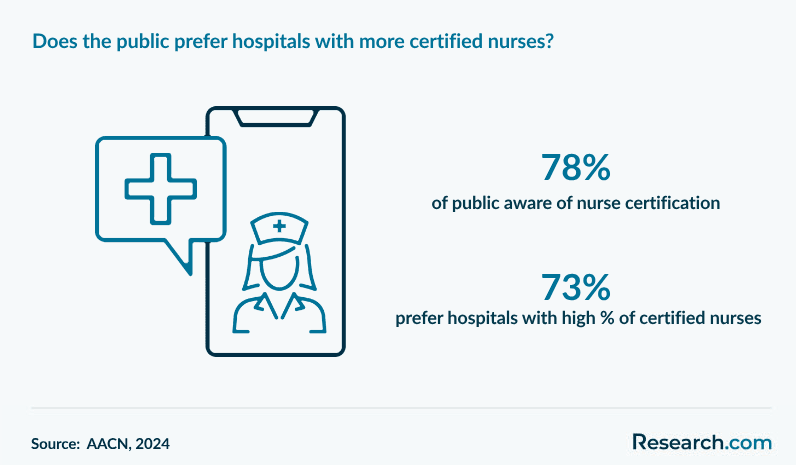
Certification often becomes relevant after a nurse chooses a specialty direction. Public awareness of certification is not new: a 2002 Harris Poll found strong public awareness of nurse certification at 78%, higher than awareness of certification in other professions. The same poll found that 73% of the public preferred hospitals that employ certified nurses.
Can advanced nursing certifications support financial growth?
Advanced nursing certifications can improve career mobility when they match a nurse’s specialty, experience level, and employer expectations. They may help nurses qualify for specialty roles, leadership opportunities, or positions that require documented expertise. However, certification is not an automatic salary guarantee. Financial benefit depends on the credential, employer policies, local labor market, specialty demand, union or compensation structures, and whether the certification is recognized for promotion or differential pay.
Before paying for an exam or review course, nurses should ask whether the certification is valued in their target role and whether their employer offers reimbursement, pay differentials, promotion credit, or continuing education support. For broader context on credentials with strong career value, review this guide to certifications that pay well.
What should students know before pursuing nursing certifications?
Nursing certifications are voluntary credentials that demonstrate focused expertise in a nursing specialty. They are different from licensure. Licensure gives a nurse legal authority to practice; certification usually signals specialized competence beyond baseline licensure requirements.
Why nurses pursue certification
- Specialty credibility: Certification can show that a nurse has met recognized standards in a practice area.
- Career advancement: Some specialty, leadership, or advanced practice roles prefer or require certification.
- Professional recognition: Credentials can help nurses demonstrate commitment to quality and continued learning.
- Potential compensation benefits: Some employers reward certification, though outcomes vary and should be confirmed before assuming a pay increase.
Common certification categories
- Medical-surgical and acute care areas: Critical care, emergency nursing, oncology, trauma, perioperative nursing, and related specialties.
- Advanced practice specialties: Nurse Practitioner specialties such as family, adult-gerontology, pediatrics, women’s health, mental health, Clinical Nurse Specialist, Certified Nurse Midwife, and Certified Registered Nurse Anesthetist.
- Pediatric specialties: Neonatal intensive care, pediatric oncology, and pediatric emergency nursing.
- Geriatric specialties: Gerontological nursing, gerontology acute care, and long-term care.
- Mental health specialties: Psychiatric-mental health nursing and substance abuse nursing.
- Other areas: Wound care, case management, diabetes education, informatics, leadership, and additional focused fields.
In 2023, there were 205,412 certified nurse practitioners across specialties certified by the American Nurses Credentialing Center (ANCC). Family Nurse Practitioners represented the largest group with 97,007 certifications. Adult-Gerontology Acute Care Nurse Practitioners followed with 24,841. Other notable groups included Adult Nurse Practitioners with 15,204 certifications, Psychiatric-Mental Health Nurse Practitioners across the life span with 40,193, and Adult-Gerontology Primary Care Nurse Practitioners with 10,765.
The American Nurses Credentialing Center (ANCC) provided these certification figures in 2024. They offer a snapshot of the nurse practitioner workforce in the United States and show the breadth of NP roles across patient populations and care settings.
Major nursing certification organizations
- American Nurses Credentialing Center (ANCC): Provides many certifications for RNs and APRNs.
- American Association of Critical-Care Nurses (AACN): Offers certifications focused on critical care and acute care nursing.
- American Academy of Nurse Practitioners Certification Board (AANPCB): Provides certification options for nurse practitioners.
Typical steps for earning a nursing certification
- Confirm eligibility. Requirements may include active licensure, education, clinical hours, specialty experience, or graduate preparation.
- Choose the right credential. Match the certification to your intended role, patient population, and specialty setting.
- Prepare for the exam. Use official exam outlines, practice questions, review courses, and specialty guidelines.
- Pass the certification exam. Follow the testing organization’s registration, identification, and scheduling rules.
- Maintain the credential. Most certifications require renewal, continuing education, practice hours, or other maintenance activities.
Certification decision checklist
| Question | Why It Matters |
| Is this credential recognized by employers in my target specialty? | A certification has more value when hiring managers and clinical leaders actively use it in role decisions. |
| Do I meet the eligibility requirements now? | Some certifications require experience or education that new graduates may not yet have. |
| Will my employer reimburse costs? | Exam fees, study materials, renewal fees, and continuing education can add up. |
| Does certification affect pay, promotion, or scheduling? | Financial value differs by employer, specialty, and market. |
| Will I remain in this specialty long enough to benefit? | Certification is most useful when it aligns with a durable career direction. |
What does the future hold for nursing careers?
Nursing careers are likely to keep expanding across direct care, advanced practice, informatics, telehealth, leadership, prevention-focused care, research, and specialized services for older adults. An aging population increases demand for geriatric and chronic-care expertise, while technology continues to create roles for nurses who understand both patient care and digital systems. At the same time, patient-centered care remains central because technology cannot replace trust, advocacy, education, and compassionate presence.
The nursing shortage also means students should be strategic rather than passive. A strong career path will depend on clinical competence, adaptability, ethical practice, communication skills, technology fluency, and lifelong learning. Nurses who combine these strengths with specialty knowledge can position themselves for broader opportunities as healthcare models continue to evolve.
What should students consider when selecting affordable online nursing education options?
Affordable online nursing education should be evaluated by total value, not tuition alone. Students should confirm accreditation, clinical placement support, state authorization, licensure alignment, faculty qualifications, NCLEX preparation where applicable, student support, transfer credit policies, technology requirements, and total program cost. An inexpensive program can become costly if credits do not transfer, clinical placements are difficult to secure, or the program does not meet licensing requirements in the student’s state.
Students comparing cost-focused options can start with this overview of cheap online nursing programs, but they should still verify accreditation and licensure fit directly with the school and the appropriate state board of nursing.
Online nursing program questions to ask before enrolling
- Is the program accredited by a recognized nursing accreditor?
- Does the program meet RN or APRN licensure requirements in my state?
- Who arranges clinical placements: the school or the student?
- Are there in-person requirements, campus visits, labs, intensives, or simulation sessions?
- What fees are charged beyond tuition?
- What student support is available for online learners?
- What is the transfer credit policy?
- How does the program support exam preparation and job placement?
When can accelerated programs help a nursing career?
Accelerated nursing pathways can help students move into nursing more quickly, especially career changers who already hold college credit or a prior degree. These programs often compress coursework and clinical preparation into a shorter timeline, which can reduce time away from the workforce. The trade-off is intensity. Students should expect demanding schedules, heavy reading, frequent assessments, and limited room for outside commitments.
Before choosing an accelerated option, compare prerequisites, clinical expectations, program pacing, support services, cost, and licensure alignment. Students exploring faster academic routes can review accelerated school programs to understand how shortened degree formats differ across fields and institutions.
| Path | Best Fit | Potential Concern |
| Traditional nursing program | Students who want a more standard academic pace and broader time for work or family responsibilities. | May take longer to complete than accelerated options. |
| Accelerated nursing program | Career changers or highly prepared students who can handle an intensive schedule. | Fast pacing can be difficult if clinical, work, or family demands are high. |
| Online or hybrid nursing program | Students needing flexibility for didactic coursework. | Clinical, lab, simulation, or residency requirements may still be in person. |
How can advanced nursing degrees affect career progression?
Advanced nursing degrees can support movement into roles that require deeper clinical expertise, leadership preparation, research ability, teaching skill, or policy knowledge. Nurses may pursue graduate education to become nurse practitioners, nurse educators, nurse administrators, informaticists, researchers, or leaders in quality and safety. The right degree depends on the role; not every nurse needs graduate school to advance.
Before enrolling, nurses should compare the required credential for their target role, the program’s accreditation, state authorization, clinical or practicum requirements, cost, employer tuition support, and likely career use. Those considering graduate study can explore broader masters programs to compare how master’s-level education supports professional advancement.
When an advanced nursing degree may be worth considering
- You need graduate preparation for a specific APRN role.
- You want to teach, lead, conduct research, or influence healthcare systems.
- Your employer or specialty area rewards advanced education.
- You have confirmed the program meets licensing, certification, or employment requirements.
- You understand the time, cost, clinical, and practicum commitments before enrolling.
How can military experience support a nursing career?
Military experience can translate well into nursing because it often builds discipline, leadership, resilience, teamwork, composure under pressure, and comfort with structured protocols. Veterans and service members may also bring exposure to high-stakes environments that strengthen situational awareness and decision-making.
Military-affiliated students should look for nursing programs that understand prior service, evaluate applicable transfer credit carefully, provide veteran support services, and explain how military benefits may apply. Some institutions may also offer flexible options for active-duty learners, spouses, or veterans. For broader education planning, review this guide to the best online military colleges.
How can an online PhD support nursing research and innovation?
An online PhD degree can prepare nursing professionals for research, scholarship, policy influence, academic roles, and evidence-generation that shapes clinical practice. Doctoral study is most appropriate for nurses who want to investigate healthcare problems, design studies, contribute to nursing science, teach at advanced levels, or influence systems of care through research and evidence.
Online doctoral formats can be useful for working nurses, but students should examine research mentorship, dissertation support, faculty expertise, residency expectations, funding options, and whether the degree type matches their goals. A PhD is typically research-focused, while other doctoral options may be more practice-focused, so applicants should be clear about the career outcome they want before enrolling.
How can cross-disciplinary skills improve nursing career options?
Nurses who combine clinical expertise with skills in informatics, management, public health, education, analytics, business, or policy can qualify for broader roles beyond traditional bedside practice. Cross-disciplinary skills can help nurses move into leadership, quality improvement, technology implementation, operations, consulting, care coordination, and healthcare strategy.
These skills may support higher-paying roles in some settings, but compensation is not guaranteed. The strongest approach is to identify a target role first, then choose complementary education or credentials that employers actually value. Students comparing fields with strong earning potential can review the most lucrative college majors for broader context on how academic choices can affect career direction.
Common Mistakes Nursing Students Should Avoid
| Mistake | Why It Can Hurt | Better Approach |
| Choosing a program without checking accreditation and licensure fit | Graduation may not lead to the intended license or credential if requirements are not met. | Verify accreditation, state board requirements, and program approvals before enrolling. |
| Focusing only on tuition | Fees, travel, clinical costs, technology, books, and lost work time can change total cost. | Compare full cost of attendance and available aid, not tuition alone. |
| Assuming online means fully remote | Nursing programs often require in-person clinicals, labs, simulations, or intensives. | Ask exactly where and when in-person requirements occur. |
| Pursuing certification too early or without a goal | Some credentials require experience and may not help if they do not match your specialty. | Choose certifications based on role requirements, employer recognition, and career plans. |
| Ignoring unit culture when accepting a job | A poor learning environment can affect confidence, safety, and retention. | Ask about orientation, preceptors, staffing expectations, and team support. |
| Assuming salary outcomes are guaranteed | Pay varies by employer, region, specialty, experience, shift, and credential recognition. | Research local job postings and ask employers how credentials affect compensation. |
More Information About the Experts We Interviewed
Dr. Anne Lynn Derouin, DNP, APRN, CPNP, PMHS, FAANP

Dr. Anne Lynn Derouin serves as Assistant Dean of the MSN Program and Lead Faculty for the Pediatric Behavior Mental Health specialty program at Duke University School of Nursing. For more than two decades, she has provided adolescent primary care through Community and School-based Health Centers affiliated with Duke’s Department of Community and Family Medicine. She has served on state and national boards of the National Association of Pediatric Nurse Practitioners (NAPNAP) and is recognized for her expertise in adolescent care. Her advocacy work includes pediatric, school-based health, and advanced nursing practice issues at state and federal levels. Dr. Derouin earned her BSN from the University of Michigan in 1989, her MSN from Duke University in 2000, and her DNP from Duke University in 2010. She has served as President of the North Carolina School Community Health Alliance and is part of the Executive Team of the Duke-Johnson & Johnson Nurse Leadership program. She also serves on the Advisory Board for the Poe Center in Raleigh, NC. Her current appointments include Clinical Professor in the School of Nursing, Vice Dean for Academic Affairs in the School of Nursing, Professor in Family Medicine and Community Health, and Affiliate at the Duke Global Health Institute.
Dr. Lisa Grubb is a healthcare executive and nurse leader with experience spanning frontline nursing, operational leadership, infection control, consulting, and performance improvement. Her work has included leadership in infection prevention, surgical operations, patient care, and healthcare quality. As a certified wound care nurse, she has contributed to research and clinical practice, particularly in pressure injury prevention. She also educates advanced practice nurses and is affiliated with the Armstrong Institute for Patient Safety and Quality and the Center for Infectious Disease and Nursing Innovation at Johns Hopkins University. Her background reflects a long-standing focus on patient safety, quality improvement, clinical innovation, and nursing leadership.
Key Insights
- Nursing students should build critical thinking, evidence-based practice, communication, data literacy, and ethical judgment from the beginning of their education.
- Technology is now routine in healthcare, but it works best when paired with careful assessment, compassionate communication, and sound clinical reasoning.
- Clinical experiences, internships, fellowships, and residencies are not just requirements; they are key opportunities to build confidence, professional habits, and specialty direction.
- The RN workforce is projected to grow 6% from 2022 to 2032, while the APRN workforce is projected to grow 38% during the same period, making preparation and specialization important for long-term opportunity.
- Certifications can support advancement when they align with a nurse’s specialty and employer expectations, but they should not be pursued only because they sound impressive.
- Online, accelerated, and advanced nursing programs should be evaluated by accreditation, licensure alignment, clinical placement support, total cost, and career fit.
- New nurses should choose work environments carefully, seek mentors with strong patient-safety values, and expect competence to develop over years of deliberate practice.
References:
- Bureau of Labor Statistics. (2024). Registered nurses. U.S. Department of Labor.
- Office of the National Coordinator for Health Information Technology. (2024). Percent of hospitals, by type, that possess certified health IT. U.S. Department of Health and Human Services.
- Office of the National Coordinator for Health Information Technology. (2024). Quick stats. U.S. Department of Health and Human Services.








