How to compare PharmD programs by licensure support

Co-Founder and Chief Data Scientist
A Pharm.D. program can prepare you for pharmacy practice without making every step to licensure equally straightforward. Exam preparation, clinical placements, and help navigating state rules differ among schools - and those differences can affect your time and costs after graduation. This guide is for prospective students comparing U.S. Doctor of Pharmacy programs. It explains which evidence to request, how to interpret licensing outcomes, and how to weigh support against tuition and schedule so you can choose a program with a credible path toward the state where you intend to practice.
Key Things You Should Know
- Start with the program's current Accreditation Council for Pharmacy Education (ACPE) status and your intended state board's eligibility rules; a Pharm.D. alone is not a pharmacist license.
- Compare recent, school-level first-time NAPLEX results alongside cohort size, repeat-attempt results, and the support offered to students who struggle - not a single pass rate in isolation.
- Confirm who coordinates clinical rotations and licensing paperwork, which jurisprudence exam your state uses, and what preparation and travel will cost beyond tuition.
What is licensure support in a PharmD program?
Licensure support is the academic and administrative help a pharmacy school provides as students work toward pharmacist licensure. It includes instruction tied to licensing exams, feedback on practice assessments, supervised clinical education, guidance on intern registration, and help understanding application deadlines. The state board of pharmacy - not the school - ultimately determines whether an applicant qualifies for a license.
Ask who advises students planning to practice outside the school's home state. Useful support should distinguish graduation requirements from state requirements and identify what the student must arrange personally. Advising on prerequisite gaps can also prevent delays before enrollment; pharmacy program admission planning is worth considering alongside later licensure support.
How does ACPE accreditation affect pharmacist licensure eligibility?
ACPE accredits professional pharmacy education programs, not individual pharmacists. For the standard U.S.-educated route, verify a program's current status in ACPE's official program records and check the intended state board's educational eligibility rules before enrolling. Ask about any status that is not full accreditation and what it means for your expected graduation date. Institutional accreditation and permission to enroll online students in a state are separate matters; neither substitutes for ACPE professional-program accreditation.
Prior undergraduate study in biology, chemistry, or pre-pharmacy does not itself qualify someone for pharmacist licensure. Applicants comparing pharmacy school for biology and chemistry graduates still need to identify an eligible professional Pharm.D. pathway. Internationally educated pharmacists may face a different board and certification process and should not assume that rules for U.S. Pharm.D. graduates apply to them.
Which PharmD programs offer the strongest NAPLEX and MPJE preparation?
No single school is strongest for every applicant. Look for a program that connects coursework to the North American Pharmacist Licensure Examination (NAPLEX), gives students diagnostic feedback before graduation, provides structured help after weak assessments, and publishes results you can interpret. The Multistate Pharmacy Jurisprudence Examination (MPJE) tests pharmacy law for jurisdictions that use it; some jurisdictions began transitioning to the Uniform MPJE (UMPJE) in 2026, while others have different requirements. Verify your jurisdiction's current exam with its board and the National Association of Boards of Pharmacy (NABP).
Ask each school for recent first-time and repeat-attempt NAPLEX results, the number of graduates represented, when practice tests occur, and whether exam resources have an extra fee. Then ask how students receive help if a practice score suggests they are not ready. Published pass rates describe past cohorts; they do not establish that a school caused those results or predict an individual's result. Compare fast-track Doctor of Pharmacy programs on the same evidence rather than assuming a shorter calendar means less - or more - effective preparation.
State boards set or administer requirements involving applications, intern registration and supervised hours, examinations, background checks, and, in some cases, state-specific training. Requirements and the treatment of experiential hours can differ. NAPLEX passage is an exam result, not a license; a board must still approve the application and any other required steps.
Before choosing a school, check the board for the state where you expect to practice and ask the program how it documents hours earned through introductory pharmacy practice experiences (IPPEs) and advanced pharmacy practice experiences (APPEs). If you may move after graduation, ask about score transfer and later license transfer rather than assuming one state license automatically applies elsewhere. Be especially careful with accelerated online pharmacy degree pathways: a short pharmacy-related credential is not necessarily a licensure-qualifying Pharm.D.
Delivery format changes where and how students study, not the need to meet professional and state requirements. An online or hybrid pathway may include live classes, in-person labs or campus visits, and supervised rotations at approved practice sites. A campus-based program also requires rotations, which may involve travel. Neither format guarantees a placement near home or compatibility with full-time work.
The comparison below separates the learning format from obligations that can affect licensure preparation. Specific schedules and placement policies must be checked with each program.
| Feature | Online or hybrid pathway | Campus-based pathway |
| Classroom instruction | May combine remote classes with scheduled live sessions | Primarily held on campus, with schedules set by the school |
| Hands-on learning | May require campus visits or other approved in-person activities | Generally uses campus facilities for scheduled labs |
| Clinical rotations | In person at approved sites; placement geography varies | In person at approved sites; travel may still be necessary |
When considering online Doctor of Pharmacy degree options, ask who secures or approves IPPE and APPE sites, whether placements are available in your state, and what intern registration, background checks, immunizations, or travel you must arrange. State authorization to enroll an online student is distinct from both ACPE accreditation and eligibility for a particular state's license.
The professional Pharm.D. curriculum typically develops knowledge in pharmacology, pharmacotherapy, calculations, medication safety, patient assessment, pharmacy law, and drug information. Labs and supervised experiences let students apply those subjects to tasks such as evaluating medication regimens and counseling patients under appropriate supervision. Undergraduate prerequisite science courses provide a foundation; they are not a substitute for the professional curriculum or clinical education.
For a meaningful comparison, request each school's current course sequence and ask when it reinforces calculations, therapeutics, and law before licensing exams. Also ask how faculty connect rotation evaluations to areas needing review. A compressed schedule can change study time between difficult courses and exam preparation; comparisons of doctoral programs with accelerated timelines should not be taken as evidence that a pharmacy curriculum covers less - or that graduates are exam-ready.
Requirements vary by school. Programs specify their own prerequisite undergraduate courses, labs, grades, application materials, and rules for coursework still in progress. Some accept applicants without a completed bachelor's degree; others set different entry conditions. Admission to the professional Pharm.D. program is separate from later eligibility for pharmacist licensure.
When understanding pharmacy school admissions, use the school's current admissions page and, if it participates, its PharmCAS directory entry for the application cycle. Confirm whether the school uses PharmCAS, requires a supplemental application or interview, and accepts your particular lab and transfer courses. The Pharmacy College Admission Test (PCAT) was retired in January 2024, so it should not be treated as a currently available admissions exam. Meeting a published minimum does not guarantee admission.
A traditional professional Pharm.D. curriculum commonly takes four academic years after prerequisite study; accelerated programs may use a shorter, more intensive schedule. Your actual time depends on completed prerequisites, course sequencing, and the school's calendar. A shorter program may reduce time away from work but leave less flexibility for employment or changes to a rotation schedule.
Compare each school's current-year tuition and mandatory fees using the same unit - per term, per credit, or full program - then account for prerequisite coursework, books and clinical resources, travel, housing during rotations, background checks, and licensing exams. Lower-cost online Pharm.D. pathways may still carry substantial in-person costs. Request an individualized aid estimate: federal borrowing rules changed for many new graduate and professional students beginning July 1, 2026, and aid eligibility depends on the student and applicable rules. Do not assume an advertised tuition figure represents the full cost or that loans will cover every expense.
Licensed pharmacists work in settings including community pharmacies, hospitals, ambulatory care, and other medication-focused services. A Pharm.D. can lead toward these roles, but graduates must meet the relevant state's licensing requirements. Some positions favor postgraduate training; a PGY1 or PGY2 residency, fellowship, and specialty board certification are distinct from licensure and are not universal requirements for pharmacist jobs.
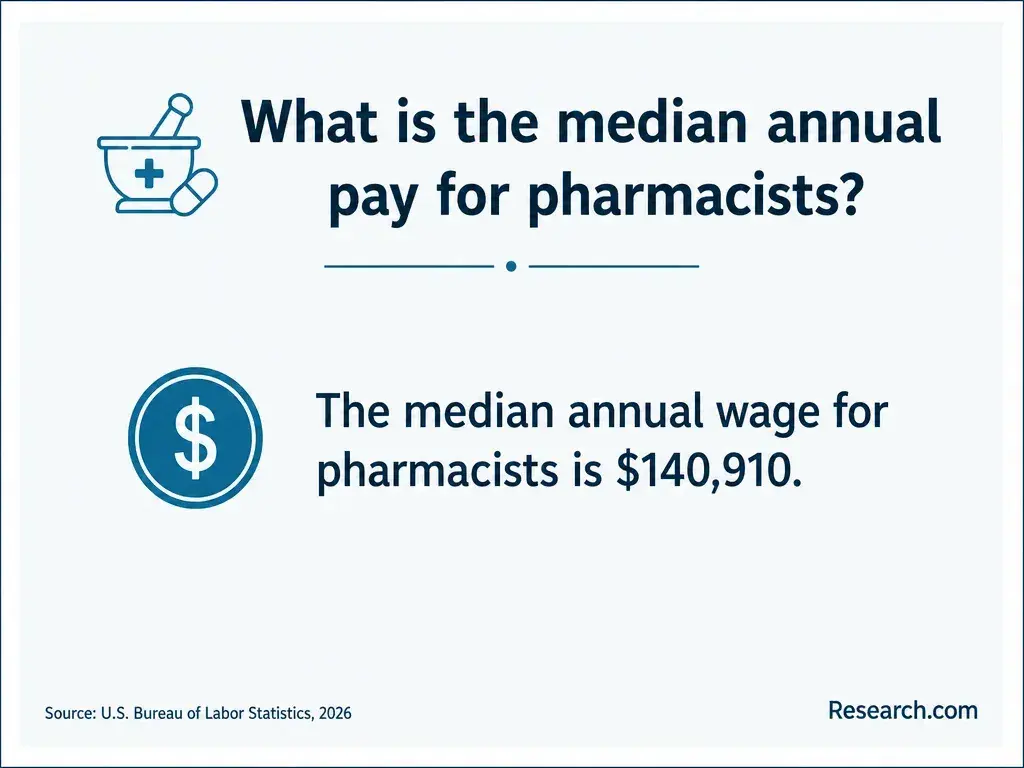
The Bureau of Labor Statistics reports median annual pay of $140,910 in May 2025 for pharmacists, with 5% projected job growth, 2025-2035, and about 12,500 openings per year. Those occupation-wide figures are not a starting-salary promise or a forecast for a particular specialty. In weighing pharmacy degree affordability and completion time, compare the likely debt and time commitment with your intended role - not just the profession's median pay. Pharmacy technician work is a separate occupation and does not ordinarily require a Pharm.D.
How can you evaluate a PharmD program's licensure outcomes?
Use the same questions for every school on your shortlist. Request written or published evidence where possible, and distinguish results achieved by graduates from services merely offered to students.
Work through these checks before paying a deposit:
- Verify the professional program's current ACPE status and confirm your intended state board's educational eligibility rules.
- Compare recent school-level first-time and repeat-attempt NAPLEX results, cohort sizes, and any explanation for unusually small or changing cohorts.
- Ask what practice assessments, individual feedback, remediation, and jurisdiction-specific law-exam guidance students receive - and whether they cost extra.
- Confirm who coordinates IPPE and APPE placements, which locations are realistic, and how the school records hours for board applications.
- Compare total expected costs and time to completion, including any prerequisites the school will not accept; the receiving school decides how prior credit applies.
A missing outcome report, vague placement promise, or refusal to clarify eligibility for your target state warrants follow-up before you commit. If prior coursework could change your timeline, review pharmacy school credit transfer options, then obtain a program-specific evaluation rather than relying on a general transfer policy. Choose the program whose documented outcomes and support address your highest-risk steps at a cost and schedule you can manage.
Other Things You Should Know About PharmD
Do not assume so. The program must approve experiential sites, supervision, and assessments; ordinary employment may not satisfy an IPPE or APPE requirement. Ask for a written determination before making work plans.
Choose your likely jurisdiction early enough to review its application and exam rules. If your plans are uncertain, check NABP score-transfer procedures and each potential state board's requirements before scheduling exams.
Not automatically. Specialty certification has separate eligibility and examination rules set by the credentialing body, often involving practice experience or postgraduate training. It is distinct from a state pharmacist license.
Ask the school for its most recent available results, the cohort size, and an explanation of how it supports students who do not pass. If you cannot obtain enough information to compare outcomes responsibly, treat that uncertainty as part of your decision.
- GAC - Chapter 480-2 LICENSURE AS A PHARMACIST https://rules.sos.ga.gov/gac/480-2
- Cost of Attendance (Budget) | 2025-2026 Federal Student Aid Handbook https://fsapartners.ed.gov/knowledge-center/fsa-handbook/2025-2026/vol3/ch2-cost-attendance-budget
- Association Between NAPLEX Preparation Program... - PMC https://pmc.ncbi.nlm.nih.gov/articles/PMC10159439/
- Background Screening: Initiate a Screening | FL HealthSource https://flhealthsource.gov/background-screening/
- Pharmacist Licensure Snapshot | Department of State https://www.pa.gov/agencies/dos/department-and-offices/bpoa/boards-commissions/pharmacy/pharmacist-licensure-snapshot
- Pharmacy graduates lead the Pacific Northwest with top licensure pass rates | WSU Insider | Washington State University https://news.wsu.edu/news/2026/02/04/wsu-pharmacy-graduates-lead-the-pacific-northwest-with-top-licensure-pass-rates/
- Pharmacy graduates No. 1 in U.S. licensure exam | University of the Pacific https://www.pacific.edu/pacific-newsroom/pharmacy-graduates-no-1-us-licensure-exam
- Key Outcomes | The Ohio State University College of Pharmacy https://pharmacy.osu.edu/education/doctor-pharmacy/key-outcomes
- NAPLEX First-time Pass Rates are 88.1% | llu.edu https://pharmacy.llu.edu/about-us/school-news/naplex-first-time-pass-rates-are-881
- PharmD Graduation & Career Outcomes | Presbyterian College https://www.presby.edu/graduate-programs/pharmacy/outcomes/