2027 Building a Public Health Governance Accountability Map for DrPH Students

Co-Founder and Chief Data Scientist
A public health initiative can have many partners yet no clear answer to who approves a decision, pays for it, or responds when results fall short. For DrPH students leading practice-based work, a governance accountability map makes those responsibilities visible before a project depends on them. This guide explains what to include, how to verify authority and performance evidence, and how to turn the map into a useful conversation with a field partner. It also shows which doctoral training options are worth considering if governance leadership is your professional goal.
Key Things You Should Know
- Map decisions, not just organizations: record who recommends, approves, implements, funds, monitors, and can challenge each consequential action.
- For each decision, document seven essentials: the decision, authority, responsible party, affected community, evidence, review route, and unresolved gaps.
- Treat a student map as a proposed working tool until the partner verifies roles, approves data use, and agrees on how the map may be shared.
What is a public health governance accountability map for DrPH students?
A public health governance accountability map is a documented view of how authority, resources, information, and answerability flow through a population-health decision. Unlike a stakeholder list, it identifies who may make a decision, who must carry it out, who reviews its consequences, and whose interests may be missed. It can be a diagram supported by a decision register, rather than a complicated software product.
For example, a DrPH student examining a county heat-response plan might map who can authorize opening cooling sites, who controls transportation funding, how community organizations report access problems, and which body reviews the response afterward. These are illustrative questions, not findings about a county. A useful map distinguishes legal authority from informal influence: a trusted neighborhood organization may shape implementation without having authority to commit public funds.
The intended reader is a practice-focused doctoral student or experienced practitioner, not someone seeking to prove that every governance problem requires another degree. If the goal is sustained organizational change, compare the applied work expected of public health doctorates for research and practice before selecting a project or program.
Why do DrPH students need public health governance and accountability skills?
DrPH work often crosses agency, clinical, nonprofit, and community boundaries. An intervention can be technically sound and still stall because a partner lacks spending authority, a procurement process takes longer than expected, or no one is assigned to act on evaluation findings. Mapping these dependencies helps a student propose a change that an organization can actually authorize and sustain.
Accountability also has an equity dimension. Reporting a program outcome to a funder is not the same as giving affected residents a way to contest inaccessible services or influence the next decision. A map should show both upward accountability to governing bodies and funders and outward accountability to the people a program serves.
Not every contributor needs doctoral training. Junior staff can help locate public records, maintain a stakeholder directory, or prepare meeting summaries under appropriate supervision. For someone building those foundational skills before graduate study, online public health undergraduate education options are a different decision from whether an experienced practitioner needs a DrPH to lead the work.
What competencies should a DrPH governance accountability map include?
The map should demonstrate more than the ability to draw connections. It should show that the student can interpret public authority, facilitate participation, assess evidence, and recommend an improvement within real operational constraints. The following competency-to-output comparison helps a student and faculty adviser assess whether the deliverable is substantive enough for advanced practice.
| Competency | Evidence visible in the map or companion brief | What remains to verify |
| Policy and governance analysis | Decision rights and the policies or agreements supporting them | Whether the cited authority applies to this decision |
| Systems leadership | Dependencies between agencies, teams, and funding streams | Whether the people named accept those responsibilities |
| Community engagement and ethics | Routes for input, feedback, and challenge | Whether affected groups consider those routes usable |
| Evaluation and data literacy | Indicators, data owners, limitations, and review timing | Whether data access and definitions are approved |
| Implementation planning | Escalation routes and proposed responses to gaps | Whether resources and authority exist to act |
A student entering doctoral study from another discipline may need foundational population-health or policy preparation before attempting this analysis. An MPH can provide that foundation, but it is not a universal DrPH prerequisite; applicants still need to check each program's requirements. Those considering that earlier step can use guidance on building an MPH application with weaker grades rather than assuming a past academic record determines their ability to develop governance skills.
Start with one bounded decision, such as approving a service change, reallocating a grant-funded activity, or responding to a missed performance target. Mapping an entire health system at once usually produces an impressive-looking chart that cannot guide action. Agree on scope, a faculty contact, and a partner contact before requesting internal material.
The following sequence turns a stakeholder inventory into a testable accountability map. Keep uncertainty visible rather than filling gaps with assumptions.
- State the decision, population affected, organizational boundary, and period covered.
- List formal decision-makers and sources of authority, such as statutes, board actions, contracts, delegated policies, or grant terms.
- Identify implementers, funders, data stewards, oversight bodies, and community representatives; distinguish a person's title from their actual decision rights.
- For each major action, record who recommends, approves, carries it out, monitors it, and receives concerns.
- Compare the draft with permitted documents and conversations; mark disputed or unverified relationships explicitly.
- Ask the partner to review gaps and agree on a feasible revision or escalation route before treating the map as operational.
Use a decision register alongside the diagram: decision, authority, responsible party, affected community, evidence, review route, and unresolved gaps. A DrPH student should own the interpretation and partner review, even if supervised student assistants help organize material. If an assistant is balancing accelerated coursework with project tasks, planning an accelerated public health bachelor's workload matters to the reliability of deadlines and handoffs - not to who holds governance authority.
No single dataset measures "good governance." Pair authority evidence, which shows what should happen, with performance evidence, which shows what was documented. Meeting minutes, adopted policies, budgets, contracts, organizational charts, and published performance reports may help establish formal arrangements. With permission, workflow logs, referral records, response times, complaints, and interviews may reveal how those arrangements work in practice.
Choose measures that match the decision. For a service-change approval, useful process indicators might be whether required reviews occurred, how long an approval took, and whether reasons were recorded. For community accountability, examine whether input was sought before the decision, whether responses were documented, and whether participants can see what changed. A completed meeting or fast approval does not, by itself, establish that the decision was fair or effective.
Record each indicator's definition, owner, reporting period, missingness, and access restrictions. Public minutes can omit informal negotiations; administrative data can miss people who never reach a service. Do not infer consent to use restricted records merely because a field partner can view them. Confirm data-use permission, confidentiality obligations, community expectations, and whether institutional review is needed before collecting or sharing information. Foundational data-handling tasks may suit staff pursuing online public health undergraduate education options, but the DrPH student remains responsible for the map's interpretations and approved use.
Look for an instructional sequence, not merely a course with "leadership" in its title. Relevant preparation may combine public health law and policy, organizational change, budgeting, systems thinking, community engagement, implementation, and evaluation. The strongest fit for this deliverable also provides supervised opportunities to apply those skills to a partner's specific decision.
Ask how students move from a problem statement to an approved applied project: Who helps define scope? Who supervises partner engagement? Can the student use an existing workplace, and what approvals are required? How are revisions assessed when authority or data access differs from the initial proposal? An employer's willingness to host work is helpful but does not automatically satisfy a program's doctoral project rules.
If the immediate gap is basic policy or evaluation literacy rather than advanced leadership practice, a targeted course or one of the affordable distance learning MPH degrees may be more proportionate than a doctorate. Compare the actual coursework and total obligations, rather than treating a lower advertised tuition figure as the complete cost.
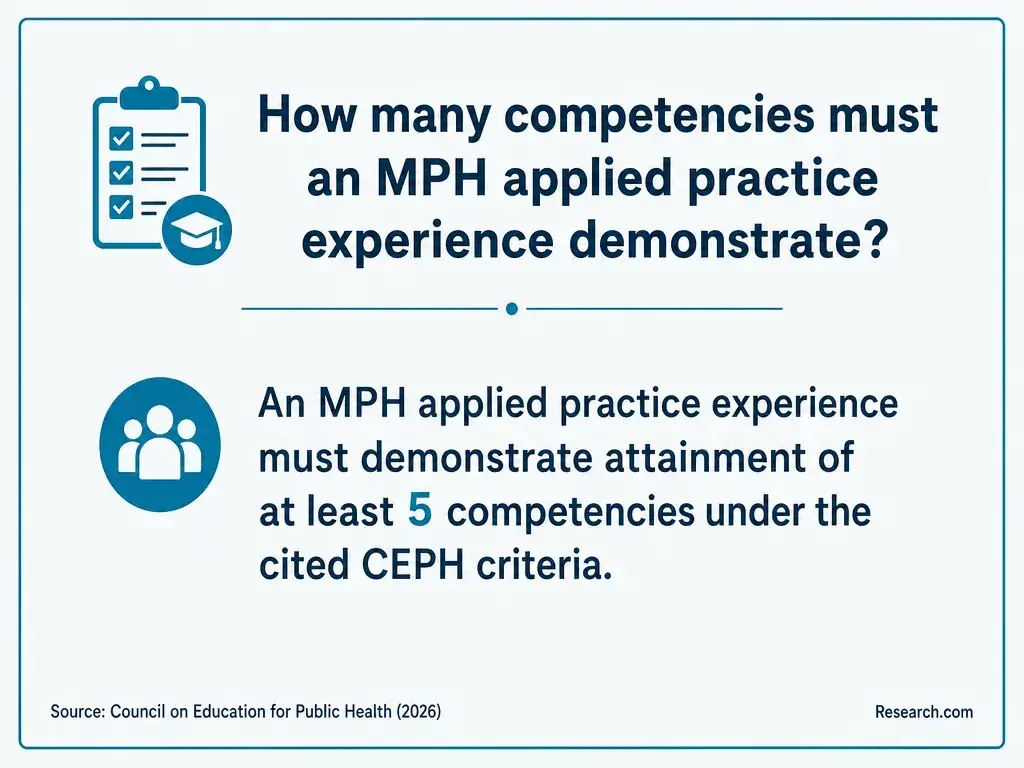
The Council on Education for Public Health (CEPH) sets accreditation criteria for public health schools and programs that include doctoral-level expectations relevant to practice leadership. Accreditation can help a student examine whether a program has an organized approach to competencies and assessment. It does not certify that a particular course will teach accountability mapping or that a proposed field project will be approved.
Check the CEPH listing for the exact school or program and confirm how the DrPH is covered; do not substitute the university's institutional accreditation or an accredited MPH for that check. Then request the current DrPH handbook and competency-to-course or project information. For this topic, the practical test is whether students must demonstrate leadership, policy or systems reasoning, evidence use, and communication in assessed work - not simply encounter those words in a catalog.
A research-focused PhD can be appropriate for someone studying governance as a scholarly question, but it should not be assumed to provide the same applied leadership pathway. Readers comparing doctoral purposes and costs can examine affordable online public health PhD programs separately from DrPH practice requirements.
Online, hybrid, and campus DrPH formats can all support governance work if students can obtain supervision, collaborate with partners, and complete the required applied project. Delivery mode alone does not establish flexibility. Live classes, group decisions, residencies, travel, and meetings with public agencies may occur during working hours regardless of where lectures are delivered.
For a working practitioner, compare the schedule of required sessions with the schedule of the proposed partner site. A local campus program may ease relationship-building; a distance program may let a student remain employed near a suitable site. Neither arrangement guarantees project access. Ask whether workplace projects are permitted, how external supervisors are approved, and what happens if the partner or the student's job changes.
Admission convenience is a separate issue from project feasibility. An online public health doctorate admissions guide can help frame entry questions, but students should verify each DrPH program's experience rules, required visits, live-session schedule, and applied-project policies directly before enrolling.
Governance mapping is relevant to public health department leadership, health-policy management, nonprofit executive work, preparedness coordination, health-system population-health strategy, and evaluation or improvement leadership. The work varies: one role may oversee budgets and staff, another may negotiate interagency agreements, and another may assess whether a community advisory process influences decisions. Hiring usually depends on prior responsibility and sector experience as well as education; a DrPH does not confer a director title or public authority.
There is no single reliable "public health governance" salary. The US Bureau of Labor Statistics reports pay by occupation, not by DrPH degree or this specialty. A social and community service manager may be a closer comparison for nonprofit program oversight, while a medical and health services manager covers healthcare operations rather than public health governance specifically. Compare the current Occupational Outlook Handbook entry for the actual target job with posted salary ranges, location, employer type, and public-sector pay grades; do not treat an occupation-wide median as a graduate earnings forecast.
For a practitioner weighing doctoral costs against advancement, MPH salary and career earnings outlook offers a separate master's-level comparison. The more decisive question is whether the desired position requires advanced organizational leadership evidence that current experience, employer training, or an MPH cannot provide.
How should students choose a reputable DrPH program for governance careers?
Choose against a proposed decision problem, not a broad promise to "become a leader." A useful short list should include programs where the student can build the needed policy and evaluation skills, secure appropriate supervision, and complete an approved project with a feasible partner. Published degree descriptions establish possibilities; written program policies and conversations with the project director establish what may work for a particular student.
Before committing, request the current curriculum and project handbook, confirm accreditation scope, and ask for examples of permitted types of governance deliverables without seeking confidential student work. Compare required live time, partner and data approvals, continuation rules, tuition and fees, travel, and the consequences of changing employers. An applied project may create substantial value at a current workplace without producing a salary increase, so include employer support and opportunity cost in the decision.
Resources on affordable public health doctorates and earning potential can help establish questions for a cost comparison, but verify each program's charges and reported outcomes before calculating a personal return. The next practical step is to draft a one-page decision scope and seven-field register, then ask a potential partner and program adviser which authority, access, and approval assumptions need correction.
Other Things You Should Know About Public Health
Review it when a governing policy, contract, funding source, key decision-maker, or service process changes. For a student project, agree on a review point with the partner and date each version so readers know which arrangements it describes.
Show the disagreement as unresolved. Record the relevant documents and each organization's stated position, then refer the question to the authorized legal, executive, or governing contact rather than assigning authority yourself.
Only if the partner and program permit it. Remove restricted details and obtain approval for any organization-specific version; a clearly labeled generic template may be safer than an internal decision map.
Use roles for the durable structure and keep a separately maintained contact list when needed. That makes the map easier to update after staff turnover and reduces unnecessary disclosure of personal information.
- Following the Money: The Audit Trail | gao.gov https://www.gao.gov/blog/following-money-audit-trail
- Health Systems Governance | who.int https://www.who.int/health-topics/health-systems-governance
- Core Competencies for Doctoral Education in Public Health | nih.gov https://pmc.ncbi.nlm.nih.gov/articles/PMC3490571/
- Elements of Accountable Communities for Health | NAM https://nam.edu/perspectives/elements-of-accountable-communities-for-health-a-review-of-the-literature/
- Doctor of Public Health (DrPH) | Claremont Graduate University https://www.cgu.edu/academics/program/doctor-public-health/
- Chapter 40., Section 4. Establishing Oversight Mechanisms | ku.edu https://ctb.ku.edu/en/table-of-contents/maintain/maintain-quality-performance/establishing-oversight-mechanisms/main
- Doctor of Public Health | llu.edu https://publichealth.llu.edu/academics/drph
- How Is Public Health Governed and Delivered in the U.S.? | KFF https://www.kff.org/other-health/health-policy-101-u-s-public-health/