2027 Public Health BS Preparation for Community Program Evaluation Work

Co-Founder and Chief Data Scientist
A public health BS can prepare you to help a community organization determine whether a program is reaching people, operating as intended, and producing useful results. But a degree title alone says little about the methods practice or supervised experience you will receive.
This guide is for prospective and current undergraduates who want evaluation work, not just a broad introduction to public health. It explains which courses and projects matter, how to assess programs and costs, and what responsibilities are realistic after graduation.
Key Things You Should Know
- Prioritize a BS that combines statistics, research methods, program planning, and a supervised community project; a general public health survey course is not enough preparation to evaluate a program.
- A bachelor's degree commonly requires about 120 semester credits, but transfer rules, course sequencing, and fieldwork can change your actual time and cost.
- Expect to pursue evaluation support or program-coordination work first. Independent study design and evaluation leadership usually require substantial experience and, often, graduate training.
What is a public health BS degree for community program evaluation work?
A public health Bachelor of Science is an undergraduate degree focused on population health, prevention, and the conditions that shape health. For an aspiring evaluator, its value lies in connecting community needs and program goals to evidence: who participates, what services are delivered, what changes are measured, and how findings should inform the next decision.
Community program evaluation is the systematic assessment of a program's design, implementation, or outcomes. For example, an evaluation of a neighborhood nutrition initiative might examine whether activities reached the intended residents before asking whether participants' knowledge changed. Neither result, on its own, would establish that the initiative caused a long-term health improvement.
A BS is a sensible route if you need an undergraduate degree and want broad preparation for community health work alongside introductory evaluation skills. If you already hold a bachelor's degree and only need to learn survey design or data analysis, targeted coursework and supervised projects may be more direct.
A master's degree can offer deeper specialization; public health master's concentrations and careers are worth comparing only after you identify the work you want to do.
What coursework prepares students for community health program evaluation?
Look past course titles to assignments and prerequisites. The strongest undergraduate sequence moves from understanding a community and its health priorities to collecting appropriate evidence and explaining its limitations.
The table distinguishes useful course content from the work a student should be able to show an employer.
| Course area | Evaluation preparation to look for | Possible evidence of learning |
| Statistics and data literacy | Descriptive statistics, denominators, missing data, and interpretation | A documented analysis of an approved, appropriately accessible dataset |
| Research and evaluation methods | Evaluation questions, study design, sampling, surveys, interviews, and bias | An evaluation plan with feasible measures and stated limitations |
| Program planning and community health | Community priorities, logic models, implementation, and stakeholder roles | A proposed logic model linked to a partner's decision needs |
| Communication and ethics | Accessible reporting, privacy, respectful engagement, and appropriate oversight | A brief that explains findings without overstating them |
Take introductory statistics before an evaluation methods course when the curriculum permits, then use a capstone or internship to connect the two.
If you hope to conduct advanced statistical analysis later, compare prerequisite expectations for online graduate biostatistics options for professionals; an undergraduate methods course should not be mistaken for specialist training.
How do you choose an accredited public health BS program?
First, confirm that the institution holds recognized institutional accreditation. Then check the Council on Education for Public Health's directory for the exact school, program, and degree under consideration. Institutional accreditation and CEPH public health accreditation are distinct; accreditation of a university or one of its graduate programs does not establish that its BS is within CEPH's accredited scope.
Accreditation is a starting point, not proof of evaluation training. Ask the department for the current degree map, evaluation-related course descriptions, and examples of the kinds of approved fieldwork students can pursue.
Determine who helps students find sites, whether evaluation projects are available, and whether a faculty member reviews project design and reporting. When comparing campus and distance learning options for public health undergraduates, apply the same questions to both.
Before committing, ask an adviser to show which requirements apply to your entry term. A course appearing in a catalog may be an elective offered infrequently rather than a reliable part of your path to graduation.
Entry-level evaluation work calls for more than software familiarity. A graduate should be able to turn a partner's practical concern into a focused question, define who or what will be counted, maintain accurate records, and communicate what the evidence does, and does not, show. Community trust matters: a technically sound measure can still be unhelpful if it ignores how residents understand the program.
A useful portfolio might include a clearly labeled proposed evaluation plan, a data dictionary, an analysis of public or authorized data, and a short findings brief. Show the question, data source, denominator, missing-data decisions, and limitations.
Obtain permission before sharing partner materials, and remove confidential or identifying information; deidentification alone does not necessarily grant publication rights.
Graduates can contribute to evaluation design under supervision, but independent leadership requires judgment developed through repeated projects. Students considering eventual doctoral-level practice or research responsibilities can use reviewing public health doctoral degree choices to distinguish those longer-term goals from the skills needed for a first job.
They can be, if the program provides substantive methods instruction, feedback on applied work, and a feasible route to supervised community experience. Online lectures alone do not teach students to negotiate a partner's evaluation question, handle imperfect records, or revise a report after stakeholder feedback.
Ask whether methods classes have live meetings, group work, or required software; whether fieldwork can occur near your home; and who secures and approves a site. A student employed by a nonprofit should also ask whether an evaluation at that organization is permitted and what separate supervision or approvals it would require. Existing employment does not automatically satisfy an internship.
Short terms may help with pacing, but compressed-term online public health BS pathways can also concentrate deadlines and group assignments. Compare the actual weekly schedule and fieldwork calendar, especially if you will work while enrolled.
Requirements vary by institution and entry route. First-year applicants generally submit secondary-school records under the institution's admission policy.
Transfer applicants typically submit transcripts from prior colleges; some schools admit students directly to the major, while others require a separate major application or prerequisite courses. Check the specific program for any statistics, science, GPA, or credit-standing conditions rather than assuming they are universal.
For transfer students, credit accepted by the university is not necessarily credit applied to the BS major. Request a written degree audit showing how prior statistics, general education, electives, and any field experience will count. Ask about course equivalencies, minimum grades, residency credits, and when the next required evaluation course is offered.
Graduate admission is a separate decision with different prerequisites. If you already have a bachelor's degree and are considering that route instead, guidance on public health graduate admission with missing prerequisites may be more relevant than starting another undergraduate degree.
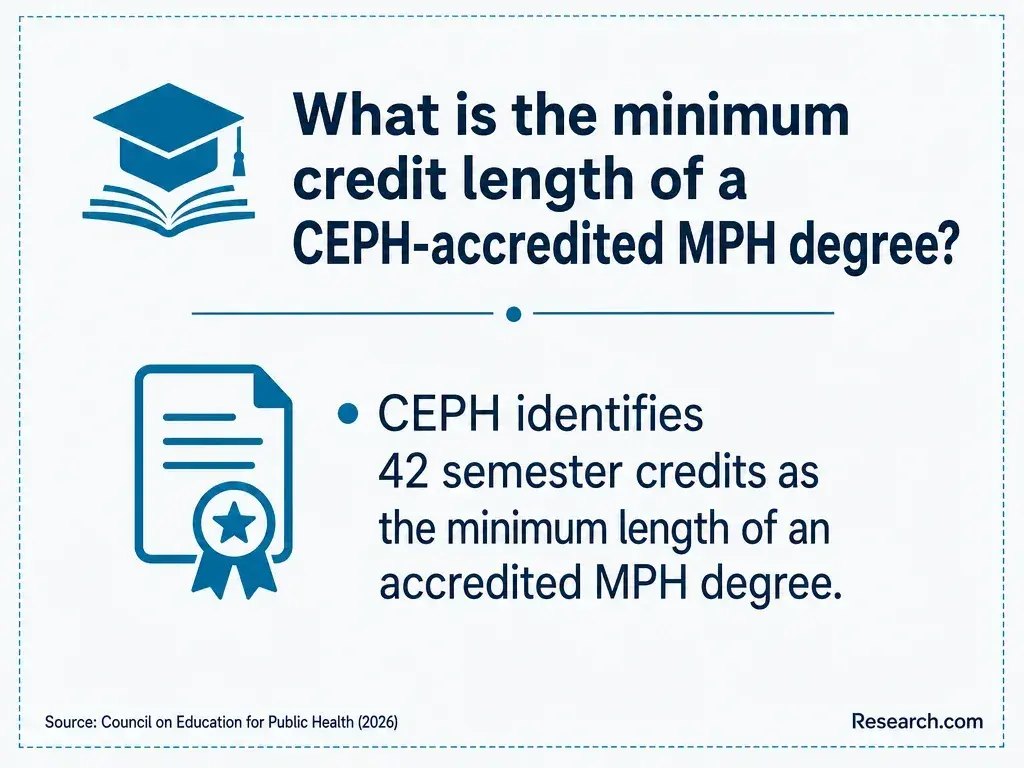
A conventional full-time bachelor's pathway is commonly planned around four academic years and about 120 semester credits. Your remaining time depends on accepted credits and how they satisfy requirements, prerequisite order, course availability, enrollment pace, and fieldwork scheduling. Do not treat an advertised accelerated format as a personalized graduation date.
For a useful cost comparison, request each school's tuition and mandatory fees for your expected credit load, then add books, technology, commuting or travel to a field site, and any reduction in paid work needed to complete an internship. Ask the financial aid office how your planned pace affects aid eligibility. Compare the resulting cost with the entry-level roles you would actually pursue, not with salaries attached to senior evaluation positions.
If you already have a bachelor's degree, include alternatives in that calculation: employer-supported training, a methods course, or a graduate program. Master of Public Health affordability comparisons can help frame that separate decision, but published tuition alone will not capture your fieldwork and opportunity costs.
Look for responsibilities rather than a single job title. Program assistant, evaluation assistant, research assistant, outreach coordinator, and some health education roles may involve tracking participation, checking data quality, helping administer surveys, summarizing interviews, or preparing reports. Requirements vary by employer; some research roles demand more statistical experience than a generalist BS provides.
A practical first-job strategy is to search postings for tasks such as data collection, program monitoring, reporting, and community engagement. Compare those tasks with your coursework and projects, then seek an internship or supervised volunteer assignment that fills a specific gap. A position devoted mainly to service delivery can still be valuable, but ask whether it offers a path to monitoring or evaluation duties.
Roles that independently design complex studies, lead evaluation teams, or direct research are usually later-career goals. To understand how graduate specializations relate to those paths, compare public health doctoral admissions comparison resources only after reviewing actual job requirements; a doctorate is not a prerequisite for entry-level evaluation support.
There is no single reliable wage figure for "community program evaluator." The work appears under different occupational titles, and compensation changes with employer, location, analytical responsibilities, and experience.
The U.S. Bureau of Labor Statistics reports wages for defined occupations such as health education specialists and community health workers, not for graduates of a particular public health BS or for every person who evaluates programs.
Use the latest Occupational Outlook Handbook wage and employment projections for the occupation that matches a posting's actual duties. Then compare local openings at the experience level you can meet. An occupation-wide median includes experienced workers and should not be treated as an entry-level offer or a return promised by the degree.
The same caution applies to additional education. A candidate contemplating research-intensive doctoral study should compare its costs and likely work with alternatives; finding affordable public health PhD study does not, by itself, establish that a PhD will raise earnings in a community evaluation role.
Do community program evaluators need certifications or advanced degrees?
There is no universal certification or graduate-degree requirement for all community program evaluation jobs. Employers set qualifications for specific positions. A BS plus relevant supervised work may fit an assistant role, while positions requiring independent study design, advanced analysis, or evaluation leadership may favor a master's degree and substantial experience.
Credentials such as Certified in Public Health or Certified Health Education Specialist have their own eligibility rules; a BS does not award either credential automatically. Check the certifying organization's current rules and the job posting before paying for an exam.
If a master's degree appears necessary for your target roles, start by comparing online MPH admission requirements, then examine each program's methods coursework and applied opportunities, not admission alone.
The best next step is to collect several postings for the work you want, identify recurring requirements, and compare them with a proposed BS degree map and fieldwork plan. That evidence will show whether you need a full degree, a stronger project portfolio, targeted methods training, or later graduate study.
Other Things You Should Know About Public Health Programs
It can demonstrate relevant skills if you clearly describe your role, methods, and supervision. Do not present a proposed plan or classroom exercise as an implemented community evaluation.
Start with a feasible question and assess the records available. An evaluation may first need a simple data-collection process; missing or inconsistent records should be reported, not hidden.
Not necessarily. Changes over time may have other explanations. Describe the comparison, timing, and limitations before making any causal claim.
Follow the school's and partner organization's procedures. Depending on the activity, questions about human-subjects research, privacy, consent, or data-use permission may need review by the appropriate offices before work begins.
- Evaluation Planning for Community Health Programs https://www.ruralhealthinfo.org/toolkits/rural-toolkit/4/evaluation-planning
- Evaluation Types and Data Requirements - NCBI https://www.ncbi.nlm.nih.gov/books/NBK594901/
- General Schedule Qualification Policies | U.S. Office of Personnel Management https://www.opm.gov/policy-data-oversight/classification-qualifications/general-schedule-qualification-policies/
- Best Practices | Field Study - UC Irvine https://fieldstudy.soceco.uci.edu/pages/best-practices
- Evaluation Consent and the Institutional Review Board Process | Meera https://meera.seas.umich.edu/evaluation-consent-and-institutional-review-board-process.html
- Course Assessment Plan Development | osu.edu https://drakeinstitute.osu.edu/institute-articles/course-assessment-plan-development
- Academic Internships | luc.edu https://catalog.luc.edu/undergraduate/university-requirements/engaged-learning/academic-internships/
- Bachelor of Science in Health Sciences: Public Health - NAU https://in.nau.edu/health-sciences/public-health/
- Practicum and Capstone: COPHP MPH | Health Systems and Population Health https://hspop.uw.edu/cophpmph/program-experience/practicum-capstone/