2027 From Medical Device Regulatory Work to Public Health: Choosing a Graduate Pathway

Co-Founder and Chief Data Scientist
Medical device regulatory work gives you experience with evidence, safety, and decisions that affect patients - but it does not automatically prepare you to study health across populations. If you want to move into surveillance, health policy, epidemiology, or broader technology assessment, the right graduate pathway depends on the work you want to do next. This guide compares degrees and career routes, identifies skills you may already have, and shows where coursework, applied experience, or a smaller training investment could close the gap.
Key Things You Should Know
- An MPH is usually the strongest fit for population-health practice or policy; a methods-intensive MS fits research and analysis, while a regulatory affairs qualification may be more direct if you plan to stay in device submissions and compliance.
- CEPH-accredited MPH programs require at least 42 semester credits, so compare the full cost and schedule - not just advertised tuition or online availability.
- Your regulatory experience can support a transition, but employers will still look for evidence of the target skill, such as epidemiologic analysis, program evaluation, or policy work.
What graduate public health degrees fit medical device regulatory professionals?
Start with the job you want, not the degree title. Regulatory work may have taught you to assess device evidence, interpret requirements, coordinate submissions, or monitor safety signals. Public health roles may use those strengths, but often ask different questions: Who is affected across a population, how is risk distributed, and which intervention or policy improves outcomes?
The main pathways differ in purpose. This comparison shows where each is most useful - and where it may add little to an established regulatory career.
| Pathway | Best fit | Key limitation to check |
| MPH | Population-health practice, policy, program evaluation, or health technology implementation | Generalist coursework may not provide advanced quantitative or device-specific training. |
| Research-oriented MS in epidemiology, biostatistics, or a related field | Study design, safety-data analysis, or research-intensive roles | Prerequisites, thesis expectations, and methods depth vary substantially. |
| Graduate certificate or targeted coursework | A defined gap, such as epidemiology, real-world evidence, or policy analysis | It may not meet a job posting's degree requirement or provide substantial supervised experience. |
| DrPH or PhD | Established practice leadership or sustained independent research, respectively | Neither is a necessary first step for most regulatory-to-public-health transitions. |
If your goal is to lead population-health programs, an MPH with relevant applied work is a sensible starting point. Choose an MS when the target job requires deeper statistical or research preparation; choose regulatory affairs training instead if the desired promotion remains primarily within submissions, quality systems, or compliance. Experienced professionals considering a doctorate can use a public health doctorate career value guide to test whether the additional commitment matches a specific leadership or research goal.
What careers can an MPH lead to in public health and medical device regulation?
An MPH can help a regulatory professional compete for work connecting device evidence to population decisions, but it is not a job qualification by itself. A plausible adjacent move is into postmarket safety or real-world evidence work that draws on existing device knowledge. A larger shift into epidemiology, community programs, or government policy usually requires a portfolio showing the new function in practice.
Relevant roles include device safety or surveillance analyst, health policy analyst, program evaluator, and public health program specialist. Depending on the employer, the work might involve assessing adverse-event reporting patterns, evaluating whether an intervention reaches intended groups, interpreting observational evidence, or preparing a policy brief. A job titled epidemiologist may demand substantially more study-design and analytical experience than a general MPH provides.
Before applying, compare several actual postings for one target role. Separate requirements you already meet from those you can demonstrate through an approved practicum, a supervised workplace project, or additional methods training. For compensation context, salary prospects with a Master of Public Health are most useful when compared with the specific occupation, location, and experience level you are targeting - not treated as a return promised by the degree.
How does CEPH accreditation affect public health graduate programs?
The Council on Education for Public Health (CEPH) accredits eligible public health schools and programs. Its review addresses public health education standards; it is different from an institution's accreditation. For an MPH applicant, CEPH status can be useful evidence of a structured public health curriculum and applied learning expectations, and it may matter to particular employers or credential pathways.
Check the accreditor's listing for the exact school or program, then ask the institution whether your intended degree, location, and delivery format fall within its accredited scope. Do not infer that every health-related MS at the same university is CEPH-accredited. CEPH-accredited MPH programs have a minimum of 42 semester credits, but programs may require more; the credit minimum alone says little about the relevance of electives or fieldwork to device safety.
A comparison of CEPH-accredited MPH program selection can help you build a shortlist. Verify accreditation scope and current curriculum directly before relying on any listing.
MPH coursework commonly covers epidemiology, biostatistics, health systems and policy, population health, and the social and structural conditions that shape outcomes. For someone from device regulation, the crucial shift is from evaluating whether a product meets requirements to asking how its use and effects vary across settings and groups.
Look for coursework and supervised projects matched to your intended work. Postmarket surveillance may call for epidemiologic study design, data quality assessment, and careful interpretation of observational findings. Policy or access work may call for health systems analysis, implementation, and evaluation. If you want to analyze device-use data, confirm that you can take methods courses at sufficient depth; a single introductory biostatistics course does not establish analyst-level proficiency.
Regulatory professionals who entered the field without a public health background can review online public health bachelor's admissions and coursework as a guide to foundational subject matter, not as a reason to earn a second bachelor's degree. A graduate prerequisite, introductory course, or certificate may address a specific gap more efficiently. For any project using device or patient information, establish data access, privacy requirements, and institutional review needs before promising an analysis.
Choose the format that lets you complete the relevant work, not simply the lectures. Online study may let you remain employed in regulatory affairs, while campus study may offer easier access to research teams, local public health partners, and in-person recruiting. Neither format guarantees a suitable device-related practicum or flexible scheduling.
Ask each program whether classes are live or asynchronous, when group work occurs, whether campus visits are mandatory, and who arranges field placements. If you hope to use your current employer as an applied practice site, obtain the program's approval first; ordinary job duties, employer permission, qualified supervision, and permission to use data are separate issues.
Compare total cost alongside scheduling. Travel, required visits, reduced work hours, and an extended part-time timeline can change the apparent price advantage of either format. A guide to comparing public health tuition and study length can help frame those trade-offs, but confirm each school's actual schedule and charges.
MPH programs generally expect a completed bachelor's degree and an application explaining your goals, but prerequisites, grade policies, references, tests, and experience requirements differ. A regulatory affairs background can make a credible case for interest in evidence and population impact; it does not automatically satisfy a program's statistics prerequisite or an MS program's advanced quantitative expectations.
Build an application around a specific transition. Explain what you have done - such as evidence review, safety monitoring, or cross-functional decision-making - then identify the public health question you are not yet equipped to answer. Check whether the program requires prior statistics or research methods, accepts introductory or online coursework, or offers a documented way to complete a prerequisite before enrollment. Ask an MS program about calculus, programming, or research preparation rather than assuming MPH and MS admission standards match.
Doctoral admission is a separate decision. If long-term leadership eventually becomes your aim, public health doctoral programs with broader entry options may suggest programs to investigate, but confirm each program's practice-experience definition, project expectations, and current requirements. Broader entry criteria do not remove the need to be ready for doctoral work.
Time and price depend on required credits, enrollment pace, tuition rules, and applied requirements. A working regulatory professional may prefer part-time study to preserve income, but a longer enrollment period can mean more terms of fees and a later career transition. An intensive schedule may shorten study while making it harder to complete a useful practicum.
Request a term-by-term plan and an itemized estimate from each finalist. Include tuition, mandatory fees, travel or residency expenses, supplies or software, and any unpaid time required for fieldwork. Then compare the total with the salary and advancement available without the degree. Employer tuition assistance is worth asking about, but confirm reimbursement limits, eligible programs, required grades, and any repayment obligation before counting it as funding.
Use public health master's tuition and salary comparisons as a screening tool rather than a personal return-on-investment forecast. A lower published tuition figure is not necessarily the lower total cost for your pace, location, and fieldwork arrangement.
There is no single license for public health work. Many policy, program, and analysis roles do not require a public health license, while particular employers may prefer a professional credential or require a license for an underlying clinical profession. An MPH does not itself confer clinical licensure or automatic certification.
The Certified in Public Health (CPH) credential has eligibility and examination rules set by its certifying body. Health education positions may reference Certified Health Education Specialist (CHES) or Master Certified Health Education Specialist (MCHES) requirements, which have distinct eligibility rules. Check the credential issuer and the actual job posting before paying for an exam or choosing courses solely to pursue it. Device regulatory roles may instead value specialized regulatory experience or credentials; a public health certificate is not a substitute for product-specific competence.
If you are advising a colleague who lacks a bachelor's degree about a bachelor's-entry health education route, a public health bachelor's affordability guide may be relevant. For an established regulatory professional who already has a bachelor's degree, that route is usually less direct than checking the target credential's eligibility rules or filling a defined skill gap.
There is no meaningful single salary for "an MPH graduate." Pay depends on occupation, employer, location, and experience - and a move from an established device-industry position to an entry-level public health role could mean lower pay initially.
For one occupation-specific benchmark, the U.S. Bureau of Labor Statistics reported a median annual wage of $83,980 for epidemiologists in May 2024. That is the median for employed epidemiologists across experience levels, not an expected starting salary for a regulatory professional who earns an MPH. It should not be applied to policy, program, or regulatory jobs with different responsibilities.
Evaluate a degree against the roles you can realistically enter and the earnings you would forgo while studying. If an online MPH is the best academic fit, investigate university-funded aid for online MPH programs and verify eligibility directly; reducing net cost may matter more to the decision than a broad occupational median.
How strong is the job outlook for public health careers?
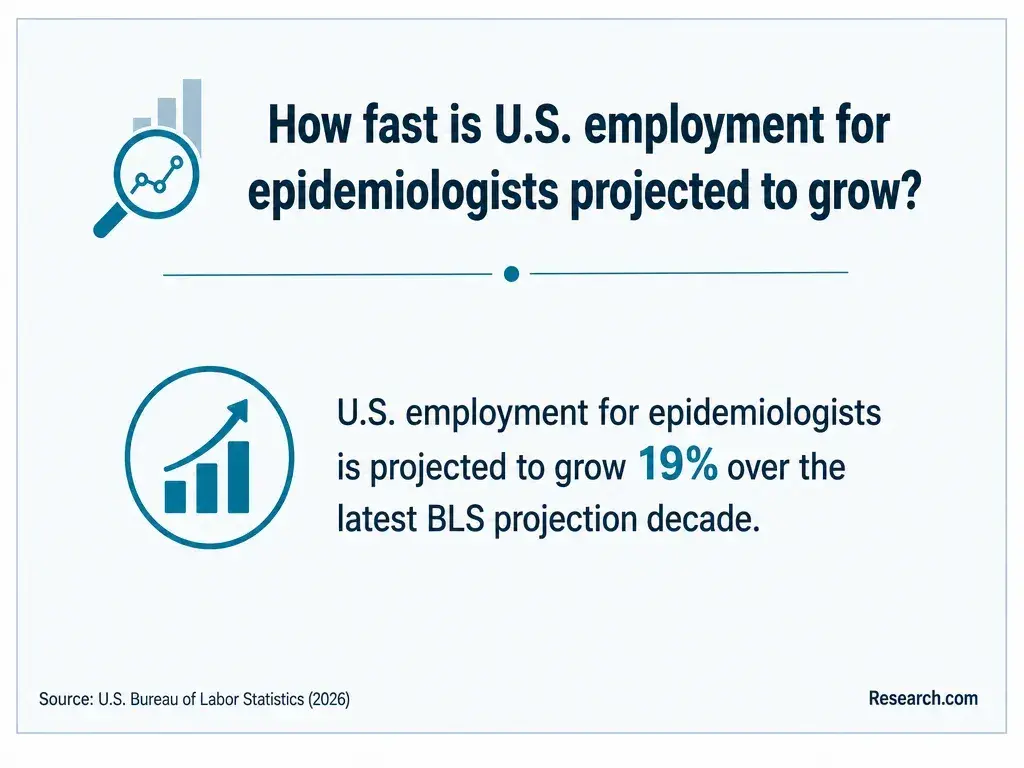
Outlook depends on the occupation, not the degree. The U.S. Bureau of Labor Statistics projected 16% employment growth for epidemiologists from 2024 to 2034. That projection describes an occupation-wide period and does not predict openings in medical device surveillance, hiring at a particular agency, or the prospects of an individual applicant.
For a practical market check, search separately for postmarket safety, real-world evidence, epidemiology, and public health policy roles in your preferred location. Compare their required methods, years of experience, and device knowledge. Your regulatory background may be an advantage in a safety-focused role yet less relevant to an epidemiology position centered on infectious disease or community surveillance.
If the postings that interest you consistently require independent research, an MPH alone may be insufficient. Investigate research experience, an MS, or - only when the career goal warrants it - grant-supported epidemiology doctoral pathways. Check funding terms and research fit rather than treating projected job growth as a reason to pursue a doctorate.
Other Things You Should Know About Public Health
Possibly, if the school approves the site, supervision, learning objectives, and deliverables. Your employer must also authorize the work and any data use; routine duties alone may not qualify.
No. Data access, confidentiality, permitted uses, and any required institutional review must be established first. A project can sometimes use public or appropriately authorized aggregate data instead.
Not necessarily. An internal safety, evidence, or policy project may help you test the transition and build relevant work samples while retaining income. Confirm that you may share any work sample externally.
Read the responsibilities, not just the title. Look for defined populations, measures of health outcomes or access, surveillance or evaluation tasks, and decisions made at a program or policy level rather than solely for an individual product submission.
- Students & Recent Graduates | U.S. Office of Personnel Management https://www.opm.gov/policy-data-oversight/hiring-information/students-recent-graduates/
- Evolution of Master of Public Health Core Curriculum - PMC https://pmc.ncbi.nlm.nih.gov/articles/PMC11574769/
- How to Study and Market Your Device | fda.gov https://www.fda.gov/medical-devices/device-advice-comprehensive-regulatory-assistance/how-study-and-market-your-device
- Working in Regulatory Affairs: Careers, Salaries, and Trends | Northeastern University Graduate Programs https://graduate.northeastern.edu/knowledge-hub/working-in-regulatory-affairs-careers-and-trends/
- Postmarket Surveillance - an overview https://www.sciencedirect.com/topics/engineering/postmarket-surveillance
- Graduate Admissions - UNC Catalog https://catalog.unc.edu/admissions/graduate/
- MPH vs MS vs MHA: Which Public Health Master's Degree Is Right for You? | Tulane WSPH https://sph.tulane.edu/mph-vs-ms-vs-mha
- How Regulatory Affairs Careers Shape Public Health Policy | SDSU Global Campus Blog https://cesblog.sdsu.edu/how-regulatory-affairs-careers-shape-public-health-policy/
- Top 10 Career Opportunities in Medical Device Development | jhu.edu https://advanced.jhu.edu/about/on-the-advance/mastering-your-future/top-10-career-opportunities-in-medical-device-development/
- What Is the Difference Between an MPH and MSPH Degree? | Emory University https://sph.emory.edu/degrees-programs/faq/mph-msph