2027 Best Online Career Training Programs With Monthly Start Dates

Co-Founder and Chief Data Scientist
Waiting for a traditional semester can delay a career change, especially when work and family schedules are already tight. Online career training programs with monthly or frequent starts can offer a faster entry point, but quality, licensing eligibility, and employer value differ widely.
The U.S. Bureau of Labor Statistics projects healthcare support occupations to grow faster than the average for all occupations from 2023 to 2033. This guide helps career changers and working adults compare program types, verify claims, estimate costs, and choose training that matches a realistic job goal.
Key Things You Should Know
- Monthly-start programs are most common in nondegree career training, online certificates, and some associate programs. Confirm the actual cohort date, required live sessions, and clinical or externship scheduling before paying a deposit.
- A school certificate is not the same as professional certification or a state license. Medical, legal, and skilled-trade roles may require a separate exam, supervised practice, background check, or state-approved education.
- For occupational context, BLS projects healthcare support occupations to grow faster than average from 2023 to 2033, but program completion alone does not guarantee employment, certification, licensure, or a particular salary.
Top 10 Best Online Career Training Programs With Monthly Start Dates
Popular Trade School Programs
Online trade training commonly covers electrical technician fundamentals, HVAC/R theory, welding concepts, construction management, automotive service, and industrial maintenance. Short noncredit certificates suit learners seeking foundational knowledge or exam preparation; credit-bearing certificates and associate degrees may include broader technical coursework.
Hands-on trades still require lab work, an employer apprenticeship, or supervised field experience. Choose online study for theory and scheduling flexibility, not as a substitute for required practical competencies. Ask whether tuition includes tools, safety equipment, exam fees, and any required in-person lab or partner-site training.
Healthcare Programs
Common options include medical billing and coding certificates, pharmacy technician training, medical assisting certificates, health information programs, and associate degrees in health-related fields. Billing and coding can often be taught fully online, while medical assisting and similar patient-facing pathways usually require an externship and may have state-specific rules.
A completion certificate may prepare students to pursue an industry certification exam, but it does not automatically confer certification. Verify whether the program meets employer expectations, includes exam preparation, and can arrange required clinical or practicum placement near your home.
Criminal Justice / Law Programs
Online programs may offer certificates or associate degrees in criminal justice, legal studies, paralegal studies, corrections, and public safety administration. These programs can build knowledge of legal research, procedure, ethics, report writing, and court systems.
Paralegal work is a particularly important distinction: employers may prefer formal education, but rules on paralegal use and supervision vary by jurisdiction, and paralegals cannot independently practice law. Learners seeking sworn law-enforcement roles should check agency hiring standards, physical requirements, academy training, and background-screening rules before enrolling.
Arts & Design Programs
Monthly-start online options often include graphic design, digital media, web design, photography, animation, interior design foundations, and UX-related training. Certificates can help beginners create portfolio pieces quickly, while associate degrees generally provide more design theory, software practice, and critique.
Employers in creative fields often evaluate portfolios more closely than the credential title, so review student work and required software before enrolling. Programs are strongest when they include feedback from experienced instructors, project deadlines, portfolio development, and a clear explanation of whether software subscriptions are included in total costs.
Which online career training programs start every month?
Programs with monthly start dates are usually offered by career colleges, adult-learning divisions, private training providers, and some online universities using rolling admissions. "Monthly start" may mean a new class begins each month, while self-paced enrollment may allow immediate access but provide less instructor interaction.
The most suitable format depends on whether your target job requires supervised practice. The following comparison separates programs that are often fully online from those that usually need local participation.
| Program type | Monthly-start availability | Typical delivery reality | Key verification point |
| Medical billing and coding | Common | Usually fully online | Exam preparation and coding-system coverage |
| IT support or cybersecurity training | Common | Online labs and simulations | Whether preparation aligns with a named certification exam |
| Paralegal or legal studies certificate | Common | Usually online | Employer recognition and local career expectations |
| HVAC, electrical, or automotive theory | Common | Online theory; practical work elsewhere | Lab, apprenticeship, and licensing pathway |
| Medical assisting | Sometimes | Online coursework plus externship | Placement support and state requirements |
Students who want a faster academic credential rather than short career training can also compare fast track college programs. An accelerated degree has a different admissions process, academic workload, and transfer-credit structure than most noncredit training programs.
Are online career training programs accredited and licensed?
Online career training can be legitimate and useful, but accreditation, approval, licensing, and certification are separate concepts.
Institutional accreditation applies to a college or school; programmatic accreditation applies to particular fields; state approval may be required for a school to operate; and professional certification is awarded by an independent organization after its own eligibility and exam requirements are met.
For roles involving patient care, regulated trades, or legal services, ask the school for a written answer to these questions before enrolling.
- Is the institution accredited by an accreditor recognized by the U.S. Department of Education or the Council for Higher Education Accreditation, if institutional accreditation is relevant to this program?
- Does the curriculum meet the education requirement for the specific certification examination or state license you plan to pursue?
- Are clinical hours, externships, lab hours, or supervised fieldwork required, and who is responsible for arranging them?
- Does the program operate legally in your state and disclose any state-specific enrollment restrictions?
A program may be worthwhile even if it is noncredit and not designed for licensure, such as software training or portfolio development. In that case, evaluate instructor expertise, employer relevance, student support, and the specific skills you will be able to demonstrate rather than assuming accreditation alone proves career value.
How do online career training programs compare with campus options?
Online training is often better for learners who need flexible study hours, want to avoid commuting, and are pursuing knowledge-based work such as coding, design, billing, or legal research. Campus or hybrid training is usually stronger for learners who need equipment access, repeated supervised practice, or immediate feedback on hands-on techniques.
This comparison shows the practical trade-off: convenience can be valuable, but it should not override training requirements for regulated or skill-intensive work.
| Decision factor | Online career training | Campus or hybrid option |
| Schedule | Often asynchronous with frequent starts | Usually fixed meeting times and term dates |
| Hands-on practice | May rely on home kits, simulations, or local placements | Usually includes direct lab or workshop access |
| Networking | Requires intentional use of virtual career services and externships | Can provide more in-person contact with peers and instructors |
| Best fit | Digital, administrative, theory-heavy, or upskilling goals | Clinical, mechanical, laboratory, and performance-based goals |
If your longer-term goal requires a graduate credential, compare admissions requirements separately rather than assuming a short program creates a graduate-school pathway. This overview of the easiest masters programs to get into can help clarify how degree admissions differ from career-training enrollment.
What do online career training programs teach?
Career training teaches job-focused knowledge and practice rather than the broad general education curriculum typical of an associate or bachelor's degree. Depending on the field, coursework may cover terminology, workplace software, documentation, customer communication, ethics, safety, regulations, troubleshooting, and portfolio or interview preparation.
Good programs connect each module to a visible job task. For example, a billing student should practice reading documentation and applying coding guidelines; a design student should create portfolio-ready projects; and an HVAC learner should understand safety, diagnostics, and the limits of online simulation.
Be cautious when a curriculum lists broad topics but does not identify software, equipment, assessments, instructor feedback, or practical assignments.
Artificial intelligence is also changing entry-level work. Training that teaches learners to use digital tools responsibly, verify automated output, protect confidential information, and explain their decisions may be more durable than training focused only on repetitive tasks.
What are the admission requirements for these programs?
Admission requirements vary more by provider than by subject. Many nondegree online career programs require a high school diploma or equivalent, identification, and basic technology access.
Some accept adult learners without a traditional academic transcript. Credit-bearing certificates and associate degrees may require an application, official transcripts, placement testing, or prerequisite coursework.
Before applying, use this sequence to avoid enrolling in a program that cannot serve your goal.
- Identify the exact job title, certification, or license you want within one to three years.
- Check the relevant employer, certification body, or state board requirements before speaking with admissions.
- Confirm that the school accepts students in your state and can support any required placement.
- Request the complete catalog, refund policy, total-cost disclosure, and credential awarded in writing.
- Compare the program's prerequisites with your education, schedule, and available study time.
Applicants rebuilding their education after justice involvement should evaluate programs for both admissions access and realistic employer screening. Resources on the best associate degrees for felons may be more appropriate when a credit-bearing associate degree is the better long-term route.
How long do online career training programs take and cost?
Completion time can range from a few weeks for a self-paced course to roughly two years for an associate degree.
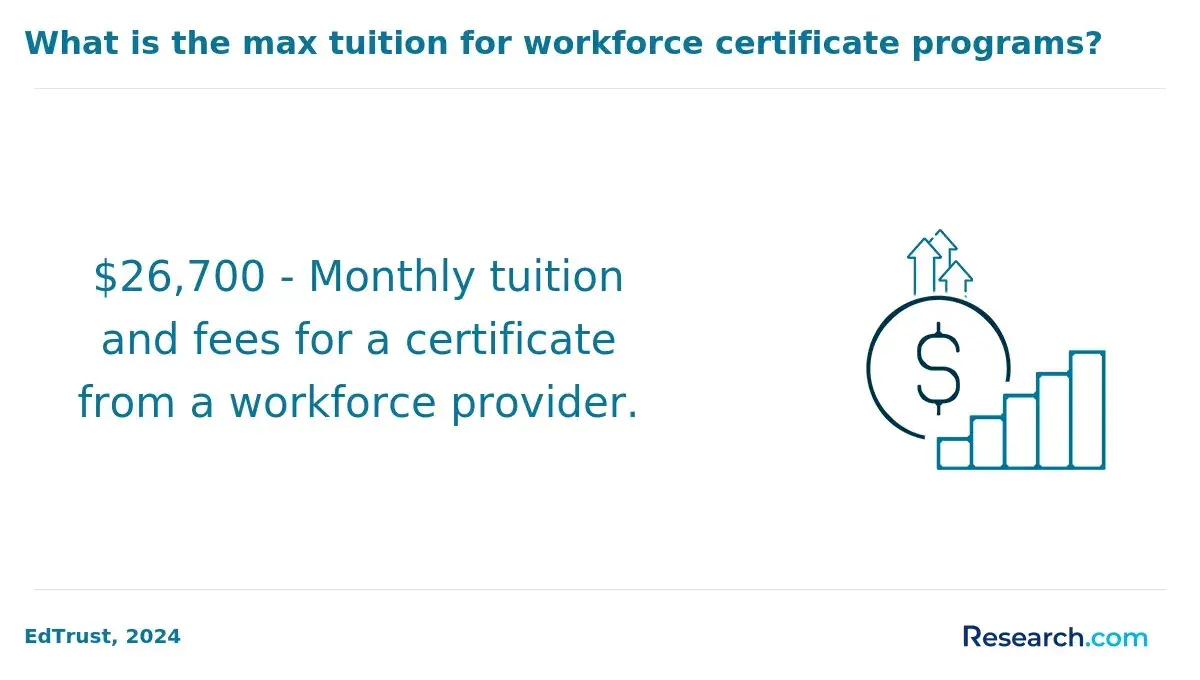
Monthly starts shorten the wait to begin; they do not necessarily shorten required instructional hours, clinical rotations, or time needed to develop competence. A low advertised tuition figure can also omit exam fees, books, software, supplies, background checks, uniforms, tools, and travel for practical training.
Use this cost-and-time framework to compare offers with different formats. The categories are ranges of program design, not a promise about a particular school's price.
| Credential format | Typical time pattern | Cost factors to compare | Transfer potential |
| Self-paced noncredit course | Weeks to months | Tuition, platform access, exam voucher | Usually limited |
| Career-training certificate | Months | Tuition, materials, externship, certification exam | Varies; often limited |
| Credit-bearing college certificate | Several months to about one year | Per-credit tuition, fees, books, lab costs | May transfer under school policy |
| Associate degree | About two academic years, sometimes accelerated | Per-credit tuition, fees, general education, supplies | Potentially stronger, subject to receiving-school review |
Federal student aid is generally tied to eligible programs at eligible institutions, not to every online course or private training provider. Ask whether aid is available, whether employer tuition assistance applies, and what happens financially if an externship cannot be scheduled.
Learners considering degree-level study should also compare the cheapest masters online options only when a master's degree is genuinely required for their intended advancement.
Which careers can these programs prepare you for?
These programs can prepare learners for entry-level or support roles, but the appropriate credential depends on the occupation. A short course may help an experienced worker add software skills, while a new entrant may need a longer certificate, supervised placement, associate degree, apprenticeship, or separate professional certification.
The examples below distinguish likely preparation from automatic qualification.
| Training focus | Possible entry-level direction | Important limitation |
| Medical billing and coding | Billing specialist, coding support, patient-account representative | Employers may prefer experience or an industry certification |
| IT support | Help desk technician, desktop support trainee | Hiring may depend on demonstrated troubleshooting ability and certifications |
| Digital design | Production artist, junior content designer, freelance creative work | Portfolio quality and software proficiency are central |
| Paralegal studies | Legal assistant or paralegal support role | Work must be supervised by an attorney; local expectations vary |
| HVAC or electrical theory | Apprentice or helper pathway | Hands-on training and licensing requirements remain necessary |
Choose a program only after matching it to job postings in your area. If postings repeatedly request a license, an associate degree, a named certification, or prior field experience, a brief online course by itself may not be enough.
What salaries and job outlooks do these careers offer?
Salary and demand depend on occupation, location, experience, shifts, employer, and credentials, not simply on whether a person completed online training. BLS occupational data is useful for judging the broader market, but it does not measure outcomes for graduates of a particular program.
The following U.S. occupational benchmarks use BLS median annual wage data for 2024 and 2023-2033 projected employment change. They provide context for career exploration, not salary guarantees.
| Occupation | 2024 median annual wage | Projected outlook, 2023-2033 | Training implication |
| Medical records specialists | $48,780 | Faster than average growth | Training in coding and health information can be relevant; employer requirements vary |
| Computer user support specialists | $60,340 | Decline projected | Foundational IT training may need to be paired with specialized skills and certifications |
| Paralegals and legal assistants | $61,010 | Little or no change projected | Formal education and legal-work experience can affect competitiveness |
| Graphic designers | $61,300 | Little or no change projected | A strong portfolio and current software skills are especially important |
| Heating, air conditioning, and refrigeration mechanics and installers | $59,810 | Much faster than average growth | Online theory should be combined with field training and applicable licensing steps |
Use occupational figures as a starting point, then review local job postings and wage information. A rapidly growing field can still have entry-level competition, while a stable field may offer solid opportunities for candidates with the right local experience.
How do you choose a reputable online career training program?
A reputable monthly-start program is transparent about what students receive, what they must do in person, and what the credential does and does not qualify them to pursue.
The strongest choice is not always the fastest or cheapest; it is the one that meets the requirements of your target role with manageable total cost and credible support.
Compare finalists using evidence rather than advertising language.
- Match the curriculum to local job descriptions, certification eligibility rules, or licensing-board requirements.
- Get total costs in writing, including supplies, software, exam fees, clinical requirements, and charges for extensions or retakes.
- Verify the credential type: noncredit completion certificate, academic certificate, associate degree, or preparation for a separate certification exam.
- Ask how instructors provide feedback, how quickly student services respond, and whether career help includes resume review, employer connections, or placement support.
- Read cancellation and refund terms before accepting financing, especially when enrollment is rolling.
- Request written confirmation of accreditation, state authorization, and any clinical, lab, or externship arrangements relevant to your state.
Common red flags include promises of guaranteed jobs or salaries, vague claims that a program is "accredited" without naming the accreditor, pressure to sign immediately, and refusal to disclose total costs. Also avoid assuming that monthly enrollment means you can begin practical training immediately; placement availability can be the real scheduling bottleneck.
Other Things You Should Know About the Best Online Career Training Programs
Many do, particularly nondegree programs and rolling-enrollment online courses. Confirm whether "monthly" means a new instructor-led cohort, an orientation date, or simply immediate access to self-paced materials.
Completion can build relevant skills, but hiring depends on the occupation, local demand, employer requirements, experience, portfolio quality, and any needed certification or license. Review actual job postings before enrolling.
Not necessarily, but accelerated pacing can make them feel more demanding. Ask about weekly workload, deadlines, live sessions, instructor availability, and the consequences of falling behind before choosing a start date.
Some eligible credit-bearing programs at eligible institutions may participate in federal aid programs. Many noncredit courses do not. Ask the provider about federal aid, state aid, employer assistance, payment plans, and refund terms.
References
- CourseCareers https://coursecareers.com/blog-posts/college-vs-online-career-training
- Online Career Training School and High School | U.S. Career Institute - USCI https://www.uscareerinstitute.edu/
- Getting Financial Assistance for Career Training https://ccitraining.edu/blog/getting-financial-assistance-for-career-training/
- For-profit workforce training, funded by public dollars https://hechingerreport.org/wasted-money-how-career-training-companies-scoop-up-federal-funds-with-little-oversight/
- Tech Training Programs for Career Transition - Merit America https://meritamerica.org/career-track/
- Why Employment Outcome Rates Matter | ACI Learning https://www.acitechacademy.com/blog/why-employment-outcome-rates-matter-a-guide-for-students-and-employers/
- Career Training and Trade School Loans https://www.salliemae.com/student-loans/career-training-loan/
- Online Career Training https://www.southeastmn.edu/continue_education/page.aspx