2027 Best Short Certificate Programs for Career Growth

Co-Founder and Chief Data Scientist
Choosing a short certificate program means balancing speed against whether the credential actually leads to the work you want. U.S. Bureau of Labor Statistics projections for 2023-33 show medical assistant employment growing 15%, faster than the average for all occupations. This guide compares practical certificate paths in trades, healthcare, law, and design; explains costs, recognition, licensing, and online options; and helps you identify when a short program is a smart career investment - and when a longer degree, apprenticeship, or certification is the better choice.
Key Things You Should Know
- Short certificate programs commonly take weeks to about one year, but a fast program is worthwhile only when its curriculum meets employer, certification-exam, or state licensing requirements for the target role.
- Healthcare and skilled-trade pathways can have strong demand: BLS projects 15% growth for medical assistants and 9% growth for heating, air conditioning, and refrigeration mechanics and installers from 2023-33.
- Compare total cost, supervised clinical or hands-on hours, accreditation, exam eligibility, and local job postings - not just advertised tuition or completion time - before enrolling.
Top 10 2026 Best Short Certificate Programs for Career Growth
Popular Trade School Programs
Short trade certificates can prepare learners for entry-level work in electrical, HVAC/R, welding, plumbing, construction, or industrial maintenance. HVAC certificates often cover refrigeration, electrical controls, and preparation for EPA Section 608 certification; welding programs emphasize process-specific practice and safety. An electrical certificate may support apprenticeship entry but usually does not replace the supervised hours required for a journeyman license. Choose campus-based training when shops, equipment, or employer partnerships matter most. BLS reported a $59,810 median annual wage for HVAC mechanics and installers in May 2024; that is occupational data, not a guaranteed certificate outcome.
Healthcare Programs
Common short healthcare options include medical assisting, dental assisting, pharmacy technician, phlebotomy, medical billing and coding, and practical nursing certificates. Clinical roles usually require in-person labs, externships, background checks, immunizations, and sometimes certification or state approval. Billing and coding may be more online-friendly, but employers can prefer documented coding knowledge or an industry certification. Medical assistant programs are a practical fit for people seeking patient-facing outpatient work; BLS projects 15% employment growth from 2023-33. Confirm whether the program qualifies graduates for a recognized certification examination before paying a deposit.
Criminal Justice / Law Programs
Legal assistant, paralegal studies, court reporting support, security, and criminal justice certificates can introduce legal research, writing, records management, ethics, and procedure. A paralegal certificate is an educational credential; it is not a law license and does not authorize independent legal practice. Programs may be best for degree holders changing fields or workers seeking legal-office skills. Some employers prefer programs approved by the American Bar Association, while requirements vary by employer and state. BLS reported a $61,010 median annual wage for paralegals and legal assistants in May 2024, reflecting the occupation overall rather than certificate-holder earnings alone.
Arts & Design Programs
Short certificates in graphic design, UX/UI foundations, digital marketing design, photography, animation, and web production build portfolio-ready technical skills. They suit learners who need targeted software training or a structured portfolio refresh, but employers often assess work samples more closely than the certificate title. Select programs with instructor feedback, copyright and accessibility instruction, and projects that can be shown publicly. A certificate alone may not qualify someone for senior design roles that expect a bachelor's degree or substantial experience. BLS listed a $61,300 median annual wage for graphic designers in May 2024, with pay varying widely by industry and location.
What are short certificate programs and who benefits most from them?
A short certificate program is a focused course of study that awards an educational credential after learners complete defined coursework, assessments, labs, or practica. Colleges, career schools, hospitals, unions, and private training providers may offer them. Completion can take a few weeks to roughly a year, depending on required hours and whether clinical or shop training is included.
It is important to separate a certificate from a certification. A certificate shows that a learner completed education; a professional certification is typically issued by an independent organization after an examination and, in some cases, experience requirements. A medical assistant certificate, for example, may prepare a student to seek certification, but it does not automatically confer the professional certification.
Short programs are strongest for career changers pursuing a defined entry role, workers needing a specific technical skill, and adults who already have a degree but need field-specific preparation. They are less suitable when the intended occupation requires a bachelor's degree, a state license with extensive supervised training, or a long apprenticeship.
The comparison below helps distinguish common short-program models before you apply.
| Program model | Best for | Typical outcome | Key limitation |
| Credit-bearing college certificate | Learners who may continue to an associate degree | Academic credential; some credits may stack | Transfer is never automatic |
| Career-school certificate | Rapid, occupation-specific training | Hands-on or career-focused preparation | Quality and licensing alignment vary |
| Industry training certificate | Skill upgrading or software training | Provider-issued completion credential | May have limited employer recognition |
| Professional certification prep | People pursuing an external exam | Education toward exam readiness | Exam eligibility and passing are separate |
How long do short certificate programs take and what do they cost?
Most short certificate programs range from several weeks for a narrowly focused online credential to nine to twelve months for programs with labs, clinical rotations, or extensive shop practice. Part-time schedules extend the calendar time but can make training manageable for working adults. Programs that promise unusually fast clinical, electrical, or licensing preparation deserve extra scrutiny because required contact hours cannot usually be replaced by videos alone.
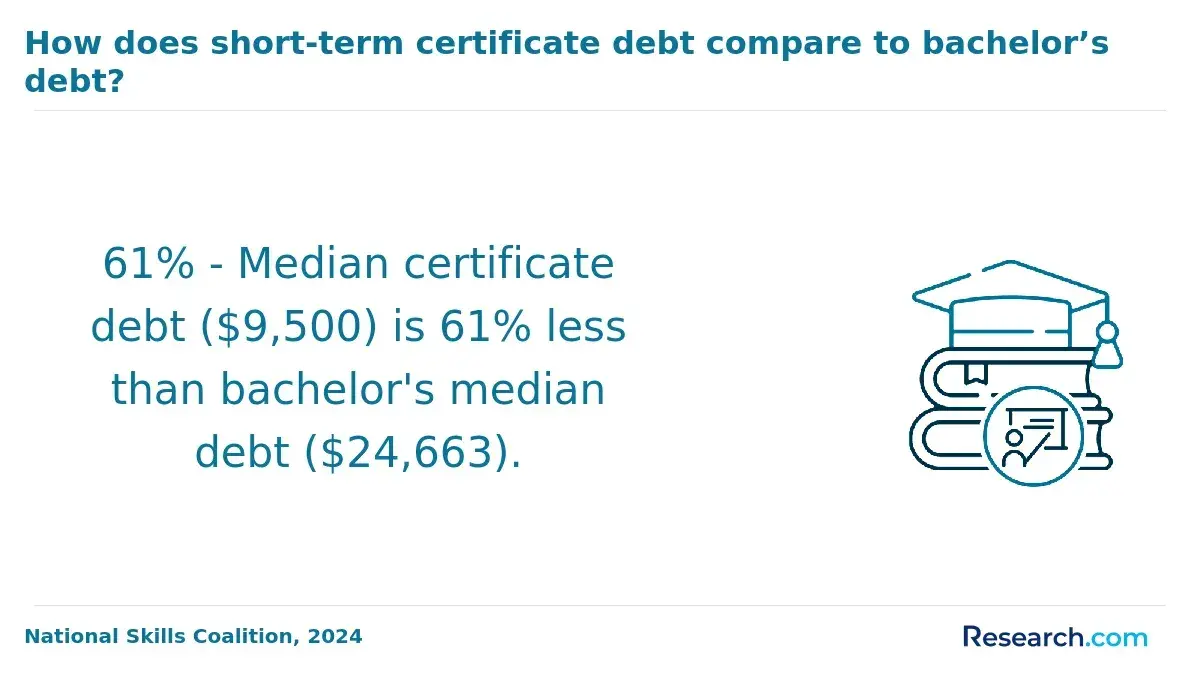
Cost depends more on provider type, equipment, required clinical placements, and location than on program length. Tuition is only one part of the decision: books, tools, uniforms, examinations, vaccinations, background checks, insurance, transportation, and licensing fees can materially change the total.
Use this cost checklist to request a written estimate before you enroll.
- Ask for tuition, mandatory institutional fees, and the amount due before the first class.
- Confirm whether tools, software licenses, textbooks, scrubs, safety equipment, and exam vouchers are included.
- For clinical programs, ask about drug screening, immunizations, CPR training, liability coverage, and travel to placements.
- For trade programs, price protective equipment, consumable materials, and any required licensing or certification exams.
Students seeking a credit-bearing program may be able to use federal aid if the school and program are eligible. Compare cheapest online colleges that accept FAFSA in USA options when affordability and federal-aid eligibility are central to your decision, but verify that the particular certificate - not merely the institution - qualifies for aid. Employer tuition assistance, workforce-agency funding, and apprenticeships can also reduce out-of-pocket cost.
How do online short certificate programs compare to campus-based options?
Online short certificate programs work well for theory-heavy subjects such as medical billing, legal research, project coordination, digital design, and software applications. They can offer asynchronous coursework and lower commuting costs. However, online delivery is not automatically better or cheaper once proctoring, software, equipment, or required in-person intensives are considered.
Campus or hybrid study is usually the safer choice for programs requiring clinical competencies, welding booths, electrical labs, HVAC equipment, anatomy labs, or direct instructor observation. For regulated occupations, confirm where practical hours occur and whether the format is accepted by the relevant state board or certifying organization.
This comparison highlights the decision factors that matter more than the delivery label.
| Factor | Online may fit best when | Campus or hybrid may fit best when |
| Schedule | You need asynchronous theory coursework | You can attend fixed labs or clinical shifts |
| Skill practice | Work is primarily digital or administrative | Competence requires tools, patients, or supervised practice |
| Networking | You already have industry contacts | You need local employer and instructor connections |
| Licensure alignment | The board explicitly accepts the format | The field requires verified in-person hours |
For a college-based online certificate, institutional quality still matters. Review accredited online colleges alongside the program's own outcomes, faculty qualifications, and licensure disclosures. Institutional accreditation does not by itself prove that a particular certificate meets every professional requirement.
What accreditation and licensing requirements should these certificate programs meet?
Accreditation and licensing are not universal requirements for short certificates, but they are essential checks in regulated fields. Institutional accreditation evaluates a college or school; programmatic accreditation evaluates a specific professional program; state approval may be required for private career schools; and occupational licensing is granted by a government board. These are different forms of oversight.
In healthcare, ask whether the program has the approval or accreditation needed for graduates to sit for the relevant certification exam or seek state authorization. In trades, verify state and local rules for apprenticeships, trainee registrations, supervised work hours, and examinations. A school's marketing statement that it is "licensed" or "accredited" should be supported by the name of the recognized agency and the program's status.
Before enrolling, complete these verification steps directly with the appropriate authority.
- Identify the exact job title and the state where you intend to work.
- Check the state licensing board or certifying organization for education, clinical-hour, and examination requirements.
- Ask the school in writing whether its specific program meets those requirements and whether there are exceptions by state.
- Confirm the school's institutional status and, where relevant, the program's specialized accreditation or approval.
Learners who may later need a graduate credential should not assume a short certificate creates a direct pathway. Compare prerequisites carefully before considering options such as the cheapest masters online programs, which generally require a bachelor's degree and may expect prior coursework.
What admission requirements and prior education do these programs typically expect?
Admission requirements vary by provider and credential type. Many entry-level career certificates require a high school diploma, GED, or equivalent, plus an application and identity documentation. Open-enrollment, noncredit programs may have few academic requirements but can still require basic computer skills or placement testing. College credit certificates may require formal admission, placement measures, or prerequisites in English, math, science, or computer applications.
Healthcare programs often add age requirements, criminal-background checks, drug screening, immunization records, CPR certification, and physical-capacity documentation before clinical placement. Competitive programs may use prerequisite grades or entrance assessments because clinical seats are limited. A prior degree can be useful for post-baccalaureate paralegal certificates or advanced technology certificates, but it is not standard for all programs.
Ask admissions staff for the requirements that apply to your cohort, not a general catalog description. Also ask whether prior learning, military training, or transfer credit can reduce time; noncredit certificates frequently do not transfer into degree programs. If your long-term goal is doctoral study, investigate degree prerequisites rather than assuming a short credential will suffice; an easiest PhD without dissertation option still generally requires substantial prior college education and may not fit every career goal.
What core courses and skills are covered in leading short certificate programs?
Leading short certificate programs emphasize a narrow, job-relevant skill set rather than broad general education. The best curriculum matches the actual tasks shown in local job postings and includes assessments that demonstrate competence, not merely attendance.
Core content differs by field, but these examples show what a credible program commonly covers.
| Pathway | Typical core learning | Evidence of readiness |
| HVAC/R | Electrical systems, refrigeration cycles, diagnostics, safety | Lab troubleshooting and EPA exam preparation |
| Medical assisting | Clinical procedures, medical terminology, records, patient communication | Supervised practicum and skills checkoffs |
| Paralegal studies | Legal research, drafting, litigation support, ethics | Research memoranda and document projects |
| Graphic or UX design | Design principles, software workflows, accessibility, portfolio development | Reviewed portfolio projects |
AI tools are changing routine drafting, design ideation, scheduling, and documentation tasks. Choose programs that teach verification, privacy, copyright, accessibility, and professional judgment alongside software use. A program that teaches only a single tool can age quickly; one that teaches workflows, communication, troubleshooting, and ethical practice is more durable.
What careers, job roles, and industries do short certificate programs support?
Short certificates support entry-level, support, technician, and specialist roles, but the credential's value depends on the employer, local labor market, prior experience, and any legal requirements. Read job advertisements in your target area before choosing a program: they reveal whether employers request a certificate, an external certification, an associate degree, a portfolio, or experience.
The following examples connect program types to realistic job directions without implying that completion alone secures employment.
| Certificate focus | Possible job roles | Industries | Important qualification note |
| HVAC/R or electrical fundamentals | Helper, installer trainee, maintenance technician | Construction, facilities, repair services | Licensure often requires supervised experience |
| Medical assisting or phlebotomy | Medical assistant, phlebotomist, clinical support worker | Clinics, physician offices, laboratories | Employers may prefer recognized certification |
| Billing and coding | Billing specialist, coding support, revenue-cycle assistant | Healthcare providers, insurers, billing firms | Experience and coding certification can matter |
| Paralegal studies | Legal assistant, litigation support assistant | Law firms, corporations, government | Independent legal practice is prohibited |
| Digital design | Junior designer, production artist, content designer | Agencies, marketing, in-house teams | Portfolio quality is often decisive |
For career changers, a certificate is most convincing when paired with a portfolio, practicum, apprenticeship, internship, volunteer work, or documented projects. If job postings consistently require a degree, plan for a stackable certificate or associate degree rather than expecting a brief program to overcome that requirement.
What salary ranges and earning potential can graduates realistically expect?
Salary research should start with the occupation and location, not a school's promotional wage claim. The BLS occupational median wage represents workers across education levels, experience levels, industries, and regions; it is not the salary a new certificate graduate should expect. Entry-level pay can be lower, while overtime, union coverage, specialty skills, and metropolitan markets can raise earnings.
May 2024 BLS data provides useful national context for several certificate-adjacent occupations.
| Occupation | May 2024 median annual wage | How to use the figure |
| Medical assistants | $44,200 | Compare with local entry-level postings and certification preferences |
| Dental assistants | $46,540 | Consider state functions and clinical requirements |
| HVAC mechanics and installers | $59,810 | Account for apprenticeship stage and licensing progression |
| Paralegals and legal assistants | $61,010 | Evaluate local employer degree and experience expectations |
| Graphic designers | $61,300 | Assess portfolio strength, industry, and freelance volatility |
To estimate return on investment, compare total educational cost plus foregone work time against conservative local starting-pay estimates. Give more weight to transparent placement definitions, employer partnerships, completion rates, and licensure-exam results than to a single advertised "average salary."
How can students choose a reputable short certificate program and avoid low-quality options?
A reputable short certificate program makes its credential, total costs, delivery format, eligibility requirements, and outcomes easy to verify. It should clearly explain whether the program awards academic credit, prepares students for an external exam, includes supervised practice, and is recognized by local employers or regulators.
Use these questions to compare programs before committing money or time.
- What exact credential will I receive, and is it a certificate of completion, academic certificate, exam-preparation course, or professional certification?
- Does the curriculum meet the education and practical-hour requirements for my target job, certification exam, or state license?
- What is the full cost through completion, including tools, books, background checks, clinical fees, exams, and retake charges?
- How many instructor-led, lab, clinical, or supervised-practice hours are included?
- What outcomes are reported, how are placements defined, and what employers hire recent completers?
- Can credits transfer or stack into a degree, and will that policy be provided in writing?
Common red flags include pressure to enroll immediately, vague claims of "accreditation," guaranteed jobs or salaries, no written refund policy, missing faculty information, and programs that do not disclose licensure limitations by state. Avoid choosing solely by the shortest advertised timeline. A slightly longer program with recognized clinical training, an apprenticeship connection, or a credible portfolio requirement can offer better career value.
The best choice is the smallest credible credential that meets your specific goal. Pick a short program for targeted entry skills; choose an apprenticeship for supervised trade progression; choose an associate or bachelor's degree when job postings, advancement pathways, or licensing rules consistently require one.
Other Things You Should Know About
They can be worthwhile when they teach a specific skill employers request and meet any required exam, licensing, clinical, or apprenticeship standards. They are less valuable when the credential is unrecognized, has no hands-on component for a hands-on job, or does not meet the education level required for the target role.
The fastest legitimate option depends on the occupation. Billing, software, customer-support, and some design certificates may take weeks or months, while patient-care and skilled-trade roles usually require more time because supervised practice, labs, or regulated training are involved. Verify local employer requirements before choosing speed over depth.
Possibly. Federal aid may be available for eligible programs at eligible institutions, while many short noncredit courses do not qualify. Ask the financial-aid office whether the specific program is eligible, then compare employer assistance, workforce grants, payment plans, and apprenticeship wages.
It depends on the role. Employers may value a certificate for targeted technical skills, especially when paired with experience or an industry certification. An associate degree can be stronger for jobs requiring broader coursework, advancement potential, or transferable academic credit. Review several local job postings to see which credential appears most often.
References
- The Top 5 Certificate Programs for Jobs With Growth Potential | CourseStorm https://www.coursestorm.com/blog/top-certificate-programs-for-jobs
- 9 Best Online Certificate Programs that Lead to Higher Pay https://blackstone.edu/9-best-online-programs-for-higher-pay/
- What You Should Know About Short-Term Certification Programs https://www.learnhowtobecome.org/career-resource-center/short-term-certifications/
- Upskilling Certificates: An Affordable Way to Increase Income https://allcampus.com/newsroom/upskilling-certificates-an-affordable-way-to-increase-income/
- 10 Learning and Development Courses to Accelerate Your Career Growth - Illumeo https://www.illumeo.com/learning-and-development-courses-career-growth/
- Best ROI Health Care Certificates 2026 https://www.healthjob.org/careers/best-roi-certificates
- CourseCareers https://coursecareers.com/blog-posts/why-employers-no-longer-require-college-degrees
- What certifications can help boost your career prospects? - MSU Denver https://www.msudenver.edu/innovative-lifelong-learning/blog/what-certifications-can-help-boost-your-career-prospects/
- What Professional Certificates Boost Your Career Fast? https://www.csinow.edu/blog/what-professional-certificates-boost-your-career-fast/
- Degree vs Certifications: What Employers Value Most in 2026 https://cccareersolutions.com/degree-vs-certifications-what-employers-value-most-2026/