
2027 Medical Illustrator Careers: Skills, Education, Salary & Job Outlook

Co-Founder and Chief Data Scientist
Choosing a medical illustrator career means deciding whether you want to build a profession at the intersection of science, art, technology, and healthcare communication. The work is highly specialized: medical illustrators do not simply make images look attractive; they translate anatomy, disease processes, surgical procedures, devices, and research findings into visuals that clinicians, students, patients, legal teams, and the public can understand.
The path is demanding because employers often expect strong drawing ability, biomedical science knowledge, digital production skills, and, for many professional roles, graduate-level preparation. Competitive admission to accredited programs can make the route feel narrow. At the same time, that high barrier is part of what gives the field its value. Medical illustrator careers are reported with median salaries between $62,000 and $71,000, and self-employed professionals may earn more depending on clients, specialization, reputation, and business skills.
This guide explains what medical illustrators do, the skills and education typically required, how earning potential and job outlook are described, where these professionals work, and what advancement can look like. Use it to decide whether this career fits your strengths, tolerance for rigorous training, and long-term goals in visual science communication.
Key Things You Should Know About Medical Illustrator Career
- A medical illustrator typically earns between $64,853 and $71,134 annually, with some self-employed professionals reaching up to $85,000.
- The field maintains steady demand due to ongoing healthcare and educational needs, though it is niche with relatively slow growth compared to other health professions.
- Entering this career requires a master's degree in medical illustration from an accredited program, usually after earning a bachelor's degree in art, biology, or a related field.
- Success depends on strong drawing and digital illustration skills, deep knowledge of human anatomy and life sciences, proficiency with medical imaging software, clear communication, and teamwork abilities.
- Career growth can lead to senior or lead illustrator roles, specialization in animation or 3D modeling, art direction, teaching, or launching a freelance business or firm.
What do Medical Illustrators do?
Medical illustrators create accurate visual explanations of medical, biological, and scientific information. Their work may appear in textbooks, journal articles, surgical training materials, patient education handouts, museum exhibits, legal presentations, pharmaceutical materials, medical apps, animations, and 3D learning tools.
The core purpose is always the same: make complex information easier to understand without distorting the science. A medical illustrator must know what to show, what to simplify, what to leave out, and how to present a subject for the intended audience. A visual made for a surgeon will differ from one made for a first-year student or a patient preparing for a procedure.
A Day in the Life of Medical Illustrators
A typical day often combines research, creative production, and expert review. A medical illustrator may read scientific papers, study imaging scans, consult with physicians, sketch concepts, build a 3D model, refine an animation sequence, or revise a figure after feedback from a researcher or editor.
Some work is studio-based and highly focused; other projects require collaboration in hospitals, labs, academic departments, or publishing teams. Depending on the role, medical illustrators may produce anatomical drawings, surgical illustrations, infographics, educational animations, interactive modules, or digital assets for websites and apps. The job rewards people who enjoy precision, independent problem-solving, and communication across disciplines.
What are the key responsibilities of Medical Illustrators?
Medical illustrators are responsible for turning specialized medical information into visuals that are both scientifically reliable and visually clear. The work usually involves more than drawing; it requires research, judgment, revision, and collaboration with subject-matter experts.
- Research medical topics, procedures, anatomy, pathology, devices, or biological processes before beginning a visual project.
- Review scientific papers, clinical references, imaging studies, and expert notes to understand the subject accurately.
- Observe surgeries, examinations, dissections, or laboratory work when firsthand reference is needed.
- Create illustrations, diagrams, animations, 3D models, interactive media, or presentation graphics using traditional and digital tools.
- Meet with physicians, researchers, educators, publishers, attorneys, or clients to clarify goals, audiences, and accuracy requirements.
- Revise artwork based on feedback while preserving both scientific accuracy and visual clarity.
- Prepare final files for textbooks, journals, patient resources, advertising, legal exhibits, training videos, websites, or other media.
- Manage project timelines, technical assets, equipment, software, and client communication.
- Promote services or maintain professional relationships with medical, scientific, legal, and publishing clients when working independently.
The Most Challenging vs. The Most Rewarding Tasks
The hardest part of the job is often interpretation. Medical illustrators may receive dense source material, incomplete references, or conflicting input from multiple experts. They must decide how to represent structures, proportions, spatial relationships, and sequences without introducing errors. This is especially challenging for rare conditions, new surgical techniques, emerging devices, or research topics with limited visual precedent.
The most rewarding part is impact. A strong medical illustration can help a student understand anatomy, help a patient feel less overwhelmed, help a surgeon teach a procedure, or help a jury interpret medical evidence. The work is practical, educational, and often deeply meaningful because it improves communication in situations where clarity matters.
If you are still comparing career-entry options, reviewing short certificate programs that pay well can help you understand how focused training compares with the longer preparation usually associated with medical illustration.
What are the key skills for Medical Illustrators?
Medical illustrators need an uncommon mix of science, art, software fluency, and communication ability. Employers and clients look for professionals who can understand complex biomedical information, choose the right visual approach, and deliver polished work that is accurate enough for professional use.
The strongest candidates usually build a portfolio that proves both artistic skill and scientific judgment. Beautiful images are not enough if the anatomy is wrong; technically correct diagrams are not enough if the audience cannot understand them.
Key Hard Skills
- Observational Drawing: Ability to draw anatomy, tissues, instruments, and spatial relationships accurately from references, specimens, imaging, or expert guidance.
- Digital Art Technology and Tools: Skill with digital illustration, image editing, animation, 3D modeling, and production workflows used in professional visual communication.
- Biomedical Science Knowledge: Understanding of anatomy, physiology, pathology, cell biology, and medical terminology well enough to interpret source material correctly.
- Anatomical Visualization: Capacity to mentally rotate structures, simplify complex forms, and show hidden or layered anatomy in a way that supports learning.
Essential Soft Skills
- Attention to Detail: Accuracy matters because a small visual error can change the meaning of a medical explanation.
- Active Listening: Medical illustrators must understand feedback from physicians, researchers, editors, and clients who may not speak in visual terms.
- Critical Thinking: The job requires deciding what information is essential, what can be simplified, and how to avoid misleading the viewer.
- Complex Problem Solving: Many projects involve explaining difficult concepts, invisible processes, or procedures that unfold over time.
The One Overlooked Skill That Separates the Good from the Great
Clear communication is often the skill that separates a competent medical illustrator from an exceptional one. The best professionals can ask precise questions, translate expert feedback into visual decisions, and explain why a particular composition, viewpoint, or level of detail serves the audience.
For example, an illustrator creating a surgical animation must confirm the sequence of steps, the orientation of the anatomy, the appearance of instruments, and the degree of simplification appropriate for learners. Poor communication can lead to subtle anatomical mistakes or confusing teaching materials. Strong communication helps the team reach a final product that is accurate, teachable, and useful.
This skill is especially valuable in specialized settings such as the Scientific Research and Development Services industry, which offers the highest pay levels. Professionals who want flexible ways to keep learning may also compare options such as online programs for seniors, particularly if they are building digital, science, or communication skills later in their careers.
Medical Illustrator Careers: A Step-by-Step Guide to Getting Started
Becoming a medical illustrator usually requires deliberate preparation in both art and science. The path is more structured than many creative careers because the work must meet professional medical standards, but there is still room to shape your portfolio around your interests.
- Build strong foundations in drawing, design, digital media, biology, anatomy, and scientific observation.
- Take coursework or pursue formal education that combines biomedical science with visual communication.
- Develop a portfolio that shows anatomical accuracy, visual clarity, storytelling, and technical range across traditional and digital formats.
- Seek internships, assistant roles, freelance projects, research collaborations, or supervised practicum experiences that expose you to real medical communication work.
- Get feedback from medical illustrators, art faculty, science faculty, clinicians, or admissions reviewers before applying to competitive programs or jobs.
- Join professional networks, attend portfolio reviews, and learn the expectations of employers in academic, hospital, publishing, legal, research, and commercial settings.
- Consider specialization in areas such as surgical illustration, 3D modeling, animation, interactive media, legal visuals, or patient education.
The most common mistake is treating the field as either “art with some science” or “science with some art.” Medical illustration requires both. A competitive candidate can draw and design well, but also understands enough biology and medicine to make informed visual decisions.
What education, training, or certifications are required?
The most common preparation for a professional Medical Illustrator role starts with a Bachelor's degree that combines biological sciences, such as anatomy and cell biology, with strong art training, especially life drawing and digital illustration. Some institutions offer specialized undergraduate options such as Pre-Medical Illustration.
For many professional-level roles, a Master's degree in Medical Illustration or Medical and Biological Illustration from a CAAHEP-accredited program is typically required. These programs are designed to integrate graduate-level biomedical study, visual communication, clinical observation, digital production, and portfolio development.
Certification is also important for experienced professionals. The Certified Medical Illustrator (CMI) credential is granted by the Board of Certification of Medical Illustrators under the Association of Medical Illustrators. It signals advanced competence and professional credibility, although no state licensure or formal residency is mandated. Graduate programs commonly include internships or practicum experiences that provide supervised clinical, academic, or research-based training.
Are advanced degrees or niche certifications worth the investment?
Advanced degrees such as the Master of Arts or Master of Science in Medical Illustration can be worth the investment for people who want access to specialized professional roles, faculty positions, higher-level scientific communication work, and stronger industry credibility. Graduates from accredited programs generally command higher starting salaries and enjoy better job security, while CMI certification can strengthen reputation and access to niche markets.
The trade-off is that these programs are competitive and costly, often lasting two years with additional time needed for prerequisite coursework and portfolio preparation. Because the field is small, the return on investment depends heavily on the quality of your work, your digital capabilities, your professional network, and your ability to find clients or employers that need specialized medical visuals.
It is possible to work in related visual communication roles without an advanced degree or certification, but advancement and earnings may be more limited in core medical illustration positions. If you are comparing graduate-level pathways, reviewing fields associated with the highest paying jobs master's degree holders pursue can help you weigh the cost, specialization, and career fit of advanced study.
What is the earning potential for Medical Illustrators?
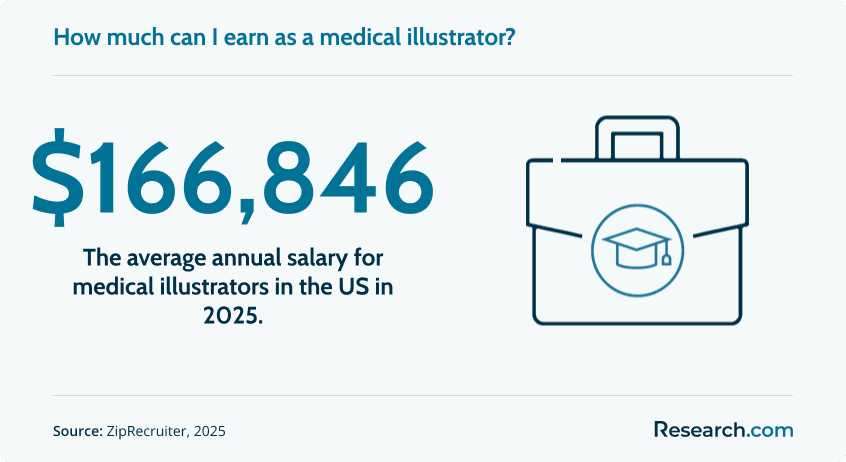
The medical illustrator salary range 2025 shows a wide spread because compensation depends on experience, specialization, employment setting, location, reputation, and whether the professional is salaried or self-employed. Annual salaries span from $74,500 at the entry-level to $250,000 for senior professionals, with top earners reaching as high as $270,000. The median salary is reported at $166,846.
The medical illustrator starting salary averages around $74,500 per year. Earnings can rise as professionals develop advanced skills in surgical visualization, animation, 3D modeling, interactive media, legal illustration, pharmaceutical communication, or leadership. Self-employed medical illustrators may have higher upside, but they also manage business development, pricing, taxes, client acquisition, contracts, and periods of uneven demand.
When evaluating earning potential, look beyond the headline salary. Consider the cost of required education, the competitiveness of the field, the strength of your portfolio, and the types of employers or clients you can realistically access. A medical illustrator with strong digital production skills and a clear specialty may have more leverage than a generalist with limited technical range.
What is the job outlook for Medical Illustrators?
The projected 10-year growth rate for medical illustrators is 5% from 2019 to 2029, which is faster than the average for all occupations. The field is small and specialized, so job availability can vary by location and niche. However, demand is supported by healthcare education, medical research, patient communication, legal medicine, digital publishing, and the continuing need to explain complex scientific information visually.
The Key Factors Shaping the Future Outlook
Technology is one of the biggest forces shaping the profession. Medical illustrators who can work with digital illustration, animation, 3D modeling, interactive platforms, and AR/VR tools may be better positioned for emerging opportunities than those who rely only on static images.
Healthcare and research growth also create ongoing demand for accurate visuals. New procedures, treatments, devices, and discoveries need to be explained to clinicians, students, patients, investors, regulators, and the public. As communication channels expand across websites, apps, video platforms, and social media, medical illustrators may be asked to create more flexible visual assets that can work across multiple formats.
The outlook is strongest for professionals who combine scientific accuracy with modern production skills. Those considering further academic specialization may explore options such as 1 year PhD programs, but doctoral study should be evaluated carefully against the specific roles you want, since medical illustration advancement often depends more on portfolio quality and specialized technical ability than on degree level alone.
What is the typical work environment for Medical Illustrators?
The medical illustrator work environment is usually office- or studio-based, with employers commonly found in medical schools, hospitals, research institutions, publishing companies, and specialized visual communication studios. Most professionals work where the majority are employed-about 35-40% in academic health centers, 20-25% in hospitals, and 15-20% in publishing and research organizations.
Although the finished work is often produced on a computer, medical illustrators may occasionally enter clinical, surgical, or laboratory environments to observe procedures, review anatomy, or gather visual references. These visits require professionalism, discretion, and respect for patient privacy and institutional rules.
Collaboration is common. Medical illustrators may work with physicians, scientists, editors, instructional designers, animators, developers, attorneys, marketing teams, or project managers. Remote work has become more practical because digital files and review tools are widely used, but institutional roles may still require onsite work depending on the employer and project needs.
The medical illustrator work schedule often follows standard business hours, Monday through Friday, from 9 to 5. Deadlines can create overtime or flexible hours, especially for urgent client projects, publication schedules, grants, courtroom deadlines, or product launches. Freelancers may have more control over scheduling but also carry the burden of managing multiple clients and unpredictable workloads.
What are the pros and cons of Medical Illustrator careers?
Medical illustration can be deeply satisfying for people who enjoy science, art, precision, and meaningful communication. It can also be stressful because the work is exacting, the field is small, and the path to professional-level roles can be competitive.
Pros
- Meaningful work that supports medical education, patient understanding, research communication, and healthcare training.
- Unusual blend of creative practice and scientific problem-solving.
- Opportunities to specialize in surgical illustration, animation, interactive media, legal visuals, pharmaceutical communication, or academic publishing.
- Potential for strong earnings as skills, reputation, and specialization increase.
- Project variety across textbooks, journals, videos, apps, exhibits, legal cases, and patient materials.
Cons
- High training expectations, often including advanced coursework in both biomedical science and visual communication.
- Competitive admissions and a relatively small job market compared with broader design fields.
- Pressure to maintain scientific accuracy, since mistakes can misinform learners or clients.
- Tight deadlines and revision-heavy workflows, especially when multiple experts review the same project.
- Possible isolation for freelancers or specialists working independently on highly technical topics.
A good fit is someone who enjoys research as much as image-making, accepts detailed critique, and can stay patient through complex revisions. Students who want to prepare early may consider academic combinations that strengthen both sides of the field; reviewing dual major programs can help you think through ways to pair art, biology, design, or communication studies.
What are the opportunities for advancement for Medical Illustrators?
Advancement in medical illustration can happen in two main ways: moving into higher-responsibility roles or developing a profitable specialty. Because the field is specialized, career growth often depends on portfolio quality, technical sophistication, subject-matter expertise, client relationships, and the ability to manage complex projects.
Medical Illustrator Promotion Pathways
Many professionals begin with supervised production work and gradually take on more complex assignments, client communication, creative direction, or team leadership.
- Entry-Level Medical Illustrator: Produces illustrations, diagrams, or digital assets under supervision for education, publishing, clinical, or research use.
- Senior Medical Illustrator / Specialist: Leads more complex projects, manages expert feedback, develops advanced visuals, and may specialize in areas such as surgery, pathology, or interactive media.
- Art Director / Project Manager / Department Head: Oversees teams, budgets, timelines, client relationships, quality control, and broader visual strategy.
- Independent Studio Owner or Consultant: Builds a client base, sets pricing, manages contracts, and delivers specialized medical visual communication services.
Areas for Specialization
Specialization can make a medical illustrator more competitive because clients often need visuals for highly specific audiences and formats.
- Surgical and Anatomical Illustration: Detailed images for textbooks, operative guides, professional education, and research publications.
- Medical Animation and Interactive Media: 2D/3D animations, apps, simulations, and learning modules for students, clinicians, or patients.
- Legal and Forensic Illustration: Visual explanations of injuries, procedures, anatomy, or medical evidence for courtroom and investigative use.
- Pharmaceutical and Marketing Illustration: Visuals for drug mechanisms, product education, packaging, campaigns, and professional presentations.
- Biomedical Visualization: 3D models, immersive tools, and digital learning environments for anatomy, procedures, and scientific concepts.
The best advancement strategy is to choose a specialty that matches your strengths and market demand. A professional who combines deep subject expertise with strong digital delivery skills may have more options than one who remains broadly skilled but undifferentiated.
What other careers should you consider?
If medical illustration interests you but the training route, job market, or subject matter feels too narrow, several related careers may still let you combine science, visual communication, and education. Comparing alternatives can also help you identify which part of the field attracts you most: drawing, animation, science writing, patient education, technology, or clinical documentation.
- Scientific Illustrator: Creates accurate visuals for biology, ecology, paleontology, botany, zoology, or other scientific fields. This may be a better fit if you enjoy science broadly but do not want to focus primarily on medicine.
- Medical Animator: Uses motion graphics, 2D animation, 3D animation, and multimedia storytelling to explain anatomy, procedures, devices, or biological processes over time.
- Clinical Photographer: Documents patients, anatomy, procedures, specimens, or treatment progress using precise photographic techniques and medical protocols.
- Graphic Designer in Healthcare: Designs patient education materials, hospital communications, public health campaigns, reports, infographics, and digital content for healthcare organizations.
- Biomedical Visualization Specialist: Builds 3D models, simulations, AR/VR tools, and interactive learning experiences for medical training, anatomy education, or research communication.
Choose the path that best matches how you like to work. If you enjoy detailed anatomy and static visual explanation, medical illustration may fit well. If you prefer motion, technology, and storytelling over time, medical animation or biomedical visualization may be stronger options. If you want broader design work with a healthcare mission, healthcare graphic design may offer a wider job market.
Here's What Professionals Say About Their Medical Illustrator Careers
- Jommel: "The moment I first learned about medical illustration, it felt like everything I loved-science, anatomy, and detailed drawing-came together perfectly. I still remember staying up late to refine the layers in a complex surgical diagram, knowing it would help students grasp difficult procedures. Being able to bridge the gap between art and medicine gives me a sense of purpose every time I pick up my stylus. It's incredibly rewarding to see my work in textbooks and realize I'm contributing to education in a meaningful way."
- Roger: "Balancing the demanding coursework that merged advanced biology and fine art was by far the toughest part of my career path. There were many days when I hadn't drawn anything for hours because I was caught up in research or consultations with doctors, which tested my patience and focus. Holding onto my passion meant accepting those challenges and pushing through the slow days where creativity felt distant. But each piece I finalize reminds me why precision and perseverance matter in medical illustration."
- Rodrigo: "Every time I get to draw new anatomical illustrations or patient education graphics, I feel a deep satisfaction knowing how important clear visuals are in health communication. It's not just about creating pretty images; it's about empathy and making complex topics understandable for those who need it most. After years of honing my skills, seeing my work support doctors and educators feels like the perfect blend of art and healing. I find joy in every line I draw because it directly impacts learning and recovery."
Key Findings
- Medical illustrators create accurate visual explanations of medical and scientific subjects for education, clinical communication, research, publishing, legal use, and digital media.
- The career requires both strong art skills and biomedical knowledge; neither side is optional for professional-level work.
- A Bachelor's degree with coursework in biological sciences and art is a common starting point, while a Master's degree in Medical Illustration or Medical and Biological Illustration from a CAAHEP-accredited program is typically required for many professional roles.
- The Certified Medical Illustrator (CMI) credential can strengthen professional credibility, but no state licensure or formal residency is mandated.
- The medical illustrator salary range 2025 spans from $74,500 at the entry-level to $250,000 for senior professionals, with top earners reaching as high as $270,000 and a reported median salary of $166,846.
- The projected 10-year growth rate is 5% from 2019 to 2029, supported by healthcare education, research, digital media, and demand for clear scientific communication.
- Common work settings include academic health centers, hospitals, publishing organizations, research institutions, studios, and freelance home offices.
- The best candidates build portfolios that prove accuracy, clarity, digital skill, and the ability to communicate with medical and scientific experts.
Other Things You Should Know About Medical Illustrator
Most employers expect a bachelor’s degree plus a graduate certificate or master’s degree in biomedical visualization from an accredited program. The Association of Medical Illustrators also requires a strong portfolio for Certified Medical Illustrator candidacy, along with passing its board certification exam.
As of 2027, medical illustrators can pursue the Certified Medical Illustrator (CMI) designation through the Board of Certification of Medical Illustrators. This certification requires passing a comprehensive exam and maintaining a portfolio review, ensuring adherence to professional standards in the field.
References
- Interview with a Medical Illustrator - Job Shadow https://jobshadow.com/interview-with-a-medical-illustrator/
- Medical Illustrator / Animator https://explorehealthcareers.org/careers/allied-health-professions/medical-illustrator-animator/
- Medical illustrator https://nationalcareers.service.gov.uk/job-profiles/medical-illustrator
- Education - Association of Medical Illustrators https://www.ami.org/medical-illustration/enter-the-profession/education
- How to Become a Medical Illustrator: Career Path & Guide | Himalayas https://himalayas.app/career-guides/medical-illustrator
- Merging art & science – an alternative science career | NEB https://www.neb.com/en/nebinspired-blog/merging-art-and-science-an-alternative-science-career
- Should You Become A Medical Illustrator? More Insight Into The Career - Wacom https://community.wacom.com/en-au/should-you-become-a-medical-illustrator-more-insight-into-the-career/
- Medical Illustrator Job Description and Top Skills - Glider AI https://glider.ai/blog/medical-illustrator-job-description/


