
2027 Child Care Provider Careers: Skills, Education, Salary & Job Outlook

Co-Founder and Chief Data Scientist
Choosing a child care provider career means deciding whether you are ready for work that is hands-on, regulated, emotionally demanding, and deeply important to families. The job is not simply “watching children.” Providers protect children’s safety, support early development, manage routines, communicate with parents, and often meet state training, background check, and certification requirements.
Entry into the field is usually accessible: many roles begin with a high school diploma or equivalent, practical training, and required safety credentials. From there, providers can build experience, earn credentials such as first aid certification or early childhood education training, and move into lead, specialized, or administrative roles.
The outlook is mixed. Some projections show employment declining by 3%, while this guide also discusses a 1% projected decline through 2033. Even with limited growth, turnover and retirements create more than 160,000 annual openings, which keeps the field relevant for people who want steady opportunities in direct care. Pay also varies widely by setting, location, education, and responsibility, with figures in this guide ranging from a median annual wage of $28,520 to broader salary references around $32,000 to $43,000.
This guide explains what child care providers do, what skills and credentials matter, how to get started, what the work environment is like, and how to decide whether this career fits your strengths and long-term goals.
Key Things You Should Know About Child Care Provider Careers
- The typical earning potential for a child care provider is around $33,094 annually, with an average hourly wage near $15.91.
- This field is expected to decline slightly, with a 3% drop in employment projected between 2024 and 2034, so competition may increase.
- A high school diploma or equivalent is generally required to begin, though additional certifications like CPR, First Aid, or a Child Development Associate credential can improve job prospects.
- Success depends on strong patience, communication, and reliability, along with practical skills in child safety, first aid, and planning engaging activities.
- Career growth often moves from child care provider to lead teacher or supervisor, and with experience and further education, can lead to center director or administrative positions.
What do child care providers do?
Child care providers supervise and care for children while supporting their physical, social, emotional, and early learning development. Their work may take place in child care centers, preschools, private homes, family child care homes, or school-based programs.
The role combines safety monitoring, routine care, developmental support, and communication with families. A strong provider helps children feel secure, follow healthy routines, practice social skills, and explore age-appropriate activities that prepare them for later learning.
A day in the life of child care providers
A typical day may include greeting children and parents, checking in about health or behavior concerns, supervising play, leading group activities, serving meals, helping with toileting or diapering, managing naps, resolving conflicts, documenting incidents, and updating families at pickup.
The work changes constantly because young children’s needs change quickly. A provider may shift from reading a story to calming a child, cleaning a spill, helping with a sensory activity, and answering a parent’s question within the same hour. Success depends on attention, patience, planning, and the ability to stay calm when several needs happen at once.
How the role supports families
Reliable child care helps parents and guardians work, study, attend appointments, and maintain daily routines. For children, consistent care can support language growth, emotional regulation, peer interaction, independence, and school readiness. For providers, the job offers visible impact: progress often appears in small but meaningful moments, such as a child learning to share, use new words, follow routines, or feel safe in a group setting.
What are the key responsibilities of child care providers?
Child care providers are responsible for keeping children safe while creating a structured, nurturing environment. The exact duties depend on the child’s age, the care setting, state rules, and the provider’s level of responsibility, but most roles include a similar mix of supervision, caregiving, learning support, and family communication.
- Supervise children closely to prevent accidents, respond to unsafe behavior, and maintain appropriate staff-to-child awareness.
- Plan and lead age-appropriate activities, including reading, music, movement, art, sensory play, outdoor play, and early STEM exploration.
- Support daily routines such as arrivals, transitions, meals, rest periods, handwashing, toileting, diapering, and pickup.
- Prepare and serve meals or snacks while following dietary restrictions, allergy protocols, and family instructions.
- Help children build social and emotional skills, including sharing, self-control, cooperation, empathy, and problem-solving.
- Maintain clean, organized, and sanitary spaces by cleaning play areas, sanitizing materials, and following health and safety procedures.
- Observe children’s behavior and development, document concerns when required, and share relevant updates with parents or supervisors.
- Communicate professionally with parents or guardians about routines, progress, incidents, milestones, and concerns.
The most challenging vs. the most rewarding tasks
The hardest part of the job is often managing many needs at the same time. A provider may need to comfort one child, prevent a conflict between two others, prepare for lunch, follow allergy rules, and keep the room calm. This requires strong judgment, stamina, and emotional control.
The most rewarding part is seeing children grow because of consistent care. Providers often remember the first time a child uses a new word, separates comfortably from a parent, makes a friend, completes a puzzle, or learns to calm down with support. These milestones make the daily effort feel meaningful.
Common mistakes new providers should avoid
- Relying only on good intentions instead of learning child development, safety rules, and program procedures.
- Using the same approach for every child rather than adapting to age, temperament, culture, ability, and family expectations.
- Underestimating documentation, especially for injuries, behavior incidents, medication, meals, and parent communication.
- Ignoring burnout signs, including exhaustion, irritability, and reduced patience.
For those who want a faster academic route into the field, pursuing the quickest associate's degree online can help build early childhood knowledge while preparing for entry-level or advancement opportunities.
What are the key skills for child care providers?
Strong child care providers combine practical caregiving skills with the interpersonal judgment needed to guide young children. Employers typically look for people who can keep children safe, follow routines, communicate clearly, and respond calmly when behavior or health concerns arise.
Key hard skills
- Monitoring: Watching children’s behavior, movement, interactions, and health closely enough to spot risks or developmental concerns early.
- First aid and safety procedures: Responding to minor injuries, recognizing emergencies, following sanitation rules, and maintaining safe indoor and outdoor spaces.
- Instructional skills: Leading age-appropriate activities that build language, motor, social, creative, and early academic skills.
- Meal preparation and nutrition: Serving meals and snacks safely while following allergies, dietary restrictions, choking-prevention practices, and family routines.
Essential soft skills
- Active listening: Paying close attention to children’s words, behavior, and nonverbal signals, as well as parents’ instructions and concerns.
- Social perceptiveness: Understanding group dynamics, noticing when a child is overwhelmed, and adjusting support before problems escalate.
- Patience: Staying calm during crying, conflict, repetition, messes, transitions, and behavior challenges.
- Service orientation: Anticipating children’s needs and supporting families with professionalism and respect.
The one overlooked skill that separates the good from the great
Emotional intelligence is one of the most important skills in child care. It allows providers to notice what a child may be feeling, respond without overreacting, and help the child build self-regulation over time.
For example, if a child withdraws during playtime, an emotionally intelligent provider does not simply label the child as difficult or shy. The provider observes, approaches gently, offers language for the child’s feelings, and creates a low-pressure way to rejoin the group. This builds trust with the child and reassures parents that the provider sees more than surface behavior.
Emotional intelligence also helps providers work better with adults. Parent conversations can be sensitive, especially when they involve behavior, injuries, delays, or family stress. Providers who can stay respectful, specific, and calm are more likely to be trusted with additional responsibility.
Those who combine core child care provider skills with emotional intelligence may be better positioned for lead or supervisory roles, including roles in sectors like local government, excluding schools and hospitals, where compensation tends to be highest.
If you need a flexible way to build foundational knowledge before committing to a longer program, easy online college courses can be a practical starting point.
Child Care Provider Careers: A Step-by-Step Guide to Getting Started
Starting a child care provider career is usually a staged process: meet basic education requirements, gain hands-on experience, complete required checks and training, then decide whether to pursue credentials or a degree for advancement. State rules and employer requirements vary, so always confirm the specific requirements where you plan to work.
- Complete foundational education. Start with a high school diploma or equivalent. If available, take introductory courses in child development, psychology, family studies, health, nutrition, or early childhood education.
- Gain practical experience. Look for assistant roles, volunteer work, babysitting experience, summer programs, church or community child care, or entry-level child care center positions. Experience helps you learn whether you enjoy the pace and responsibility of the work.
- Meet screening and safety requirements. Many employers and licensing agencies require background checks, health documentation, mandated reporter training, first aid, CPR, and other state-specific trainings.
- Earn relevant credentials. Depending on your goals, you may pursue a CDA, state certificate, associate degree, or bachelor’s degree in Early Childhood Education. Credentials can improve competitiveness and may be required for some lead or public program roles.
- Build a professional track record. Document training hours, references, classroom experience, age groups served, and any leadership duties. This matters when applying for lead teacher, supervisor, or director-track roles.
- Choose a specialization or advancement path. As you gain experience, consider whether you prefer infant care, preschool readiness, special needs/inclusion care, family child care ownership, or program administration.
Best first step if you are unsure
If you are undecided, start with supervised experience before investing heavily in a degree. Child care work can be rewarding, but it is physically active and emotionally demanding. A short period in a real care setting can tell you more than a course description.
What education, training, or certifications are required?
Child care provider requirements depend on the state, employer, children’s ages, and type of facility. Some entry-level roles may require a high school diploma or equivalent plus mandatory training, while lead teacher, preschool, public program, director, or specialized roles may require additional credentials or degrees.
Common education options
- High school diploma or equivalent: Often the minimum starting point for assistant or entry-level care roles.
- Associate degree in Early Childhood Education: Common options include an Associate of Arts (A.A.) or Associate of Science (A.S.), which can strengthen preparation for classroom and lead roles.
- Bachelor’s degree in Early Childhood Education: A Bachelor of Science (B.S.) or related degree may support advancement into teaching, leadership, public preschool, or administrative paths.
Common certifications and credentials
- Child Development Associate (CDA) Credential: A nationally recognized credential issued by the Council for Professional Recognition.
- State-specific credentials: These may include specialized or leadership credentials such as the PA Director's Credential for management roles.
- Safety training: Employers commonly expect training in first aid, CPR, health and safety, sanitation, emergency procedures, and child abuse reporting where required.
Training and field experience
Formal education is only part of preparation. Many providers complete supervised field experience at licensed childcare sites and document work hours. This hands-on training is where providers learn classroom flow, behavior guidance, family communication, safety procedures, and age-appropriate care.
For faster entry, some students consider quickest associates degree online programs that may help them earn a credential more efficiently while still building essential early childhood knowledge.
Are advanced degrees or niche certifications worth the investment?
Advanced degrees can be worth it if your goal is to become a lead teacher, public preschool educator, center director, program administrator, trainer, or specialist. They may also improve mobility between employers and support higher responsibility roles.
However, advanced education requires time, tuition, and ongoing commitment. For many entry-level roles, a CDA, associate degree, or required state training may be enough. Before enrolling, compare three things: the requirements for jobs in your area, the wages attached to those roles, and the total cost of the program.
| Goal | Credential path to consider | Why it may fit |
| Start working as soon as possible | High school diploma or equivalent plus required safety training | Best for testing the field and gaining experience before committing to college coursework. |
| Become a stronger classroom candidate | CDA or associate degree | Useful for building child development knowledge and qualifying for more structured roles. |
| Move toward leadership or specialized roles | Bachelor’s degree, state director credential, or niche certification | Better aligned with lead, administrative, public preschool, or program management goals. |
What is the earning potential for child care providers?
The median annual wage for child care providers is $28,520. This figure is a useful national benchmark, but actual earnings can vary substantially by employer, location, experience, credential level, and job duties.
Entry-level child care workers start around $22,040 annually. Senior professionals, including those in supervisory or specialized positions, can earn up to $37,520. Broader salary references for child care provider careers may also describe pay around $32,000 to $43,000, depending on location and experience.
What affects pay the most?
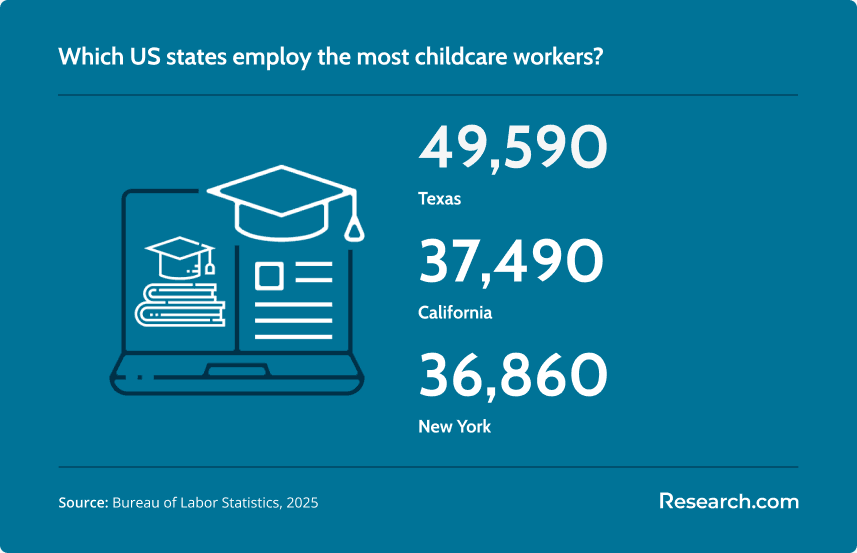
- Location: Metropolitan areas and higher-cost states often pay more. The District of Columbia, Massachusetts, and California are identified as places where pay may be better.
- Setting: Pay can differ between private households, child care centers, schools, public programs, and government-related roles.
- Experience: Providers with proven classroom management, infant care, inclusion support, or leadership experience may qualify for higher-responsibility roles.
- Education and credentials: A CDA, associate degree, bachelor’s degree, or state-specific credential can improve competitiveness for roles with more responsibility.
- Role level: Assistants generally earn less than lead providers, supervisors, program managers, or administrators.
How to think about salary before entering the field
Child care is not usually chosen for high pay alone. Before committing, compare expected wages with local cost of living, commute time, required training costs, benefits, and advancement options. A lower starting wage may still make sense if the employer offers paid training, tuition support, stable scheduling, or a clear path to lead or administrative roles.
What is the job outlook for child care providers?
Employment of child care providers is projected to decline by 1% through 2033, compared with the average growth rate of 3% for all occupations. Even so, the field is expected to continue producing regular openings because many jobs become available when workers change occupations, leave the labor force, or retire. Other guidance in this article also references a projected 3% employment decline and more than 160,000 annual openings.
The key factors shaping the future outlook
Demand for child care is closely tied to family work patterns. When parents and guardians participate in the workforce, study, or need reliable daily support, child care remains necessary. Population trends among families with young children also influence demand.
Public funding and policy decisions matter as well. Expansions in subsidized child care programs or early education investment can support demand, while funding reductions or stricter operating pressures may limit hiring.
Technology is also changing the administrative side of the field. Digital tools for enrollment, attendance, parent communication, billing, and incident reporting are becoming more common. However, the core work remains in-person because young children require direct supervision and responsive care.
Is this a stable career choice?
The field is moderately stable, but not fast-growing. It may be a good fit if you want accessible entry, consistent community need, and meaningful work with children. It may be less attractive if your main priority is rapid wage growth without additional training or leadership responsibility.
For those planning to strengthen their qualifications while working, programs at the most popular online universities may offer flexible options aligned with the changing demands of the field.
What is the typical work environment for child care providers?
Child care providers work in settings where direct supervision, movement, noise, routine, and constant interaction are normal. The most common environments include child care centers, private homes, family child care homes, preschools, and school-based programs.
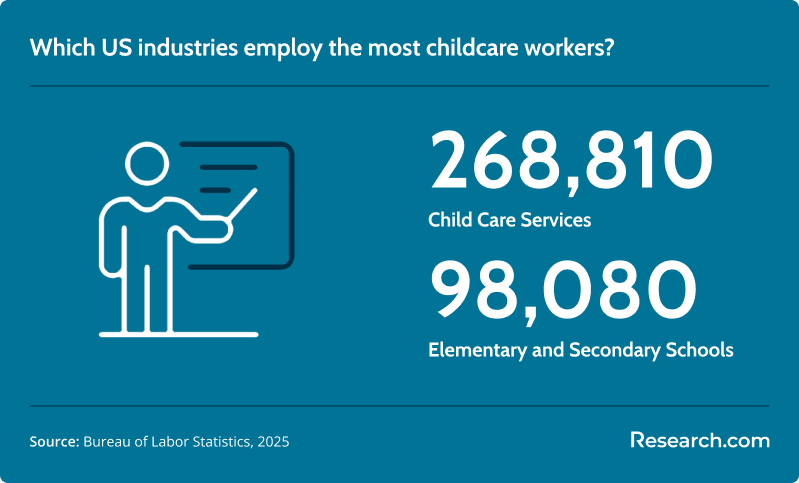
Evidence shows that 28.62% of childcare workers are employed in child care services, 11.7% work in private households, and 7.4% work in elementary and secondary schools. This mix reflects both structured facility-based care and more personal home-based arrangements.
Schedule and hours
Schedules vary by employer and family need. Providers may work part-time, full-time, early mornings, evenings, split shifts, or occasional weekends. Many programs open before standard work hours and close after typical office hours to support working families.
Remote or hybrid work is generally not an option because the role requires physical presence, supervision, and hands-on care. Administrative tasks may use digital systems, but child care itself happens in person.
Work culture and daily conditions
The work culture is highly interactive. Providers communicate with children, parents, guardians, coworkers, supervisors, and sometimes specialists or school staff. Good teamwork matters because staff often coordinate transitions, breaks, behavior strategies, cleaning duties, and safety procedures.
The physical environment can be demanding. Providers may lift children, sit on the floor, bend frequently, move between indoor and outdoor spaces, clean materials, and respond quickly to safety issues. People who enjoy active, relational work often adapt best.
What are the pros and cons of child care provider careers?
A child care provider career can be meaningful, but it is not easy work. The best way to decide whether it fits you is to compare the emotional rewards with the daily pressure, physical demands, and compensation realities.
Pros
- Meaningful impact: Providers help children build confidence, language, independence, social skills, and healthy routines.
- Strong relationships: The role can create lasting connections with children, families, and coworkers.
- Accessible entry: Many roles begin with a high school diploma or equivalent, required training, and supervised experience.
- Active workday: People who dislike desk-based work may prefer the movement, variety, and interaction of child care.
- Room to specialize: Providers can focus on infants, toddlers, preschool, inclusion support, administration, or family child care ownership.
Cons
- Physical demands: The job often involves standing, lifting, cleaning, bending, and staying alert for long periods.
- Emotional strain: Crying, conflict, separation anxiety, behavior challenges, and parent concerns can be stressful.
- Modest pay: Earnings may not match the level of responsibility unless providers move into higher-responsibility roles or better-paying settings.
- Irregular schedules: Some jobs require early mornings, evenings, or nontraditional hours.
- Limited resources: Providers may face high workloads, staffing shortages, tight budgets, or insufficient support.
Who is this career best for?
This career is best for people who are patient, observant, dependable, physically active, emotionally steady, and genuinely interested in young children’s development. It is less likely to fit someone who needs quiet work, predictable adult-only tasks, remote flexibility, or quick high-income growth.
If further education is part of your long-term plan, researching the most affordable online schools for working adults can help you compare flexible options before taking on tuition costs.
What are the opportunities for advancement for child care providers?
Child care provider advancement usually comes from a combination of experience, reliability, credentials, and leadership ability. Providers who document their training, develop strong classroom management skills, and communicate well with families are better positioned for promotion.
Advancement paths in child care
- Entry-level child care provider or assistant: Supports daily routines, activities, supervision, cleaning, and basic care under more experienced staff.
- Lead child care provider, teacher, or program lead: Manages a classroom or group, plans activities, guides assistants, communicates with families, and supports curriculum goals.
- Site supervisor, program manager, or administrator: Oversees staff, scheduling, compliance, enrollment, parent relations, budgeting, training, and program quality.
- Owner or director: May operate a family child care home or manage a child care center, depending on licensing rules and business readiness.
Specialization opportunities
- Infant and toddler care: Focuses on feeding, sleep routines, attachment, early motor development, and safety for children from birth to age three.
- Special needs/inclusion care: Builds skills in adapting routines, environments, communication, and activities for children with disabilities or developmental differences.
- Early childhood education with a preschool focus: Emphasizes school readiness, early literacy, social development, and structured learning for ages three to five.
- Program administration and leadership: Centers on staff development, licensing compliance, family engagement, quality improvement, and operations.
How to improve your chances of promotion
- Ask your supervisor what specific credential, training, or experience is required for the next role.
- Keep records of completed trainings, certifications, hours, evaluations, and responsibilities.
- Volunteer for appropriate leadership tasks, such as mentoring new staff or organizing activities.
- Develop strong parent communication habits, because family trust is critical in lead and supervisory roles.
- Learn licensing and safety requirements, since compliance knowledge becomes more important in management.
Strong advancement opportunities exist for providers who treat child care as a profession, not just an entry-level job. The clearest path is to pair dependable experience with targeted credentials that match the roles available in your local market.
What other careers should you consider?
If you like working with children but are unsure whether child care is the right fit, several related careers use similar skills. The best alternative depends on whether you prefer education, one-on-one care, recreation, healthcare support, or management.
- Preschool or kindergarten teacher: Works with young learners through structured lessons and developmental activities. This path may involve more formal education requirements and a stronger instructional focus.
- Nanny: Provides care in a home setting, often for one family or a small number of children. This role can offer deeper family relationships and personalized routines, but job stability and benefits vary by employer.
- Camp counselor: Supervises children in recreational, outdoor, or enrichment programs. This may be a good fit for people who enjoy group activities, seasonal work, and high-energy environments.
- Child life specialist: Supports children through difficult experiences such as hospitalization using play, preparation, and therapeutic activities. This path is more specialized and typically connected to healthcare settings.
- Childcare center director: Oversees staff, curriculum, compliance, enrollment, and operations. This option fits providers who want leadership responsibility and are comfortable with administration.
How to choose among related careers
Choose child care if you want daily, direct work with young children in routines that blend care and early learning. Choose teaching if you want a stronger academic focus. Choose nannying if you prefer a home setting and close family relationships. Choose administration if you want to influence program quality through leadership rather than direct care alone.
The right path should match your strengths, schedule needs, education plans, and tolerance for emotional and physical demands.
Here's What Professionals Say About Their Child Care Provider Careers
- Jasmine: "Being a child care provider means more than just watching over kids; I get to be a mentor who shapes how they view the world and themselves. I spend a lot of time encouraging their curiosity and creativity, which feels incredibly rewarding. It's amazing to know that the patience and love I invest now will help build their confidence for years to come. This role gives me a true sense of pride every single day."
- Harold: "The physical and emotional energy this job demands can be intense, especially during long days filled with nonstop activity. Still, I find that focusing on the small moments-like comforting a upset child or sharing a laugh with parents-helps me push through. Support from my coworkers keeps me grounded, and those genuine smiles make it worth every challenge. Despite the exhaustion, nothing compares to seeing a child feel safe and happy in my care."
- Nina: "Watching children learn new skills and hit developmental milestones is deeply fulfilling for me. One of my favorite parts of the day is when a shy child suddenly speaks up or masters a puzzle they've been working on for weeks. I love knowing I've helped create a nurturing space where kids can thrive and where families feel supported. Their gratitude reminds me why this work matters so much."
Key Findings
- Child care providers do far more than supervise children. They support safety, routines, social development, early learning, and family communication.
- Entry is usually accessible with a high school diploma or equivalent, but many roles also require background checks, safety training, first aid, CPR, and state-specific requirements.
- The Child Development Associate (CDA) Credential, associate degrees, bachelor’s degrees, and state credentials can improve access to lead, specialized, or administrative roles.
- The median annual wage discussed in this guide is $28,520, with entry-level workers around $22,040 and senior professionals reaching up to $37,520. Broader salary references also place child care provider pay around $32,000 to $43,000 depending on location and experience.
- Employment projections are modest, with a 1% decline through 2033 discussed in the outlook section and another referenced projection showing a 3% decline. Even so, more than 160,000 annual openings are expected because of turnover and retirements.
- The best candidates are patient, observant, emotionally steady, physically active, and comfortable communicating with both children and adults.
- Advancement is possible through experience, credentials, specialization, and leadership, especially for providers who move into lead teacher, supervisor, program manager, administrator, or director roles.
Other Things You Should Know About Child Care Providers
In 2027, essential skills for child care providers include effective communication, patience, problem-solving, and understanding child development. Physical stamina and basic first aid knowledge are also critical, ensuring the ability to respond to emergencies and foster a safe, supportive environment for children's growth.
In 2027, the average salary for child care providers is approximately $28,500 annually. Factors influencing this include geographical location, level of education, years of experience, and whether the provider works in a private or public setting. Urban areas tend to offer higher salaries than rural ones due to the higher cost of living.
References
- Careers & Education : Child Care Provider - TOOTRiS https://tootris.com/edu/child-care-education/careers/provider/
- 5 Career Opportunities After Completing an Early Childhood Certificate https://robincollege.ca/5-career-opportunities-after-completing-an-early-childhood-certificate/
- Daycare Leads: Top 30 Strategies for Recruiting Top-Notch Staff - No Joke Childcare https://nojokechildcare.com/daycare-leads-top-30-strategies-for-recruiting-top-notch-staff/
- Testimonials and First Hand Experience from Students | CCEI https://www.cceionline.com/testimonials/
- The Ultimate Careers Page Checklist for Child Care Programs - The Child Care Success Company https://www.childcaresuccess.com/the-ultimate-careers-page-checklist-for-child-care-programs/
- Getting started as a residential childcare practitioner — Residential Childcare Careers https://www.residentialchildcarecareers.co.uk/getting-started
- 10 Reasons to Become a Child Care Professional| Penn Foster https://www.pennfoster.edu/blog/top-10-reasons-to-become-a-child-day-care-provider
- Questions to ask a child care provider http://www.ontario.ca/page/questions-ask-child-care-provider
- Child Care Worker https://www.princetonreview.com/careers/35/child-care-worker
- Child Care Provider Career and Salary Profile https://online.fit.edu/degrees/undergraduate/applied-psychology/aa-general/child-care-provider-career-and-salary-profile/


