# 1 position
Concorde Career College-Garden Grove - Dental Assisting/Assistant.
certificate or diploma

Audited and Verified:
Our Editorial and Data Verification Process
Research.com uses government datasets, official education statistics and primary institutional information to support its career and degree guides. Our review process checks factual accuracy, occupational definitions, source dates and the requirements associated with the credentials discussed.
How This Article Was Fact-Checked
Our editorial team verifies salary estimates, employment projections, education requirements and program information against original data providers and official organizations. Salary figures are checked against the relevant occupational definitions and reporting periods. Information about licensure, accreditation and required in-person training is reviewed separately.
Fact-checked and verified on:

Co-Founder and Chief Data Scientist

Reviewed by Karolina Broda
Fact-Checker and Data Verification
Choosing dental assistant training in Garden Grove means looking beyond the fastest course or lowest advertised tuition: California rules determine which duties you can perform, and hands-on practice matters. The U.S. Bureau of Labor Statistics projects 7.4% national employment growth for dental assistants from 2025 to 2035. This guide accompanies the Best Dental Assistant Trade Schools in Garden Grove for 2027 ranking, created by the Research.com team of data scientists to help students make an informed choice about programs worth considering. Use it to compare costs, credentials, practical training, and routes into work.
Expect instruction in chairside assistance, instrument processing, infection control, patient communication, dental records, and office workflow, followed by supervised practice. Programs differ in how much work occurs in a simulation lab, a dental office, or both. Ask for the actual lab and externship hours rather than assuming similarly named certificates provide equivalent experience.
Garden Grove students can compare local career-school offerings, including those at Concorde Career College-Garden Grove and UEI College-Garden Grove, with supervised entry-level hiring at dental practices. A school route may suit someone who wants structured practice and placement assistance; employer training may suit someone able to secure a supportive office position and learn while earning. Neither route should be confused with automatic eligibility for California Registered Dental Assistant (RDA) licensure.
Dental offices are the principal workplace for dental assistants, according to the U.S. Bureau of Labor Statistics (BLS). In Garden Grove, searching across nearby Orange County practices broadens the pool of potential externship sites and employers, but travel time can substantially change the value of a placement. General dentistry offices may offer broad chairside exposure; specialty practices can provide narrower, deeper experience.
Before accepting an externship, check which duties you will observe or perform under supervision, whether the office can accommodate your schedule, and whether the commute is sustainable. California limits certain dental assisting tasks by training and credential, so a placement's value depends on the skills you can lawfully develop, not just its name (Dental Board of California).
The BLS reports a $48,070 national median annual wage for dental assistants in May 2025. That is the midpoint for employed workers across experience levels and locations - not a Garden Grove wage or a forecast for a new graduate. Compare current Garden Grove and nearby Orange County postings for entry-level pay, schedules, benefits, and whether an employer pays for additional training before estimating your likely earnings.
For a realistic return-on-investment calculation, compare expected earnings with what you could earn without enrolling. Include the chance of completing the program, time out of work, aid, debt payments, and how long you expect to remain in the occupation. A higher-paying posting that requires RDA licensure should not be treated as an immediate outcome of an entry-level certificate.
There is no single Garden Grove program length: schedules, externships, and the intended credential vary. Ask each school for its current calendar duration, total scheduled hours, required on-site hours, and the time between finishing classes and completing an externship. Part-time study may preserve income but delay entry; an accelerated schedule may reduce time away from work while leaving less flexibility for missed clinical days.
California's RDA pathways have separate eligibility rules. The Dental Board of California recognizes qualifying education and a work-experience route, but completing an entry-level dental assistant program does not by itself prove that its hours or curriculum satisfy an RDA pathway. Request the school's specific RDA eligibility explanation in writing before enrolling for that goal.
Online delivery can work for terminology, records, and other theory. It cannot replace supervised practice in instrument handling, infection control, radiography procedures, or chairside care. A hybrid program is useful only if its required labs and clinical placements are accessible from Garden Grove and fit your work schedule.
The comparison below separates delivery convenience from the practical preparation needed for a dental office. Confirm the format and location of every required component with the provider.
| Format | Potential advantage | Decision-critical limitation |
| On-campus | Scheduled access to instructors, equipment, and skills practice | Travel and fixed lab times |
| Hybrid | Some theory completed remotely | Labs and clinical work still require attendance |
| Entirely online | Flexible theory study | Does not, by itself, establish practical competence or California duty eligibility |
Advertisements for top 6 month associate programs online address a different education search; their advertised speed says nothing about the hands-on dental training required here. Judge a dental assisting program by its actual in-person skills and California alignment.
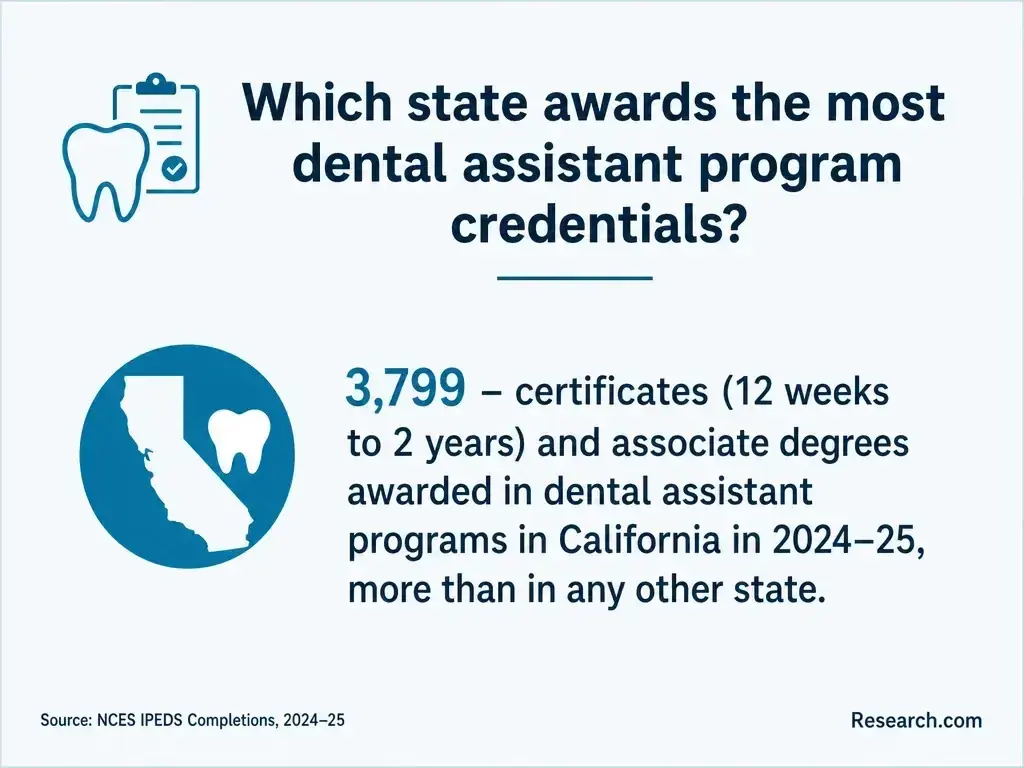
A defensible Garden Grove average is not available from the information consistently published across local training routes. Advertised tuition can omit required purchases and does not capture employer training. Obtain a current, itemized quote from each provider rather than treating a single price as typical.
These cost categories show what to include when comparing offers. Mark items as included only after the school confirms them in writing.
| Cost category | What to confirm |
| School charges | Tuition, registration, lab, technology, and externship fees |
| Training supplies | Uniforms, protective equipment, textbooks, and consumable materials |
| Career-entry expenses | Required courses, examinations, applications, and any health or background requirements |
| Time and travel | Transportation to labs and placements, plus earnings forgone during training |
Ask whether the specific program qualifies for federal student aid, scholarships, or workforce funding; eligibility varies by provider and program (Federal Student Aid; U.S. Department of Education). Compare the net cost after grants with the value of wages you might earn through employer training. A search for open enrollment colleges online will not answer whether a dental assisting option has affordable, accessible clinical training.
Depending on the offering, a graduate may receive a school-issued certificate or diploma. That completion document is distinct from institutional accreditation, dental program accreditation, professional certification, and a California occupational license. Ask what appears on the final credential and what, if anything, it qualifies you to apply for.
For an RDA goal, distinguish a program accredited by the Commission on Dental Accreditation (CODA) from one describing itself as career-focused or institutionally accredited. Also ask whether the Dental Board of California recognizes the specific curriculum or pathway you intend to use. Certification from the Dental Assisting National Board (DANB) is a separate credential with its own eligibility requirements; do not assume it substitutes for California RDA licensure (CODA; DANB; Dental Board of California).
Schools set their own admission rules, which may include proof of prior schooling, an interview or assessment, and documentation needed before clinical placement. An office that trains new hires sets different hiring requirements. Neither admission nor hiring alone confirms that you may perform every dental assisting duty in California.
Request the program's current admissions checklist and externship requirements before paying a nonrefundable fee. If you hope to receive credit for prior dental-office experience, ask what documented training the provider accepts and whether that credit changes your practical training or RDA eligibility; do not assume experience automatically transfers.
Core training generally combines dental anatomy and terminology with infection prevention, chairside procedures, materials, patient communication, and records. Equipment practice matters as much as theory: students need opportunities to prepare rooms, handle instruments safely, assist during procedures, and respond to a dentist's instructions. BLS identifies both clinical and administrative duties within the occupation.
Look closely at how a program teaches radiography and California-specific infection-control rules. Ask which skills are practiced on models, which are performed under supervision in a dental office, and how competency is assessed. Digital records and imaging may be part of a workplace's workflow, but familiarity with software is not a substitute for permitted clinical training or required safety instruction (Dental Board of California).
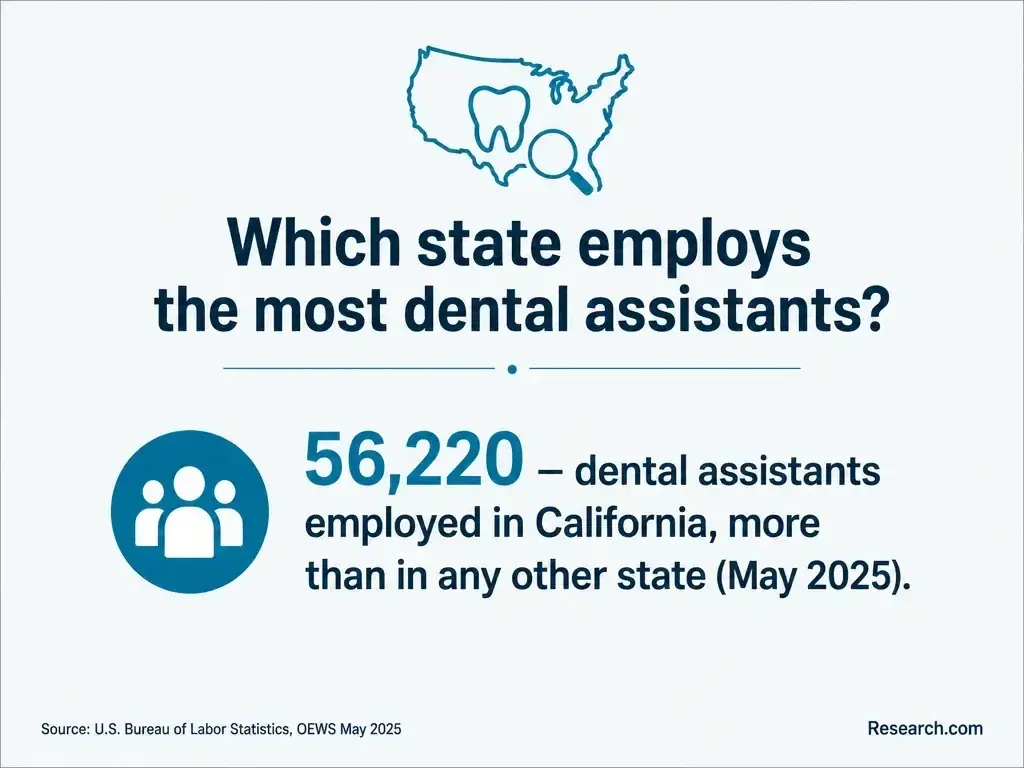
California distinguishes an unlicensed dental assistant from a licensed RDA. Entry into permitted assisting work does not require every worker to hold an RDA license, but the duties an assistant may perform depend on California rules, supervision, and applicable training. Radiography and other specified functions have additional requirements. The Dental Board of California - not a school's marketing description - is the authority for current duty and eligibility rules.
RDA is an advancement credential with its own qualifying pathway, required education or experience, and examinations; a course certificate is not the license. DANB certification is also separate from California licensure (Dental Board of California; DANB). If your target job posting specifies RDA, verify the program's pathway against the board's current application requirements before enrolling. If you seek entry-level work first, ask prospective employers which duties they train new assistants to perform and when required instruction must be completed.
Choose for your intended first job and next credential, not for ranking position alone. The most consequential mistake is paying for a short program on the assumption that its certificate, online lessons, or institutional accreditation automatically establishes California RDA eligibility.
Use this sequence when speaking with admissions teams at Concorde Career College-Garden Grove and UEI College-Garden Grove, or with an employer offering supervised training:
A useful rule is to reject a comparison that mixes unrelated credentials. Lists of certification courses that pay well may suggest other career ideas, but they cannot establish a dental program's California clinical or licensing fit. Likewise, affordable online master's programs address a different investment decision, not the cost of becoming job-ready as a dental assistant.
An entry-level assistant may build experience in chairside care and office operations, then pursue permitted additional duties, RDA licensure, specialty-office experience, or a lead-assistant role. Progression depends on the specific training, examinations, experience, and employer needs; a school certificate does not automatically unlock later duties (Dental Board of California; BLS).
If you want to work soon, a program with strong supervised practice - or a supportive employer willing to train - may be more useful than a credential with little clinical exposure. If RDA is the goal, favor a clearly documented eligibility pathway even when another option finishes sooner. Searches for 1-year phd programs online canada are unrelated to California dental assisting and should not influence that trade-school decision.
BLS projects 7.4% growth nationally from 2025 to 2035 for dental assistants. This indicates demand across the U.S. occupation, not a guaranteed opening in Garden Grove or a local growth rate. It is most useful alongside recent nearby job postings: note how often employers request entry-level assistants, radiography qualifications, or RDA licensure, then match those requirements to the training you are considering.
For a Garden Grove student, the practical labor market extends beyond city boundaries when the commute is manageable. That wider search can make a placement or first job easier to find, but travel costs and schedule reliability belong in the same decision as tuition and wages.
Investing in training is an important decision, so the Research.com team built the ranking to compare programs against others in the same occupation and location - not against unrelated schools nationwide. It uses reported student outcomes, costs, earnings, and quality indicators to help readers identify programs worth examining more closely. Only programs with completions reported to the Integrated Postsecondary Education Data System (IPEDS) are included; absence from the ranking does not establish that another training option is unavailable or poor quality.
Best-program scores cover student outcomes, earnings and return on investment, costs and debt, and quality and recognition. Occupation-relevant programmatic accreditation or industry recognition accounts for 20%, institutional accreditation for 10%, and student support for 10%. The remaining 60% covers completion, full- and part-time retention, earnings one year after completion, earnings relative to annual attendance cost, tuition, attendance cost, debt - including debt among students who withdrew - and federal loan default rates. An entropy-based method gives more weight to indicators that distinguish programs more clearly. Most-affordable-program rankings instead score only tuition, attendance cost, debt, and loan default rates; they do not score accreditation or other quality indicators.
The ranking draws on the following databases and organizations. Some cover the broader trade-school ranking framework rather than dental assisting specifically; for dental program recognition, CODA and the relevant California regulator deserve particular attention.
Scores make comparison easier, but they cannot establish that a particular graduate will qualify for every California dental assisting duty. Readers can review the full approach on the Research.com methodology page, then confirm current program details directly with the school and Dental Board of California.
# 1 position
# 2 position
Potentially. California permits an unlicensed dental assistant to perform allowed duties under applicable rules, and some employers train new hires. Confirm required instruction and the duties you may perform with the Dental Board of California and the hiring office.
No. RDA licensure has separate eligibility and examination requirements. Ask a school to identify its specific board-recognized pathway in writing (Dental Board of California).
Online study can cover theory, but it cannot replace in-person clinical skills practice. Confirm where required labs and any externship take place.
Choose based on your target job. A faster schedule has limited value if it leaves you without the supervised experience an employer expects or the training required for your intended duties.
No. The BLS median includes workers with different experience levels nationwide. Use current local entry-level postings and your likely hours and benefits to estimate first-job earnings.