Choosing an online counseling master's in Florida means deciding where you want to practice, not just where you want to study. A flexible program can still require local clinical placements, and the wrong specialization may not support your intended credential. This guide compares those trade-offs alongside cost, time, and career prospects. It also features the 2027 Best Online Master's in Counseling Degree Programs Ranking in Florida, created by the Research.com team of data scientists to help students make an informed choice about which counseling programs are worth considering.
Key findings about online Counseling degrees in Florida
Start with the credential: Florida clinical mental health licensure and school counseling certification follow different state processes, so a counseling master's is not interchangeable across career goals (Florida Board of Clinical Social Work, Marriage & Family Therapy and Mental Health Counseling; Florida Department of Education).
For clinical mental health and substance use counseling occupations, the U.S. median annual wage was $59,350 in May 2025; projected national employment growth is 18% for 2025-2035. Neither figure predicts an individual graduate's pay or local hiring prospects (U.S. Bureau of Labor Statistics).
Compare total tuition and fees, placement support, and time away from work - not online tuition alone. Clinical training must still be completed in person at approved sites, even when coursework is remote (CACREP; Florida Board of Clinical Social Work, Marriage & Family Therapy and Mental Health Counseling).
What can I expect from an online Counseling degree in Florida?
An online counseling master's combines remote academic coursework with supervised, in-person training. Students typically study assessment, counseling techniques, ethics, and research before completing a practicum and internship. "Online" describes how classes are delivered; it does not mean clinical hours can be completed from home. Ask each school whether it arranges Florida placements, approves student-proposed sites, or expects students to find sites independently (CACREP).
The essential distinction is professional destination. Clinical mental health counseling programs are aimed at preparation for mental health practice; school counseling programs focus on work in educational settings; rehabilitation counseling emphasizes disability, employment, and independent living. Florida's clinical licensure and school certification authorities set different requirements, so confirm the exact credential a program prepares you to pursue before paying an enrollment deposit (Florida Board of Clinical Social Work, Marriage & Family Therapy and Mental Health Counseling; Florida Department of Education).
Where can I work with an online Counseling degree in Florida?
Work settings depend on specialization and credential. Clinical mental health graduates may pursue roles in community mental health agencies, hospitals, substance use treatment organizations, or private practices once they meet applicable licensing requirements. School counseling graduates may pursue positions in Florida public or private schools, subject to employer and certification rules. Rehabilitation counselors work in settings such as vocational rehabilitation agencies and disability services (U.S. Bureau of Labor Statistics; Florida Department of Education).
Location affects training as well as employment. Someone living outside a major metro area should ask whether a program has approved supervisors and suitable placements near home; a distant placement can erase the scheduling advantage of online classes. Students planning to move should also check the destination state's credential rules rather than assuming a Florida-oriented program transfers automatically.
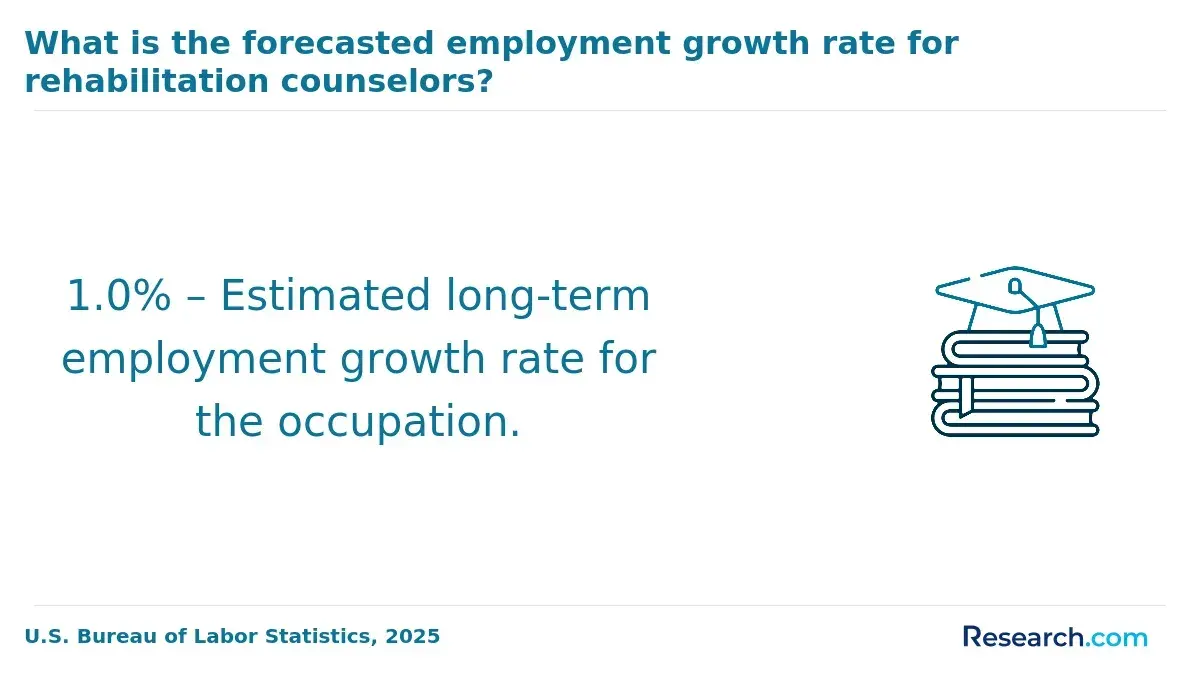
These national occupation figures provide a benchmark for comparing career directions - not a Florida salary offer. The wages have a May 2025 reference period, while growth projections cover 2025-2035; both are from the U.S. Bureau of Labor Statistics.
Career direction
U.S. median annual wage, May 2025
U.S. projected growth, 2025-2035
Clinical mental health or addiction counseling occupations
$59,350
18%
School counseling occupations
$64,330
3%
Rehabilitation counseling occupations
$46,850
2%
Occupation-wide medians include workers at different career stages; they are not starting salaries or outcomes measured for a particular master's program. For a personal investment decision, compare likely pay in your intended Florida setting with your current earnings, expected borrowing, and the time required to qualify for the role.
The programs below serve different professional goals, and a program's presence here does not establish that every course or placement is available remotely. These distinctions are most useful when matched against your target credential, location, and ability to attend any required in-person activities (institutional program pages).
Florida State University - Counseling and Human Systems: The distance-program listing identifies master's and specialist study, a different degree structure from a stand-alone counseling master's. Ask which credential and specialization the particular pathway awards before comparing its time and cost with an MS program.
Southeastern University - MS in Professional Counseling: Its professional-counseling focus is worth examining if you want a clinical pathway at a faith-based university rather than a school-counseling degree. Confirm how its curriculum, delivery format, and placements align with your intended Florida license.
Florida International University - MS in School Counseling: This program targets school counseling rather than clinical mental health practice. It is a more direct starting point for applicants planning school-based careers, provided they verify Florida certification alignment and field-placement arrangements.
Florida International University - MS in Rehabilitation Counseling: Its rehabilitation focus separates it from the clinical and school pathways in this group. Consider it if disability services or vocational rehabilitation is your goal; check its credential fit before assuming it prepares you for mental health licensure.
Lynn University - MS in Clinical Mental Health Counseling: The degree's stated clinical mental health focus makes it relevant to applicants pursuing that practice area, rather than school certification. Request a current course and fieldwork map so you can compare its licensing preparation and delivery requirements with other clinical options.
Palm Beach Atlantic University - Online MS in Clinical Mental Health Counseling: Its program is explicitly identified as online, making it a useful comparison for students who cannot relocate for classes. Ask which campus visits, synchronous meetings, and locally arranged clinical hours remain necessary.
Jacksonville University - MS in Mental Health Counseling: Its mental health emphasis distinguishes it from the school and rehabilitation degrees. Northeast Florida applicants should check whether suitable supervised placements are available near their intended work location, not just near campus.
Nova Southeastern University - Counseling master's curriculum: Its published curriculum gives applicants a concrete basis for checking course-by-course fit against a target credential. Use that detail to compare required clinical training and electives rather than judging programs by degree title alone.
University of North Florida - Counselor Education in School Counseling: This is a school-counseling pathway, making certification and school-based fieldwork the key comparison points. It is particularly relevant to applicants planning to work in Northeast Florida schools, subject to confirmation of available placements and delivery format.
Keiser University-Ft Lauderdale - Master's in Clinical Mental Health Counseling: Its clinical mental health specialization is the pertinent feature for prospective mental health practitioners. Confirm which instruction is online and whether Fort Lauderdale-area attendance or clinical-site arrangements would affect your schedule.
For any of these options, obtain written confirmation of the current modality, degree awarded, accreditation status, required visits, and placement policy. A program title alone cannot establish eligibility for a Florida credential (Florida Board of Clinical Social Work, Marriage & Family Therapy and Mental Health Counseling; Florida Department of Education).
A counseling master's commonly takes about two to three years of full-time study; part-time enrollment can take longer. Your actual timeline depends on course sequencing, fieldwork availability, and whether a program permits summer study. An accelerated academic schedule will not necessarily accelerate the supervised experience required after graduation for clinical licensure (CACREP; Florida Board of Clinical Social Work, Marriage & Family Therapy and Mental Health Counseling).
Compare fastest counseling programs against their placement calendars, not just advertised coursework duration. Ask when internships begin, whether required courses are offered every term, and how a delayed placement would affect graduation.
The principal difference is where academic instruction happens. Both formats can require face-to-face skills development, approved supervisors, and in-person practicum or internship hours. Online study may reduce travel for classes, but students who need substantial help securing a clinical site should compare placement services closely (CACREP).
On-campus study may suit someone who wants regular access to faculty and nearby placement networks. Online study may better fit a working adult who can reliably attend scheduled virtual sessions and complete supervised hours near home. Neither format is inherently a better licensure route: compare the specific program's curriculum, accreditation, and Florida credential alignment.
There is no single defensible statewide price for an online counseling master's: program length, required credits, public-university residency rules, private-institution pricing, and fees vary. NCES IPEDS publishes institution-level tuition information, but an institution-wide graduate tuition figure is not necessarily the price of its counseling program. Request a program-specific total before treating any published annual rate as your expected bill (NCES IPEDS; institutional tuition schedules).
When comparing most affordable counseling programs, include mandatory fees, travel for any campus meetings, placement-related expenses, and the wages you might forgo while completing fieldwork. In-state public tuition can be attractive, but verify residency eligibility and whether online or program-specific rates override the general graduate rate.
Start with the Free Application for Federal Student Aid (FAFSA) and confirm that both the institution and your enrollment status meet federal aid rules. Eligible graduate students may be considered for federal Direct Unsubsidized Loans; institutions may also offer assistantships, scholarships, or payment plans. Award availability and terms depend on the student and school, so obtain an individual aid offer rather than assuming the same package applies across programs (Federal Student Aid; institutional financial aid offices).
Ask whether an assistantship requires campus work, whether aid covers summer terms, and whether changing to part-time enrollment affects eligibility. Florida residents should check current state and institutional graduate awards directly: undergraduate-focused aid programs should not be assumed to fund a master's degree.
View the chart data as a table
Best score distribution across ranked programs (Source: Research.com)
Category
Value
78–79
1
80–82
0
82–84
1
85–86
0
88–89
0
90–92
5
92–94
3
Programs generally require a bachelor's degree and review academic records, recommendations, a statement of purpose, and an interview or similar fit assessment. Some specify prerequisite coursework or experience; a psychology undergraduate major is not universally required. Check each institution's current admissions page rather than assuming a common GPA or testing rule (institutional admissions pages).
Before applying, compare easiest counseling programs with the training and credential you actually need. Less restrictive admission does not compensate for a specialization mismatch. Also ask whether prior graduate credits can transfer, which courses qualify, and whether transfer credit changes your placement sequence or aid eligibility.
Common subjects include counseling theories, interviewing and helping skills, ethics, human development, assessment, research, and multicultural counseling. Clinical mental health pathways also emphasize diagnosis and treatment planning; school pathways address student development and school-based practice; rehabilitation pathways examine disability and employment-related services (CACREP; institutional program curricula).
Course titles are less important than coverage and sequencing. Ask a program to show where Florida-relevant credential requirements are taught and when students must qualify for practicum or internship. That check can reveal a mismatch before you invest in courses that do not advance your intended path.
The major choices in this group are clinical mental health, school, and rehabilitation counseling. Some institutions may offer additional focus areas, but an elective or concentration should not be mistaken for a separate state credential. Compare the complete required curriculum and field experience, especially if you hope to work with a particular population (institutional program curricula; Florida credential authorities).
Choose clinical mental health if your goal is the corresponding Florida practice pathway; choose school counseling if you want to work primarily in schools; consider rehabilitation counseling if disability and vocational services are your focus. If you are undecided, ask schools what changing tracks would require - credits in one pathway may not satisfy another pathway's fieldwork or credential requirements.
Start with the job you want, then work backward from its Florida credential rules. A ranking can narrow the field, but a good personal choice must also fit your budget, location, schedule, and likelihood of completing clinical training.
Name the target role. Determine whether it calls for clinical licensure, school certification, another credential, or employer-specific qualifications.
Verify the program. Check institutional and applicable programmatic accreditation and ask the relevant Florida authority how the curriculum relates to credential eligibility; accreditation and graduation are not licenses (CACREP; Florida credential authorities).
Test the placement plan. Ask who secures sites, which supervisors qualify, and whether placements are available where you live.
Compare complete costs and outcomes. Request total tuition and fees, aid terms, completion information, and applicable exam results using the same definitions and reporting periods.
Review most valuable counseling programs alongside your own return-on-investment estimate. That estimate should account for aid, borrowing, completion probability, lost earnings during study, current earnings, plausible post-degree earnings, and how long you expect to work in the field - not institution type or sticker price alone.
View the chart data as a table
Median wage by counseling career path (U.S., BLS May 2025) (Source: BLS)
Category
Value
Psychologists
99,110
Postsecondary Teachers
85,330
Marriage & Family Therapists
66,940
School & Career Counselors
64,330
Mental Health Counselors
59,350
Rehabilitation Counselors
46,850
A relevant master's can be a step toward work as a mental health counselor, school counselor, substance use counselor, or rehabilitation counselor, depending on the curriculum and applicable credential rules. Graduates may initially work under supervision while completing requirements for independent clinical practice; finishing the degree alone does not confer Florida licensure (Florida Board of Clinical Social Work, Marriage & Family Therapy and Mental Health Counseling; Florida Department of Education).
The degree is a stronger investment if you want sustained, direct counseling work and can accommodate supervised training. If your goal is a nonclinical student-support or human-services role, compare its actual job requirements before committing to a lengthy clinical degree. If you want to prescribe medication or practice a different profession, a counseling master's is not a substitute for that profession's education and licensing pathway.
View the chart data as a table
Median wage by U.S. state - Substance Abuse, Behavioral Disorder, and Mental Health Counselors (BLS OEWS, May 2025) (Source: BLS)
State
Value
AK
80,770
AL
47,310
AR
51,580
AZ
65,300
CA
59,250
CO
62,390
CT
63,590
DC
60,450
DE
56,020
FL
56,790
GA
58,960
HI
60,090
IA
60,880
ID
63,360
IL
60,730
IN
53,760
KS
59,470
KY
54,190
LA
37,910
MA
59,890
MD
59,530
ME
59,970
MI
61,690
MN
58,780
MO
56,910
MS
46,990
MT
59,000
NC
55,490
ND
68,630
NE
63,770
NH
54,840
NJ
62,820
NM
74,100
NV
57,210
NY
59,450
OH
58,360
OK
59,350
OR
74,590
PA
52,010
PR
46,790
RI
65,120
SC
52,370
SD
53,650
TN
49,580
TX
62,630
UT
63,890
VA
59,880
VT
61,810
WA
68,910
WI
62,220
WV
49,430
WY
62,980
National demand varies sharply by specialty. The U.S. Bureau of Labor Statistics projects 18% employment growth for clinical mental health and substance use counseling occupations over 2025-2035, compared with 3% for school counseling occupations. These are national projections, not Florida vacancy counts; they suggest comparing specialties as well as schools, but cannot tell you how quickly you will find a position in a particular county.
Florida applicants should examine current openings in the area where they intend to live and note which specify a license, certification, or supervised status. Also compare placement access with hiring geography: training near your intended community may help you learn its service network, while limited local supervisors can make an otherwise flexible online program harder to finish.
2027 Best Online Master's in Counseling Degree Programs Ranking in Florida
Investing in a graduate degree is a consequential decision. Research.com created its counseling rankings to help readers compare programs using documented outcomes, credentials, and costs rather than relying on reputation alone. The team checks and combines information from these sources:
IPEDS database - institutional enrollment, completion, and cost information.
Peterson's database - program and institutional information used to support comparisons.
For the Best ranking, a graduate-outcomes-and-accreditation score combines program completion (40%), employment or doctoral admission (20%), applicable licensure-exam pass rates (20%), CACREP programmatic accreditation (16%), and institutional Title IV eligibility (4%). Shares are renormalized when a criterion does not apply. Program cost then contributes about 7% of the final score. The method applies to online and on-campus programs; rankings named for another dimension order programs by that dimension. These measures offer a starting point, not proof that a program fits an individual's licensing plans. See Research.com's methodology for more detail.
# 1 position
Florida State University
Master
Counseling & Human Systems, MS/Specialist (School Counseling)
Delivery mode: online
93.48
/ 100
Final score
Program length
8 semesters (part-time)
Specialization
School Counseling
Required credits
60 semester credits
Acceptance rate
33.8%
GPA range
3.00 - 4.00
Application deadline
December 1
Class size
25
Application process
direct
GRE
no
Prerequisites
Coursework in general psychology, human services, school settings, and/or related areas preferred, but no specific undergraduate prerequisites required before entry.
Accreditation
Accredited by the Council for Accreditation of Counseling and Related Educational Programs (CACREP), with institutional accreditation from the Southern Association of Colleges and Schools Commission on Colleges (SACSCOC).
Florida State University earned a Research.com Counseling Program Score of 93.48/100. The program is CACREP-accredited, valid through 2028-03-31.
# 2 position
Southeastern University
Master
MS in Professional Counseling
Delivery mode: hybrid
93.44
/ 100
Final score
Specialization
Clinical Mental Health Counseling
Required credits
60
GPA range
3.00 - 4.00
Program completion rate
100% (2025-26)
Employment or doctoral admission
82% (2025)
Licensure exam pass rate
100% (2025-26)
Application process
direct
GRE
no
Prerequisites
Minimum GPA of 3.0. Applicants below this minimum may complete the graduate certificate in mental health services and reapply with a graduate GPA of at least 3.0. GRE is not required.
Additional requirements
Admission essay, letter of recommendation, faculty committee evaluation, and admission interview.
Accreditation
Accredited by the Council for Accreditation of Counseling and Related Educational Programs (CACREP), with institutional accreditation from the Southern Association of Colleges and Schools Commission on Colleges (SACSCOC).
Southeastern University earned a Research.com Counseling Program Score of 93.44/100, supported by 100% licensure exam pass rate and 100% program completion rate. The program is CACREP-accredited, valid through 2034-10-31.
# 3 position
Florida International University
Master
MS in Counselor Education: School Counseling Major
Delivery mode: hybrid
93.37
/ 100
Final score
Program length
The length of study is 2.5 years
Specialization
School Counseling
Required credits
60 semester credits
GPA range
3.20 - 4.00
Licensure exam pass rate
100% (2024-25)
Application deadline
Spring 2027: November 1, 2026, 5 p.m. EST; Fall 2027: March 15, 2027, 5 p.m. EST
Class size
31
Application process
direct
GRE
no
Prerequisites
Students entering with an undergraduate degree in an area other than education must enroll in general professional education courses as required by FLDOE to meet state certification requirements.
Additional requirements
Unofficial transcripts, autobiographical sketch/letter of intent, 3 letters of recommendation, resume, interview by admissions committee (if selected), proctored writing sample (if selected), pass the Florida Teacher Certification General Knowledge exam.
Accreditation
Accredited by the Council for Accreditation of Counseling and Related Educational Programs (CACREP), with institutional accreditation from the Southern Association of Colleges and Schools Commission on Colleges (SACSCOC).
Florida International University earned a Research.com Counseling Program Score of 93.37/100, with 100% licensure exam pass rate among the verified supporting factors. The program is CACREP-accredited, valid through 2030-03-31.
# 4 position
Florida International University
Master
MS in Counselor Education: Rehabilitation Counseling Major
Delivery mode: hybrid
91.92
/ 100
Final score
Program length
The length of study is 2.5 years
Specialization
Rehabilitation Counseling
Required credits
60 semester credits
GPA range
3.00 - 4.00
Application deadline
Spring 2027: November 1, 2026, 5 p.m. EST; Fall 2027: March 15, 2027, 5 p.m. EST
Class size
18
Application process
direct (FIU Graduate Application)
GRE
no
Prerequisites
Bachelor's degree with a 3.0 GPA in the last 60 credits of undergraduate work; GRE not required; unofficial transcripts, autobiographical sketch/letter of intent, 3 letters of recommendation, resume, interview and proctored writing sample if selected.
Additional requirements
Unofficial transcripts; autobiographical sketch/letter of intent; 3 letters of recommendation; resume; interview by admissions committee; proctored writing sample
Accreditation
Accredited by the Council for Accreditation of Counseling and Related Educational Programs (CACREP), with institutional accreditation from the Southern Association of Colleges and Schools Commission on Colleges (SACSCOC).
Florida International University earned a Research.com Counseling Program Score of 91.92/100. The program is CACREP-accredited, valid through 2026-10-31.
# 5 position
Lynn University
Master
Master of Science in Clinical Mental Health Counseling
Delivery mode: online
91.75
/ 100
Final score
Program length
two or more years of coursework taken year-round
Specialization
Clinical Mental Health Counseling
Required credits
61 semester credits
Application process
direct
GRE
no
Prerequisites
Bachelor's degree from an accredited institution
Additional requirements
Completed application, personal statement, official transcripts from all previously attended colleges/universities, current resume, letter of recommendation, and an admissions committee interview (CMHC-specific requirement)
Accreditation
Accredited by the Council for Accreditation of Counseling and Related Educational Programs (CACREP), with institutional accreditation from the Southern Association of Colleges and Schools Commission on Colleges (SACSCOC).
Lynn University earned a Research.com Counseling Program Score of 91.75/100. The program is CACREP-accredited, valid through 2027-10-31.
# 6 position
Palm Beach Atlantic University
Master
Clinical Mental Health Counseling, M.S. (Online)
Delivery mode: hybrid
91.43
/ 100
Final score
Program length
2 ½ calendar years (seven semesters)
Specialization
Clinical Mental Health Counseling
Required credits
60 semester credits
GPA range
3.00 - 4.00
Application process
direct
GRE
no
Prerequisites
Baccalaureate degree from a regionally accredited institution; minimum undergraduate GPA of 3.0 on a 4.0 scale, with case-by-case exceptions. Specific prerequisite courses are not identified.
Additional requirements
Online application; official transcripts from the bachelor's institution and prerequisite course institutions; two confidential recommendation forms; essay on the supplied prompt; interview after application review.
Accreditation
Accredited by the Council for Accreditation of Counseling and Related Educational Programs (CACREP), with institutional accreditation from the Southern Association of Colleges and Schools Commission on Colleges (SACSCOC).
Palm Beach Atlantic University earned a Research.com Counseling Program Score of 91.43/100. The program is CACREP-accredited, valid through 2032-03-31.
# 7 position
Jacksonville University
Master
Master of Science in Clinical Mental Health Counseling
Delivery mode: hybrid
91.31
/ 100
Final score
Program length
two-year, full-time
Specialization
Clinical Mental Health Counseling
Required credits
60 semester credits
GPA range
3.00 - 4.00
Application deadline
Fall: February 15
Application process
direct
GRE
Conditional: GRE (minimum combined 290) required if cumulative GPA is below 3.0
Prerequisites
No specific undergraduate major required, but the undergraduate degree must be from a regionally accredited college or university.
Additional requirements
Completed JU Application, unofficial transcripts for all degrees conferred, statement of intent, resume/CV, 3 letters of recommendation; applicants with a cumulative GPA below 3.0 must submit official GRE scores (minimum combined 290).
Accreditation
Accredited by the Council for Accreditation of Counseling and Related Educational Programs (CACREP), with institutional accreditation from the Southern Association of Colleges and Schools Commission on Colleges (SACSCOC).
Jacksonville University earned a Research.com Counseling Program Score of 91.31/100. The program is CACREP-accredited, valid through 2027-10-31.
# 8 position
Nova Southeastern University
Master
M.S. in Counseling – Clinical Mental Health Counseling Concentration
Delivery mode: hybrid
90.84
/ 100
Final score
Specialization
Clinical Mental Health Counseling
Required credits
60 semester credits
GPA range
2.50 - 4.00
Application process
direct
GRE
Conditional: GRE (300 V+Q) required if GPA in the last 60 undergraduate hours is below 2.5 and no master's with 3.0 GPA (or 'other similar measures')
Prerequisites
Regionally accredited bachelor's degree; a degree in psychology, education, behavioral science, social work, or a related field preferred, and/or demonstrated aptitude for counseling through professional, volunteer, or research experience.
Additional requirements
Online application, official transcripts from all schools attended (or evaluation of foreign degrees), an 800-word, three-paragraph statement of professional goals, and English proficiency scores for international applicants.
Accreditation
Accredited by the Council for Accreditation of Counseling and Related Educational Programs (CACREP), with institutional accreditation from the Southern Association of Colleges and Schools Commission on Colleges (SACSCOC).
Nova Southeastern University earned a Research.com Counseling Program Score of 90.84/100. The program is CACREP-accredited, valid through 2029-10-31.
# 9 position
University of North Florida
Master
M.Ed. in Counselor Education
Delivery mode: hybrid
83.96
/ 100
Final score
Program length
designed to be completed over two years as a Cohort Model
Specialization
School Counseling
Required credits
60 semester credits
GPA range
3.00 - 4.00
Employment or doctoral admission
50% (2023-24)
Licensure exam pass rate
100% (2024)
Application deadline
Fall: July 28; Summer: April 15
Application process
direct
Prerequisites
Pre-professional competencies for Florida School Counseling Certification (6 credits): TSL6700 ESOL for School Counselors (3 credits) plus Reading competency coursework (3 credits).
Additional requirements
Online application, official transcripts, professional resume or CV, letter of intent, three letters of recommendation on official letterhead, and an individual interview with School Counseling faculty.
Accreditation
Accredited by the Council for Accreditation of Counseling and Related Educational Programs (CACREP), with institutional accreditation from the Southern Association of Colleges and Schools Commission on Colleges (SACSCOC).
University of North Florida earned a Research.com Counseling Program Score of 83.96/100, supported by 100% licensure exam pass rate and 50% employment or doctoral admission rate. The program is CACREP-accredited, valid through 2033-03-31.
# 10 position
Keiser University-Ft Lauderdale
Master
Master of Science in Clinical Mental Health Counseling
Delivery mode: hybrid
78.70
/ 100
Final score
Program length
36 - 48 months
Specialization
Clinical Mental Health Counseling
Required credits
60 semester credits
GPA range
3.00 - 4.00
Program completion rate
44% (2024-25)
Employment or doctoral admission
82% (2024-25)
Licensure exam pass rate
100% (2024-25)
Application process
direct
GRE
optional
Prerequisites
Bachelor's degree; experience in mental health or counseling through coursework, research, or work is considered; background check required for admission consideration.
Additional requirements
Completed Graduate School Application and application fee; Personal Statement Letter (GPA-statement required if CGPA < 3.0); three professional Letters of Recommendation; background check; possible admissions interview with CMHC committee.
Accreditation
Accredited by the Council for Accreditation of Counseling and Related Educational Programs (CACREP), with institutional accreditation from the Southern Association of Colleges and Schools Commission on Colleges (SACSCOC).
Keiser University-Ft Lauderdale earned a Research.com Counseling Program Score of 78.7/100, supported by 100% licensure exam pass rate and 44% program completion rate. The program is CACREP-accredited, valid through 2032-01-31.
Frequently asked questions about online Counseling degree in Florida
Can I become a Florida mental health counselor with an online master's?
Potentially, if the education meets Florida's requirements and you complete all applicable supervised experience, examination, and application steps. Confirm the specific program with the Florida licensing board before enrolling; online delivery alone neither qualifies nor disqualifies it (Florida Board of Clinical Social Work, Marriage & Family Therapy and Mental Health Counseling).
Are online counseling internships remote?
Do not assume so. Programs generally require supervised field experience at an approved site even when academic courses are online. Ask who finds and approves placements near you (CACREP; institutional program policies).
Is CACREP accreditation the same as institutional accreditation?
No. CACREP accredits eligible counseling programs; institutional accreditation applies to the institution. Check both, along with Florida's rules for your intended credential (CACREP; U.S. Department of Education).
Can a school counseling degree lead to private clinical practice?
Do not assume it can. Florida school certification and clinical mental health licensure have different requirements. Ask the licensing board to evaluate the educational pathway before choosing a school-focused degree for a clinical goal (Florida Department of Education; Florida licensing board).
Is an online counseling master's worth the cost?
It may be if the program supports your intended credential and you can complete its fieldwork without taking on unmanageable debt. Compare your total cost and lost work time with realistic local job requirements and earnings, rather than treating national median pay as a personal forecast.
See What Experts Have To Say About Studying Counseling