2027 LMFT vs LPC: Explaining The Difference

Co-Founder and Chief Data Scientist
Choosing between becoming a Licensed Marriage and Family Therapist (LMFT) and a Licensed Professional Counselor (LPC) is not just a question of job title. It affects the graduate program you choose, the clients you are trained to serve, the licensing exam you take, the supervised hours you complete, and the kinds of roles you can pursue after graduation.
The decision matters because demand for mental health services remains high. According to the Health Resources and Services Administration (HRSA), 122 million Americans live in areas with mental health provider shortages, and the country needs more than 6,000 practitioners to meet the current demand. For people who want to enter the mental health field without pursuing a doctorate, both LMFT and LPC pathways can lead to licensed clinical practice after a master’s degree, supervised experience, and state approval.
This guide compares LMFT vs. LPC careers in practical terms: what each professional does, how training differs, how long licensure can take, what courses and skills matter, salary and job outlook, reciprocity, career growth, and how to decide which route fits your goals.
Quick Answer: LMFT vs. LPC
An LMFT is usually the better fit if you want to specialize in couples, families, relationship patterns, and family systems. An LPC is usually the better fit if you want broader training in individual counseling, mental health disorders, crisis work, group counseling, substance abuse counseling, or career counseling.
| Factor | LMFT | LPC |
| Primary focus | Relationships, couples, families, and family systems | Individuals, groups, and a wider range of mental health concerns |
| Typical graduate program | Marriage and family therapy or closely related counseling program | Clinical mental health counseling or professional counseling program |
| Common accreditation focus | COAMFTE for marriage and family therapy programs | CACREP for counseling-related programs |
| Licensing exam | Marriage and Family Therapy National Exam | NCE or NCMHCE, depending on state rules |
| Best for students who want | A relational, systems-based clinical identity | Broader counseling flexibility across settings and populations |
Key Things You Should Know About LMFT vs. LPC Career Differences
- As of May 2023, the median annual salary for Marriage and Family Therapists is $58,510. Substance Abuse, Behavioral Disorder, and Mental Health Counselors, a category that includes many LPC roles, can make $53,710.
- LMFTs typically complete fewer supervised hours than LPCs, so the route can be slightly shorter in some states. State rules still matter more than national averages.
- LPC programs usually emphasize individual counseling, diagnosis, clinical mental health treatment, and evidence-based therapies. LMFT programs concentrate more heavily on couples, families, relational psychology, and systems theory.
- What do LMFTs and LPCs do in 2026?
- Do LMFTs and LPCs follow different training paths?
- How long does it take to become an LMFT or LPC?
- What courses are common in LMFT and LPC programs?
- What skills do LMFTs and LPCs need?
- How much do LMFTs and LPCs earn?
- What is the job outlook for LMFTs and LPCs?
- What specialization and advancement options are available?
- How can mentorship and networking support your career?
- Can an accelerated program shorten the path?
- Why does accreditation matter for LMFT and LPC careers?
- How can online education support specialization?
- How does continuing education affect career outcomes?
- Can a dual degree strengthen a mental health career?
- What are the long-term growth options for LMFTs and LPCs?
- How does license reciprocity work?
- What challenges should LMFTs and LPCs expect?
- Should you become an LMFT or an LPC?
What do LMFTs and LPCs do in 2026?
LMFTs and LPCs are both licensed mental health professionals who provide counseling, create treatment plans, maintain client records, and help clients work through emotional, behavioral, and relational concerns. The major difference is the clinical lens each professional is trained to use.
What LMFTs do
- Client focus: LMFTs commonly work with individuals, couples, families, parents, children, and adolescents, but they interpret client concerns through relationship systems and family context.
- Clinical emphasis: Their work often centers on communication patterns, conflict, parenting issues, marital stress, premarital concerns, divorce-related stress, and family transitions.
- Treatment approach: LMFTs typically use systems-oriented models that examine how relationships, roles, boundaries, and interaction patterns influence mental health and behavior.
What LPCs do
- Client focus: LPCs may counsel individuals, couples, families, and groups, but their training is usually broader and more focused on individual mental health and behavioral concerns.
- Clinical emphasis: LPCs often work with anxiety, depression, trauma, substance use, grief, stress, life transitions, career concerns, and crisis situations.
- Treatment approach: LPCs may use cognitive-behavioral therapy, dialectical behavior therapy, solution-focused therapy, trauma-informed approaches, and other evidence-based practices.
Where LMFTs and LPCs overlap
- Licensure: Both must be approved by a state licensing board before practicing independently. Most candidates complete a master’s program, supervised clinical experience, and a licensing exam. Students comparing campus and distance options should verify whether accredited online counseling degree programs meet the education requirements in the state where they plan to practice.
- Clinical duties: Both can assess client needs, diagnose and treat mental health conditions within their scope, provide therapy, and develop treatment plans.
- Ethics: Both must protect confidentiality, follow mandated reporting rules, maintain professional boundaries, and comply with state and federal regulations.
- Work settings: Both may work in private practice, community mental health agencies, schools, hospitals, residential programs, telehealth organizations, and nonprofit organizations.
The simplest distinction is this: LMFTs are trained to view problems through relationships and systems, while LPCs are trained for a wider range of counseling roles across individual, group, and clinical mental health settings.
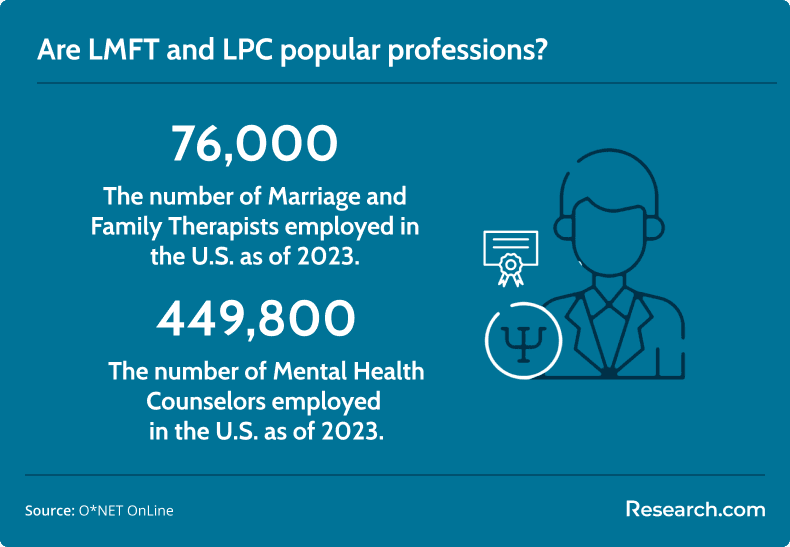
O*NET OnLine reports 76,000 Marriage and Family Therapists and 449,800 Mental Health Counselors employed in the United States as of 2023. That difference reflects the broader employment category and wider variety of settings available to mental health counselors.
Do LMFTs and LPCs follow different training paths?
Yes. Both routes usually require a master’s degree, supervised experience, and a licensing exam, but the curriculum, accreditation expectations, clinical supervision, and exam content are not identical. If you are comparing how to become a marriage and family therapist with the LPC route, start by reviewing your state board’s rules before enrolling.
Education and accreditation differences
- LMFT programs, including in-person and online marriage and family therapy graduate programs, typically emphasize family systems theory, couples counseling, relational assessment, and family-based intervention. Many are accredited by the Commission on Accreditation for Marriage and Family Therapy Education (COAMFTE).
- LPC programs generally focus on clinical mental health counseling, diagnosis, treatment planning, individual counseling, group counseling, and professional counseling practice. When comparing campus programs or affordable online master's in counseling programs, students often look for Council for Accreditation of Counseling and Related Educational Programs (CACREP) accreditation.
- Some schools offer dual-track or carefully designed curricula that may help students meet requirements for both LMFT and LPC licensure, but this depends on state rules and course alignment.
Clinical training differences
- LMFT students usually complete 300 to 500 supervised internship hours during the degree, with cases tied to marriage, couple, and family therapy.
- LPC students often complete about 600 supervised internship hours, with broader exposure to assessment, diagnosis, individual counseling, group counseling, and clinical mental health practice.
- After graduation, LMFTs often need 2,000 to 4,000 supervised hours, while LPCs commonly need 3,000 to 4,000 supervised hours.
- LMFT supervision may need to come from a licensed marriage and family therapist. LPC supervision rules can allow supervision by an LPC, psychologist, licensed clinical social worker, or another approved professional, depending on the state.
Licensing exam differences
- LMFT candidates typically take the Marriage and Family Therapy National Exam, administered by the Association of Marriage and Family Therapy Regulatory Boards (AMFTRB). The exam emphasizes family therapy, systemic assessment, relational treatment, and professional practice.
- LPC candidates usually take the National Counselor Examination (NCE) or the National Clinical Mental Health Counseling Examination (NCMHCE), administered by the National Board for Certified Counselors (NBCC). These exams focus more on counseling practice, diagnosis, case conceptualization, treatment planning, and clinical decision-making.
- Some states also require jurisprudence, ethics, or state law exams for LMFTs, LPCs, or both.
| Training Requirement | LMFT Path | LPC Path |
| Graduate degree focus | Marriage and family therapy, family systems, relational counseling | Clinical mental health counseling, professional counseling, diagnosis and treatment |
| Typical program accreditation | COAMFTE | CACREP |
| In-program clinical hours | 300 to 500 hours | Typically 600 hours |
| Postgraduate supervised hours | 2,000 to 4,000 hours | 3,000 to 4,000 hours |
| Exam | Marriage and Family Therapy National Exam | NCE or NCMHCE |
The best program is not simply the cheapest or fastest one. It is the one that meets your state’s licensure requirements, offers appropriate clinical placements, prepares you for the correct exam, and supports the type of clients you want to serve.
How long does it take to become an LMFT or LPC?
Most LMFT and LPC pathways take about six to eight years from the start of undergraduate study through licensure, although the timeline depends on the student’s prior credits, graduate program format, internship schedule, supervised postgraduate hours, exam timing, and state requirements.
| Stage | Typical LMFT Timeline | Typical LPC Timeline |
| Bachelor’s degree | Usually completed before graduate admission | Usually completed before graduate admission |
| Master’s degree | Often two to three years, depending on full-time, part-time, or accelerated format | Often two to three years, depending on full-time, part-time, or accelerated format |
| Graduate internship/practicum | 300 to 500 hours, focused on relational and family therapy cases | Typically 600 hours, with broader clinical mental health exposure |
| Postgraduate supervised experience | 2,000 to 4,000 hours | 3,000 to 4,000 hours |
| Licensing exam and board review | Marriage and Family Therapy National Exam plus any state-specific requirements | NCE or NCMHCE plus any state-specific requirements |
What can shorten the timeline?
- Choose an accelerated campus program, an accelerated LPC program, or an online master's degree in family counseling that meets licensure requirements. Some accelerated master’s programs can be completed in 18 to 24 months.
- Complete supervised postgraduate hours on a full-time schedule if your personal finances, employer, and state board rules allow it.
- Prepare for the licensing exam early and take it as soon as you become eligible.
- Confirm that your practicum and internship placements count toward the right license before you begin logging hours.
What can delay licensure?
- Enrolling in a program that does not meet your state’s required coursework.
- Completing supervised hours under someone who is not approved by the state board.
- Moving states before licensure without checking endorsement or additional coursework rules.
- Waiting too long to apply for exams, submit documentation, or resolve transcript issues.
What courses are common in LMFT and LPC programs?
LMFT and LPC programs share a foundation in counseling ethics, human development, clinical skills, and assessment. The difference is how each program applies those foundations. LMFT coursework is more relational and systems-based. LPC coursework is usually broader and more individual-clinical in orientation.
Courses both LMFT and LPC students often take
- Counseling theories: Major models of therapy, such as cognitive-behavioral, psychodynamic, humanistic, and solution-focused approaches.
- Ethics and professional practice: Confidentiality, informed consent, mandated reporting, legal duties, documentation, and professional boundaries.
- Multicultural counseling: Culturally responsive care, identity, bias, power, access, and social context in counseling relationships.
- Human growth and development: Cognitive, emotional, social, and lifespan development from childhood through older adulthood.
- Research methods: Research design, data interpretation, evidence-based practice, and how to evaluate clinical literature.
- Assessment and diagnosis: Intake, clinical interviewing, diagnosis, case conceptualization, and treatment planning.
- Crisis intervention: Safety assessment, stabilization, referral, and response to urgent mental health situations.
Courses more common in LMFT programs
- Family systems theory: How family structures, boundaries, roles, and interaction patterns shape individual and relational functioning.
- Family therapy models: Approaches such as structural, Bowenian, strategic, and other family-focused models.
- Couples therapy: Assessment and intervention for communication problems, conflict, intimacy concerns, trust issues, and relationship repair.
- Child and adolescent therapy in family context: How child and adolescent concerns intersect with parenting, family stress, development, and home environment.
Courses more common in LPC programs
- Individual counseling: One-on-one clinical work for emotional, behavioral, career, and life adjustment concerns.
- Career counseling: Career development theory, vocational assessment, work transitions, and decision-making support.
- Group counseling: Group process, facilitation skills, member dynamics, and therapeutic group design.
- Substance abuse counseling: Addiction theory, recovery models, screening, relapse prevention, and co-occurring mental health concerns.
Course titles vary by school, so do not rely only on the program name. Compare the curriculum against your state board’s required content areas, internship rules, and approved degree standards.
Some counseling-adjacent majors can support LMFT or LPC admission, but licensure depends on whether the graduate curriculum includes the required courses and supervised training. Zippia reports that psychology is the most popular major among counselors based on its analysis of real counselor resumes. The chart below provides additional context.
What skills do LMFTs and LPCs need?
Successful LMFTs and LPCs need more than academic knowledge. Both roles require clinical judgment, emotional discipline, communication skill, and the ability to maintain ethical boundaries while working with vulnerable clients.
Core counseling skills for both roles
- Empathy: Clients need to feel understood without being judged. Empathy helps build trust and supports disclosure.
- Active listening: Therapists must notice words, tone, pauses, body language, and emotional themes. Research in the American Psychological Association literature identifies supportive counseling skills such as active listening and empathy as critical ingredients of all psychotherapies.
- Clear communication: Counselors need to ask precise questions, summarize accurately, explain treatment plans, and adapt language to the client’s needs.
- Interpersonal boundaries: Strong clinicians can be warm and supportive while preserving professional limits.
- Problem-solving: Therapists help clients define problems, test alternatives, strengthen coping strategies, and make realistic plans.
- Critical thinking: Clinical work requires weighing symptoms, history, risk, context, diagnosis, culture, and client goals before choosing interventions.
Skills that matter especially for LMFTs
- Systems thinking: LMFTs must see how one person’s symptoms or behavior can be connected to family rules, communication patterns, conflict cycles, and relationship roles.
- Family dynamics assessment: They need to understand development, parenting structures, generational patterns, alliances, boundaries, and common family stressors.
- Couples counseling skill: LMFTs often help partners communicate, repair trust, de-escalate conflict, and identify recurring relationship patterns.
Skills that matter especially for LPCs
- Individual counseling depth: LPCs often work with clients over time on anxiety, depression, trauma, grief, identity, stress, and life transitions.
- Assessment and diagnosis: LPCs need strong intake, screening, risk assessment, diagnostic, and treatment planning abilities.
- Crisis intervention: Many LPC roles require calm decision-making when clients face suicidal ideation, self-harm risk, abuse, acute distress, or severe symptoms.
Professional skills employers and clients also value
- Cultural responsiveness: Effective therapy requires respect for culture, race, gender, religion, disability, socioeconomic background, family structure, and lived experience.
- Ethical and legal awareness: Therapists must understand confidentiality, records, supervision, telehealth rules, mandated reporting, and duty-to-warn obligations.
- Self-care and burnout prevention: Emotional stamina is essential because clinical work can involve trauma, grief, conflict, addiction, and crisis.
- Administrative competence: Scheduling, documentation, treatment plans, insurance forms, and billing affect both client care and employability.
When comparing programs, cost matters, but preparation matters more. Students looking for the most affordable online colleges for counseling degrees should also evaluate supervision support, skills training, practicum quality, and exam preparation. Zippia data notes that crisis intervention, substance abuse services, and open, flexible, non-denominational patient care are among the top counselor resume skills.
How much do LMFTs and LPCs earn?
Salary comparisons can be confusing because sources may report median wages, mean wages, or broader occupational categories. As of May 2023, the average annual salaries reported for these mental health occupations are:
- Marriage and Family Therapists: $68,730
- Substance Abuse, Behavioral Disorder, and Mental Health Counselors: $60,080
These U.S. Bureau of Labor Statistics figures show higher average annual pay for Marriage and Family Therapists than for the broader category that includes substance abuse, behavioral disorder, and mental health counselors. However, your actual earnings will depend on state, employer, years of experience, license level, practice setting, client population, insurance participation, and specialization.
Location can make a major difference. For example, LMFTs in New Jersey earn an average annual salary of $92,120, while LMFTs in Alaska make $74,420.
Industry also matters. Mental health counselors working in child care services can earn an average annual salary of $76,790, while those employed by junior colleges can make $72,930. Therapists in private practice or those with specialized expertise may also earn more, although self-employment adds business costs, insurance considerations, marketing, and income variability.
| Salary Factor | How It Can Affect LMFT or LPC Earnings |
| State and metro area | Licensure rules, local demand, cost of living, and reimbursement rates vary widely. |
| Work setting | Hospitals, colleges, agencies, private practice, schools, and telehealth companies may pay differently. |
| Specialization | Training in trauma, addiction, couples work, child therapy, or crisis care can support access to specialized roles. |
| Experience and license level | Fully licensed clinicians generally have more options than associate-level or pre-licensed clinicians. |
| Private practice model | Income may rise with a strong caseload, but clinicians must manage overhead, billing, referrals, and cancellations. |
The chart below uses the most recent BLS data to compare LMFTs, LPC-related occupations, and other mental health providers.
What is the job outlook for LMFTs and LPCs?
The employment outlook is strong for both pathways. The U.S. Bureau of Labor Statistics projects that employment for marriage and family therapists will grow 16% from 2023 to 2033. For substance abuse, behavioral disorder, and mental health counselors, the projected growth is 19% from 2023 to 2033.
Why demand remains high
- Greater willingness to seek help: Public discussion of mental health has increased, and research continues to show a growing awareness of mental health issues.
- Expanded access models: Telehealth, integrated care, school-based services, community programs, and employer-sponsored mental health benefits have increased access points for clients.
- Complex client needs: Therapists are needed for anxiety, depression, addiction, trauma, relationship conflict, family stress, grief, and aging-related concerns.
Technology and AI trends to watch
- Telehealth is now a standard delivery option: Many clinicians provide remote sessions, but state licensure rules still control where clients can be located.
- AI may change documentation and practice management: AI tools can assist with scheduling, note drafting, and administrative workflows, but clinicians remain responsible for confidentiality, accuracy, clinical judgment, and ethical compliance.
- Employers increasingly value measurable outcomes: Clinicians may be expected to use screening tools, treatment plans, progress measures, and evidence-based interventions.
Both licenses can lead to meaningful work, but employment flexibility differs. LPCs often have broader job categories across mental health counseling, substance abuse counseling, and behavioral health settings. LMFTs may have a stronger identity in relationship, couple, and family-focused practice.
What specialization and advancement options are available?
After licensure, LMFTs and LPCs can build careers around specific populations, treatment methods, or service settings. Specialization can help clinicians stand out, qualify for niche roles, and improve clinical effectiveness, but it should be chosen intentionally rather than collected at random.
| Specialization | Best Fit | Why It May Help |
| Trauma therapy | LMFT or LPC | Useful for clinicians working with abuse, violence, grief, disaster response, or post-traumatic symptoms. |
| Substance abuse counseling | Often LPC, also useful for LMFTs | Supports work with addiction, recovery, relapse prevention, and co-occurring conditions. |
| Child and adolescent mental health | LMFT or LPC | Helpful for school, family, youth agency, and pediatric behavioral health settings. |
| Couples and family therapy | Especially LMFT | Aligns with relational assessment, communication patterns, parenting, and family systems work. |
| Applied behavior analysis | Adjunct specialization | Interdisciplinary study, such as a BCBA degree online pathway, may broaden work with behavior-focused interventions. |
Advancement may include clinical supervision, program management, private practice ownership, training, consulting, agency leadership, teaching, or doctoral study. Before investing in a credential, ask whether it improves competence, meets employer expectations, or helps serve the clients you actually want to work with.
How can mentorship and networking support your career?
Mentorship can make the licensing years less confusing. A strong supervisor or mentor can help you interpret board rules, prepare for documentation audits, choose continuing education, avoid ethical missteps, and build confidence with difficult cases.
- Join professional associations related to marriage and family therapy, counseling, addiction counseling, or your chosen specialty.
- Attend conferences, state board information sessions, workshops, and ethics trainings.
- Ask supervisors about their approach to case consultation, documentation, risk management, and exam preparation.
- Build referral relationships with physicians, school counselors, social workers, psychiatrists, community agencies, and other therapists.
- Use career roadmaps, including resources on the requirements to become a counselor, to understand each step before you commit to a program.
Networking is not only about finding clients. It can help you locate quality supervision, learn about job openings, understand local reimbursement realities, and identify which specializations are actually in demand in your area.
Can an accelerated program shorten the path?
An accelerated program can reduce the time spent in graduate school, but it cannot erase state licensing requirements. You still need approved coursework, clinical placement hours, postgraduate supervision, exams, and board review.
Accelerated options work best for students who can handle intensive reading, frequent assignments, practicum scheduling, and limited breaks. They may be risky for students who need to work full time, manage caregiving responsibilities, or learn better at a slower pace.
Questions to ask before choosing an accelerated option
- Does the program meet LMFT, LPC, or dual licensure requirements in my state?
- How are practicum and internship placements arranged?
- Can I complete clinical hours in my local area?
- What is the graduation rate and exam preparation support?
- Does the schedule allow enough time for supervised client contact?
- What happens if I need to slow down or take a leave?
Students exploring shorter academic formats may also review the fastest degree in psychology options to understand how accelerated education models differ across behavioral science fields.
Why does accreditation matter for LMFT and LPC careers?
Accreditation can affect licensure eligibility, transferability, employer confidence, and access to clinical placements. It does not guarantee licensure, but it is one of the first quality signals students should verify.
- For LMFT students: COAMFTE accreditation may simplify the process of showing that a program covers marriage and family therapy competencies, depending on state rules.
- For LPC students: CACREP accreditation can matter in states that reference CACREP standards or prefer CACREP-aligned coursework.
- For specialized study: Related training, including top ABA programs, may complement clinical work when it aligns with your population and professional goals.
Before enrolling, contact the state licensing board where you plan to practice and ask whether the degree, accreditation, internship, and supervision structure meet current requirements. Do not rely only on a school’s marketing page.
How can online education support specialization?
Online education can make graduate study and continuing education more accessible, especially for working adults and students outside major metro areas. The key question is not whether a program is online; it is whether the program is accredited, clinically rigorous, and accepted by your state board.
Online programs can be useful for specialized coursework in trauma, child and adolescent mental health, family therapy, addiction, ethics, telehealth, or assessment. For example, an online master's in child psychology may be relevant for clinicians who want deeper preparation for youth-focused work, depending on their license goals and state requirements.
Online vs. campus LMFT or LPC programs
| Factor | Online Program | Campus Program |
| Flexibility | Often better for working students or those outside commuting range | More structured schedule and in-person access |
| Clinical placement | May require students to find or help coordinate local placements | May have established local agency partnerships |
| Peer connection | Depends on cohort design, residencies, and live sessions | Often easier to build in-person relationships |
| Licensure fit | Must be checked carefully across state lines | Often designed for the state or region where the school is located |
How does continuing education affect career outcomes?
Continuing education is required to maintain many licenses, but it should also be used strategically. The best continuing education helps clinicians improve client outcomes, keep up with legal and ethical changes, and expand into areas they are prepared to serve responsibly.
- Choose ethics, risk management, and documentation courses regularly.
- Use specialty training to deepen competence rather than chase every trend.
- Track continuing education deadlines and keep certificates organized.
- Seek consultation when learning a new population or intervention.
- Consider cost-effective options carefully, including fields adjacent to counseling such as affordable online forensic psychology master's programs, when they match your career plan.
Professional development can improve confidence and employability, but it does not replace license scope. Always confirm whether a new service area requires additional certification, supervision, or board approval.
Can a dual degree strengthen a mental health career?
A dual degree can be valuable for students who want broader clinical, diagnostic, research, or leadership preparation. It can also be expensive and time-intensive, so the return depends on your career goals.
Programs such as combined master's and PsyD programs may appeal to students who want advanced doctoral-level training while building a foundation in counseling or psychology. This route may be useful for people interested in psychological assessment, advanced clinical practice, academic work, or leadership roles, but students must compare licensure outcomes carefully.
Consider a dual pathway if you want:
- Broader diagnostic and assessment training.
- More research or teaching preparation.
- Potential eligibility for multiple professional directions.
- A long-term plan that justifies the added cost and time.
Be cautious if:
- Your goal is to begin independent counseling practice as quickly as possible.
- You have not confirmed how the degree maps to state licensure.
- The extra credential does not clearly improve your target career path.
What are the long-term growth options for LMFTs and LPCs?
Long-term career growth usually comes from a combination of license maturity, clinical competence, specialization, supervision experience, business skills, and professional reputation. Both LMFTs and LPCs can build durable careers, but their growth routes may look different.
- Clinical specialist: Focus on trauma, couples therapy, addiction, youth counseling, grief, crisis care, or another evidence-based specialty.
- Supervisor: Become approved to supervise associate-level clinicians after meeting state requirements.
- Private practice owner: Build a solo or group practice, manage referrals, choose a fee model, and handle business operations.
- Program leader: Move into clinical director, agency manager, training coordinator, or behavioral health leadership roles.
- Educator or researcher: Pursue teaching, training, or further study. An online PsyD program may be relevant for some clinicians seeking advanced doctoral preparation.
The strongest long-term path is usually the one that combines a clear client focus with sustainable workload management. Burnout can derail even a promising career, so growth planning should include supervision, consultation, rest, and financial planning.
How does license reciprocity work?
License portability is one of the most important practical issues for LMFTs and LPCs. If you may move states or provide telehealth across state lines, you need to understand reciprocity, endorsement, compact participation, and state-specific restrictions before choosing a program or job.
True reciprocity, where states automatically accept each other’s licenses, is uncommon. More often, clinicians apply through endorsement, meaning the new state board reviews the applicant’s education, supervision, exam history, license status, and disciplinary record.
- Reciprocity: A formal agreement in which participating states accept a license under specified terms. Requirements may include proof of good standing, documentation that the original license met comparable standards, and a reciprocity application. North Carolina, for example, offers an LCMHC License by Reciprocity for South Carolina, Kentucky, and Tennessee licensees.
- Endorsement: A case-by-case review by the new state licensing board. The board may require additional coursework, supervised hours, exams, ethics training, or documentation before granting a license.
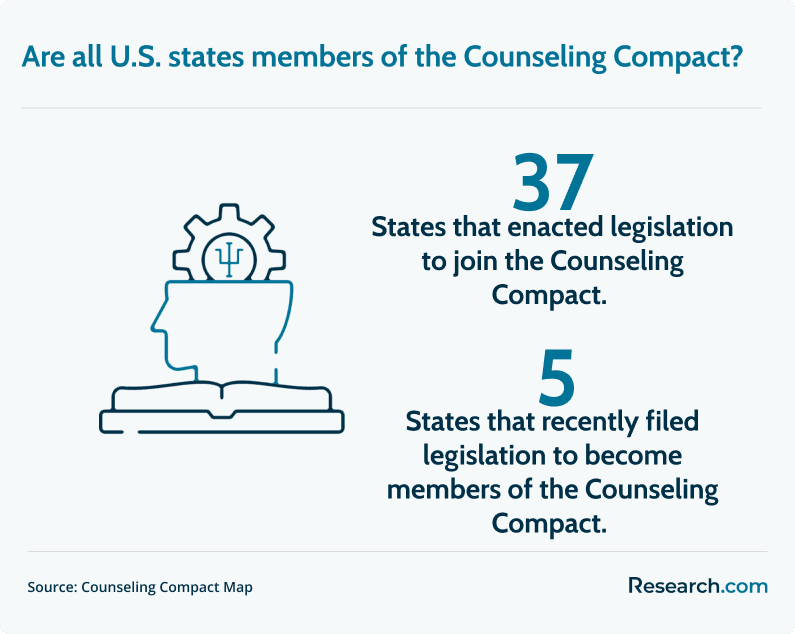
The Counseling Compact is designed to improve license portability for counselors by allowing eligible counselors in participating states to practice across state lines, including through telehealth. As of this writing, 37 states have enacted legislation to join the compact, while five more have filed legislation to become members.
Questions to ask before moving or offering telehealth
- Does my current license qualify for endorsement in the new state?
- Will the new state accept my graduate program accreditation and coursework?
- Do my supervised hours meet the new state’s minimums?
- Do I need an additional ethics, jurisprudence, or clinical exam?
- Can I legally serve clients located in another state through telehealth?
What challenges should LMFTs and LPCs expect?
LMFT and LPC careers can be rewarding, but they are not easy. Students should understand the professional pressures before entering graduate school, especially if they plan to work in high-need settings.
1. Burnout and compassion fatigue
- Both LMFTs and LPCs may work with trauma, abuse, addiction, grief, family conflict, suicidal ideation, and severe distress.
- LMFTs may feel drained by high-conflict couples, family crises, divorce-related disputes, and cases where several family members have competing goals.
- LPCs may carry heavy emotional responsibility in crisis work, chronic mental illness treatment, or long-term trauma care.
- Protective strategies include clinical supervision, peer consultation, reasonable caseload limits, personal therapy when appropriate, and firm boundaries around availability.
2. High caseloads and documentation pressure
- Demand for services can create large caseloads, long waitlists, and limited time for notes, treatment plans, risk documentation, and coordination of care.
- LMFT sessions involving families or couples may require additional planning and careful documentation because multiple participants are involved.
- LPCs may manage ongoing individual cases with complex histories, crisis risk, or co-occurring conditions.
- Helpful practices include using efficient documentation systems, scheduling administrative time, setting client limits, and clarifying employer expectations.
3. Licensing complexity
- State-by-state rules can be difficult to navigate, especially for students in online programs or clinicians who relocate.
- LMFTs may face specific supervision rules tied to marriage and family therapy supervisors.
- LPC candidates may need to determine whether their state requires the NCE, NCMHCE, or another state-specific requirement.
- Clinicians should check state board websites regularly, track continuing education deadlines, and keep supervision records organized.
4. Financial pressure and reimbursement limits
- Pre-licensed clinicians may earn less while completing supervised hours.
- Community mental health roles can offer valuable experience but may involve high caseloads and modest pay.
- Private practice can increase autonomy, but income depends on referrals, fees, insurance reimbursement, cancellations, and business expenses.
- Many clinicians use hybrid models, combining insurance panels, private pay, workshops, supervision, consulting, or telehealth services where legally permitted.
5. Ethical and legal responsibility
- Therapists must manage confidentiality, safety planning, mandated reporting, duty to warn, informed consent, recordkeeping, and boundaries.
- LMFTs may face complex consent and confidentiality issues when treating couples, families, minors, or separated parents.
- LPCs may need to make urgent decisions involving hospitalization, suicide risk, abuse reporting, or coordination with medical providers.
- When in doubt, clinicians should seek consultation, document decisions clearly, and follow applicable laws and professional ethics codes.
Common mistakes to avoid
| Mistake | Why It Can Hurt You | Better Approach |
| Choosing a program without checking licensure requirements | You may graduate missing required coursework or clinical hours. | Confirm requirements with your state board before enrolling. |
| Focusing only on tuition | A low-cost program may have weak placement support or poor licensure alignment. | Compare cost, accreditation, clinical support, exam preparation, and outcomes. |
| Assuming online programs are automatically accepted | State boards may have specific rules for coursework, internships, and residency. | Ask the board and program for written licensure alignment information. |
| Ignoring supervision requirements | Hours may not count if the supervisor is not approved. | Verify supervisor credentials before beginning postgraduate hours. |
| Assuming salaries are guaranteed | Pay varies by location, employer, license level, specialization, and caseload. | Research local job postings, reimbursement rates, and cost of living. |
Should you become an LMFT or an LPC?
The right choice depends on the clients you want to serve, the clinical lens you want to use, the work settings you prefer, and the state where you plan to practice. Neither license is universally better. They are different tools for different career goals.
Choose LMFT if you want to:
- Specialize in couples, families, parenting, premarital counseling, relationship conflict, or family transitions.
- Use systems theory as a central part of assessment and treatment.
- Build a private practice focused on relationship and family work.
- Work with individuals while still considering relational and family context.
- Complete a pathway that may involve fewer supervised hours in some states.
Choose LPC if you want to:
- Work with a broad range of individual mental health concerns.
- Keep more flexibility across agencies, schools, hospitals, group practices, telehealth companies, and behavioral health settings.
- Focus on anxiety, depression, trauma, addiction, crisis intervention, career counseling, or group counseling.
- Pursue a wider set of counseling roles tied to clinical mental health practice.
- Prioritize license portability where counseling compact participation or endorsement rules may support mobility.
Consider dual licensure if:
- You want both relational training and broad clinical mental health counseling preparation.
- Your state allows dual licensure and your program can meet both sets of requirements.
- You are willing to complete additional coursework, supervised hours, exams, and fees.
- Your long-term career plan benefits from both credentials.
| Your Priority | More Likely Fit |
| Couples therapy and family systems | LMFT |
| Broad individual mental health counseling | LPC |
| Private practice focused on relationships | LMFT |
| Behavioral health agency flexibility | LPC |
| Substance abuse or crisis counseling | Often LPC |
| Parenting, divorce adjustment, and family conflict | Often LMFT |
| Possible future interstate mobility | Often LPC, depending on state rules |
Employment projections can also help you evaluate your preferred specialty. Using the most current data from O*NET OnLine, the chart below shows projected annual job openings for selected mental health roles from 2023 to 2033.
Key Insights
- LMFT and LPC licenses both lead to mental health practice, but the clinical focus differs: LMFTs specialize in relationship systems, while LPCs usually have broader training in individual and clinical mental health counseling.
- Both pathways require state licensure, a master’s degree, supervised clinical experience, and a licensing exam. Always check your state board’s requirements before choosing a program.
- According to O*NET OnLine, there are 76,000 Marriage and Family Therapists and 449,800 Mental Health Counselors employed in the United States as of 2023.
- BLS data shows strong projected growth for both fields: 16% for marriage and family therapists and 19% for substance abuse, behavioral disorder, and mental health counselors from 2023 to 2033.
- LMFT may be the better choice if you want to focus on couples, families, and relational patterns. LPC may be the better choice if you want wider role flexibility across mental health, crisis, trauma, substance abuse, and group counseling settings.
- Cost, speed, and online format should never be the only deciding factors. Accreditation, clinical placement quality, state licensure fit, supervision rules, and exam preparation are more important for long-term career access.
- Some states allow therapists to hold dual licensure as both an LMFT and an LPC, provided they meet the education, clinical hours, and exam requirements for both credentials.
References:
- Counseling Compact (n.d.). Compact Map. https://prod761aul1.wpenginepowered.com/map
- Health Resources and Services Administration (n.d.). Health Workforce Shortage Areas. https://data.hrsa.gov/topics/health-workforce/shortage-areas Data Retrieved on February 2025
- O*NET OnLine (n.d.). O*NET OnLine Help. https://www.onetonline.org/help/online/find_occ Data Retrieved on February 2025
- U.S. Bureau of Labor Statistics (April 2024). 21-1013 Marriage and Family Therapists. https://www.bls.gov/oes/2023/may/oes211013.htm
- U.S. Bureau of Labor Statistics (April 2024). 21-1018 Substance Abuse, Behavioral Disorder, and Mental Health Counselors. https://www.bls.gov/oes/2023/may/oes211018.htm
- U.S. Bureau of Labor Statistics (April 2024). May 2023 National Occupational Employment and Wage Estimates. https://www.bls.gov/oes/2023/may/oes_nat.htm
- U.S. Bureau of Labor Statistics (August 2024). Marriage and Family Therapists. https://www.bls.gov/ooh/community-and-social-service/marriage-and-family-therapists.htm
- U.S. Bureau of Labor Statistics (August 2024). Substance Abuse, Behavioral Disorder, and Mental Health Counselors. https://www.bls.gov/ooh/community-and-social-service/substance-abuse-behavioral-disorder-and-mental-health-counselors.htm
- Zippia (January 2025). Counselor Education Requirements. https://www.zippia.com/counselor-jobs/education
Other Things You Need to Know About Differences in LMFT and LPC Careers
In 2027, the educational requirements for LMFTs typically involve completing a Master's degree focused on marriage and family therapy, with courses on family systems and relational dynamics. LPCs are required to hold a Master's degree in counseling or a related field and focus on a broader range of mental health topics.丆
LMFT candidates must pass the Association of Marital and Family Therapy Regulatory Boards (AMFTRB) Exam, while LPC candidates typically take the National Counselor Examination (NCE) or the National Clinical Mental Health Counseling Examination (NCMHCE), depending on state regulations in 2027.
LMFT licenses are usually issued by a state board of behavioral or mental health, while LPC licenses are commonly regulated by a state counseling board. In California, for example, the Board of Behavioral Sciences oversees both LMFT and LPCC credentials, and each state sets its own rules.