An online counseling master's can let you keep working while preparing for a new career - but the wrong track or field-placement arrangement can leave you paying for a degree that does not fit your goal. This guide explains how to compare Georgia programs by career pathway, licensure fit, cost, time, and training requirements. It also features the 2027 Best Online Master's in Counseling Degree Programs Ranking in Georgia, created by the Research.com team of data scientists to help students make an informed choice about which programs are worth considering.
Key findings about online Counseling degrees in Georgia
Choose the pathway before the school: Georgia's Licensed Professional Counselor route and its school counselor certification route have different authorities and preparation requirements (Georgia Composite Board; Georgia Professional Standards Commission).
Plan for supervised, in-person training even when coursework is online. Ask each program whether it can approve a placement near your home and whether any campus visits are required.
National median annual pay was $59,350 for substance abuse, behavioral disorder, and mental health counselors and $64,330 for school and career counselors and advisors in May 2025; those occupational figures are not Georgia graduate starting salaries (U.S. Bureau of Labor Statistics).
What can I expect from an online Counseling degree in Georgia?
Expect graduate courses in counseling theory, assessment, ethics, and work with clients or students, followed by supervised practicum and internship experiences. "Online" usually describes how academic courses are delivered - not a way to complete supervised counseling work entirely from home. Programs may also require scheduled live classes, intensive sessions, or visits to campus; confirm the format before applying (institutional program descriptions).
The first decision is whether you want to counsel clients in mental health settings or support students in schools. A clinical mental health program should be evaluated against Georgia Licensed Professional Counselor requirements administered by the Georgia Composite Board of Professional Counselors, Social Workers, and Marriage and Family Therapists. A school counseling program should be evaluated against Georgia Professional Standards Commission certification requirements. A degree title alone does not establish eligibility for either credential.
This path makes sense if you want supervised, relationship-centered work and can accommodate field hours alongside classes. If your goal is primarily academic advising, human resources, or general wellness education without a counseling credential, compare less specialized graduate options before committing to a licensure-oriented degree.
Where can I work with an online Counseling degree in Georgia?
Your setting depends on your track and credentials. Clinical mental health graduates may seek roles in community mental health agencies, health systems, substance use treatment organizations, or private practices once they meet the applicable hiring and licensing requirements. School counseling graduates generally prepare for K-12 positions under the state's educator certification framework; employment in a public school is not the same credential pathway as independent clinical practice (Georgia Composite Board; Georgia Professional Standards Commission).
Location affects the search. If you live far from a metropolitan area, ask schools how they approve local supervisors and placements before assuming you can train without relocating. If you expect to move out of Georgia, compare the destination state's rules before enrolling: completing a Georgia-focused program does not automatically establish eligibility elsewhere.
The U.S. Bureau of Labor Statistics reports a May 2025 national median annual wage of $59,350 for substance abuse, behavioral disorder, and mental health counselors. Its median for school and career counselors and advisors was $64,330. These are medians for employed workers across experience levels, not offers to newly qualified counselors or Georgia-specific salary estimates (BLS, Occupational Outlook Handbook).
Use the occupation that matches your intended job when weighing the degree's cost. Agency employment, school-system pay schedules, supervised prelicensure work, and eventual independent practice can involve different compensation arrangements. Ask programs for recent, clearly defined graduate employment results, then compare likely pay and debt against what you currently earn rather than treating a national median as a personal forecast.
The programs below illustrate different choices within Georgia's counseling landscape. Their published degree descriptions are a starting point - not proof that every course, placement, or certification step can be completed remotely. Verify the current catalog, delivery format, and credential alignment directly with each school.
Fort Valley State University - M.S. Ed. in School Counselor Education. Its specifically named school counselor education degree gives future K-12 counselors a focused option to compare against broader counselor education degrees. Ask how the program arranges school placements and documents preparation for Georgia certification (Fort Valley State University).
Columbus State University - M. Ed. in School Counseling. The school counseling degree provides a clearly identified educator pathway, distinct from the university's clinical mental health offering. It is the relevant program to investigate if your intended workplace is a school rather than a clinical agency (Columbus State University).
Columbus State University - M.S. in Clinical Mental Health Counseling. This separately named clinical degree lets applicants distinguish mental health counselor preparation from the university's school counseling route. Compare its current curriculum and supervised training requirements with Georgia's LPC education rules before applying (Columbus State University; Georgia Composite Board).
Valdosta State University - M. Ed. in Counselor Education. Its counselor education degree requires a closer look at the current program pathway than a degree whose title names one practice setting. Request the course sequence and written confirmation of which Georgia credential the pathway is designed to support (Valdosta State University).
Albany State University - M. Ed. in Counselor Education. The graduate catalog is the useful starting point for checking the degree's current requirements rather than relying on an abbreviated program title. Prospective students should match the listed pathway and fieldwork requirements to their intended school or clinical role (Albany State University graduate catalog).
University of West Georgia - counseling program. Its program listing is worth comparing for its specific curriculum and delivery requirements, not just its institutional location. Request the current catalog entry and a placement plan for your area before deciding whether it fits work and travel commitments (University of West Georgia).
South University-Savannah - M.A. in Clinical Mental Health Counseling. This is a clinical mental health option associated with the Savannah campus, making its delivery and local training arrangements especially important to confirm. Ask which courses require attendance and whether approved placements are available where you intend to live and work (South University).
A full-time counseling master's commonly takes about two to three years; part-time study can take longer. The meaningful comparison is not just the advertised course schedule but when practicum and internship are offered and how many hours per week you must be available at a placement. Those commitments can limit how quickly a working adult finishes, even with asynchronous classes (institutional program requirements).
Compare each school's actual term-by-term plan and ask whether delaying fieldwork postpones graduation. If finishing quickly is your priority, the fastest counseling programs are a useful starting point - but an accelerated calendar is only an advantage if you can complete its supervised training on schedule.
The central difference is access to coursework: online delivery can reduce routine commuting, while on-campus study provides a regular physical learning setting. Neither format removes the need to develop and demonstrate counseling skills under supervision. For Georgia students, the practical question is where live instruction, skills practice, and fieldwork take place - not simply whether a program calls itself online.
Choose online study if you need to remain employed or live far from campus and the school can support your location and schedule. Consider campus-based study if regular in-person contact or access to nearby placement relationships would make training easier. Before committing to either format, ask for the required campus dates, live-session schedule, technology requirements, and process for approving an outside placement (institutional program requirements).
There is no single reliable price for an online Georgia counseling master's: tuition policies, required credits, fees, residency classification, and fieldwork costs vary by school. A quoted per-credit rate is not a degree price. Compare the school's published tuition and mandatory fees against its current degree plan, then request a program-specific estimate that includes travel, books, technology, and any placement-related expenses (institutional tuition schedules and program catalogs).
At public institutions, check whether online students receive a distinct rate and whether Georgia residency changes the bill; do not assume online delivery qualifies you for in-state tuition. Private institutions may have different pricing structures, but public versus private status alone cannot tell you which option is less expensive after aid. The most affordable counseling programs can help you create a shortlist to price in full.
Start with the Free Application for Federal Student Aid and each institution's graduate aid office. Depending on eligibility and the program, funding may include federal Direct Unsubsidized Loans, institutional scholarships or assistantships, employer tuition support, and aid tied to a particular service commitment. Ask whether your enrollment level and online program qualify for each award; admission alone does not establish aid eligibility (Federal Student Aid; institutional financial aid offices).
Graduate PLUS rules changed for borrowing beginning July 1, 2026: new graduate borrowers generally cannot rely on that program, while limited transitional eligibility may apply to students who were already enrolled in and borrowing for the same program before the change. Confirm your individual status and current limits with Federal Student Aid and your school before building a financing plan around a Graduate PLUS loan (Federal Student Aid).
A lower net price matters more than a large scholarship headline. Compare your expected out-of-pocket cost and borrowing across the full program, including terms spent in fieldwork when paid work may be harder to maintain. The most valuable counseling programs offer another comparison, but your own aid offer and completion plan should drive the final calculation.
View the chart data as a table
Best score distribution across ranked programs (Source: Research.com)
Category
Value
86-87
2
88-89
7
90-91
3
92-93
6
94-95
1
Expect to submit evidence of a completed bachelor's degree, transcripts, and application materials that explain your interest in counseling; schools may also request recommendations, an interview, or specific prerequisite coursework. Requirements vary by institution and may change by application cycle, so use the current admissions page for the particular degree rather than a general graduate-school checklist (institutional admissions requirements).
Admissions accessibility and professional readiness are different questions. Before applying, ask whether the program admits students from your state of residence, what background-check or placement conditions apply, and which courses - if any - can transfer. A transfer-credit approval should be obtained in writing: accepting a course toward graduation does not necessarily establish that a licensing or certification authority will accept it. If admissions flexibility is a priority, compare the easiest counseling programs without assuming that easier entry means an easier credentialing path.
Core study generally covers counseling theories and techniques, ethics, assessment, research, multicultural counseling, and human development. Supervised practicum and internship put those topics into use with clients or students. School counseling plans may add education-focused coursework and school placements; clinical mental health plans may emphasize diagnosis, treatment planning, and clinical placements (institutional program catalogs).
Course titles are a poor substitute for a credential review. Request a degree audit or curriculum map showing which courses and field experiences address the relevant Georgia authority's requirements. That step is particularly important if you are considering transfer credit or a program based outside Georgia (Georgia Composite Board; Georgia Professional Standards Commission).
The most consequential distinction in this program set is school counseling versus clinical mental health counseling. School counseling is aimed at student support within educational settings and the applicable educator credential. Clinical mental health counseling is aimed at clinical assessment and counseling roles that may lead toward LPC licensure after all state requirements are met (Georgia Professional Standards Commission; Georgia Composite Board).
Some programs may offer additional emphasis through electives or placements, such as substance use or work with particular populations. Treat an emphasis as a curriculum choice, not a separate license. If you want a specialized role, ask what supervised opportunities are available in that setting and what credential employers require.
Start with your intended job and work backward to its credential. A ranking can identify programs worth investigating, but it cannot verify whether a particular placement, schedule, aid offer, and licensing pathway fit you. Use the following checks before accepting an offer:
Identify whether your target role calls for Georgia school counselor certification, LPC licensure, another credential, or no counseling credential (Georgia Professional Standards Commission; Georgia Composite Board).
Confirm institutional accreditation and, where relevant to your goal, the specific program's current CACREP status; do not assume that accreditation of the university means accreditation of its counseling program (U.S. Department of Education; CACREP).
Get written answers about online delivery, campus visits, supervised placement approval, transfer credits, and the program's intended credential pathway.
Compare total net cost, likely borrowing, expected time to completion, forgone earnings during fieldwork, and the likelihood that you can finish on your planned schedule.
For a realistic return-on-investment comparison, consider your current earnings, plausible earnings after the degree, debt payments, completion probability, and how long you expect to work in the new role. A common mistake is choosing the lowest tuition or highest-ranked school before confirming that its fieldwork and credential pathway are workable for you.
A school counseling pathway can lead toward school counselor roles after the applicable Georgia certification steps. A clinical mental health pathway can support a progression from supervised clinical work toward roles requiring independent LPC licensure, subject to Georgia's education, examination, and supervised-experience rules. Related positions in substance use services or community programs may have their own employer and credential requirements (Georgia Professional Standards Commission; Georgia Composite Board).
Think of the master's as one stage, not the final credential. If you want private clinical practice, verify the steps after graduation before comparing programs. If you want to work in K-12 schools, prioritize the educator-certification route instead of assuming a clinical counseling degree is interchangeable.
View the chart data as a table
Median wage by counseling career path (U.S., BLS May 2025) (Source: BLS)
Category
Value
Psychologists
99,110
Postsecondary Teachers
85,330
Marriage & Family Therapists
66,940
School & Career Counselors
64,330
Mental Health Counselors
59,350
Rehabilitation Counselors
46,850
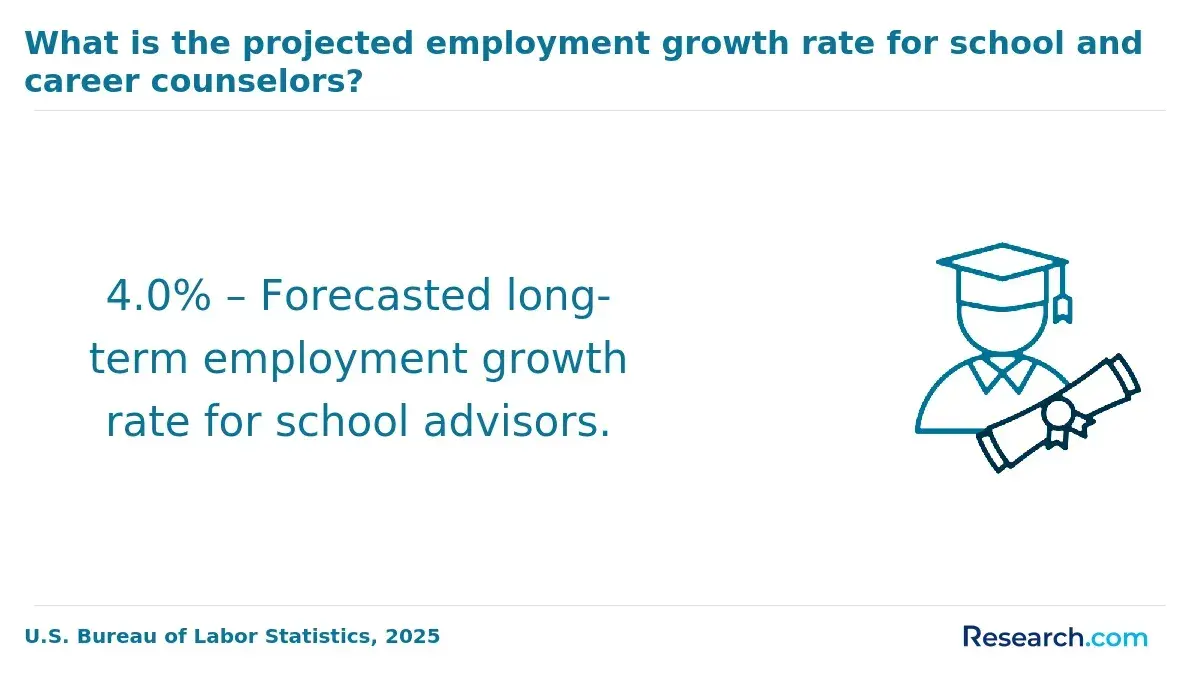
Nationally, employment of substance abuse, behavioral disorder, and mental health counselors is projected to grow 18% from 2025 to 2035. The comparable projection for school and career counselors and advisors is 3% (BLS, Employment Projections). These are U.S. occupational projections, not forecasts of openings for graduates of any Georgia program.
The contrast is useful when choosing a track, but growth alone does not determine your prospects. Search current postings in the Georgia communities where you could work and record the required credential, supervision arrangements, schedule, and experience. That will show whether local opportunities match the degree you are considering - particularly if you cannot relocate or need an employer willing to support a prelicensure role.
2027 Best Online Master's in Counseling Degree Programs Ranking in Georgia
Investing in a graduate degree is a consequential decision. Research.com designed this ranking to help readers compare programs using documented outcomes, accreditation, and cost rather than promotional claims. The team draws on multiple education databases to check the quality, credibility, and accuracy of the information used.
The ranking uses these data sources:
IPEDS database: Institutional reporting on education programs and related characteristics.
Peterson's database: Program and institutional information used in comparisons.
For the Best ranking, a graduate-outcomes-and-accreditation score weights program completion at 40%, employment or doctoral admission at 20%, licensure exam pass rates at 20% where applicable, CACREP programmatic accreditation at 16%, and institutional Title IV eligibility at 4%. Inapplicable criteria are removed and the remaining weights adjusted. Program cost then contributes about 7% of the final score. The same approach applies to online and on-campus programs; other Research.com rankings order programs by the dimension in their names. These comparisons can narrow your search, but you should still confirm current program details with each school. Read more about Research.com's methodology.
# 1 position
Fort Valley State University
Master
M.S. in School Counselor Education
Delivery mode: online
95.03
/ 100
Final score
Program length
almost two years by taking three courses per semester
Specialization
School Counseling
Required credits
60 semester credits
GPA range
2.75 - 4.00
Program completion rate
90% (2023-24)
Employment or doctoral admission
100% (2023-24)
Licensure exam pass rate
100% (2023-24)
Application deadline
April 15
Application process
GradCAS
GRE
no
Prerequisites
Passed GACE Program Admissions exams (Basic Skills tests in Reading, Writing, and Math), OR certification as a teacher in Georgia, OR exemption via SAT, GRE, or ACT scores; undergraduate GPA of at least 2.75.
Additional requirements
Completed Graduate Application, professional resume, statement of purpose (550-600 words), three professional recommendations (FVSU form), official transcripts (cumulative GPA >=2.75), immunization records.
Accreditation
Accredited by the Council for Accreditation of Counseling and Related Educational Programs (CACREP), with institutional accreditation from the Southern Association of Colleges and Schools Commission on Colleges (SACSCOC).
Fort Valley State University earned a Research.com Counseling Program Score of 95.03/100, supported by 100% licensure exam pass rate and 90% program completion rate. The program is CACREP-accredited, valid through 2030-03-31.
# 2 position
Columbus State University
Master
M.Ed. in School Counseling
Delivery mode: hybrid
93.98
/ 100
Final score
Program length
Completion Time: 3 Years
Specialization
School Counseling
Required credits
60 semester credits
GPA range
2.75 - 4.00
Application deadline
Fall: Priority Dec 1; Final March 1
Application process
direct
GRE
no
Prerequisites
Undergraduate degree from an accredited institution; minimum 2.75 GPA (regular) or 2.50 (provisional); resume; statement of purpose; faculty interview. Teaching experience and teacher certification are not required.
Additional requirements
Resume, Statement of Purpose, successful completion of an interview with departmental faculty; minimum undergraduate GPA of 2.75 (regular) or 2.50 (provisional)
Accreditation
Accredited by the Council for Accreditation of Counseling and Related Educational Programs (CACREP), with institutional accreditation from the Southern Association of Colleges and Schools Commission on Colleges (SACSCOC).
Columbus State University earned a Research.com Counseling Program Score of 93.98/100. The program is CACREP-accredited, valid through 2034-04-30.
# 3 position
Valdosta State University
Master
M.Ed. in Counselor Education
Delivery mode: online
93.81
/ 100
Final score
Specialization
School Counseling
Required credits
60 semester credits
GPA range
2.75 - 4.00
Program completion rate
84% (2024-25)
Employment or doctoral admission
100% (2024-25)
Licensure exam pass rate
100% (2024-25)
Application deadline
March 15
Application process
direct
GRE
no
Prerequisites
Bachelor's degree from a regionally accredited institution in any major; minimum cumulative undergraduate GPA of 2.75 on a 4.0 scale.
Additional requirements
Online graduate application; official transcripts from all prior institutions; 250-500 word statement on plans in the chosen Counselor Education track; lawful presence verification if applicable; TOEFL/IELTS for non-native speakers.
Accreditation
Accredited by the Council for Accreditation of Counseling and Related Educational Programs (CACREP), with institutional accreditation from the Southern Association of Colleges and Schools Commission on Colleges (SACSCOC).
Valdosta State University earned a Research.com Counseling Program Score of 93.81/100, supported by 100% licensure exam pass rate and 84% program completion rate. The program is CACREP-accredited, valid through 2033-04-30.
# 4 position
Albany State University
Master
M.Ed. in Counselor Education – Clinical Mental Health Counseling
Delivery mode: hybrid
93.33
/ 100
Final score
Specialization
Clinical Mental Health Counseling
Required credits
60 semester credits
GPA range
2.80 - 4.00
Program completion rate
85% (2022-23)
Employment or doctoral admission
100% (2022-23)
Application process
direct
GRE
yes
Prerequisites
Undergraduate degree from a regionally accredited institution; no specific coursework prerequisites stated for the Clinical Mental Health Counseling concentration.
Additional requirements
Graduate School and program applications; MAT or GRE scores; professional statement; three references; committee interview. Regular admission: GPA 2.8+, MAT 402 or GRE 146V/140Q.
Accreditation
Accredited by the Council for Accreditation of Counseling and Related Educational Programs (CACREP), with institutional accreditation from the Southern Association of Colleges and Schools Commission on Colleges (SACSCOC).
Albany State University earned a Research.com Counseling Program Score of 93.33/100, supported by 85% program completion rate and 100% employment or doctoral admission rate. The program is CACREP-accredited, valid through 2031-10-31.
# 5 position
Columbus State University
Master
Master of Science in Clinical Mental Health Counseling
Delivery mode: hybrid
93.06
/ 100
Final score
Program length
2 Years (Full-time)
Specialization
Clinical Mental Health Counseling
Required credits
60 semester credits
GPA range
2.75 (regular admission) or 2.50 (provisional admission)
Application deadline
Priority: Dec 1; Final: Mar 1 (Fall admission)
Application process
direct
GRE
no
Prerequisites
An earned undergraduate degree from an accredited college or university
Additional requirements
Resume, Statement of Purpose, successful completion of an interview with departmental faculty, minimum GPA (2.75 regular / 2.50 provisional)
Accreditation
Accredited by the Council for Accreditation of Counseling and Related Educational Programs (CACREP), with institutional accreditation from the Southern Association of Colleges and Schools Commission on Colleges (SACSCOC).
Columbus State University earned a Research.com Counseling Program Score of 93.06/100. The program is CACREP-accredited, valid through 2034-04-30.
# 6 position
Albany State University
Master
M.Ed. in Counselor Education – School Counseling
Delivery mode: hybrid
92.82
/ 100
Final score
Specialization
School Counseling
Required credits
63 semester credits
GPA range
2.80 - 4.00
Program completion rate
80% (2022-23)
Employment or doctoral admission
100% (2022-23)
Licensure exam pass rate
100% (2022-23)
Application process
direct
GRE
yes
Prerequisites
Teacher certification is not required for admission. Georgia-certified candidates or those with 3+ semester hours in identifying and educating children with special needs complete 60 SH instead of 63.
Additional requirements
Graduate School and program applications; GACE Program Admission (Praxis Core out of state) or MAT/GRE scores; professional statement; three references; committee interview; GPA 2.8+ for regular admission. Two on-campus residencies.
Accreditation
Accredited by the Council for Accreditation of Counseling and Related Educational Programs (CACREP), with institutional accreditation from the Southern Association of Colleges and Schools Commission on Colleges (SACSCOC).
Albany State University earned a Research.com Counseling Program Score of 92.82/100, supported by 100% licensure exam pass rate and 80% program completion rate. The program is CACREP-accredited, valid through 2031-10-31.
# 7 position
Valdosta State University
Master
M.Ed. in Counselor Education
Delivery mode: online
92.66
/ 100
Final score
Program length
60 hours completed over two years including summers
Specialization
Clinical Mental Health Counseling
Required credits
60 semester credits
GPA range
2.75 - 4.00
Program completion rate
83% (2024-25)
Employment or doctoral admission
100% (2024-25)
Licensure exam pass rate
100% (2024-25)
Application deadline
March 15
Application process
direct
GRE
no
Prerequisites
Bachelor's degree from a regionally accredited institution in any major; minimum cumulative undergraduate GPA of 2.75 on a 4.0 scale.
Additional requirements
Online graduate application; official transcripts from all prior institutions; 250-500 word statement on plans in the chosen Counselor Education track; lawful presence verification if applicable; TOEFL/IELTS for non-native speakers.
Accreditation
Accredited by the Council for Accreditation of Counseling and Related Educational Programs (CACREP), with institutional accreditation from the Southern Association of Colleges and Schools Commission on Colleges (SACSCOC).
Valdosta State University earned a Research.com Counseling Program Score of 92.66/100, supported by 100% licensure exam pass rate and 83% program completion rate. The program is CACREP-accredited, valid through 2033-04-30.
# 8 position
University of West Georgia
Master
Master of Education with a Major in Professional Counseling, Clinical Mental Health
Delivery mode: hybrid
91.52
/ 100
Final score
Program length
2-1/2 years or 7 semesters of full-time study
Specialization
Clinical Mental Health Counseling
Required credits
60 semester credits
GPA range
2.70 - 4.00
Program completion rate
94% (2024-25)
Employment or doctoral admission
100% (2024-25)
Licensure exam pass rate
79% (2024-25)
Application process
direct
Additional requirements
Online Graduate Application ($55 fee), official transcripts, resume, personal statement (3-5 page double-spaced essay)
Accreditation
Accredited by the Council for Accreditation of Counseling and Related Educational Programs (CACREP), with institutional accreditation from the Southern Association of Colleges and Schools Commission on Colleges (SACSCOC).
University of West Georgia earned a Research.com Counseling Program Score of 91.52/100, supported by 79% licensure exam pass rate and 94% program completion rate. The program is CACREP-accredited, valid through 2032-03-31.
Graduate School and program applications; MAT or GRE scores (GACE for Georgia School Counseling certification); professional statement; three references; committee interview. Regular admission: GPA 2.8+, MAT 402 or GRE 146V/140Q.
Accreditation
Accredited by the Council for Accreditation of Counseling and Related Educational Programs (CACREP), with institutional accreditation from the Southern Association of Colleges and Schools Commission on Colleges (SACSCOC).
Albany State University earned a Research.com Counseling Program Score of 90.91/100. The program is CACREP-accredited, valid through 2031-10-31.
# 10 position
South University-Savannah
Master
Master of Arts in Clinical Mental Health Counseling
Delivery mode: hybrid
90.66
/ 100
Final score
Program length
8 or 10 quarters
Specialization
Clinical Mental Health Counseling
Required credits
91 quarter credits
Acceptance rate
30.95%
GPA range
2.30 - 4.00
Application process
direct
GRE
no
Prerequisites
Bachelor's degree from an accredited institution; minimum GPA of 2.3 for the last 60 semester/90 quarter hours or overall; or a graduate degree with GPA of at least 3.0. English proficiency testing for non-native English speakers.
Additional requirements
Application; personal/professional statement on counseling interests, goals, and qualifications; official transcripts; résumé; background check; faculty interview; admissions committee approval; English proficiency if applicable.
Accreditation
Accredited by the Council for Accreditation of Counseling and Related Educational Programs (CACREP), with institutional accreditation from the Southern Association of Colleges and Schools Commission on Colleges (SACSCOC).
South University-Savannah earned a Research.com Counseling Program Score of 90.66/100. The program is CACREP-accredited, valid through 2034-04-30.
# 11 position
Thomas University
Master
Master of Science in Counseling
Delivery mode: online
89.94
/ 100
Final score
Program length
Average completion: 2.3 years full-time (7 semesters)
Specialization
Clinical Rehabilitation Counseling
Required credits
60 semester credits
GPA range
3.00 - 4.00
Licensure exam pass rate
86%
Application deadline
rolling
Application process
direct
GRE
no
Prerequisites
Bachelor's degree in a relevant field from a regionally accredited college or university; open to students with undergraduate majors in any area.
Additional requirements
Personal statement of career and educational objectives (max two pages); minimum 3.0 GPA in last 60 undergraduate credit hours or relevant graduate coursework (GPA below 3.0 may require additional writing course); reference letters; bachelor's degree.
Accreditation
Accredited by the Council for Accreditation of Counseling and Related Educational Programs (CACREP), with institutional accreditation from the Southern Association of Colleges and Schools Commission on Colleges (SACSCOC).
Thomas University earned a Research.com Counseling Program Score of 89.94/100, with 86% licensure exam pass rate among the verified supporting factors. The program is CACREP-accredited, valid through 2032-10-31.
# 12 position
Thomas University
Master
Master of Science in Counseling
Delivery mode: online
89.76
/ 100
Final score
Program length
Full-time 2.3 year (7 semesters)
Specialization
Addiction Counseling
Required credits
60 semester credits
GPA range
3.00 - 4.00
Application deadline
rolling
Application process
direct
GRE
no
Prerequisites
Bachelor's degree in a relevant field from a regionally accredited college or university; open to students with undergraduate majors in any area.
Additional requirements
Personal statement of career and educational objectives (max two pages); minimum 3.0 GPA in last 60 undergraduate credit hours or relevant graduate coursework (GPA below 3.0 may require additional writing course); reference letters; bachelor's degree.
Accreditation
Accredited by the Council for Accreditation of Counseling and Related Educational Programs (CACREP), with institutional accreditation from the Southern Association of Colleges and Schools Commission on Colleges (SACSCOC).
Thomas University earned a Research.com Counseling Program Score of 89.76/100. The program is CACREP-accredited, valid through 2032-10-31.
# 13 position
Thomas University
Master
Master of Science in Counseling
Delivery mode: online
89.76
/ 100
Final score
Program length
Average completion (full-time): 2.3 years (7 semesters)
Specialization
Clinical Mental Health Counseling
Required credits
60 semester credits
GPA range
3.00 - 4.00
Application deadline
rolling
Application process
direct
GRE
no
Prerequisites
Bachelor's degree in a relevant field from a regionally accredited college or university; open to students with undergraduate majors in any area.
Additional requirements
Personal statement of career and educational objectives (max two pages); minimum 3.0 GPA in last 60 undergraduate credit hours or relevant graduate coursework (GPA below 3.0 may require additional writing course); reference letters; bachelor's degree.
Accreditation
Accredited by the Council for Accreditation of Counseling and Related Educational Programs (CACREP), with institutional accreditation from the Southern Association of Colleges and Schools Commission on Colleges (SACSCOC).
Thomas University earned a Research.com Counseling Program Score of 89.76/100. The program is CACREP-accredited, valid through 2032-10-31.
# 14 position
Thomas University
Master
Master of Science in Counseling
Delivery mode: online
89.76
/ 100
Final score
Program length
Average completion: 2.3 years full-time (7 semesters)
Specialization
School Counseling
Required credits
60 semester credits
GPA range
3.00 - 4.00
Application deadline
rolling
Application process
direct
GRE
no
Prerequisites
Bachelor's degree in a relevant field from a regionally accredited college or university; open to students with undergraduate majors in any area.
Additional requirements
Personal statement of career and educational objectives (max two pages); minimum 3.0 GPA in last 60 undergraduate credit hours or relevant graduate coursework (GPA below 3.0 may require additional writing course); reference letters; bachelor's degree.
Accreditation
Accredited by the Council for Accreditation of Counseling and Related Educational Programs (CACREP), with institutional accreditation from the Southern Association of Colleges and Schools Commission on Colleges (SACSCOC).
Thomas University earned a Research.com Counseling Program Score of 89.76/100. The program is CACREP-accredited, valid through 2032-10-31.
# 15 position
Mercer University
Master
M.S. in School Counseling
Delivery mode: hybrid
89.30
/ 100
Final score
Program length
30–36 months full-time
Specialization
School Counseling
Required credits
60 semester credits
Acceptance rate
13.11%
Program completion rate
73% (2023-24)
Employment or doctoral admission
90% (2023-24)
Licensure exam pass rate
100% (2023-24)
Application deadline
Fall: February 1; Spring: September 30; Summer: Priority May 18 / Standard April 30
Application process
direct
GRE
no
Prerequisites
Bachelor's degree with an acceptable GPA from an accredited college or university; degree may be in any discipline. Prior to Practicum/Internship, students must complete 19 semester hours of foundational coursework (COUN 605, 606, 612, 618, 631, 632).
Additional requirements
$35 non-refundable application fee ($100 international); official transcripts from all previously attended institutions; two letters of recommendation; background check (DISA/Castle Branch); goal statement; current résumé; interview.
Accreditation
Accredited by the Council for Accreditation of Counseling and Related Educational Programs (CACREP), with institutional accreditation from the Southern Association of Colleges and Schools Commission on Colleges (SACSCOC).
Mercer University earned a Research.com Counseling Program Score of 89.3/100, supported by 100% licensure exam pass rate and 73% program completion rate. The program is CACREP-accredited, valid through 2033-03-31.
# 16 position
Fort Valley State University
Master
Clinical Mental Health Counseling (Master of Science)
Completed graduate application; professional resume; 550–600-word statement of purpose; three professional recommendations; official transcripts from every postsecondary institution attended; immunization records.
Accreditation
Accredited by the Council for Accreditation of Counseling and Related Educational Programs (CACREP), with institutional accreditation from the Southern Association of Colleges and Schools Commission on Colleges (SACSCOC).
Fort Valley State University earned a Research.com Counseling Program Score of 88.91/100, supported by 67% licensure exam pass rate and 91% program completion rate. The program is CACREP-accredited, valid through 2030-03-31.
# 17 position
LaGrange College
Master
Clinical Mental Health Counseling Program (M.A.)
Delivery mode: online
88.34
/ 100
Final score
Program length
24 months
Specialization
Clinical Mental Health Counseling
Required credits
60 semester credits
GPA range
2.50 - 4.00
Program completion rate
89% (2024-25)
Employment or doctoral admission
79% (2024-25)
Application process
direct
GRE
no
Prerequisites
Undergraduate academic background with a cumulative GPA of at least 2.5; no revocation of licenses or certifications. No specific prerequisite coursework is listed.
Additional requirements
Completed application; official undergraduate and any previous graduate transcripts; two-page essay explaining the applicant's path to counseling and career goals; background check; résumé; one recommendation letter.
Accreditation
Accredited by the Council for Accreditation of Counseling and Related Educational Programs (CACREP), with institutional accreditation from the Southern Association of Colleges and Schools Commission on Colleges (SACSCOC).
LaGrange College earned a Research.com Counseling Program Score of 88.34/100, supported by 89% program completion rate and 79% employment or doctoral admission rate. The program is CACREP-accredited, valid through 2029-10-31.
# 18 position
Mercer University
Master
Master of Science in Clinical Mental Health Counseling
Delivery mode: hybrid
87.74
/ 100
Final score
Program length
30-42 months
Specialization
Clinical Mental Health Counseling
Required credits
60 semester credits
Acceptance rate
27.79%
Program completion rate
75% (2023-24)
Employment or doctoral admission
90% (2023-24)
Licensure exam pass rate
98.4% (2023-24)
Application deadline
Spring: September 30; Fall: February 1
Application process
direct
GRE
no
Prerequisites
Bachelor’s degree in any discipline from an accredited college or university with an acceptable GPA; no specific prerequisite courses are listed.
Additional requirements
Application; official transcripts from all prior institutions; background check; two professional references; current résumé; autobiographical goal statement; interview; identity verification. International applicants need TOEFL or IELTS.
Accreditation
Accredited by the Council for Accreditation of Counseling and Related Educational Programs (CACREP), with institutional accreditation from the Southern Association of Colleges and Schools Commission on Colleges (SACSCOC).
Mercer University earned a Research.com Counseling Program Score of 87.74/100, supported by 98.4% licensure exam pass rate and 75% program completion rate. The program is CACREP-accredited, valid through 2033-03-31.
# 19 position
Mercer University
Master
M.S. in Clinical Rehabilitation Counseling
Delivery mode: hybrid
87.26
/ 100
Final score
Specialization
Clinical Rehabilitation Counseling
Required credits
60 semester credits
Acceptance rate
22.73%
Program completion rate
67% (2023-24)
Employment or doctoral admission
90% (2023-24)
Licensure exam pass rate
94.4% (2023-24)
Application deadline
Spring: September 30; Summer: Priority May 18, Standard April 30; Fall: February 1
Application process
direct
GRE
no
Prerequisites
Applicants must have a bachelor's (undergraduate) degree with an acceptable grade point average from an accredited college or university; the degree may be in any discipline.
Additional requirements
Official transcripts from all previously attended institutions; background check; two professional letters of reference; current resume; goal statement (autobiographical statement); interview.
Accreditation
Accredited by the Council for Accreditation of Counseling and Related Educational Programs (CACREP), with institutional accreditation from the Southern Association of Colleges and Schools Commission on Colleges (SACSCOC).
Mercer University earned a Research.com Counseling Program Score of 87.26/100, supported by 94.4% licensure exam pass rate and 67% program completion rate. The program is CACREP-accredited, valid through 2033-03-31.
Frequently asked questions about online Counseling degree in Georgia
Can I become a licensed counselor with an online master's?
Potentially, but online delivery alone establishes nothing about eligibility. Confirm that the specific curriculum and supervised training meet Georgia Composite Board requirements, then account for the examination and post-degree steps that apply to your pathway.
Are school counseling and clinical mental health counseling interchangeable?
No. Georgia school counselor certification and Licensed Professional Counselor licensure are administered through different state systems. Choose the pathway that matches the job you intend to pursue (Georgia Professional Standards Commission; Georgia Composite Board).
Will I need to complete an internship in person?
Expect supervised field experience with students or clients even if academic courses are online. Ask the program where placements can occur, who approves supervisors, and whether campus attendance is also required.
Does CACREP accreditation matter?
It is a program-level accreditation worth checking when comparing counseling degrees, but you should verify its current status for the exact program and separately confirm the rules for your intended Georgia credential (CACREP; Georgia Composite Board; Georgia Professional Standards Commission).
How can I tell whether a program is worth its cost?
Compare the full net price and borrowing with your current earnings, likely career path, time in school, fieldwork-related work constraints, and chances of completing. Do not use a national occupational median as a promised starting salary.
See What Experts Have To Say About Studying Counseling