Choosing a clinical mental health counseling master's program in Washington, D.C., means comparing more than school names: tuition, supervised training, and licensure fit can change the value of the degree. This guide is for prospective students and career changers weighing those trade-offs. It accompanies the 2027 Best Clinical Mental Health Counseling Degree Programs Ranking in District of Columbia, created by the Research.com team of data scientists to help students make an informed choice about programs worth considering. You'll learn how to compare costs, formats, credentials, and career prospects before applying.
Key findings about Clinical Mental Health Counseling degrees in District of Columbia
For an applicant aiming at D.C. professional counselor licensure, program fit starts with the D.C. Board of Professional Counseling's education requirements; accreditation alone does not confer a license.
The national median annual wage for substance abuse, behavioral disorder, and mental health counselors was $59,350 in May 2025, not a guaranteed starting salary or a D.C.-specific wage (U.S. Bureau of Labor Statistics).
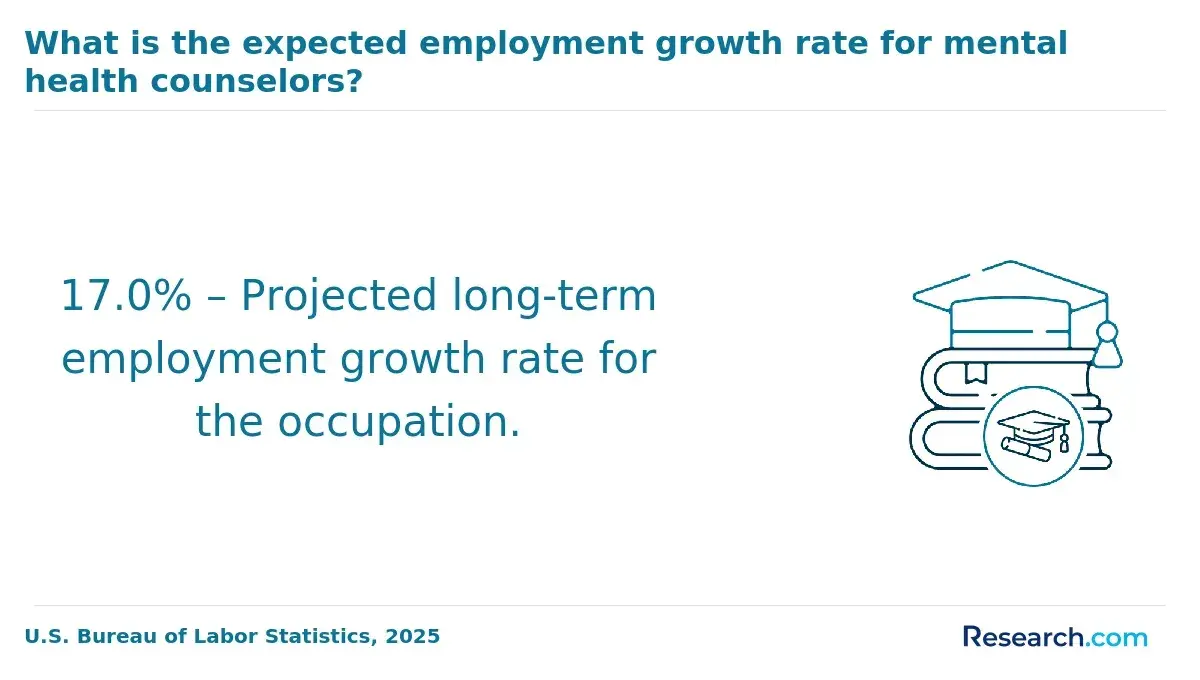
National employment in that occupational group is projected to grow 18% from 2025 to 2035. Compare that demand with each program's total cost and clinical-placement arrangements before enrolling (U.S. Bureau of Labor Statistics).
What can I expect from a Clinical Mental Health Counseling degree in District of Columbia?
A clinical mental health counseling degree prepares students to assess clients, plan treatment, provide counseling, and work within professional and ethical boundaries. For someone seeking independent clinical practice, the relevant option is generally a licensure-oriented master's degree - not an undergraduate psychology major or a short counseling certificate. CACREP's entry-level counseling standards set a minimum of 60 graduate semester credits and include supervised fieldwork (Council for Accreditation of Counseling and Related Educational Programs).
Expect coursework, skills practice, and clinical placements rather than lectures alone. In D.C., ask where placements occur, who arranges them, and whether a site's supervision meets the D.C. Board of Professional Counseling's requirements. A degree can be worthwhile for someone committed to client-facing clinical work; someone primarily interested in research, school counseling, or a nonclinical support role should compare those distinct education paths before taking on graduate debt.
Where can I work with a Clinical Mental Health Counseling degree in District of Columbia?
Potential settings include community behavioral health organizations, hospitals, outpatient clinics, substance-use treatment programs, and group practices. D.C.'s Department of Behavioral Health and its provider network are relevant places to investigate both placements and employment because community-based services can expose trainees to different client needs and care teams (D.C. Department of Behavioral Health). Employers set their own credential and experience requirements.
The distinction between working in D.C. and working elsewhere in the Washington area matters. A placement or job across the border can involve Maryland or Virginia rules rather than D.C. rules. If you expect to build a career outside the District, ask the program how its curriculum and placements support licensure in the jurisdiction where you intend to practice; a D.C. license is not automatically a license in another jurisdiction.
The U.S. Bureau of Labor Statistics reports a $59,350 national median annual wage in May 2025 for substance abuse, behavioral disorder, and mental health counselors. This occupational figure covers workers with varied experience, settings, and credentials; it is neither a D.C. starting salary nor an estimate of what graduates of a particular school earn.
For an investment decision, compare actual job postings for the setting you want with the school's full attendance budget. A pre-licensure role, a salaried hospital position, and a practice paid partly through client billings can have different compensation and benefits. Ask programs for recent, clearly defined graduate outcomes rather than treating a national median as your expected post-graduation income.
These D.C. options serve different priorities. Their most useful distinctions are institutional setting, program-specific training, and how each pathway fits a student's budget and intended place of practice - not a claim that one format produces a guaranteed outcome.
University of the District of Columbia: UDC offers a clinical mental health counseling pathway at the District's public university (University of the District of Columbia). That makes its published graduate charges and residency rules particularly important to compare with private-school offers; public status by itself does not establish a lower total cost.
The Chicago School, Washington, D.C.: Its campus-specific M.A. in Clinical Mental Health Counseling sits within an institution focused on psychology and related behavioral-health fields (The Chicago School). Students seeking that professional-school environment should ask how the Washington campus arranges local clinical placements and whether its current program requirements align with their intended licensing jurisdiction.
George Washington University: Its clinical mental health counseling master's is housed in the Graduate School of Education and Human Development (George Washington University). That academic setting is a meaningful contrast with a psychology-focused institution or a public university; applicants should compare its counseling curriculum and placement support against the additional cost, if any, of attending.
Use program pages to verify current credits, fieldwork requirements, delivery format, and published outcomes before making a direct numerical comparison. The most popular clinical mental health counseling programs offer another way to explore options, but popularity does not establish licensure fit or value.
A licensure-oriented counseling master's commonly takes about two to three years of study; part-time enrollment or limited availability of required courses and placements can extend that timeline. CACREP's minimum of 60 graduate semester credits helps explain why this is usually a substantial commitment rather than a brief conversion course (Council for Accreditation of Counseling and Related Educational Programs).
Ask each school for a term-by-term plan showing when practicum and internship begin, whether placements are available to evening or weekend students, and how often required courses run. Finishing the degree is also distinct from completing any post-degree supervised experience, examination, and application steps required for D.C. licensure (D.C. Board of Professional Counseling).
The decisive difference is usually where you complete coursework and skills practice, not whether you need clinical experience. Before choosing a format, confirm its in-person requirements and placement arrangements in the jurisdiction where you will train.
Format
Potential advantage
Key point to verify
Online or hybrid
Less routine travel to class; potentially easier to keep working
Required campus visits, live class times, local placement support, and licensure alignment
On-campus
Regular face-to-face skills practice and access to local classmates and faculty
Commute, class schedule, placement travel, and the cost of reducing work hours
An online program is not automatically available to a D.C. resident or designed for D.C. licensure. Get a written answer from the school about authorization, required in-person activities, and how its curriculum maps to the D.C. Board of Professional Counseling's education requirements. Campus students should make the same licensure check rather than assuming location settles it.
A defensible D.C.-wide average for the total cost of these specific counseling degrees is not established by a single standard tuition figure. Published graduate tuition may be institution-wide, while programs differ in required credits, fees, enrollment pace, and clinical-placement expenses. IPEDS price data are useful context, but they should not be mistaken for a personalized, program-level bill (National Center for Education Statistics).
Request a written cost estimate covering all required terms, fees, books, placement-related travel, and any periods when clinical hours may limit paid work. Subtract confirmed grants or assistantships, then compare the amount you would finance. The most affordable clinical mental health counseling programs can help build a shortlist; verify each school's current charges and your eligibility for its quoted rate.
Eligible graduate students may be able to use Direct Unsubsidized Loans, while schools may offer scholarships, assistantships, or employer-supported tuition benefits. Submit the FAFSA and ask each financial aid office whether awards apply during clinical-placement terms. Federal loan eligibility and school awards are different decisions; admission does not guarantee either (Federal Student Aid).
Do not budget on the assumption that Graduate PLUS is available. Under federal changes taking effect July 1, 2026, new graduate borrowers generally cannot obtain new Graduate PLUS loans. Certain continuing students who had a qualifying Direct Loan for the same program before that date may be eligible under a limited transition rule; Federal Student Aid and the school's financial aid office can determine individual eligibility (Federal Student Aid). If financing has a gap, compare a lower-cost offer, a part-time schedule, or employer support before committing.
Applicants generally need a bachelor's degree and must meet the individual school's admissions requirements, which may include transcripts, recommendations, a statement of purpose, an interview, or prerequisite coursework. A counseling or psychology bachelor's is not necessarily required; verify prerequisites on the current admissions page for the program you choose (University of the District of Columbia; The Chicago School; George Washington University).
Transfer credit is another question to settle before applying. Ask how many graduate credits the program will review, whether prior courses can satisfy clinical requirements, and whether accepting them changes your completion schedule or aid eligibility. Prior professional experience may strengthen an application, but it should not be assumed to replace required graduate clinical training.
Expect study in counseling skills, assessment, diagnosis and treatment, ethics, human development, group counseling, research, and supervised practicum and internship. These subjects reflect the breadth of entry-level counselor preparation described in CACREP standards; course titles and sequencing vary by school (Council for Accreditation of Counseling and Related Educational Programs).
Compare syllabi, not just catalog titles. If you want to work with clients experiencing co-occurring mental health and substance-use concerns, for example, ask where those topics appear in the curriculum and whether relevant placements are available. Also ask how the school prepares students to document clinical work and receive supervision - skills that matter during training and later licensure applications.
Students may be able to pursue an interest through electives or clinical placements involving trauma, substance-use concerns, children and adolescents, or community mental health. Availability depends on the school and placement sites; an interest area is not necessarily a named concentration, separate credential, or authorization to practice independently.
Choose the core degree for its fit with the counseling role and licensing jurisdiction first. Then ask whether your preferred population or setting has relevant coursework, qualified supervisors, and feasible placement opportunities. If your actual goal is school counselor employment or marriage and family therapist licensure, compare those distinct programs and licensing pathways rather than relying on a clinical mental health counseling elective to change the degree's purpose.
Start with the credential you want at the end of training: D.C. professional counselor licensure, a license elsewhere, or a nonclinical career. Then narrow programs using answers you can verify, rather than ranking position alone.
Ask the D.C. Board of Professional Counseling which education, supervised-experience, and examination requirements apply to your intended license; request the school's written explanation of how its program fits them.
Check the program's current CACREP status directly with CACREP and distinguish programmatic accreditation from the university's institutional accreditation.
Request a full cost and course sequence, including placement terms; compare net borrowing and any income you may forgo while training.
Ask who finds placements, where recent students trained, and whether the school publishes clearly dated completion, examination, and employment outcomes.
Confirm transfer-credit decisions and format-specific requirements before paying a deposit.
The most valuable clinical mental health counseling programs provide a useful additional comparison, but your own return depends on aid, debt, time to completion, current earnings, plausible post-degree earnings, and how long you expect to work in the field. A common mistake is comparing tuition alone while overlooking unpaid or reduced-work clinical terms.
View the chart data as a table
Wage range - Mental Health Counselors in District of Columbia (BLS OEWS, May 2025) (Source: BLS)
Category
Value
10th percentile
43,060
25th percentile
46,920
Median
60,450
75th percentile
83,570
90th percentile
107,980
Depending on the employer, license status, and experience, graduates may pursue supervised counseling roles in community agencies, behavioral-health positions in hospitals or clinics, substance-use treatment work, and eventually independently licensed professional counseling. Supervisory or practice-management work may become relevant later, but a master's degree alone does not confer independent-practice authority (D.C. Board of Professional Counseling).
If you want to begin working in behavioral health without committing to a clinical master's, compare the duties and credential requirements of support roles first. If your goal is independent psychotherapy, work backward from the applicable licensing board's rules when selecting a degree; job titles such as "counselor" do not all have the same legal scope.
View the chart data as a table
Best score by program (Source: Research.com)
Category
Value
George Washington Univer
87.55
The Chicago School - Was
92.97
University of the Distri
95.24
National employment for substance abuse, behavioral disorder, and mental health counselors is projected to grow 18% from 2025 to 2035 (U.S. Bureau of Labor Statistics, Employment Projections). That signals demand across the occupation, not a forecast of D.C. openings or a promise that a particular graduate will find work quickly.
For a local assessment, review current D.C.-area postings by setting and license level. Separate roles open to supervised or license-eligible applicants from those requiring an active independent license, and check whether the workplace is in D.C., Maryland, or Virginia. That distinction can be more useful to a new graduate than a broad growth rate because it identifies the credentials needed for jobs they can actually pursue.
2027 Best Clinical Mental Health Counseling Degree Programs Ranking in District of Columbia
Investing in graduate education is a consequential decision, so the Research.com team designed its counseling rankings to make program comparisons more consistent and transparent. The Best ranking first combines program completion (40%), employment or doctoral admission (20%), licensure exam pass rate where applicable (20%), CACREP programmatic accreditation (16%), and institutional Title IV eligibility (4%). The applicable shares are renormalized when a criterion does not apply. Program cost then contributes about 7% of the final score. The same method applies to online and on-campus programs; rankings named for another dimension order programs by that dimension.
The team used the following data sources to assess program quality, outcomes, and cost. Readers can use the ranking to narrow a shortlist, then confirm current tuition, accreditation, and licensure eligibility with each school.
IPEDS database - institutional enrollment, completions, and price information.
Peterson's database - program and institutional information used in school comparisons.
A ranking is a screening tool, not a finding that every graduate will obtain a license or a particular job. For more on the approach, see Research.com's methodology.
# 1 position
University of the District of Columbia
Master
Master of Science in Counseling: Clinical Mental Health Counseling
Delivery mode: campus
95.24
/ 100
Final score
Specialization
Clinical Mental Health Counseling
Required credits
60 semester credits
GPA range
3.00 - 4.00
Program completion rate
100% (2023-24)
Employment or doctoral admission
100% (2021-22)
Application deadline
Fall: April 15; Spring: September 15
Application process
direct
GRE
no
Prerequisites
Bachelor's degree from an accredited post-secondary institution
Additional requirements
Online application, official transcripts, two professional references, minimum 3.0 GPA; GRE waived
Accreditation
Accredited by the Council for Accreditation of Counseling and Related Educational Programs (CACREP), with institutional accreditation from the Middle States Commission on Higher Education (MSCHE).
University of the District of Columbia earned a Research.com Counseling Program Score of 95.24/100, supported by 100% program completion rate and 100% employment or doctoral admission rate. The program is CACREP-accredited, valid through 2028-03-31.
# 2 position
The Chicago School - Washington, D.C.
Master
M.A. Clinical Mental Health Counseling
Delivery mode: campus
92.97
/ 100
Final score
Program length
2.5-3 years full-time
Specialization
Clinical Mental Health Counseling
Required credits
60 semester credits
Acceptance rate
50%
GPA range
3.00 - 4.00
Program completion rate
100% (2024-25)
Application process
direct
GRE
no
Prerequisites
Bachelor’s degree from an accredited university
Additional requirements
Application; $50 application fee; GPA of 3.0 or higher; two-page essay on how the applicant would contribute to the program's mission and to the profession as a clinical mental health counselor; resume; three letters of recommendation;
Accreditation
Accredited by the Council for Accreditation of Counseling and Related Educational Programs (CACREP), with institutional accreditation from the WASC Senior College and University Commission (WSCUC).
The Chicago School - Washington, D.C. earned a Research.com Counseling Program Score of 92.97/100, with 100% program completion rate among the verified supporting factors. The program is CACREP-accredited, valid through 2027-10-31.
# 3 position
George Washington University
Master
Master's in Clinical Mental Health Counseling
Delivery mode: campus
87.55
/ 100
Final score
Program length
2.6 years (8 semesters) on average
Specialization
Clinical Mental Health Counseling
Required credits
60 semester credits
GPA range
2.75 - 4.00
Employment or doctoral admission
95% (2024-25)
Licensure exam pass rate
100% (2025-26)
Application deadline
Priority: Nov 2; Program Deadline: Dec 1
Class size
30
Application process
direct
GRE
optional
Prerequisites
Bachelor's Degree
Additional requirements
Online application, resume, transcripts from all previously attended colleges/universities, personal statement, two letters of recommendation; GRE preferred (not required); no application fee.
Accreditation
Accredited by the Council for Accreditation of Counseling and Related Educational Programs (CACREP), with institutional accreditation from the Middle States Commission on Higher Education (MSCHE).
George Washington University earned a Research.com Counseling Program Score of 87.55/100, supported by 100% licensure exam pass rate and 95% employment or doctoral admission rate. The program is CACREP-accredited, valid through 2030-10-31.
Frequently asked questions about Clinical Mental Health Counseling degree in District of Columbia
Do I need a master's degree to become a licensed professional counselor in D.C.?
The D.C. Board of Professional Counseling sets graduate education requirements for professional counselor licensure. Check its current rules and have the program explain how its degree meets them; graduating does not itself grant a license.
Is CACREP accreditation the same as licensure eligibility?
No. CACREP accredits programs, while the D.C. board decides whether an applicant meets licensure requirements, including applicable education, supervised experience, and examination rules. Verify both independently.
Can I study online and complete clinical training in D.C.?
Possibly, if the program accepts D.C. students, supports an appropriate local placement, and meets the rules relevant to your intended license. Obtain those answers in writing before enrolling.
How long does the degree usually take?
Plan on roughly two to three years for a master's, with longer timelines possible for part-time study or placement scheduling. Any required post-degree licensure steps add time.
Is a D.C. counseling degree worth the cost?
It can be if the degree fits your intended license and work, placements are feasible, and your likely financing is manageable. Compare total cost and foregone earnings with realistic career options - not a promised salary or ranking position.