Choosing an online counseling degree in California means weighing more than school reputation. You need a program that fits your schedule, supports California clinical placement requirements, prepares you for licensure, and makes financial sense before you commit to tuition and fees.
The 2026 Best Online counseling Degree Programs Ranking in California was developed by the Research.com team of data scientists to help prospective counseling students compare online options with greater confidence. This guide is designed for working adults, career changers, recent graduates, and future counselors who want flexible study without overlooking accreditation, supervised experience, licensing exams, and long-term return on investment.
Use this article to understand affordability, program expectations, common specializations, career outcomes, salary ranges, and California-specific licensure considerations so you can choose a program that supports both graduation and professional practice.
Key benefits of getting a Online counseling degree in California
An online counseling degree in California can be a practical path for students who want graduate-level training without relocating or pausing their careers. The main benefits are flexibility, access to California-focused clinical preparation, and a direct connection to counseling roles in schools, healthcare, community agencies, and nonprofit settings.
Competitive earning potential: Graduates with a counseling degree in California can pursue roles where Addiction Counselors make around $60,080 annually and Community Outreach Coordinators earn approximately $54,020 per year.
Multiple career directions: Career paths include Rehabilitation Specialist, Family Support Worker, and Intervention Specialist, giving graduates options across mental health, recovery, family services, and community support.
Flexible study format: Online counseling degrees from reputable California universities allow students to balance coursework with work, caregiving, and other responsibilities while pursuing the same type of professional preparation expected in traditional programs.
The biggest advantage is not convenience alone. For many students, the value of an online format is the ability to complete graduate training while building local professional connections through practicum and supervised experience in California communities.
What can I expect from Online counseling degree in California?
An online counseling degree in California usually combines graduate coursework, live or asynchronous online learning, faculty supervision, and in-person clinical experiences arranged in approved settings. Students should expect a rigorous program, not a self-paced certificate. Counseling degrees require active participation, ethical training, supervised practice, and preparation for state licensure requirements.
The average cost of an online counseling degree in California typically ranges from $15,000 to $40,000 in tuition, depending on the university and program format. Graduates from well-known public universities often report that the ability to continue working while studying made the cost more manageable. Spreading payments across multiple semesters can also make the investment feel less overwhelming.
Common expectations for online counseling students
Structured coursework: Courses often cover counseling theory, ethics, assessment, multicultural counseling, and clinical techniques.
Practicum and internship requirements: Even online students usually complete hands-on clinical training in approved local settings.
Licensure planning: Students should track how each course and placement supports California requirements.
Additional costs: Licensing exam fees, study materials, technology expenses, and continuing education after graduation can add to the total budget.
Many students choose programs with strong local partnerships, including California State University campuses, because these relationships can help reduce placement uncertainty and limit extra travel costs. Graduates also stress that selecting a CACREP-accredited program in California may be worth a slightly higher price if it improves licensure readiness and employer recognition.
Where can I work with Online counseling degree in California?
Graduates with an online counseling degree in California can work in many settings after meeting the state’s licensure requirements. Common roles include licensed professional clinical counselor (LPCC), marriage and family therapist (MFT), and substance abuse counselor. Graduates from programs at California State University or University of Southern California often pursue work in community mental health centers, private clinics, and agencies where supervised clinical hours support the path to licensure.
Common workplaces for counseling graduates
Community mental health centers: Counselors support clients facing anxiety, depression, trauma, substance use, and family challenges.
Schools: Graduates may help students address academic, social, emotional, and mental health needs, especially when their program includes school-focused practicum preparation.
Hospitals and ambulatory healthcare centers: Programs such as those at San Diego State University often emphasize hands-on experience that can translate to clinical healthcare environments.
Private clinics: Licensed professionals may provide therapy to individuals, couples, families, or groups.
Nonprofit organizations: Graduates may work in substance abuse recovery, family support, crisis services, or outreach programs.
Corporate employee assistance programs: Some counselors support workplace wellness, stress management, and employee mental health services.
The best work setting depends on your specialization, license goal, clinical experience, and preferred population. Students should choose practicum placements strategically because early experience can influence both hiring options and long-term professional identity.
How much can I make with Online counseling degree in California?
Graduates with an online counseling degree in California can earn competitive salaries, but pay varies by role, licensure status, employer, location, specialization, and experience. Entry-level graduates should expect compensation to grow as they complete supervised hours, pass exams, and qualify for independent practice.
Role
Reported salary figure
What it can indicate
Intervention Specialist
Around $76,000 annually
Strong demand for professionals who coordinate support and intervention services.
Addiction Counselor
Mean wages near $60,080
A realistic benchmark for counseling work connected to substance use recovery.
Rehabilitation Specialist
Approximately $48,430 per year
A common pathway for graduates supporting clients with disabilities or recovery needs.
Community Outreach Coordinator
Around $54,020 annually
A role focused on connecting communities with mental health and support services.
Family Support Worker
Around $54,020 annually
A service-oriented role supporting families through social, emotional, or behavioral challenges.
Graduates from institutions such as California State University or University of San Diego often report that clinical placements helped them demonstrate practical skills to employers. In higher-cost metropolitan areas such as Los Angeles or San Francisco, counselors may be able to use local demand, certifications, and experience to negotiate stronger pay.
The Research.com team developed the "2026 Best Online Counseling Degree Programs Ranking in California" to help prospective students evaluate online counseling programs using a structured, data-informed process. Because counseling education affects licensure eligibility, career readiness, and long-term earning potential, rankings should be based on credible information rather than advertising claims.
To build this ranking, we reviewed reputable education data sources, including:
These sources help support a more consistent evaluation of online counseling programs available in California. Students should still verify details directly with each school, especially tuition, admissions requirements, accreditation, clinical placement policies, and licensure alignment, because program details can change.
The Master's program in Business Taxation at the University of Southern California is a 14-month program with a 92% graduation rate. The average total cost is $59,850, with 76% of students receiving financial aid. The program focuses on Business and Counseling, with an acceptance rate of 13%. This program is designed for working professionals looking to advance their knowledge and skills in taxation. With a strong emphasis on business and counseling, students can expect a comprehensive education that prepares them for success in the field.
The University of Southern California offers a Master of Laws program with a focus on counseling. The program has a graduation rate of 92% and a length of 15 months. The average total cost is $49,875, with 76% of students receiving financial aid. The acceptance rate is 13%. This program provides a specialized education in counseling within the legal field, preparing students for successful careers in this area.
National University offers a Bachelor's Degree in Paralegal Studies with a focus on counseling. The program has a graduation rate of 47% and can be completed in 4 months at an average total cost of 66600 USD. All students receive financial aid, and the acceptance rate is 55%. With 20886 online students enrolled, this program provides a comprehensive education in the field of law and prepares students for a successful career as a paralegal.
Program Length
4
Financial Aid for online learning
Yes
% of student receiving financial aid
100
Cost per credit
370
Required Credits to Graduate
180
Accreditation
Data not available
What Online counseling degree graduates have to say
Graduate feedback can help prospective students understand what an online counseling program feels like beyond the course catalog. These reflections highlight flexibility, faculty support, virtual community, and the importance of applied clinical learning.
Studying my Online Counseling degree at the University of Southern California was a transformative journey. The flexible schedule allowed me to balance work and study seamlessly, while expert faculty guided me with real-world insights. It truly prepared me to make a meaningful difference in people's lives. - Jessica
Pursuing an Online Counseling degree through California State University, Fullerton gave me a deep understanding of therapeutic techniques with a supportive virtual community. The interactive classes made learning engaging, and I felt empowered by the practical skills I gained. It was the perfect blend of academic rigor and personal growth. - Marcus
My experience at Azusa Pacific University's online counseling program exceeded expectations. The faith-based approach enriched my learning, and the personalized mentorship helped me develop my own counseling style. Studying remotely never felt isolating, thanks to the vibrant student network and responsive faculty. Truly an inspiring path to success. - Elena
When reading graduate comments, look for patterns rather than isolated praise. Strong signs include responsive faculty, clear clinical placement support, active peer interaction, and coursework that connects directly to counseling practice.
Key Findings
California requires counseling degree programs to meet academic standards set by the California Board of Behavioral Sciences for LPCC and LMFT licensure.
Master's degree programs in counseling are available online, with costs ranging from $15,000 to $40,000 depending on the school and residency.
Entry-level counselors in California typically earn $50,000 to $60,000 annually, with median salaries for licensed counselors around $75,000.
In metropolitan areas like Los Angeles and San Francisco, licensed counselor salaries can exceed $85,000 per year.
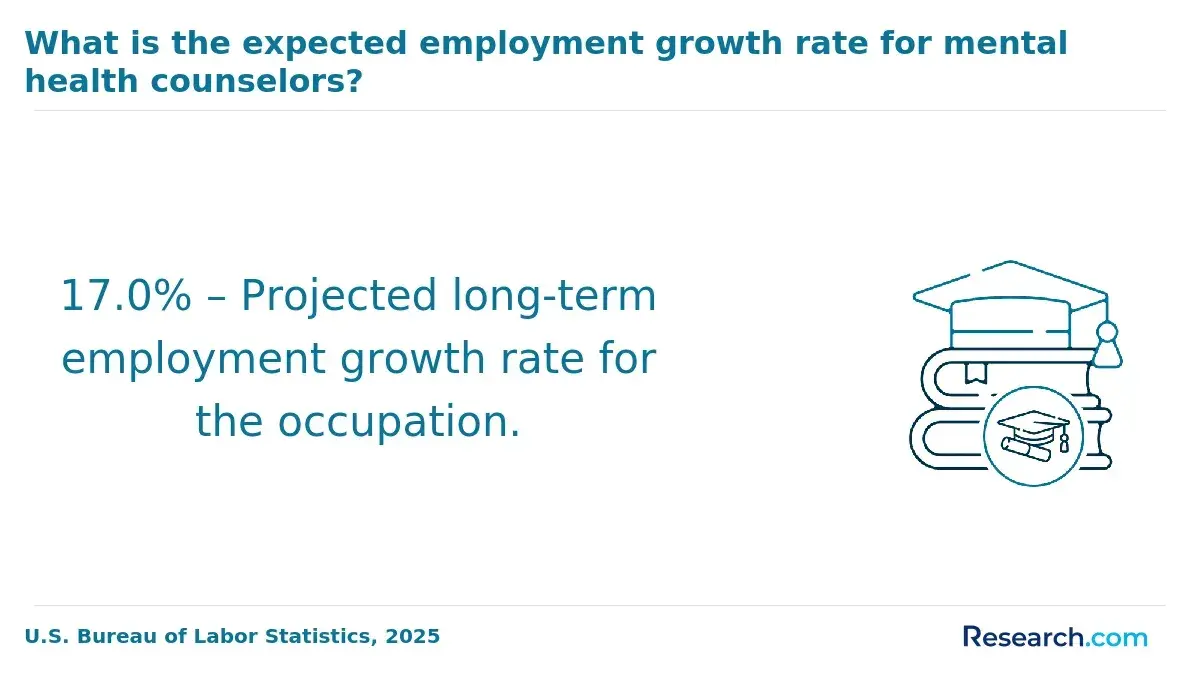
The job market for mental health counselors in California is projected to grow 19% over the next decade, faster than average for all occupations.
Programs must include coursework in human development, multicultural counseling, ethics, and supervised clinical experience with practicum placements in California.
The main takeaway is that online counseling degrees can be a strong option in California when they combine affordability, licensure alignment, supervised clinical experience, and career support. Students should verify requirements early because the wrong program can delay licensing even if the coursework is academically strong.
How long does it take to complete Online counseling degree in California?
Completing an online counseling degree in California typically takes between two to four years, depending on the degree level, enrollment pace, transfer credits, and clinical requirements. For many students pursuing licensure, the master’s degree is the key credential and commonly takes about two to three years.
Master’s programs usually require 48 to 60 semester units and include practicum work. Online formats may make it easier to schedule coursework around employment or family responsibilities, but clinical training still requires careful planning because placements must be completed in approved settings.
Typical timelines by study path
Accelerated master’s path: Some motivated students finish as quickly as 18 months by taking a heavier course load.
Standard master’s path: Many students complete the degree in about two to three years.
Part-time path: Students balancing work, caregiving, or other responsibilities may extend the program toward four years.
Doctoral path: PhD or EdD programs commonly take four to six years and usually include research and dissertation requirements. Some hybrid models combine online coursework with occasional campus visits.
Graduates often emphasize that the degree timeline is only part of the full professional journey. California supervised clinical hours can extend the time between enrollment and independent practice, so students should map the academic calendar and licensure steps together.
California Licensure Pathway
California’s licensure pathway is easier to manage when students understand each requirement before selecting an online program. Choosing a CACREP-accredited program, such as those listed among cacrep accredited online counseling programs, can help ensure coursework is structured around California Board of Behavioral Sciences (BBS) standards.
Earn your master’s degree with the required semester units (typically 48–60).
Complete 3,000 supervised experience hours.
Complete at least 1,700 direct client contact hours.
Apply up to 1,300 hours of related activities, such as case management and supervision.
Pass the California Law and Ethics Exam.
For LPCC applicants: pass the National Counselor Examination (NCE) or CPCE.
For LMFT applicants: pass the California MFT Law and Ethics Exam and the National MFT Exam.
Submit fingerprints and a background check to the BBS.
Apply for licensure and pay the applicable fees.
Planning these steps early can help you move from online coursework to supervised practice and then to licensure with fewer surprises. Keep copies of syllabi, practicum documentation, supervision records, exam results, and BBS correspondence throughout the process.
What's the difference between online and on-campus counseling degree?
The main difference between an online and on-campus counseling degree in California is how coursework is delivered. Both formats can include the same core academic content and clinical expectations, but they differ in scheduling, interaction, placement logistics, and day-to-day student experience.
Factor
Online counseling degree
On-campus counseling degree
Schedule
Often better for students balancing work, family, or travel limits.
Better for students who prefer a fixed in-person routine.
Class interaction
Uses video lectures, virtual meetings, discussion boards, and online advising.
Offers face-to-face discussion, campus events, and spontaneous peer interaction.
Clinical placements
Students often arrange local placements near their California homes.
Students may use university-established partnerships that simplify placement logistics.
Networking
Requires intentional participation in virtual communities and local placements.
Can make networking easier through campus-based relationships.
Cost considerations
Tuition may be similar, but students may save on commuting and housing.
May include commuting, relocation, parking, or housing costs.
Online programs through well-known California state universities can be especially useful for students who need flexibility. On-campus programs, including those at institutions such as UCLA or USC, may be a stronger fit for students who value live classroom energy and direct campus connections. The better option depends on your learning style, schedule, and access to clinical placements.
Licensing and Certification Requirements in California
Before starting a counseling career in California, online students should understand how education, supervised experience, exams, and continuing education fit together. For the Licensed Professional Clinical Counselor (LPCC) credential, graduates apply through the California Board of Behavioral Sciences (BBS).
California LPCC requirements to review before enrolling
Education and accreditation: You must hold a master’s or doctoral degree in counseling or a closely related field from a program accredited by the Council for Accreditation of Counseling and Related Educational Programs (CACREP) or its equivalent. This helps ensure your coursework addresses clinical knowledge, ethics, and professional standards expected by the BBS.
Supervised experience: California mandates 3,000 hours of supervised professional experience. At least 1,700 of these hours must be direct counseling practice under a qualified supervisor, while the remaining hours may include assessment, evaluation, and other client-related activities. Many online programs include practicum and internship components designed to help students begin building this experience.
Examinations: Candidates are required to pass the National Counselor Examination (NCE) or the National Clinical Mental Health Counseling Examination (NCMHCE), along with the California Law and Ethics Exam. Planning your exam timeline early can help you avoid gaps between graduation, supervised practice, and licensure steps.
Continuing education is also part of the career. LPCCs must complete 36 hours of approved continuing education every two years, including six hours on law and ethics. Students should choose programs that teach licensing rules clearly, not just clinical theory.
What is the average cost of Online counseling degree in California?
The average cost of an online counseling degree in California generally centers around the median total cost of $59,850, reflecting combined tuition and fees. Graduates from programs at schools such as CSU Fullerton and CSU Northridge often describe the cost as easier to manage when reviewed per unit rather than as one large total.
Public universities in California may offer reduced tuition rates for residents, which can make the overall investment more attainable than some private options. Still, tuition is only one part of the cost. Students should also budget for technology fees, books, licensing exam preparation, and supervision-related costs during practicum hours.
How to compare program costs accurately
Ask for the full estimated cost of attendance. Include tuition, fees, books, technology, and clinical-related expenses.
Compare per-unit tuition and total units required. A low per-unit price can still lead to a high total if the program requires more units.
Review financial aid eligibility. Federal aid, state aid, institutional scholarships, and counseling-specific awards can reduce out-of-pocket costs.
Consider work flexibility. Online programs that allow continued employment may improve affordability even when tuition is not the lowest.
California online counseling degree expenses vary, but careful planning can make the investment more manageable. If you are still considering broader academic pathways before committing to graduate study, resources such as what is the easiest associate's degree to get can help you think through lower-division options, financing, and career preparation.
Licensure Requirements in California
To legally practice counseling in California, graduates must meet Board of Behavioral Sciences (BBS) requirements. Students should treat licensure planning as part of program selection, not as a task to address only after graduation.
Earn a master’s or doctoral degree in counseling that meets BBS coursework requirements. Choosing a CACREP-accredited program, including options discussed among the best online cacrep counseling programs, can help streamline this step.
Complete at least 3,000 hours of supervised clinical experience, including a minimum of 1,750 direct client-contact hours.
Pass the California Law and Ethics Exam, which covers state-specific regulations on confidentiality, scope of practice, and professional conduct.
Succeed on the appropriate national exam: the National Counselor Examination (NCE) for LPCC candidates or the National Clinical Mental Health Counseling Examination (NCMHCE) for certain specialties.
Submit a license application to the BBS, including official transcripts, exam results, and supervisor evaluations.
Meeting these steps supports both legal eligibility and professional credibility. Before enrolling, ask each program to confirm how its coursework and field experience map to California requirements so you can avoid delays after graduation.
What financial aid is available to Online counseling degree students in California?
Online counseling degree students in California should begin the financial aid process by filing the FAFSA. This step can open access to federal grants and loans, and it is often required for many state and institutional aid programs as well. Graduates from schools such as Fresno State or San Diego State report that federal loan access, including Direct Subsidized Loans with reasonable repayment options, helped reduce immediate financial pressure. While the Pell Grant is mostly for undergraduates, graduate students may use federal PLUS loans for additional support.
California residents should also review state aid options such as the Cal Grant, including Cal Grant C, which can cover up to $5,472 annually. Graduates of online counseling programs at institutions such as CSU Northridge have described this type of aid as valuable for reducing tuition stress.
Financial aid sources to check
Federal aid: FAFSA-based loans and grants where eligible.
California state aid: Programs such as the Cal Grant, including Cal Grant C.
Institutional scholarships: University awards based on merit, financial need, or counseling-related goals.
Professional association awards: Groups such as the American Counseling Association may offer scholarships or funding opportunities.
Employer tuition reimbursement: Mental health, education, and human services employers may help pay for career-related graduate study.
Community grants: Local organizations may support students preparing for service-oriented professions.
The best approach is to apply early and stack multiple sources when possible. Even smaller awards can reduce borrowing when combined with employer support, payment plans, or part-time enrollment.
Paying for Your Online Counseling Degree in California: Exploring Affordable Options
An online counseling degree in California can be a major financial commitment, so affordability should be evaluated before you apply—not after you receive an admission offer. Start by comparing total tuition, mandatory fees, practicum-related costs, technology charges, books, exam fees, and any expenses tied to in-person requirements.
Students who want to lower their education costs should review affordable counseling schools in California and compare whether the lowest-priced programs still meet the academic and clinical preparation needed for their intended counseling credential. A cheaper program is not automatically the better choice if it lacks strong placement support, licensure alignment, or advising.
Ways to make an online counseling degree more affordable
Compare total program cost, not only per-credit tuition. Fees and practicum expenses can change the real cost of attendance.
Ask about scholarships for counseling students. Some universities reserve awards for students entering mental health, school counseling, or related service fields.
Use payment plans when available. Spreading costs across terms can make tuition easier to manage while working.
Check grant and assistantship options. Some schools provide institutional aid or work-related opportunities that reduce out-of-pocket costs.
Prioritize programs with local clinical placement support. Placement delays can extend your timeline and increase expenses.
The strongest financial strategy is to balance price with licensing fit. A program that is affordable, flexible, and clearly structured around California counseling requirements is usually a better investment than one that only advertises low tuition.
What are the prerequisites for enrolling in Online counseling degree program in California?
Prerequisites for an online counseling degree program in California depend on the degree level. Undergraduate pathways may require a high school diploma or GED, while most graduate counseling programs require a bachelor’s degree from an accredited college. Students applying to master’s programs should review admissions requirements carefully because counseling programs often evaluate both academic readiness and professional fit.
Common admissions requirements
Prior education: A high school diploma or GED for entry-level programs, and a bachelor’s degree for most graduate programs.
Relevant coursework: Courses in psychology, human development, or related subjects may help applicants meet prerequisites, especially if their undergraduate major was unrelated.
Minimum GPA: Many programs expect a GPA around 2.5 to 3.0.
Official transcripts: Schools typically require transcripts from all previously attended colleges.
Letters of recommendation: Strong letters can show academic ability, professionalism, and readiness for counseling work.
Personal statement: Applicants should explain their motivation, relevant experience, and understanding of the counseling profession.
Technology readiness: Online students need reliable internet access and the ability to participate in virtual learning environments.
Graduates from institutions such as California State University, Fullerton, often note that prerequisite courses in psychology or human development made the admissions process smoother. Because California licensure requires programs to align with Board of Behavioral Sciences expectations, applicants should also confirm that supervised clinical experience is built into the curriculum. Online learners considering programs such as those at Loyola Marymount University should also be prepared for regular virtual engagement.
Licensing and Certification Requirements in California
An online counseling degree is only one part of becoming a practicing counselor in California. Graduates who plan to become a licensed professional counselor (LPCC) or marriage and family therapist (LMFT) must meet California-specific licensure criteria through the California Board of Behavioral Sciences (BBS).
Most California programs are CACREP-accredited, which can help align coursework with BBS expectations and support eligibility for the National Counselor Examination (NCE). However, students should never rely on a general accreditation claim alone. Before enrolling, confirm directly that the program’s curriculum, practicum, and internship structure match the license you intend to pursue.
Core licensure steps to plan for
Degree completion: Finish a qualifying counseling-related graduate program that supports California licensure preparation.
Supervised experience for LPCC candidates: Complete 3,000 supervised clinical hours, including at least 150 hours of direct supervision.
Supervised experience for LMFT candidates: Complete 3,000 hours with at least 225 direct supervision hours under an approved supervisor.
Required exams: LPCC candidates must pass the California Law and Ethics Exam and the NCE. LMFT candidates must pass the California Law and Ethics Exam plus the Examination in Marital and Family Therapy.
License renewal: Continuing education is required every two years, with 36 hours of approved coursework covering ethics, cultural competency, and clinical practice updates.
Many graduates recommend tracking supervised hours from the beginning of training through a dedicated supervision log. This habit can reduce confusion when it is time to submit documentation and can help prevent missing signatures, incomplete categories, or delays in application review.
If cost is a major concern, compare tuition alongside accreditation and placement support. Our ranking of affordable school counseling online degrees can help you identify programs that may better fit your budget while still supporting professional preparation.
What courses are typically in Online counseling degree programs in California?
Online counseling degree programs in California typically combine theory, ethics, assessment, clinical methods, multicultural training, and supervised practice. The goal is to prepare students not only to understand counseling concepts but also to apply them responsibly with clients.
Common course areas
Counseling theories: Students study approaches such as cognitive-behavioral, humanistic, and psychodynamic counseling. Graduates often say this foundation helped them understand how different methods fit different client needs.
Ethics and legal issues: Courses address confidentiality, client rights, professional boundaries, and California-specific legal responsibilities. Students from universities such as CSU and Pepperdine often describe this training as essential for licensure preparation.
Assessment and diagnosis: Students learn to use tools such as the DSM-5 for identifying and understanding mental health conditions.
Counseling techniques: Role-playing, case studies, and skills practice help students build practical client-facing abilities.
Multicultural counseling: Programs prepare students to work with California’s diverse populations with cultural awareness and ethical sensitivity.
Group counseling: Students learn how to facilitate therapeutic groups and manage group dynamics.
Addiction counseling: Coursework may address substance use, recovery models, relapse prevention, and co-occurring concerns.
Family therapy: Students examine relationship systems, communication patterns, and family-based intervention strategies.
Crisis intervention: Training focuses on urgent client needs, safety planning, and appropriate referral practices.
Supervised practicum: Students gain in-California experience with real clients under supervision, which many graduates describe as a key step toward professional readiness.
When comparing programs, students should ask how online skills courses are delivered. Strong programs create opportunities for observation, feedback, role-play, and supervised practice rather than relying only on readings and recorded lectures.
What types of specializations are available in Online counseling degree programs in California?
Online counseling degree specializations California programs typically include Marriage and Family Therapy, Clinical Mental Health Counseling, School Counseling, Substance Abuse Counseling, and Rehabilitation Counseling. The right specialization should match your preferred clients, desired workplace, and intended license or credential.
Specialization
Best fit for students interested in
Potential career direction
Marriage and Family Therapy
Relationships, couples, families, and family systems
Licensed marriage and family therapist pathway
Clinical Mental Health Counseling
Psychotherapy, mental health assessment, and clinical treatment
Licensed Professional Clinical Counselor (LPCC) pathway
School Counseling
K-12 student development, academic planning, and student wellness
School-based counseling roles
Substance Abuse Counseling
Addiction recovery, prevention, and relapse support
Substance use and recovery services
Rehabilitation Counseling
Supporting individuals with disabilities and career or life transitions
Rehabilitation and vocational support roles
Graduates from California colleges often report that Marriage and Family Therapy helped them connect deeply with clients facing relational challenges, while School Counseling prepared them to work directly with K-12 students. Students pursuing the best counseling specialties California online programs also note that Substance Abuse Counseling can be especially rewarding because of demand for addiction recovery professionals.
Affordability matters when choosing a specialization. Many students compare tuition options between $15,000 and $45,000 and use online study to reduce commuting or relocation costs. If you are also considering credentials that can strengthen employability, reviewing top paying certifications may help you plan additional career development alongside your degree.
How do you choose the best Online counseling degree in California?
To choose the best online counseling degree in California, start with licensure alignment. A program should be approved by the California Board of Behavioral Sciences (BBS) or clearly designed to meet required coursework for LPCC or LMFT licensure. If the program does not support your intended credential, flexibility and price will not compensate for the licensing risk.
Decision checklist for comparing programs
Licensure fit: Confirm whether the curriculum supports LPCC, LMFT, school counseling, or another goal.
Accreditation: Graduates from institutions such as California State University often note that CACREP accreditation helped smooth the path toward licensing and supervised placements.
Clinical placement support: Ask whether the school helps secure practicum and internship sites near your home or expects you to find them independently.
Cost: Affordable online counseling degrees California programs at public universities may offer lower tuition for residents.
Flexibility: Look for a manageable mix of asynchronous coursework, scheduled virtual sessions, and local practicum requirements.
Faculty access: Strong advising can make a major difference when questions arise about coursework, supervision, and exams.
Career services: Prioritize programs that help with resume preparation, field placements, licensing steps, and employer connections.
One graduate described how choosing an affordable public university option made it possible to balance family expenses with graduate education. Another valued asynchronous courses because they could maintain full-time employment while progressing steadily toward graduation. If you are comparing counseling with other career pathways, resources on trade school jobs may offer a useful contrast for timeline, cost, and job-entry expectations.
What career paths are available for Online counseling degree students in California?
Online counseling degree students in California can pursue several career paths, depending on their specialization, supervised experience, and licensure status. The degree can lead to clinical, school-based, community, recovery, rehabilitation, and family-focused roles.
Common career paths
Licensed Professional Clinical Counselor (LPCC): This path allows qualified professionals to provide psychotherapy independently after meeting state requirements. Salaries commonly fall between $50,000 and $70,000.
School Counselor: School counselors support K-12 students with academic, social, emotional, and mental health needs. Programs in California often emphasize real-world training, and average salaries are around $65,000.
Substance Abuse Counselor: These professionals support clients in recovery, prevention, and relapse management. Additional certification may be required depending on the role.
Rehabilitation Counselor: This path focuses on helping clients with disabilities or major life transitions pursue independence, employment, and stability.
Marriage and Family Therapist (MFT): MFTs work with couples, families, and relational systems, typically requiring additional licensing steps.
Graduates from universities known for counseling programs often value the ability to combine online coursework with local internships. That combination can make career transitions smoother because students build practical experience in the communities where they may later work. To compare online institutions that may align with different counseling goals, review the best universities online.
What is the job market for Online counseling degree in California?
The job market for online counseling degree graduates in California is robust, with opportunities in schools, hospitals, private practices, community agencies, and telehealth settings. Graduates from institutions such as California State University and University of Southern California often use their credentials, supervised clinical hours, and local placements to move into counseling-related employment.
For online counseling jobs in California, salaries are competitive, with median pay around $59,500 annually and higher wages in metropolitan areas like Los Angeles and San Francisco. Telehealth growth also supports demand for counselors who are comfortable with digital communication, documentation, and virtual client interaction—skills that often align well with online learning environments.
Where demand is especially relevant
School counseling: Students need academic, emotional, and mental health support across K-12 settings.
Marriage and family therapy: Family systems and relationship-focused services remain important across California communities.
Community mental health: Agencies need counselors prepared to serve diverse populations and complex client needs.
Substance abuse services: Recovery and prevention programs require trained professionals who understand addiction and co-occurring concerns.
Telehealth counseling: Remote services continue to expand access for clients who face geographic, scheduling, or mobility barriers.
Students should plan financially because tuition varies widely. Learners comparing options across life stages and career goals may also find value in resources such as top degrees for 60 year olds, which include flexible degree pathways for diverse students.
Frequently Asked Questions About counseling
How can I customize my Online counseling degree program in California to fit my career goals?
Customizing your online counseling degree can be achieved by choosing electives that align with your career interests. In 2026, many California programs offer specializations in areas such as school counseling, mental health, and addiction, allowing students to tailor their education to their specific career goals. Consult with academic advisors to best identify your options.
How to find internships in California relevant to a counseling degree?
Finding internships relevant to a counseling degree in California involves searching through university career centers, online job portals, and networking with faculty and alumni. Many counseling programs partner with local establishments to offer internship placements, providing vital hands-on experience essential for career preparation.
How to prepare for the job market after completing Online counseling degree in California?
After completing an online counseling degree in California, preparing for the job market involves several important steps. First, graduates must obtain licensure through the California Board of Behavioral Sciences, which typically requires passing the Licensed Professional Clinical Counselor (LPCC) exam.
Gaining supervised clinical experience is essential; California mandates 3,000 hours of post-degree supervised work. This practical training improves skills and builds professional networks.
Graduates should also develop a strong resume highlighting both academic achievements and hands-on experience. Joining professional organizations such as the California Association of Marriage and Family Therapists can offer valuable resources and job listings.
Understanding current labor market data is crucial. According to the U.S. Bureau of Labor Statistics, counseling jobs in California are projected to grow faster than average, by about 12% through 2030, indicating positive employment prospects.
How can Online counseling degree students in California maximize their learning experience?
In 2026, students in California's top-ranked online counseling programs can enhance their learning by engaging in virtual workshops, participating in online forums, seeking mentorship opportunities, and utilizing digital resources provided by their programs. Staying organized and actively participating in course discussions also ensures a more enriching academic experience.
How does a Online counseling degree influence career mobility and advancement in California?
Obtaining an online counseling degree in California can significantly enhance career mobility and advancement. The California Board of Behavioral Sciences requires specific educational credentials for licensure as a Licensed Professional Clinical Counselor (LPCC), making accredited online degrees a practical option for flexible and accessible training. Graduates with these degrees often qualify for entry-level counseling roles, with opportunities to progress into specialized areas like marriage and family therapy or substance abuse counseling.
The California Employment Development Department reports a steady job growth rate of about 14% for mental health counselors through 2030, indicating strong demand.
Online programs accredited by recognized bodies such as CACREP provide assurance of quality and often facilitate smoother licensure processes, which directly impacts employability and promotional opportunities.
Additionally, earning an online degree allows working professionals to gain credentials without relocating, supporting career advancement while maintaining current employment.
What are the networking opportunities for Online counseling students in California?
Networking opportunities for online counseling students in California include virtual conferences, webinars, and local chapters of professional associations like the California Association for Licensed Professional Clinical Counselors. These platforms provide access to industry leaders and peers, enhancing professional growth.
How to choose between a thesis and a non-thesis counseling degree program in California?
When choosing between a thesis and a non-thesis counseling degree program in California, consider your career goals carefully. A thesis option typically requires conducting original research, which could benefit those interested in academic, research, or clinical roles. Conversely, non-thesis programs often focus more on practical skills and direct counseling experience, which suits students aiming for immediate licensure and practice.
Many California schools require either a thesis or a comprehensive exam to graduate. According to the California Board of Behavioral Sciences, practical training hours and supervised experience are critical, regardless of the path chosen. Financial and time commitments may also differ: thesis tracks can extend program length due to research demands. Understanding these factors helps align your education with your professional objectives.
What part-time job opportunities in California can complement counseling degree education?
California students pursuing an online counseling degree often seek part-time work that complements their academic training. Roles such as mental health technician, behavioral aide, or peer support specialist offer practical experience while enhancing counseling skills.
These positions typically involve assisting licensed counselors or working directly with clients in various settings, including clinics, schools, and community centers. According to the California Employment Development Department, the demand for mental health support roles is projected to grow by over 17% from 2022 to 2032, offering ample opportunities for students.
Additionally, internships or assistant roles in university counseling centers provide supervised experience aligned with degree requirements. Such jobs help build professional networks and deepen understanding of ethical and clinical practices crucial for counseling licensure in California.
How do alumni networks benefit Online counseling degree students in California?
Alumni networks provide valuable support for students pursuing online counseling degrees in California. These networks connect current students with graduates who have practical experience in local settings, which is essential given California's diverse population and strict state licensing requirements.
Access to alumni events, job boards, and mentorship programs helps students build professional relationships. According to the California Association of Licensed Professional Clinical Counselors, networking significantly improves employment opportunities after graduation, with 65% of new counselors finding jobs through personal connections.
Furthermore, alumni offer insights into California-specific internship placements and continuing education resources tailored to state regulations, enhancing students' readiness for licensure exams and clinical practice.
What are the typical challenges that Online counseling students in California are facing?
Online counseling students in California face several challenges during their studies. One common difficulty is balancing coursework with personal and professional responsibilities, as many students are working adults. According to California State University data, nearly 60% of online students juggle jobs alongside their education.
Another challenge is gaining sufficient clinical experience. California's licensing board requires thousands of supervised hours, which can be harder to arrange remotely. Additionally, students sometimes struggle with technology issues or limited interaction with instructors and peers, impacting their learning and engagement.
Finally, navigating financial aid and understanding licensing requirements specific to California adds complexity for many students.
What professional certifications can I pursue with a Online counseling degree?
With an online counseling degree in California, graduates can pursue several professional certifications essential for career advancement. The most common certification is the Licensed Professional Clinical Counselor (LPCC), which requires completing a master's degree, supervised experience, and passing the California Law and Ethics Exam as well as the National Clinical Mental Health Counseling Examination.
The Marriage and Family Therapist (MFT) license is another option, especially for those focusing on family or couples therapy. This license also requires relevant graduate education, supervised hours, and passing exams administered by the California Board of Behavioral Sciences.
Other certifications include Certified Rehabilitation Counselor (CRC) and credentials related to school counseling, each with specific educational and exam requirements. According to the California Board of Behavioral Sciences, the state had over 43,000 active licensed counselors in 2023, reflecting strong demand for certified professionals.
How to write a winning application for a Online counseling program in California?
Writing a winning application for an online counseling program in California begins with understanding specific state requirements set by the California Board of Behavioral Sciences (BBS). Applicants should clearly demonstrate their commitment to California's counseling standards, including knowledge of ethics and laws governing mental health practice in the state.
Highlight relevant academic achievements and any practical experience, as many programs value prior counseling or psychology coursework. Emphasize your motivation for becoming a counselor and how the online format fits your learning style and career goals.
Use a well-organized personal statement to showcase communication skills, critical for counseling professionals. Also, secure strong letters of recommendation, ideally from academic or professional sources familiar with your counseling potential.
According to the National Board for Certified Counselors, California ranks among the top states for counseling careers, making program competitiveness high. Tailoring your application to reflect local practice standards can improve chances of admission.
How do I choose the right concentration within a Online counseling degree program in California?
To choose the right concentration in a California-based online counseling degree program, consider your career goals and the areas of counseling that interest you. Research each concentration's courses, speak with alumni for their insights, and seek advice from industry professionals to understand which concentration aligns best with your aspirations.
How can I gain practical experience while studying for a Online counseling degree in California?
Gaining practical experience while studying for an online counseling degree in California is essential for licensure and career readiness. Many California programs integrate required fieldwork or clinical internships, typically lasting 3,000 hours, as mandated by the California Board of Behavioral Sciences (BBS). These internships allow students to apply theoretical knowledge in real-world settings, such as community clinics or schools.
Students often coordinate with accredited internship sites through their universities, ensuring supervision by qualified licensed professionals. Additionally, some programs offer virtual simulation tools to supplement in-person experiences.
According to the BBS, completing supervised hours is a critical step before applying for licensed professional counselor credentials in California.
Introducing an Approach for Interdisciplinary Supervision in Vocational Rehabilitation Counseling | Published in Rehabilitation Counselors and Educators Journal https://rcej.scholasticahq.com/article/123259