Choosing an online counseling master's near Columbia means looking beyond convenience: your degree must support supervised training and the license you intend to pursue. This guide is for career changers and working professionals comparing program fit, cost, time, and career prospects in South Carolina. It also features the 2027 Best Online Clinical Mental Health Counseling Degree Programs Ranking in Columbia, created by the Research.com team of data scientists to help students make an informed choice about programs worth considering. Use the comparisons below to narrow your options before applying.
Key findings about online Clinical Mental Health Counseling degrees in Columbia
For prospective South Carolina licensed professional counselors, an online master's must still provide suitable coursework and supervised clinical training; confirm eligibility with the South Carolina licensing board before enrolling.
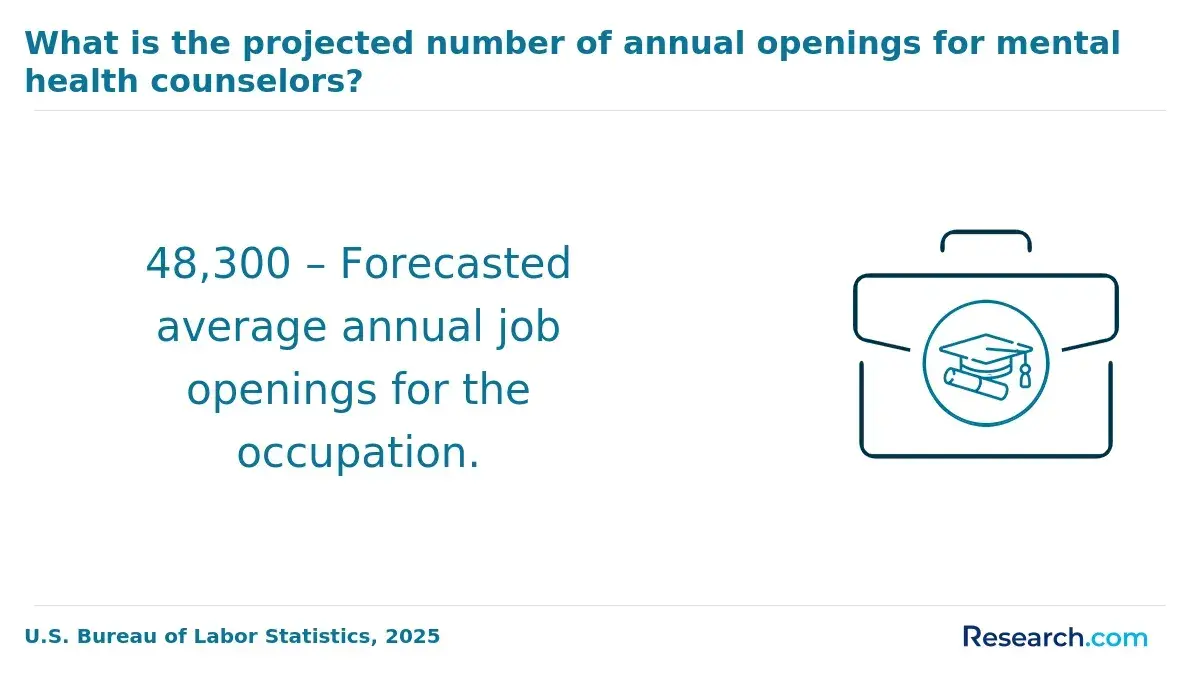
The U.S. median annual wage for substance abuse, behavioral disorder, and mental health counselors was $59,350 in May 2025, and employment is projected to grow 18% from 2025 to 2035 (U.S. Bureau of Labor Statistics). Neither figure predicts an individual graduate's earnings.
Compare Columbia-area options on verified delivery format, local placement support, total cost, and licensure alignment - not tuition or ranking position alone.
What can I expect from an online Clinical Mental Health Counseling degree in Columbia?
Clinical mental health counseling is a graduate-level path focused on assessing concerns, developing treatment plans, and providing counseling under an appropriate professional license. An online master's generally delivers academic coursework remotely, but practicum and internship training require supervised work with clients. "Online" does not mean that clinical requirements can be completed without an approved placement.
For a Columbia resident, the decisive question is whether a school will approve an accessible South Carolina site and supervisor. Ask how placements are arranged, whether any campus visits are mandatory, and whether the curriculum is designed for South Carolina's licensed professional counselor pathway. A psychology bachelor's or short certificate may build relevant knowledge, but neither should be assumed to substitute for the graduate education required for that license (South Carolina Board of Examiners for Licensure of Professional Counselors, Marriage and Family Therapists, Addiction Counselors, and Psycho-Educational Specialists).
Where can I work with an online Clinical Mental Health Counseling degree in Columbia?
Potential settings include community mental health agencies, hospitals, outpatient practices, substance-use treatment organizations, and private practices. In the Columbia area, compare placements by the clients and supervision they offer, not merely by distance from home. Experience in an agency serving complex needs may suit someone pursuing public-sector or integrated-care work; a private-practice placement may better fit a different long-term goal.
A degree alone does not authorize independent practice. South Carolina's licensing board determines the applicable associate and professional license requirements, including education, examination, and post-degree supervised experience. Employers may also set requirements beyond the license (South Carolina licensing board).
The national median annual wage for substance abuse, behavioral disorder, and mental health counselors was $59,350 in May 2025 (U.S. Bureau of Labor Statistics, Occupational Employment and Wage Statistics). This is an occupational median across workers with different experience levels, settings, and credentials - not a starting salary or a Columbia-specific graduate outcome.
For an investment decision, compare actual local job postings by license level and setting. An associate-license role may offer different pay and supervision costs from an independently licensed position. Estimate whether the likely change from your current earnings justifies tuition, borrowing, and any reduction in work hours during clinical training; do not use the national median as a promised return. The most valuable clinical mental health counseling programs can help start that comparison, but your own costs and career stage matter most.
The strongest differentiator depends on what you need from training. The following program characteristics provide starting points for comparing two schools associated with the Columbia market; confirm current online availability, South Carolina placement arrangements, and licensure alignment directly before treating either as an online option.
Columbia International University: Its MA in Clinical Counseling explicitly integrates a Christian perspective into counselor preparation (Columbia International University, program information). Compared with a broadly framed counseling degree, that curricular approach may be a meaningful fit for applicants who want faith integrated into their training; others should review the course descriptions and placement options before applying.
Webster University, South Carolina: Webster presents counseling through an MA with a clinical mental health counseling emphasis rather than a degree titled solely clinical counseling (Webster University, MA in Counseling program information). That structure makes the selected emphasis especially important: ask the program which courses and clinical requirements apply to the South Carolina pathway, and which delivery options are currently available to Columbia residents.
Neither a program title nor a school's presence in the area establishes that its entire degree can be completed online. Request a written plan showing required credits, in-person obligations, fieldwork, total charges, and how graduates pursue the intended license.
A clinical mental health counseling master's commonly takes about two to three years of full-time study; part-time study can take longer. Your actual timeline depends on course sequencing, approved transfer credits, and when you can complete supervised fieldwork. CACREP's entry-level clinical mental health counseling standards specify at least 60 semester credit hours, which helps explain why this path generally takes longer than a short graduate certificate (Council for Accreditation of Counseling and Related Educational Programs).
An accelerated calendar is useful only if clinical placements and your work schedule can keep pace. Ask when practicum and internship are offered and whether delaying either postpones graduation. Compare the fastest clinical mental health counseling programs on their full clinical-training timelines, not advertised classroom completion alone.
The main difference is where and how coursework is delivered, not whether students need supervised practice. This comparison can help Columbia-area applicants decide which format fits their schedule and access to clinical sites.
Decision factor
Online coursework
On-campus coursework
Class schedule
May reduce commuting; live sessions or scheduled meetings may still be required.
Requires travel for classes but provides regular face-to-face contact.
Clinical training
Requires an approved site and supervisor; local placement support is essential.
Also requires supervised training; proximity to campus partners may help.
Best fit
Students who need coursework flexibility and can secure approved fieldwork.
Students who prefer in-person classes or a campus-centered professional network.
Neither format is inherently more licensure-ready. Check the specific program's curriculum and authorization to serve South Carolina students, as well as any required travel, before choosing (South Carolina licensing board; institution program information).
There is no reliable single "average Columbia online counseling degree" price: schools may charge by credit, term, or program, and published tuition may exclude fees and clinical expenses. A useful comparison multiplies the required credits by the applicable rate, then adds mandatory fees, books, travel, background checks, and any costs associated with placements or required campus visits. Ask whether an online student pays a different rate from an on-campus student and whether residency affects it.
Use each institution's current graduate tuition schedule and financial-aid estimate rather than an unrelated undergraduate tuition figure (institution tuition schedules; National Center for Education Statistics). The most affordable clinical mental health counseling programs are worth reviewing, but compare net total cost through graduation, not the lowest advertised per-credit price.
Eligible students can submit the FAFSA for consideration for federal graduate aid and ask schools about scholarships, assistantships, and payment plans. Federal aid depends on factors including the institution's and program's eligibility and the student's enrollment and circumstances; online delivery by itself does not establish eligibility (Federal Student Aid). South Carolina residents should also ask whether a school offers graduate funding tied to residency or service, rather than assuming an undergraduate state award applies.
Graduate PLUS rules have changed for new borrowers. Students beginning a graduate program under the rules effective July 2026 generally should not budget on receiving a new Graduate PLUS loan; a limited transition may apply to qualifying borrowers who were already enrolled and had borrowed for that program before the change. Confirm your individual status and current borrowing options with Federal Student Aid and the school's aid office before accepting an offer (Federal Student Aid).
View the chart data as a table
Wage range - Mental Health Counselors in South Carolina (BLS OEWS, May 2025) (Source: BLS)
Category
Value
10th percentile
35,010
25th percentile
43,070
Median
52,370
75th percentile
65,070
90th percentile
81,420
Applicants generally need a bachelor's degree and must satisfy the school's graduate admissions requirements. Programs may request transcripts, recommendations, a statement of purpose, an interview, or evidence of preparation for counseling work; required undergraduate courses and transfer-credit rules vary by institution (institution admissions information).
Admissions ease is not the same as career suitability. If you are changing fields, ask whether prerequisite courses are needed and whether prior graduate coursework can count without disrupting the sequence required for licensure. The easiest clinical mental health counseling programs can help identify accessible entry points, but verify academic support and clinical requirements as carefully as admissions criteria.
Expect work in counseling theories, ethics, assessment, diagnosis, research, multicultural counseling, career development, and group counseling, followed by supervised practicum and internship. Exact course names and clinical requirements differ by program; CACREP standards describe curriculum and professional-practice expectations for accredited counseling programs (Council for Accreditation of Counseling and Related Educational Programs).
Read the course sequence with your intended work setting in mind. Someone interested in co-occurring mental health and substance-use concerns should look for relevant coursework and placement options. Ask which courses address South Carolina-specific professional practice and whether required clinical experiences can be completed near Columbia.
Programs may offer focused electives or experiences in areas such as substance-use counseling, trauma, child and adolescent counseling, or couples and family work. An emphasis is not necessarily a separate credential, and its name does not establish eligibility for another profession's license. Compare the actual courses, supervised work, and faculty expertise behind any advertised specialization (institution program information; South Carolina licensing board).
Choose a clinical mental health track when your primary aim is mental health counseling. If your goal is school counseling or marriage and family therapy, compare the education and licensing pathway for that profession before committing to a mental health emphasis; changing tracks later may require additional training.
Start with the license and work setting you want, then test each school against that goal. The following checks can prevent an attractive online offer from becoming an expensive mismatch:
Confirm the institution's accreditation and check whether the specific counseling program holds CACREP accreditation; these are different checks (U.S. Department of Education; Council for Accreditation of Counseling and Related Educational Programs).
Ask the South Carolina licensing board and program how the curriculum, supervised training, and examination pathway relate to the license you intend to seek; graduation alone does not confer licensure.
Request the current course map, total charges, in-person requirements, transfer-credit evaluation, and written explanation of who finds and approves Columbia-area clinical sites.
Compare likely net cost and time away from paid work with your current earnings, realistic early-career opportunities, borrowing, and the possibility that completion takes longer than planned.
Use rankings to narrow the field, not to override a failed licensure or placement check. A lower-cost program that cannot support your required clinical work is not a bargain.
View the chart data as a table
Best score by program (Source: Research.com)
Category
Value
Webster University, Sout
83.98
Columbia International U
88.93
The most direct path is supervised counseling work followed by independent practice eligibility under South Carolina's licensing rules. Depending on qualifications and employer requirements, counselors may work in outpatient mental health, community agencies, hospitals, or substance-use services. Experience can later support clinical leadership, supervision, or a move into private practice, but those steps may carry additional credentialing or business requirements (South Carolina licensing board; U.S. Bureau of Labor Statistics).
This degree makes the most sense if you want sustained, client-facing clinical work and are willing to complete supervised training. If you primarily want a nonclinical human-services role - or cannot accommodate fieldwork and post-degree supervision - compare other graduate paths before taking on counseling-degree debt.
U.S. employment of substance abuse, behavioral disorder, and mental health counselors is projected to grow 18% from 2025 to 2035 (U.S. Bureau of Labor Statistics, Employment Projections). That national projection signals demand across the occupation, but it does not measure vacancies in Columbia or guarantee a local job.
For a local decision, review current Midlands-area openings for the license level you would hold at graduation. Note whether employers offer the supervision an associate-level counselor needs, what populations they serve, and whether roles require evening hours or travel. Those conditions can matter more to your first job than national growth alone.
2027 Best Online Clinical Mental Health Counseling Degree Programs Ranking in Columbia
Investing in a counseling degree is a consequential decision, so Research.com's team evaluates outcomes, credentials, and cost rather than relying on a school's reputation alone. The Best ranking first combines program completion (40%), employment or doctoral admission (20%), applicable licensure-exam pass rates (20%), applicable CACREP programmatic accreditation (16%), and institutional Title IV eligibility (4%). Weights are adjusted when a criterion does not apply. Cost contributes about 7% of the final score. The same approach applies to online and on-campus programs.
The team uses the following sources to check and compare program information:
IPEDS database - institutional enrollment, completion, and financial data.
These checks are intended to make comparisons more credible, but a ranking cannot confirm that a particular cohort, delivery format, or field placement meets your licensing needs. Use it to build a shortlist, then verify details with each school and the South Carolina licensing board. Read more about Research.com's methodology.
# 1 position
Columbia International University
Master
Master of Arts in Clinical Counseling
Delivery mode: hybrid
88.93
/ 100
Final score
Program length
Typical completion: 3 years; completion deadline: 7 years
Specialization
Clinical Mental Health Counseling
Required credits
60 semester credits
GPA range
3.00 - 4.00
Program completion rate
71% (2024-25)
Employment or doctoral admission
100% (2024-25)
Licensure exam pass rate
95% (2024-25)
Application process
direct
GRE
no
Prerequisites
Undergraduate Introduction/General Psychology, and Old or New Testament Survey (or biblical competency exam), each with a minimum 'C' (or CLEP 50); applicants missing these may be conditionally accepted.
Additional requirements
Online application, application fee, affirmation of CIU's Statement of Faith, official transcripts (min 3.0 GPA on most recent degree), 800-word essay, professional reference, and an in-person or online interview.
Accreditation
Accredited by the Council for Accreditation of Counseling and Related Educational Programs (CACREP), with institutional accreditation from the Southern Association of Colleges and Schools Commission on Colleges (SACSCOC) and the Association for Biblical Higher Education, Commission on Accreditation (ABHE).
Columbia International University earned a Research.com Counseling Program Score of 88.93/100, supported by 95% licensure exam pass rate and 71% program completion rate. The program is CACREP-accredited, valid through 2032-10-31.
# 2 position
Webster University, South Carolina
Master
Master of Arts in Counseling with an Emphasis in Clinical Mental Health Counseling
Delivery mode: online
83.98
/ 100
Final score
Program length
2 to 4 years
Specialization
Clinical Mental Health Counseling
Required credits
60 semester credits
Acceptance rate
71.9%
GPA range
2.50 - 4.00
Program completion rate
60% (2024-25)
Employment or doctoral admission
86% (2024-25)
Application deadline
Rolling review; priority consideration: Fall 1 by July 1; Spring 1 by December 1
Application process
direct
GRE
no
Prerequisites
Bachelor's degree
Additional requirements
Bachelor's degree with minimum 2.5 GPA; official transcripts from all institutions; three professional references
Accreditation
Accredited by the Council for Accreditation of Counseling and Related Educational Programs (CACREP), with institutional accreditation from the Higher Learning Commission (HLC).
Webster University, South Carolina earned a Research.com Counseling Program Score of 83.98/100, supported by 60% program completion rate and 86% employment or doctoral admission rate. The program is CACREP-accredited, valid through 2027-10-31.
Frequently asked questions about online Clinical Mental Health Counseling degree in Columbia
Can I complete a clinical mental health counseling degree entirely from home?
Coursework may be online, but supervised practicum and internship require approved clinical training. Ask about live classes, campus visits, and South Carolina placement requirements before enrolling.
Will an online degree qualify me for a South Carolina counseling license?
Not automatically. The South Carolina licensing board determines eligibility, including education, examination, and supervised-experience requirements. Have the school explain how its specific program supports that pathway.
Is CACREP accreditation the same as institutional accreditation?
No. Institutional accreditation applies to the school; CACREP accreditation applies to a specific counseling program. Check both rather than relying on a university-wide accreditation statement (U.S. Department of Education; Council for Accreditation of Counseling and Related Educational Programs).
How long should I plan to study?
Plan for roughly two to three years of full-time master's study, with longer possible for part-time enrollment or delayed fieldwork. Request a term-by-term plan based on your schedule.
Is the degree worth the investment?
It may be if the program fits your licensing goal and its total cost is reasonable relative to your likely career path. Compare net price, borrowing, foregone income, completion time, and early-career opportunities - not the national median wage alone.
Webster University, South Carolina - Master of Arts in Counseling with an Emphasis in Clinical Mental Health Counseling Official program page (curriculum, tuition, admissions). https://www.webster.edu/science-health/ma-counseling.php