Choosing a Jacksonville counseling master's means comparing more than a school's name: the degree must fit Florida's licensure rules, your clinical-placement needs, and your budget. This guide is for prospective students and working professionals weighing those trade-offs. It accompanies the 2027 Best Clinical Mental Health Counseling Degree Programs Ranking in Jacksonville, created by the Research.com team of data scientists to help students make an informed choice about programs worth considering. You'll learn how to compare training, costs, formats, and career prospects before applying.
Key findings about Clinical Mental Health Counseling degrees in Jacksonville
Florida's licensed mental health counselor pathway requires qualifying graduate education and supervised experience after graduation; a master's degree alone is not a license (Florida Board of Clinical Social Work, Marriage & Family Therapy and Mental Health Counseling).
The U.S. median annual pay for substance abuse, behavioral disorder, and mental health counselors was $59,350 in May 2025; national employment is projected to grow 18% from 2025 to 2035. Neither figure predicts a Jacksonville graduate's pay or hiring outcome (U.S. Bureau of Labor Statistics).
Jacksonville applicants can compare the University of North Florida's public-university clinical mental health counseling route with Jacksonville University's private-university mental health counseling route. Request each program's full cost and written Florida licensure-alignment details before choosing.
What can I expect from a Clinical Mental Health Counseling degree in Jacksonville?
A clinical mental health counseling degree is graduate preparation for assessing concerns, developing treatment plans, and providing counseling under appropriate supervision. For someone seeking Florida licensure as a mental health counselor, the relevant choice is a qualifying master's program - not a short certificate or an undergraduate psychology degree. Coursework, supervised field training, and later licensing steps serve different purposes; completing one does not automatically complete the others (Florida Board of Clinical Social Work, Marriage & Family Therapy and Mental Health Counseling).
Expect skills training alongside academic work: interviewing, diagnosis, ethics, multicultural counseling, and documented clinical practice. Ask where practicum and internship students actually work in the Jacksonville area, how sites are approved, and whether placement hours fit around your job. Those answers may matter more than a program's general description of "hands-on learning."
Where can I work with a Clinical Mental Health Counseling degree in Jacksonville?
Potential settings include community mental health organizations, hospital or health-system behavioral health services, substance-use treatment providers, and group practices. Jacksonville's mix of health care and community services gives students several kinds of placement settings to investigate, but a local degree does not guarantee a local placement or job. Ask each program which sites have accepted its students recently and whether students must arrange their own interviews.
Your role depends on your stage of licensure. A graduate accumulating supervised experience should not assume they can practice independently; independent clinical work requires meeting Florida's licensing requirements. If your goal is school counseling rather than clinical mental health practice, compare school-counselor preparation separately because the credential and job setting differ (Florida Board of Clinical Social Work, Marriage & Family Therapy and Mental Health Counseling; Florida Department of Education).
The latest national Occupational Outlook Handbook figure available as of October 2026 puts median annual pay for substance abuse, behavioral disorder, and mental health counselors at $59,350 in May 2025 (U.S. Bureau of Labor Statistics). This is an occupation-wide U.S. median, not starting pay, a Jacksonville wage, or an earnings estimate for graduates of either university. Employment setting, experience, licensure status, and hours worked can change an individual offer.
For an investment decision, compare realistic local job offers with what you could earn without enrolling. Include any reduced work hours during field training and the time spent completing post-degree supervision. A salary figure by itself cannot tell you whether the degree will repay your costs.
Jacksonville's named options merit comparison on program fit, not an assumption that a public or private institution will deliver a better outcome. The distinctions below point to what each applicant should verify before committing.
University of North Florida: UNF offers a 60-credit Clinical Mental Health Counseling master's at a public university, making its stated credit requirement and applicable Florida-resident graduate rates important starting points for a total-cost comparison (University of North Florida). It may suit a student seeking a locally based public option; confirm the current curriculum, field-placement process, and your actual residency classification with UNF.
Jacksonville University: JU's MS in Mental Health Counseling provides a private-university alternative to UNF's public route (Jacksonville University). Its most useful comparison point is the individual offer: request the complete program price, any graduate funding, course schedule, and placement arrangements in writing to see whether it better accommodates your circumstances.
Do not treat a degree title as proof of accreditation or licensure eligibility. Check the current programmatic accreditation status with the Council for Accreditation of Counseling and Related Educational Programs, and ask each school to document how its curriculum meets Florida's applicable educational requirements.
A full-time counseling master's commonly takes about two to three years; part-time enrollment often takes longer because courses and supervised placements must be sequenced. The more useful number is your expected graduation date under the school's actual course rotation, especially if you will keep working. Confirm whether internships require weekday availability and whether summer courses are necessary.
Graduation is not the end of Florida's independent-licensure pathway. Applicants must also satisfy the board's supervised-experience and examination requirements (Florida Board of Clinical Social Work, Marriage & Family Therapy and Mental Health Counseling). If finishing quickly is your priority, compare timelines against total borrowing and lost earnings rather than assuming the shortest schedule is cheapest. The most popular clinical mental health counseling programs can broaden your shortlist, but popularity does not establish that a schedule fits your life.
The main difference is where academic instruction occurs - not whether clinical training disappears. This comparison helps working Jacksonville applicants identify which questions to ask about attendance and placement before applying.
Format
Potential advantage
Point to verify
On-campus
Regular in-person access to faculty, classmates, and skills activities.
Travel time and whether required classes conflict with work.
Online or hybrid
Less routine travel for some coursework.
Required campus visits, live meeting times, and who secures an approved local clinical site.
Neither format automatically satisfies Florida's educational rules. An out-of-state online program can be practical for a Jacksonville resident only if its curriculum, supervised training, and applicable accreditation or equivalency documentation support the student's intended Florida license. Get the program's written answer before paying a deposit (Florida Board of Clinical Social Work, Marriage & Family Therapy and Mental Health Counseling).
There is no reliable single "average Jacksonville program cost" to use as a quote for these two schools. Graduate prices depend on credit requirements, residency classification at a public university, mandatory fees, and aid; published tuition may exclude placement-related travel or other expenses. NCES IPEDS reports institutional tuition data, but an institution-wide figure is not the price of a particular counseling master's.
Request an itemized estimate through graduation from both schools. Multiply only the school's confirmed applicable rate by its required credits, then add fees and likely clinical-placement costs; subtract grants or scholarships you can actually receive. UNF's public status makes residency especially important, while JU's private price should be judged after any individual award. Use the most affordable clinical mental health counseling programs as a shortlist, then verify your own net price.
Ask each graduate aid office about institutional scholarships, assistantships, employer tuition benefits, and eligibility for federal Direct Unsubsidized Loans. Complete the FAFSA for the relevant academic year and compare award letters against the full program budget, not just first-term tuition (Federal Student Aid).
Graduate PLUS needs particular caution for 2027 entrants. Under federal rules effective for new graduate borrowing from July 2026, new students generally cannot rely on Graduate PLUS loans; limited transitional eligibility can apply to certain continuing borrowers who meet the federal conditions (Federal Student Aid). Do not build a financing plan around that exception without having the aid office confirm your eligibility. If a funding gap remains, consider a slower course load only after checking whether it delays fieldwork or changes aid eligibility.
View the chart data as a table
Wage range - Mental Health Counselors in Florida (BLS OEWS, May 2025) (Source: BLS)
Category
Value
10th percentile
39,430
25th percentile
46,590
Median
56,790
75th percentile
73,030
90th percentile
84,410
Applicants generally need a bachelor's degree and must meet the university's graduate admission standards. Programs may also request transcripts, recommendations, a statement of purpose, and an interview; prerequisite coursework and application policies can change, so use JU's and UNF's current admissions pages rather than assuming their requirements match (Jacksonville University; University of North Florida).
A bachelor's in counseling is not the same thing as the graduate education required for Florida mental health counselor licensure. Career changers should ask whether their prior degree is acceptable and whether any leveling courses add time or cost. Before accepting an offer, request written confirmation of the program's licensure-alignment guidance for Florida; admission alone does not establish future licensing eligibility (Florida Board of Clinical Social Work, Marriage & Family Therapy and Mental Health Counseling).
Expect study in counseling theories, assessment and diagnosis, ethics, human development, research, group counseling, and culturally responsive practice, followed by supervised practicum and internship work. The Florida licensing board evaluates specified graduate education and clinical training, so a course title alone is less useful than its catalog description, credit value, and placement within a documented degree plan (Florida Board of Clinical Social Work, Marriage & Family Therapy and Mental Health Counseling).
If you have taken graduate courses elsewhere, ask for a formal transfer-credit evaluation before enrolling. Credits that a university accepts toward graduation may still need separate review for licensing purposes; do not assume a transferred course resolves both questions.
Students may pursue interests such as substance-use treatment, trauma-informed practice, or counseling different age groups through electives and approved clinical sites. Availability depends on the program's current curriculum and placement network; an area of interest should not be mistaken for a formally named concentration. Ask JU and UNF which relevant electives run regularly and which sites have recently offered appropriate supervision (Jacksonville University; University of North Florida).
Choose a specialization for the population and work setting you want, not because it sounds like a separate license. For example, aspiring school counselors should verify school-counselor credential requirements rather than assume a clinical mental health elective substitutes for a school-counseling program (Florida Department of Education).
The best fit is the program that meets your licensing goal at a workable total cost and timetable. A ranking helps narrow the field; these checks help prevent an expensive mismatch.
Confirm the degree's current accreditation status and obtain written guidance on its alignment with Florida's mental health counselor education requirements.
Ask for the full course sequence and placement policy, including who finds sites, when clinical hours occur, and what happens if a site falls through.
Compare written, aid-adjusted costs through graduation, including fees, travel, likely lost work hours, and borrowing.
Ask for program-specific completion and licensure-exam information with its reporting period; do not substitute university-wide outcomes.
For return on investment, weigh completion probability, baseline earnings, plausible post-degree earnings, debt, opportunity cost, and the time until you can pursue independent practice. The most valuable clinical mental health counseling programs offer another comparison lens, but your financial aid and career starting point determine whether a particular offer is worth it for you.
A graduate may seek supervised counseling work and, after satisfying Florida's additional requirements, pursue licensed mental health counselor practice. Possible directions include community-based care, substance-use treatment, integrated behavioral health, and private or group practice. Employers and clinical duties vary, so check whether a posting requires a degree, registered supervised status, or full licensure (Florida Board of Clinical Social Work, Marriage & Family Therapy and Mental Health Counseling).
This degree is most directly aligned with someone who wants to provide clinical counseling. If your principal goal is school counseling, psychology practice, or a nonclinical human-services role, compare the credential required for that occupation before taking on clinical master's-level debt.
View the chart data as a table
Best score by program (Source: Research.com)
Category
Value
University of North Flor
88.14
Jacksonville University
91.31
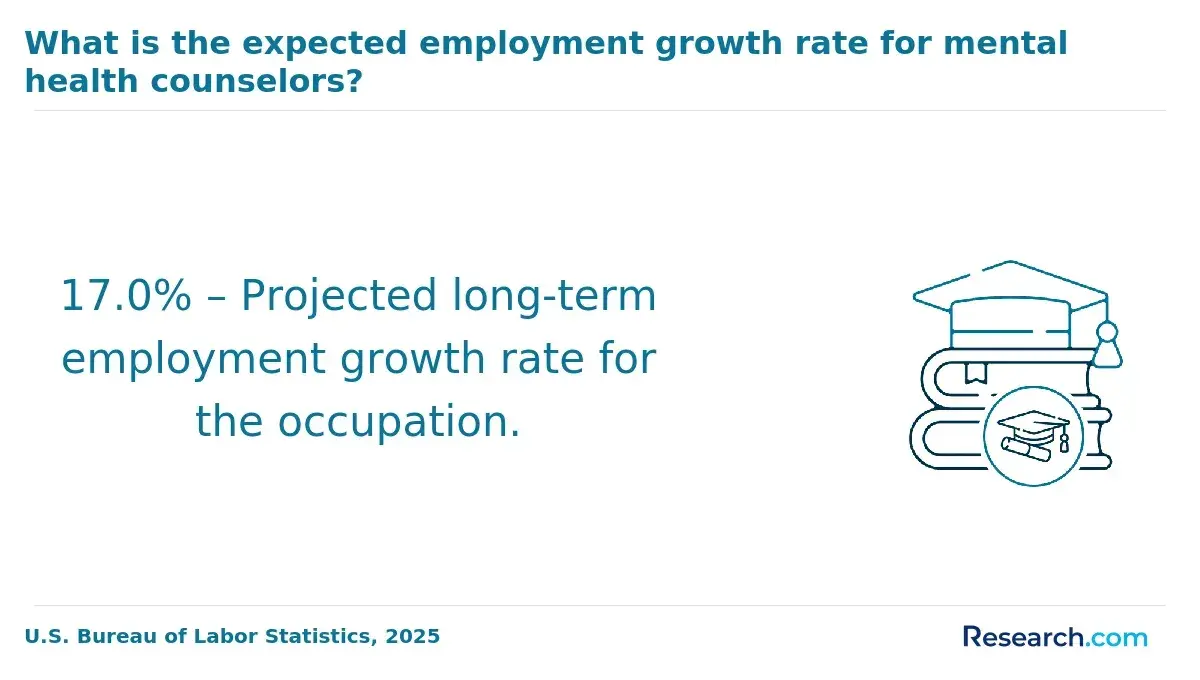
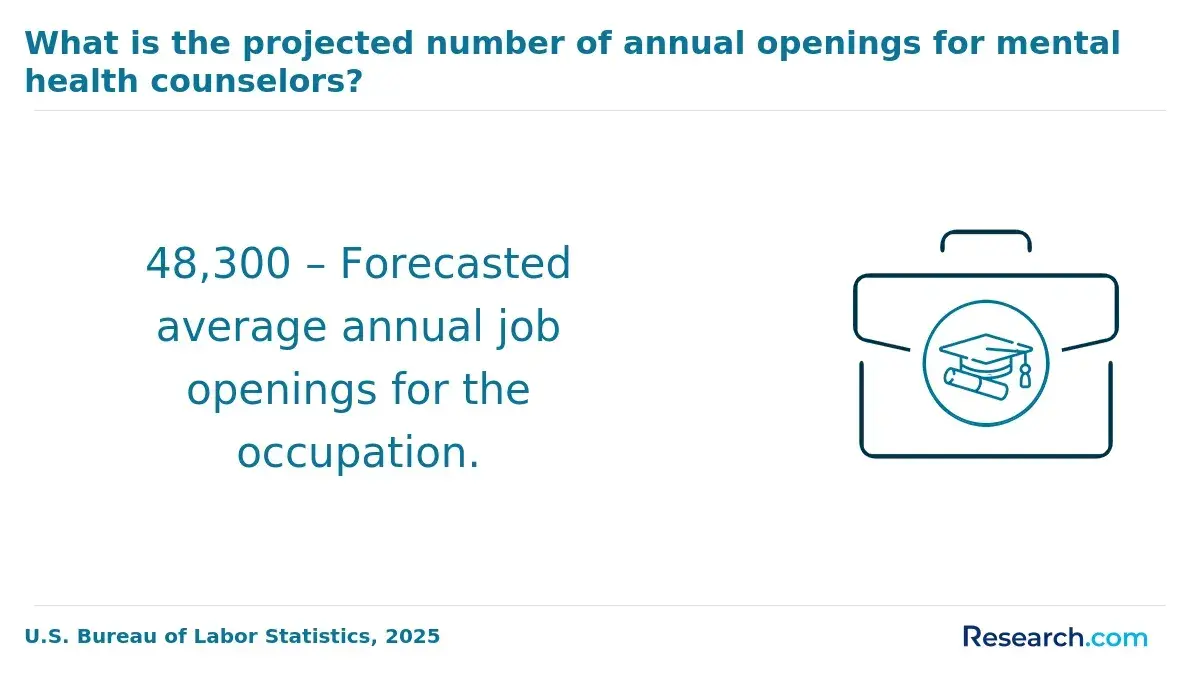
National employment of substance abuse, behavioral disorder, and mental health counselors is projected to grow 18% from 2025 to 2035 (U.S. Bureau of Labor Statistics, Employment Projections). That signals demand across the U.S. occupation, but it is not a Jacksonville placement rate or a forecast of openings available to new graduates.
To test the local market before enrolling, review current Jacksonville-area postings from health systems, community providers, and treatment organizations. Note which roles accept supervised graduates, which require a Florida license, and whether schedules and pay would support your loan payments. That employer-level check is more actionable than applying a national growth figure to your personal job search.
2027 Best Clinical Mental Health Counseling Degree Programs Ranking in Jacksonville
An education investment deserves more scrutiny than a single ranking position. Research.com's counseling rankings are designed to help readers compare programs using outcomes, accreditation, and cost rather than reputation alone. The team draws on multiple education databases and checks how each measure applies to the programs being evaluated.
For the Best ranking, a graduate-outcomes-and-accreditation score combines program completion at 40%, employment or doctoral admission at 20%, licensure exam pass rates at 20% where applicable, CACREP programmatic accreditation at 16%, and federal Title IV eligibility at 4%. Weights are renormalized when a measure does not apply. Program cost contributes a smaller component - about 7% of the final score. On-campus and online programs use the same method; rankings named for another dimension order programs by that dimension. Research.com identifies these data sources:
IPEDS database - institutional enrollment, completion, and price data.
These measures provide a starting point, not a substitute for checking current tuition, clinical placements, and Florida licensure eligibility with a school. Readers can review more about the approach on Research.com's methodology page.
# 1 position
Jacksonville University
Master
Master of Science in Clinical Mental Health Counseling
Delivery mode: hybrid
91.31
/ 100
Final score
Program length
two-year, full-time
Specialization
Clinical Mental Health Counseling
Required credits
60 semester credits
GPA range
3.00 - 4.00
Application deadline
Fall: February 15
Application process
direct
GRE
Conditional: GRE (minimum combined 290) required if cumulative GPA is below 3.0
Prerequisites
No specific undergraduate major required, but the undergraduate degree must be from a regionally accredited college or university.
Additional requirements
Completed JU Application, unofficial transcripts for all degrees conferred, statement of intent, resume/CV, 3 letters of recommendation; applicants with a cumulative GPA below 3.0 must submit official GRE scores (minimum combined 290).
Accreditation
Accredited by the Council for Accreditation of Counseling and Related Educational Programs (CACREP), with institutional accreditation from the Southern Association of Colleges and Schools Commission on Colleges (SACSCOC).
Jacksonville University earned a Research.com Counseling Program Score of 91.31/100. The program is CACREP-accredited, valid through 2027-10-31.
# 2 position
University of North Florida
Master
Clinical Mental Health Counseling (M.S.)
Delivery mode: campus
88.14
/ 100
Final score
Program length
2 years
Specialization
Clinical Mental Health Counseling
Required credits
60 semester credits
GPA range
3.00 - 4.00
Program completion rate
92% (2024-25)
Employment or doctoral admission
100% (2024-25)
Licensure exam pass rate
63% (2023-24)
Application deadline
Fall: February 1
Application process
direct
GRE
no
Prerequisites
Applicants must hold a bachelor's degree.
Additional requirements
Resume (max 2 pages); letter of intent (max 2 pages) on reasons and goals; two recommendation forms (preferably one from faculty); interview for top candidates; application, fee, and official transcripts.
Accreditation
Accredited by the Council for Accreditation of Counseling and Related Educational Programs (CACREP), with institutional accreditation from the Southern Association of Colleges and Schools Commission on Colleges (SACSCOC).
University of North Florida earned a Research.com Counseling Program Score of 88.14/100, supported by 63% licensure exam pass rate and 92% program completion rate. The program is CACREP-accredited, valid through 2031-03-31.
Frequently asked questions about Clinical Mental Health Counseling degree in Jacksonville
Is a counseling master's enough to become licensed in Florida?
No. Florida applicants must meet the licensing board's applicable education, supervised-experience, examination, and other requirements. Confirm your intended program's alignment with the board before enrolling (Florida Board of Clinical Social Work, Marriage & Family Therapy and Mental Health Counseling).
Should I choose UNF or Jacksonville University?
Compare your written net costs, course schedules, placement arrangements, and documented licensure preparation. UNF's public-university status and JU's private-university status are useful starting points, not verdicts on fit or value.
Can I complete a counseling degree online and work in Jacksonville?
Possibly, but online coursework does not eliminate supervised clinical training. Confirm how local placements are approved and whether the degree meets Florida's applicable educational requirements before enrolling (Florida Board of Clinical Social Work, Marriage & Family Therapy and Mental Health Counseling).
How long will it take before I can practice independently?
Allow for both the master's program and Florida's post-degree licensing steps. Ask a school for its realistic graduation timetable and the state board for current supervised-experience and examination rules; finishing the degree does not itself authorize independent practice.
Is this degree worth the investment?
It can be if clinical counseling is your goal and your likely earnings and financing can support the full cost. Compare aid-adjusted tuition, time away from work, completion prospects, and licensing time against the career you could pursue without the degree.