Choosing an online counseling master's degree near Columbia, South Carolina, is not just about getting admitted. The program must fit your schedule, clinical-placement options, budget, and path to licensure. This guide explains those trade-offs for career changers and working professionals. It also features a 2027 Easiest Online Clinical Mental Health Counseling Degree Programs Ranking in Columbia, created by the Research.com team of data scientists to help students make an informed choice about which programs are worth considering. Use the comparisons below to decide what to verify before applying.
Key findings about online Clinical Mental Health Counseling degrees in Columbia
Start with licensure fit, not apparent ease: an online master's must provide suitable graduate coursework and supervised training for the South Carolina license you intend to seek.
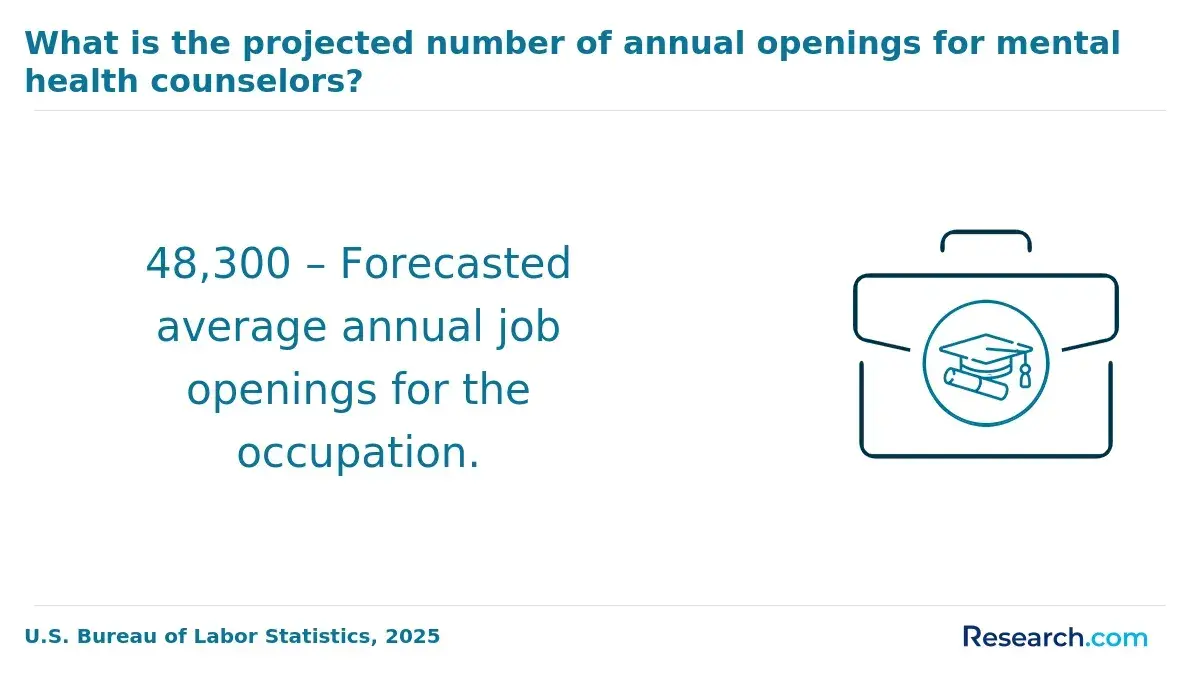
The U.S. median annual wage for the relevant counseling occupation was $59,350 in May 2025, while national employment is projected to grow 18% from 2025 to 2035 (U.S. Bureau of Labor Statistics). Neither figure predicts an individual graduate's earnings or a Columbia job offer.
Compare the full cost and logistics of clinical placement before applying. A program's online classes do not remove in-person supervision requirements, and its advertised tuition may exclude fees and placement-related expenses.
What can I expect from an online Clinical Mental Health Counseling degree in Columbia?
Expect a graduate degree designed to prepare students for supervised clinical counseling practice - not a self-paced credential that grants a license upon graduation. Coursework typically covers assessment, diagnosis, counseling theories, ethics, research, and treatment planning. Students also practice counseling under supervision through a practicum and internship.
For a Columbia resident, the decisive question is where that supervised work can happen. Online lectures may allow you to keep your job, but a placement may require weekday hours at a local clinic, hospital, community agency, or other approved site. Confirm whether the school helps secure South Carolina placements, who approves supervisors, and whether required live classes or campus visits fit your schedule.
This path suits someone who wants to provide clinical mental health services and can accommodate supervised training. If your goal is school counseling, pastoral care without clinical licensure, or a quicker entry into a helping role, compare those distinct credentials before committing to a clinical master's.
Where can I work with an online Clinical Mental Health Counseling degree in Columbia?
Potential settings around Columbia include community mental health services, outpatient practices, hospitals, substance-use treatment organizations, and agencies serving families or veterans. The work available to a graduate depends on the employer, the graduate's supervised-practice status, and eventual licensure - not simply the degree title.
South Carolina's Department of Mental Health and the region's health care and community-service organizations make local placement networks worth investigating. Ask programs which types of Columbia-area sites have accepted their students and whether those sites can provide the supervision needed for your intended role. A school's ability to teach you online matters less if you cannot complete an approved placement near home.
The U.S. Bureau of Labor Statistics reports a $59,350 national median annual wage for substance abuse, behavioral disorder, and mental health counselors in May 2025. That is an occupation-wide midpoint, not a starting salary for a new master's graduate or a Columbia-specific wage. Employer type, experience, license status, and the mix of salaried and private-practice work can change an individual offer.
Use that figure as a benchmark for a repayment scenario, not a promised return. Compare realistic local job postings with the program's total price and the income you may forgo during placement. If you already earn close to the occupational median, a large loan balance may take longer to justify than it would for someone entering the field from a lower-paid role.
The useful distinction between these options is their educational design, not a claim that either makes clinical training easy. Confirm current delivery and South Carolina placement arrangements directly with each school; a program webpage alone does not establish that every requirement can be completed remotely from Columbia.
Webster University: Webster presents clinical mental health counseling within its M.A. in Counseling, making the degree's emphasis structure an important point of comparison with a stand-alone clinical counseling degree (Webster University). It may fit a student who wants to examine emphasis-specific coursework, but ask which courses, campus visits, and placements are actually available to a Columbia-based online student.
Columbia International University: CIU's M.A. in Clinical Counseling explicitly integrates a Christian perspective into counselor preparation (Columbia International University). That curricular commitment distinguishes it from Webster's emphasis-based presentation and may appeal to applicants seeking faith-integrated training; ask how its clinical requirements and supervised placements align with the South Carolina license you plan to pursue.
Neither a degree title nor an institutional affiliation substitutes for checking the current catalog, accreditation status, fieldwork handbook, and licensing-board requirements. Request written answers if an admissions description leaves any of those points unclear.
Plan on approximately two to three years of full-time study for a clinical counseling master's; part-time enrollment commonly takes longer. The controlling variables are course sequencing, whether placements are offered year-round, and how many supervised hours you can complete alongside paid work. Ask for a term-by-term plan based on your actual enrollment pace rather than relying on an advertised minimum.
An accelerated calendar is useful only if it leaves enough time to secure and complete an approved placement. If speed is your priority, compare fastest clinical mental health counseling programs, then ask whether their stated timelines include clinical training and any required campus sessions.
The principal difference is how academic instruction is delivered, not whether students must demonstrate counseling skills or complete supervised fieldwork. This comparison shows where format can change a Columbia student's practical experience.
Decision factor
Online or hybrid
On campus
Scheduled learning
May reduce commuting, but can still require live meetings
Requires regular travel to scheduled classes
Skills practice
May use live video sessions or scheduled in-person sessions
Typically happens in scheduled campus sessions
Clinical placement
Must be arranged at an approved site; proximity is not assured
Still requires an approved site and supervisor
Best fit
Students who need geographic flexibility and can manage placement logistics
Students who value regular in-person interaction and can commute
Ask both formats the same questions about supervisor approval, placement assistance, and any required travel. An online option may save commuting time yet cost more overall if it requires distant residencies or makes local placement difficult.
There is no single reliable Columbia-wide average for these specific online degrees: tuition can be quoted per credit, per term, or by program, and published prices may omit clinical expenses. A useful comparison is the total amount you would pay to finish, using each school's current tuition schedule and your expected completion plan. Do not treat a general undergraduate tuition figure as a counseling master's price.
Request an itemized estimate covering required credits, university and technology fees, books, travel for any campus sessions, placement-related costs, and additional terms if you study part time. Check whether tuition changes by campus, delivery format, or residency; do not assume a South Carolina address produces an in-state rate at every institution. The most affordable clinical mental health counseling programs are a useful shortlist, but compare their complete estimates before choosing the lowest advertised price.
Eligible graduate students can seek federal Direct Unsubsidized Loans by submitting the FAFSA; institutional scholarships, assistantships, employer tuition assistance, and eligible South Carolina workforce benefits may also reduce costs. Eligibility and amounts depend on the student, school, enrollment pattern, and award terms (Federal Student Aid; institution financial aid offices).
Do not build a 2027 budget assuming Graduate PLUS will cover the gap. New graduate borrowers generally cannot use that loan program beginning July 1, 2026; qualifying students who borrowed for their program before the change may have limited transitional eligibility (Federal Student Aid). Ask each financial aid office to explain your individual status and remaining borrowing options in writing.
Borrow only after testing the repayment amount against a plausible early-career salary. If an award requires full-time enrollment but your placement schedule makes that impractical, ask how a part-time term changes the aid package.
Applicants generally need a bachelor's degree and must meet the school's graduate admissions standards. Programs may also request transcripts, recommendations, a statement of purpose, an interview, or prerequisite coursework; requirements differ by school (Webster University; Columbia International University). A related undergraduate major can be helpful, but do not assume it is required without checking the current admissions page.
Before applying, separate admission eligibility from licensure eligibility. Ask whether prior graduate credits can transfer, whether transferred courses replace required clinical coursework, and whether a resident of South Carolina can complete every required course and placement through the program. An easy admissions process will not help if the resulting education does not fit your intended license.
Expect counseling theories, human development, assessment and diagnosis, ethics, multicultural counseling, group work, research, and treatment planning, followed by supervised practicum and internship. Exact titles and sequencing differ across catalogs. Courses in telehealth may also matter because remote care requires deliberate attention to privacy, client location, and professional rules - not just comfort with video calls.
Compare syllabi and clinical handbooks rather than counting course names alone. A prospective South Carolina practitioner should check whether required content and supervised experiences match the South Carolina licensing board's current educational standards. The board, not an admissions adviser's general assurance, determines licensing eligibility (South Carolina Board of Examiners for Licensure of Professional Counselors, Marriage and Family Therapists, Addiction Counselors, and Psycho-Educational Specialists).
Clinical programs may offer electives or training focused on trauma, substance use, children and adolescents, couples and families, or particular treatment approaches. These interests can help you choose a placement site and build relevant skills, but an elective or concentration does not itself confer a separate license or certification.
Match specialization to the role you actually want. If you intend to be a school counselor or marriage and family therapist, verify that the degree meets that profession's distinct South Carolina requirements rather than assuming a clinical mental health counseling track is interchangeable. If you are undecided, prioritize strong general clinical preparation and reliable placement support over a narrowly labeled elective.
Start with the license and work setting you want, then compare programs against requirements you cannot fix after graduation. Use best clinical mental health counseling programs to build a shortlist - not to replace direct checks with schools and the licensing board.
Ask each program for written answers to these questions before paying an enrollment deposit:
Does the current curriculum satisfy South Carolina's educational requirements for my intended counseling license, and how does the school document that alignment?
What are the institution's and program's current accreditation statuses, and does the board require or recognize a particular accreditation for my pathway?
Which requirements must I attend live or in person, and who finds and approves a placement near Columbia?
What is my itemized cost and likely completion schedule after any accepted transfer credits and financial aid?
What recent program-level completion, exam, and employment outcomes can the school substantiate?
The common mistake is choosing by a ranking label or tuition rate alone. If a school cannot clearly explain its clinical-placement process or licensure alignment, pause before committing - even if admission looks straightforward.
View the chart data as a table
Admissions GPA by program (Source: Research.com)
Category
Value
Webster University, Sout
2.5
Columbia International U
3
A graduate may pursue supervised counseling work and, after satisfying the applicable South Carolina requirements, seek licensure for independent professional practice. Possible directions include community mental health, outpatient therapy, integrated health care, and behavioral health or substance-use services. Duties and permitted titles change with license status and employer requirements (South Carolina licensing board; U.S. Bureau of Labor Statistics).
Judge the degree's value against your starting point, not an occupation-wide wage alone. A meaningful return-on-investment comparison includes aid and debt, time to completion, lost earnings during training, likelihood of finishing, expected earnings before and after the degree, and how long you expect to work in the field. The most valuable clinical mental health counseling programs can help frame that comparison, but your circumstances determine whether the investment makes sense.
View the chart data as a table
Wage range - Mental Health Counselors in South Carolina (BLS OEWS, May 2025) (Source: BLS)
Category
Value
10th percentile
35,010
25th percentile
43,070
Median
52,370
75th percentile
65,070
90th percentile
81,420
National employment for substance abuse, behavioral disorder, and mental health counselors is projected to grow 18% from 2025 to 2035 (U.S. Bureau of Labor Statistics, Employment Projections). That signals broad demand, but it is not a Columbia-specific forecast or evidence that every newly qualified applicant will find a preferred position.
For a local decision, look beyond the number of postings. Compare openings by required license, supervision offered, client population, schedule, and pay structure. A placement that builds relationships with Columbia-area providers can be useful, but it is not a job guarantee. If your preferred specialty has few suitable openings locally, consider whether you would accept a broader first role or a wider commute before taking on graduate debt.
2027 Easiest Online Clinical Mental Health Counseling Degree Programs Ranking in Columbia
Investing in a counseling degree is a consequential decision. Research.com developed its rankings to help readers compare programs using documented outcomes, accreditation, and cost rather than promotional claims. Its team reviews multiple education datasets and accounts for criteria that do not apply to every program.
Research.com's counseling methodology scores program completion, employment or doctoral admission, licensure-exam pass rates where applicable, programmatic CACREP accreditation, federal Title IV eligibility, and cost. For its Best ranking, completion carries 40% of the initial outcomes-and-accreditation score; employment or doctoral admission and applicable exam results carry 20% each; CACREP recognition carries 16%; and Title IV eligibility carries 4%. Inapplicable criteria are renormalized. Cost contributes about 7% of the final Best score. The same approach applies to online and campus programs; other rankings order programs by the dimension named in the ranking.
The following sources were used to create the ranking:
IPEDS database: institutional reporting on enrollment, completion, and prices.
A ranking is a starting point, not proof that admission, coursework, or professional licensure will be easy. Readers can review Research.com's methodology, then ask each school for current program-level requirements, costs, and outcomes before making a decision.
# 1 position
Webster University, South Carolina
Master
Master of Arts in Counseling with an Emphasis in Clinical Mental Health Counseling
Delivery mode: online
81.80
/ 100
Final score
Program length
2 to 4 years
Specialization
Clinical Mental Health Counseling
Required credits
60 semester credits
Acceptance rate
71.9%
GPA range
2.50 - 4.00
Program completion rate
60% (2024-25)
Employment or doctoral admission
86% (2024-25)
Application deadline
Rolling review; priority consideration: Fall 1 by July 1; Spring 1 by December 1
Application process
direct
GRE
no
Prerequisites
Bachelor's degree
Additional requirements
Bachelor's degree with minimum 2.5 GPA; official transcripts from all institutions; three professional references
Accreditation
Accredited by the Council for Accreditation of Counseling and Related Educational Programs (CACREP), with institutional accreditation from the Higher Learning Commission (HLC).
Webster University, South Carolina earned a Research.com Admissions Accessibility Score of 81.8/100, supported by a minimum GPA of 2.5 and 71.9% acceptance rate. The program is CACREP-accredited, valid through 2027-10-31.
# 2 position
Columbia International University
Master
Master of Arts in Clinical Counseling
Delivery mode: hybrid
51.40
/ 100
Final score
Program length
Typical completion: 3 years; completion deadline: 7 years
Specialization
Clinical Mental Health Counseling
Required credits
60 semester credits
GPA range
3.00 - 4.00
Program completion rate
71% (2024-25)
Employment or doctoral admission
100% (2024-25)
Licensure exam pass rate
95% (2024-25)
Application process
direct
GRE
no
Prerequisites
Undergraduate Introduction/General Psychology, and Old or New Testament Survey (or biblical competency exam), each with a minimum 'C' (or CLEP 50); applicants missing these may be conditionally accepted.
Additional requirements
Online application, application fee, affirmation of CIU's Statement of Faith, official transcripts (min 3.0 GPA on most recent degree), 800-word essay, professional reference, and an in-person or online interview.
Accreditation
Accredited by the Council for Accreditation of Counseling and Related Educational Programs (CACREP), with institutional accreditation from the Southern Association of Colleges and Schools Commission on Colleges (SACSCOC) and the Association for Biblical Higher Education, Commission on Accreditation (ABHE).
Columbia International University earned a Research.com Admissions Accessibility Score of 51.4/100, supported by a minimum GPA of 3 and 71% program completion rate. The program is CACREP-accredited, valid through 2032-10-31.
Frequently asked questions about online Clinical Mental Health Counseling degree in Columbia
Are online clinical counseling degrees easier than campus degrees?
Not necessarily. Online classes can reduce commuting, but students still must meet academic and supervised clinical requirements. Compare schedules and placement support rather than assuming online means less work.
Can I become a licensed counselor as soon as I graduate?
No. Graduation alone does not grant a South Carolina license. Check the state licensing board's current rules for the degree, supervised experience, examinations, and application steps that apply to your intended license.
Will an online program arrange a clinical placement in Columbia?
Policies vary. Ask whether the school finds sites, provides leads, or expects you to secure one, and confirm who approves the site and supervisor before enrollment.
Is the least expensive program the best investment?
Not automatically. Compare total cost, aid, completion time, placement access, licensure fit, and credible outcomes. A lower tuition quote can lose its advantage if added terms or travel increase what you pay.
What should I verify about accreditation?
Check both the institution's accreditation and any claimed programmatic accreditation directly with the accrediting organization. Then confirm with the South Carolina licensing board how that status affects your intended application.
CACREP - Directory of Accredited Programs Used to verify CACREP accreditation status of specific programs. https://www.cacrep.org/directory/
Counseling Compact - Participating States Verified professional/licensure/career reference. https://counselingcompact.org/
Webster University, South Carolina - Master of Arts in Counseling with an Emphasis in Clinical Mental Health Counseling Official program page (curriculum, tuition, admissions). https://www.webster.edu/science-health/ma-counseling.php