
2027 How to Become a Teacher in Illinois – What Degree Do You Need to Be a Teacher?

Co-Founder and Chief Data Scientist
Becoming a teacher in Illinois means choosing the right preparation route, completing state-approved training, passing required assessments, and applying for the correct educator license. The process is manageable, but it is not one-size-fits-all. Your path depends on whether you want to teach elementary students, high school math, special education, career and technical education, kindergarten, English, or another subject area.
This guide explains how to become a teacher in Illinois in 2026, including degree requirements, licensure options, alternative routes, online programs, salary expectations, job demand, renewal rules, financial aid, and career advancement. It is designed for first-time college students, career changers, substitute teachers, online learners, and current educators who want to specialize or move into leadership.
Quick Answer: How do you become a teacher in Illinois?
To become a licensed teacher in Illinois, you generally need a bachelor’s degree, completion of an Illinois-approved teacher preparation program, supervised student teaching or field experience, passing scores on required assessments, and an application for the appropriate license through the Illinois State Board of Education. Most full-time public school teachers pursue the Professional Educator License (PEL). Teachers must also complete 120 hours of professional development every five years to maintain licensure.
Key Things You Should Know About Becoming a Teacher in Illinois
- Illinois requires most public school teachers to complete a state-approved teacher education program that includes supervised classroom experience.
- Candidates must pass required assessments, which may include a performance assessment and subject-area exams based on the grade level or endorsement area.
- The Professional Educator License (PEL) is the main credential for teachers who complete a bachelor’s degree and approved preparation program, while other licenses serve substitute, alternative, emergency, and specialized teaching roles.
- Teacher shortages remain a major issue in Illinois, especially in special education and career technical education, with over 90% of schools reporting difficulty filling positions.
- Illinois teacher salaries vary by role and grade level. Elementary school teachers earn an average salary of $70,880 per year, while secondary school teachers earn an average of $80,200 annually.
- Steps to become a teacher in Illinois
- Education requirements for Illinois teaching licensure
- Easier and more flexible routes into teaching Review degree requirements
- Types of Illinois teaching licenses
- Current state of the Illinois teaching workforce
- Job outlook for Illinois teachers
- Illinois teacher salary expectations
- Where teachers work in Illinois
- Financial aid for future Illinois teachers Compare employment settings
- Teacher responsibilities and daily work
- Becoming an English teacher in Illinois
- Why subject expertise matters
- Top Teaching Programs in Illinois for 2027
- Illinois teaching license renewal
- School librarian pathways in Illinois
- Kindergarten teacher requirements
- Professional development for Illinois teachers
- Online education routes to teaching in Illinois
- Traditional vs. alternative certification routes
- Substitute teacher qualifications
- Career advancement options for teachers Plan professional development Compare programs
- First steps for aspiring teachers
- Special education teacher certification
- Private school teacher requirements
- Is teaching in Illinois worth it? Read key insights
Steps to become a teacher in Illinois
The standard Illinois teaching pathway is built around approved preparation, supervised classroom practice, testing, and licensure. The Illinois State Board of Education outlines licensure requirements for candidates who plan to teach in public schools.
- Choose the grade level and subject you want to teach. Your endorsement area determines the coursework, field experience, and subject exams you may need. Elementary education, secondary education, special education, early childhood education, and career technical education each have different preparation expectations.
- Complete a qualifying teacher preparation program. Most candidates enroll in an Illinois-approved undergraduate education program. Students who need flexibility may also compare online education degree programs, but they should confirm that the program supports Illinois licensure.
- Finish supervised fieldwork or student teaching. Classroom-based practice is not optional for most licensure routes. Student teaching helps candidates learn lesson planning, assessment, classroom management, and communication with families under the supervision of experienced educators.
- Pass the required assessments. Illinois candidates may need to complete a performance assessment and subject-specific exams. Requirements vary by endorsement and preparation route, so candidates should verify testing expectations before applying for licensure.
- Apply for the appropriate Illinois teaching license. After meeting education, fieldwork, and testing requirements, candidates apply through the Illinois State Board of Education. Out-of-state candidates may need to submit additional documentation.
- Keep the license active. Illinois teachers must complete 120 hours of professional development every five years to renew their teaching license.
| Stage | What to do | Decision point |
| Before enrolling | Identify your grade level, subject, and preferred teaching setting. | Do you need elementary, secondary, special education, early childhood, or career technical preparation? |
| During college or preparation | Complete approved coursework and supervised field experience. | Does the program lead to the Illinois license and endorsement you need? |
| Before applying | Pass required assessments and gather documentation. | Have you confirmed every testing and transcript requirement with ISBE or your program? |
| After licensure | Teach, document professional development, and renew on time. | Are you tracking your 120 hours across the five-year renewal cycle? |
What Illinois teachers say about the career
- Teaching in Illinois gives me a direct way to help students grow. The best moments come when a student who has struggled finally connects with a lesson and realizes they can succeed. Allie
- I completed my preparation through an online program, and the flexibility helped me move into teaching without putting the rest of my life on hold. The classroom is still challenging, but my training gave me a strong foundation. Dominic
- What I value most is the sense of shared responsibility. Teachers, families, and school staff work together, and that collaboration makes the job meaningful even on difficult days. Maya
Education requirements for Illinois teaching licensure
Illinois teacher licensure usually requires both a college degree and state-approved teacher preparation. These requirements matter because earning a degree alone may not qualify you for a public school teaching license if the program does not include approved educator preparation and fieldwork.
- Bachelor’s degree: Candidates must hold a bachelor’s degree from an accredited institution. The major does not always have to be education, but the degree must support the licensure route and endorsement sought.
- Approved teacher preparation: Candidates must complete a state-approved educator preparation program with coursework, clinical experiences, and student teaching or a comparable supervised placement.
Graduate study is not always required for initial licensure, but it can help teachers deepen instructional skills, qualify for advanced roles, and meet professional goals. Some educators compare online master’s degrees for educators after earning initial licensure. As shown below, 58.6% of teachers in Ilionis have graduate degrees. That does not mean every candidate must pursue graduate school immediately, but it does show that advanced education is common among Illinois educators and may support long-term career mobility.
Is an easier path to teaching available in Illinois?
There is no shortcut that avoids Illinois licensure standards for public school teachers, but there are more flexible routes depending on your background. The best path is not always the fastest one. It is the route that gets you properly licensed for the grade level, subject, and school setting where you plan to work.
Students starting college for the first time may choose a traditional bachelor’s degree in education. Career changers may look at alternative certification or post-baccalaureate options. Working adults may compare online or accelerated programs, including affordable options such as low-cost online education degrees. The key is to confirm that any program aligns with Illinois requirements before enrolling.
| Route | Best for | Main advantage | Watch out for |
| Traditional bachelor’s in education | First-time college students who know they want to teach | Combines degree coursework, preparation, and fieldwork in one pathway | Changing grade levels or subjects later may require additional endorsements |
| Online education degree | Students who need scheduling flexibility | Can reduce commuting and help working adults study while employed | Must still include approved clinical or student teaching experiences |
| Alternative certification | Career changers with a bachelor’s degree | May shorten the transition from another field into teaching | Requirements can be intensive and vary by endorsement area |
| Substitute teaching license | Candidates testing the classroom environment before committing | Provides school experience without completing a full teacher preparation program | Does not replace full licensure for permanent public school teaching roles |
Some programs may feel easier because they are more streamlined, offer online coursework, or have clearer transfer policies. However, candidates should not choose a program only because it looks simple. A weaker program can leave you underprepared for student teaching, exams, classroom management, and hiring expectations.
Types of teaching licenses issued in Illinois
Illinois uses different educator licenses for different school roles. Choosing the correct license matters because a substitute credential, emergency license, or license with stipulations does not automatically qualify someone for every teaching position.
| License type | Who it is for | Common use |
| Professional Educator License (PEL) | Candidates who complete a bachelor’s degree and approved teacher preparation program | The main license for public school teachers from pre-kindergarten through 12th grade, including many candidates pursuing special education careers |
| Educator License with Stipulations (ELS) | Candidates in specific or limited teaching situations | Career and technical education, alternative routes, and other specialized circumstances |
| Substitute Teaching License | Individuals who want to serve as substitute teachers | Short-term classroom coverage without completing a full teacher preparation program |
| Emergency License | Schools facing a critical shortage of licensed teachers in a subject area | Temporary staffing during urgent vacancies |
| Short-Term Substitute License | Candidates filling brief substitute assignments | Substituting for up to 5 consecutive days per licensed teacher |
Current state of the Illinois teaching workforce
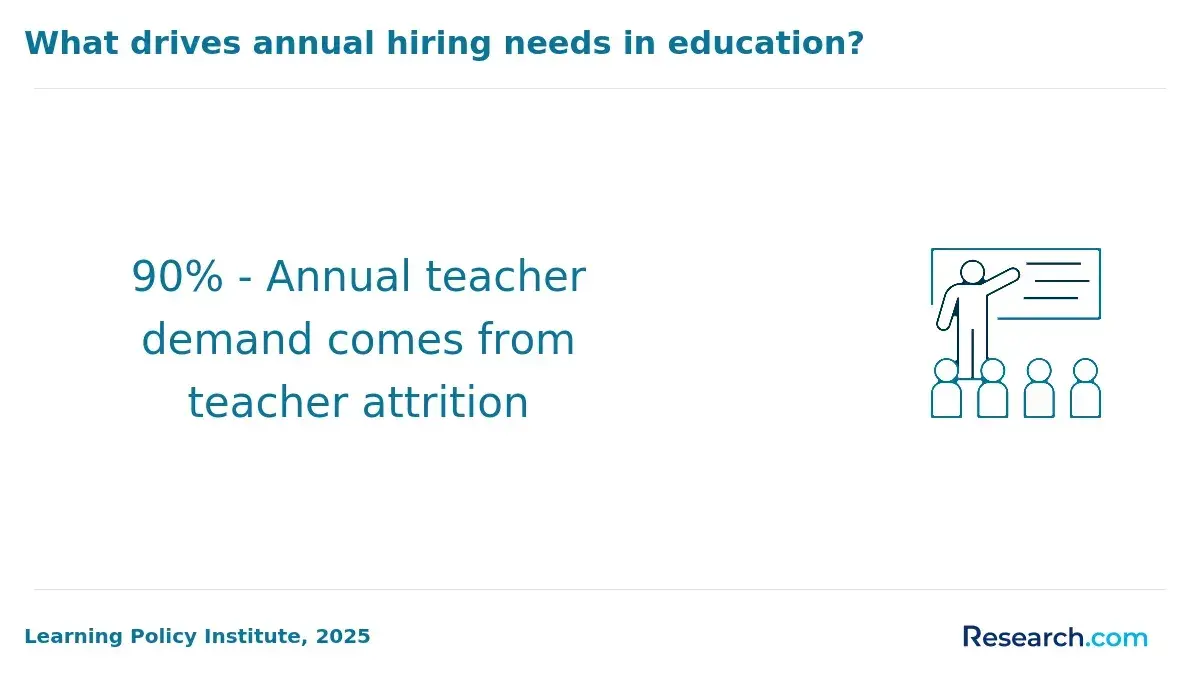
Illinois continues to face a serious teacher shortage. Over 90% of schools in the state report major difficulty filling teaching positions, with special education and career technical education among the hardest areas to staff. The shortage is especially visible in city districts and rural communities, where applicant pools can be thin and hiring timelines can be difficult.
School leaders report that 88% see very few applicants for open positions, and some candidates do not have the proper credentials. As a result, districts may rely on substitutes, retired educators, combined classes, or larger class sizes to keep schools operating. In 2025, 74% of districts reported trouble filling open positions compared to the previous year, and national surveys indicate shortages persist in about 1 in 8 teaching roles. Illinois has more than 42,200 educators employed, yet the state still reports an annual job opening of 3,001. For students considering a degree in education, these shortages can create opportunities, particularly in high-need fields.
Job outlook for Illinois teachers
The Illinois teacher job outlook is steady but uneven. Overall growth may show little to no change, but that headline does not tell the full story. Openings depend heavily on geography, subject area, school funding, retirements, and student enrollment patterns. Candidates exploring education career paths should look beyond statewide averages and compare local demand.
According to the Illinois Work Net Center, places with more high school students and areas with declining teacher-student ratios may see stronger demand. Cook County is projected to have around 1,084 annual openings for high school teachers, while Du Page County shows a significant growth rate of 11.7%. In contrast, areas such as the Champaign Area are expected to see declining teacher employment. Candidates with preparation in math, science, or special education may have stronger prospects because those specialties remain difficult for districts to fill.
Illinois teacher salary expectations
Teacher pay in Illinois varies by grade level, specialization, district, experience, union contract, and local cost of living. Statewide averages can help candidates estimate earning potential, but they should not be treated as guaranteed starting salaries.
| Teaching role | Average annual salary in Illinois | What to consider |
| Elementary school teachers, except special education | $70,880 per year | Salary may depend on district pay schedules, education level, and years of experience. |
| Secondary school teachers | $80,200 annually | Subject area demand can affect hiring opportunities, especially in high-need fields. |
| Secondary school special education teachers | $80,620 annually | Special education can offer strong demand but often requires specialized preparation and responsibilities. |
Salary should be evaluated alongside program cost, student loan debt, retirement benefits, commute, local housing costs, and advancement opportunities. A higher salary in one district may not always mean better long-term value if the workload, commute, or cost of living is significantly higher.
Where teachers work in Illinois
Illinois teachers work in large urban districts, suburban systems, rural schools, charter networks, private schools, technical programs, and specialized settings. The best employment market for you depends on the subject you teach, the type of license you hold, and the student population you want to serve.
Illinois regions with notable teacher demand
- Cook County: The state’s largest teacher labor market, including Chicago and a wide range of grade levels and subject areas.
- Du Page County: A strong market with growth and regular teaching openings.
- Lake County and Will County: Counties with consistent demand and meaningful annual openings.
- DeKalb-Elgin-Aurora Area: A broader employment region with a substantial base of teaching positions.
School settings to consider
- Public schools: The primary employer for licensed teachers and the setting where state licensure requirements are most important.
- Private and charter schools: Options for candidates interested in mission-driven schools, smaller environments, specialized curricula, or alternative instructional models.
- Special education and technical education programs: High-need areas that may offer opportunities in regions such as Peoria-Bloomington and Edwardsville.
| Work setting | Good fit for | Key question to ask |
| Urban public district | Teachers who want diverse classrooms and broad support services | What mentoring, planning time, and classroom support are available for new teachers? |
| Suburban district | Teachers seeking established programs and district resources | How competitive is hiring in your endorsement area? |
| Rural school | Teachers comfortable with smaller communities and broader responsibilities | Will you need to teach multiple subjects, grade levels, or activities? |
| Private school | Teachers interested in a specific educational philosophy or school mission | Does the school require state licensure, and how does compensation compare? |
| Specialized program | Teachers with special education, bilingual, technical, or high-need endorsements | What specialized training, caseload expectations, and support staff are provided? |
Financial aid options for future teachers in Illinois
The cost of becoming a teacher can vary widely based on institution type, residency status, transfer credits, delivery format, and whether you pursue undergraduate or graduate preparation. Future teachers should compare total cost, not tuition alone.
Illinois students may qualify for the Monetary Award Program (MAP), a need-based grant for students attending approved Illinois postsecondary institutions. Because MAP grants do not require repayment, they can be especially helpful for low-to-moderate-income students pursuing educator preparation.
The Illinois TEACH Grant Program may also support students who commit to high-need teaching fields such as special education, math, and science or to service in low-income schools. Because grant programs can carry service obligations, candidates should understand the requirements before accepting funds. If the required teaching service is not completed, repayment obligations may apply.
Scholarships from groups such as the Illinois Retired Teachers Association Foundation and local education organizations may also reduce out-of-pocket costs. Candidates comparing alternative routes should review cost-effective teaching certificate options in Illinois before choosing a program.
Loan forgiveness may be available to eligible educators through programs such as federal Public Service Loan Forgiveness (PSLF) and the Illinois Teachers’ Loan Repayment Program. These programs can help qualified teachers reduce student loan balances, but eligibility rules are specific. Teachers should keep employment records, loan documentation, and certification paperwork organized from the beginning.
What teachers do
Teachers do far more than deliver lessons. They design instruction, align activities with curriculum standards, assess student learning, adapt materials for different needs, manage classroom routines, communicate with families, collaborate with colleagues, and support students’ academic and social development.
Daily responsibilities may include writing lesson plans, leading discussions, grading assignments, using data to adjust instruction, preparing accommodations, supervising students, attending team meetings, and documenting progress. Secondary teachers often focus on one or more subject areas and may need deeper content knowledge. Candidates interested in teaching older students can explore online secondary education programs that prepare educators for middle and high school classrooms.
How can I specialize as an English teacher in Illinois?
To become an English teacher in Illinois, candidates should focus on certification requirements for language arts instruction, literature, writing, grammar, composition, and adolescent literacy. Strong English teachers need both subject expertise and instructional strategy: they must know the texts and writing skills they teach, but they must also know how to help students analyze, argue, revise, and communicate clearly.
Prospective English teachers should look for programs with coursework in literature, writing pedagogy, assessment, and classroom practice. Mentorship and field placements in English classrooms can also help candidates learn how to teach discussion-based lessons, writing workshops, and reading strategies. For a focused pathway, review this guide on how to become an English teacher in Illinois.
How subject matter expertise improves teaching effectiveness
Strong content knowledge helps teachers explain ideas clearly, answer student questions, identify misconceptions, and design lessons that go beyond memorization. This is especially important in subjects that build sequentially, such as mathematics, science, reading, and writing.
For example, teachers with advanced quantitative preparation may be better equipped to connect concepts, use multiple problem-solving approaches, and support students who struggle with abstract reasoning. Candidates who want a deeper foundation in mathematics can compare options for a mathematics degree. Subject expertise also supports curriculum development, academic mentoring, and leadership within a department.
Top Teaching Programs in Illinois for 2027
Choosing a teaching program is one of the most important decisions future Illinois teachers make. A strong program should match your intended license, provide supervised classroom experience, prepare you for required assessments, and offer clear support for placement, advising, and endorsement planning. As of 2024, specialized Illinois teaching fields show potential salaries reaching up to $80,620 annually for special education.
How do we rank schools?
Research.com rankings are developed through structured research and data analysis. For details on how programs are evaluated, review our methodology. Data sources used in the ranking process include:
- IPEDS database
- Peterson’s database
- Distance Learning Licensed Data Set, College Scorecard database
- National Center for Education Statistics
| Program | Delivery or focus | Best for | Important details |
| Illinois State University, Mathematics Teacher Education | Mathematics teacher preparation | Students preparing to teach math | 120 credit hours; 4 years; multiple education-related accreditations |
| National Louis University, BA in Elementary Education | Online elementary education | Students seeking flexible elementary preparation | 180 quarter hours; multiple concentration options |
| University of Illinois Urbana-Champaign, International Education Administration & Leadership EdD | Online doctoral leadership program | Educators interested in international education leadership | 64 credits; $510 cost per credit |
| Northwestern University, MA in Literature | Online literature master’s program | Secondary teachers strengthening English and literature expertise | Estimated cost of $31,950 |
| Elmhurst University, Special Education Major | Special education preparation | Candidates pursuing Learning Behavior Specialist licensure | 4 years; full-time tuition of $41,258 |
1. Illinois State University, Mathematics Teacher Education
Illinois State University offers a Mathematics Teacher Education program with small class sizes and individualized attention. The program reports the largest cohort of candidates among schools reporting to the American Association for Colleges of Teacher Education. Students may also access scholarships for math majors and research opportunities, including conference presentations and publications.
Program Length: 4 years
Cost of Attendance:
- $34,309 (on-campus, resident)
- $27,787 (commuter, resident)
- $46,374 (on-campus, nonresident)
Required Credits to Graduate: 120 credit hours
Accreditations: Council for the Accreditation of Educator Preparation, National Council for Teachers of Mathematics, State Educator Preparation and Licensure Board of the Illinois State Board of Education
2. National Louis University, BA in Elementary Education (online)
National Louis University has offered education degrees since 1886. Its online BA in Elementary Education is designed to help students build lesson-planning, presentation, classroom instruction, and child development skills while preparing them to support learners with different backgrounds and needs.
Program Length: No information available
Tracks/Concentrations:
- English
- Fine Arts
- Mathematics
- Psychology
- Science
- Sociology/Anthropology
Full-Time Rates:
- $12,333/year (transferring in with 30 quarter hours or less-domestic)
- $19,350/year (transferring in with 30 quarter hours or less-international)
- $6,000/term (transferring in with more than 30 quarter hours-domestic)
- $6,333/term (transferring in with more than 30 quarter hours-international)
Required Quarter Hours to Graduate: 180 quarter hours
Accreditations: National Council for Accreditation of Teacher Education (NCATE)
3. University of Illinois Urbana-Champaign, International Education Administration & Leadership EdD (online)
The University of Illinois Urbana-Champaign offers an online EdD in International Education Administration & Leadership for educators who want to lead, evaluate, and manage international education initiatives. The program provides academic support resources such as handbooks, library and textbook services, and technology tools. Graduates earn an EdD in Education Policy, Organization, and Leadership.
Program Length: No information available
Track/Concentration: Global Studies in Education
Cost Per Credit: $510
Required Credits to Graduate: 64
Accreditations: HLC
4. Northwestern University, MA in Literature (online)
Northwestern University offers an online MA in Literature that can help secondary teachers strengthen their knowledge of classic texts, contemporary literature, genre studies, literary analysis, and interpretation. Students may focus on areas such as American Literature, British Literature, Comparative and World Literature, Film, Literature, and Visual Culture, or Interdisciplinary Studies.
Program Length: No information available
Tracks/Concentrations:
- American Literature
- British Literature
- Comparative and World Literature
- Film, Literature, and Visual Culture
- Interdisciplinary Studies
Estimated Cost: $31,950
Required Credits to Graduate: No information available
Accreditations: HLC
5. Elmhurst University, Special Education Major
Elmhurst University offers a Special Education Major focused on preparing teachers to support students with disabilities. The program emphasizes the use of technology and assistive devices and leads to Learning Behavior Specialist licensure. Graduates are prepared to work with students from kindergarten through high school, including learners with autism and cognitive, emotional, and orthopedic impairments.
Program Length: 4 years
Tuition: $41,258 (full-time); $1,172/semester hour (part-time)
Required Credits to Graduate: No information available
Accreditations: HLC
How can I renew my Illinois teaching license efficiently?
Illinois teachers should treat renewal as an ongoing responsibility, not a last-minute task. The state requires teachers to complete and document approved professional development across each renewal period, including 120 hours every five years. Because renewal rules can change, educators should verify current requirements with the Illinois State Board of Education before the end of each cycle.
Efficient renewal starts with recordkeeping. Teachers should save certificates, transcripts, workshop records, district professional development logs, and evidence of approved coursework. Some educators use renewal planning as a chance to build a specialization. For example, coursework in school media and information access, such as a library science degree, may support future movement into library or media specialist roles.
Can I pursue a role as a school librarian in Illinois?
Yes. Teachers who enjoy literacy, research, technology, and schoolwide instructional support may consider becoming a school librarian. This path can require preparation beyond standard classroom teaching because school librarians combine instruction, library management, digital literacy, collection development, and collaboration with classroom teachers.
The exact requirements can differ from classroom teaching, so candidates should confirm credential expectations before enrolling in a program. To compare the pathway, review this guide on how to become a school librarian in Illinois.
What are the kindergarten teacher requirements in Illinois?
Prospective kindergarten teachers in Illinois typically need a bachelor’s degree in early childhood education or a closely related field, coursework in child development and early learning, supervised student teaching in an appropriate setting, and state licensure. Kindergarten teachers must be prepared to teach foundational literacy, numeracy, social development, routines, and classroom behavior in ways that match young children’s developmental needs.
Because early childhood requirements can be specific, candidates should verify current certification standards before choosing a program. For a detailed pathway, review kindergarten teacher requirements in Illinois.
Professional development opportunities for Illinois teachers
Professional development helps Illinois teachers maintain licensure, improve instruction, adapt to changing student needs, and prepare for leadership or specialization. The best professional development plan connects renewal requirements with a teacher’s actual career goals.
- State-approved professional development: ISBE-recognized workshops and training can support license renewal and help teachers stay current in classroom management, instructional strategies, assessment, and technology integration.
- Professional associations: Organizations such as the Illinois Education Association (IEA) and Illinois Association of Teachers of English (IATE) can offer conferences, networking, subject-specific training, and advocacy resources.
- Graduate programs and endorsements: Advanced degrees and endorsements in fields such as special education, bilingual education, literacy, or leadership can expand career options.
- Online professional learning: Platforms such as edX and Coursera may help teachers explore instructional design, education technology, leadership, and current teaching methods, though teachers should confirm whether specific courses count toward renewal requirements.
Can I become a teacher through online education in Illinois?
Yes, online education can be part of an Illinois teaching pathway, but candidates must choose carefully. Online coursework may offer flexibility for working adults, parents, rural students, and career changers, but teacher licensure still requires approved preparation and practical classroom experience.
Before enrolling, confirm that the program is accredited, supports Illinois licensure, includes field placement or student teaching arrangements, and prepares students for required assessments. For a more focused guide, review how to become a teacher online in Illinois.
Traditional vs. alternative certification routes in Illinois
Illinois offers more than one route into teaching. The traditional route is usually best for candidates who are beginning college or already know they want an education major. Alternative certification may be better for adults who already hold a bachelor’s degree and want to move into teaching from another profession.
| Comparison point | Traditional route | Alternative route |
| Typical candidate | Undergraduate student or early planner | Career changer with a bachelor’s degree |
| Preparation structure | Education coursework, field experience, and student teaching built into the degree | Targeted coursework combined with supervised classroom experience |
| Main benefit | Comprehensive preparation before entering full-time teaching | Potentially faster transition for qualified adults |
| Main risk | Can take longer if the student changes subject or grade level late | Can be demanding because candidates may learn pedagogy while entering classrooms quickly |
For more detail on choosing between these routes, review teacher certification requirements in Illinois.
How do I qualify as a substitute teacher in Illinois?
Substitute teaching can be a practical way to gain classroom experience before committing to a full teacher preparation program. Illinois has specific eligibility rules for substitute and short-term substitute roles, including credentialing steps, training expectations, and background checks.
Because substitute rules differ from full teacher licensure, candidates should not assume that substitute teaching automatically leads to a permanent teaching license. To understand eligibility and application steps, review the Illinois substitute teacher requirements.
Top career advancement opportunities for teachers in Illinois
Illinois teachers can advance by deepening their expertise, adding endorsements, taking leadership roles, or moving into administration. Advancement is usually strongest when teachers align professional development with a clear goal rather than collecting credits without a plan.
- Lead teacher or mentor teacher: Experienced educators may coach new teachers, coordinate grade-level teams, or support instructional improvement.
- Specialized endorsements: Additional preparation in high-need areas such as special education or bilingual education can increase versatility and career stability.
- Instructional coach or curriculum specialist: Teachers who excel at planning, assessment, and professional learning may support colleagues across classrooms or schools.
- School administration: Educators who want to become principals or district leaders may need additional graduate preparation and licensure.
- Doctoral study: Teachers interested in research, policy, or senior leadership may compare options such as the most affordable online EdD programs.
First steps for aspiring teachers in Illinois
If you are early in the process, start by choosing the student age group and subject you want to teach. Then verify the degree, preparation, testing, and licensure requirements for that area before applying to schools. Many candidates make the mistake of choosing a general education program without confirming whether it leads to the endorsement they actually need.
Students interested in elementary education can begin with this guide on how to become an elementary school teacher in Illinois. Early research can help you avoid lost credits, missed fieldwork requirements, and delayed licensure.
How can I obtain special education teacher certification in Illinois?
Special education teachers need preparation that goes beyond general classroom instruction. Candidates typically complete coursework in disability categories, individualized education programs, behavior supports, inclusive teaching, assistive technology, assessment, and collaboration with families and specialists.
Field experience is especially important because special education teachers must learn how to adapt instruction, document student progress, and support learners with varied academic, behavioral, and communication needs. For a complete pathway, review this guide to special education teacher certification in Illinois.
Private school teacher requirements in Illinois
Private school teaching requirements in Illinois can differ from public school requirements. Some private schools may not require state licensure, but many still expect a bachelor’s degree, subject knowledge, classroom readiness, background checks, references, and alignment with the school’s mission or instructional approach.
Candidates should review each school’s hiring requirements instead of assuming one rule applies everywhere. Some private schools may prefer or require licensed teachers even when state rules allow more flexibility. For more detail, review private school teacher requirements in Illinois.
Common mistakes to avoid when becoming a teacher in Illinois
| Mistake | Why it can hurt you | Better approach |
| Choosing a program without checking licensure alignment | You may earn credits or a degree that does not lead to the Illinois license or endorsement you need. | Ask the program directly whether it prepares students for Illinois licensure in your intended grade level and subject. |
| Looking only at tuition | Fees, commuting, books, testing, unpaid student teaching, and lost work time can affect total cost. | Compare full cost of attendance, transfer credit, financial aid, and time to completion. |
| Assuming online means fully remote | Teacher preparation usually still requires in-person fieldwork or student teaching. | Confirm how the program arranges local classroom placements before enrolling. |
| Waiting too long to plan assessments | Testing delays can postpone licensure and hiring. | Ask your advisor when each assessment should be completed and how retakes are handled. |
| Ignoring local job markets | Demand varies by county, subject, and school type. | Research openings in your target region and consider high-need endorsements. |
| Assuming salary averages are starting salaries | Actual pay depends on district salary schedules, experience, education level, and contract terms. | Review district pay scales and compare salary against local cost of living. |
Questions to ask before choosing an Illinois teacher preparation program
- Is the program approved for Illinois teacher licensure in the grade level and subject I want?
- What endorsement will I be eligible for after completing the program?
- How are student teaching and field placements arranged?
- What are the program’s testing requirements and supports for exam preparation?
- How many credits can I transfer, and will transfer credits reduce time to completion?
- What is the total cost, including fees, books, testing, and field placement expenses?
- Does the program support working adults, online students, or career changers?
- What career services, district partnerships, or placement support are available?
- Will the program help me document requirements for licensure application?
- What happens if Illinois changes licensure or assessment requirements while I am enrolled?
Is a career in teaching in Illinois worth it?
Teaching in Illinois can be worth it for people who want meaningful work, stable public service employment, and opportunities to specialize in high-need fields. The financial picture is stronger in some roles than others: secondary special education teachers earn an average of $80,620 annually, and Illinois’s cost of living is 8% lower than the national average. These factors can make the career more financially workable than in some higher-cost states.
However, teaching is not an easy career. Candidates should consider workload, classroom demands, certification requirements, unpaid or low-paid student teaching periods, local hiring conditions, and long-term professional development expectations. The best return on investment often comes from choosing an approved, affordable program; entering a field with strong demand; limiting debt; and continuing to build credentials strategically. Teachers who want to expand their options may compare affordable master’s degrees for teachers after gaining classroom experience.
Key Insights
- The main Illinois pathway to teaching is a bachelor’s degree, state-approved teacher preparation, supervised classroom experience, required assessments, and application for the appropriate license.
- The Professional Educator License (PEL) is the standard credential for most public school teachers, while substitute, emergency, alternative, and stipulated licenses serve narrower purposes.
- Illinois teacher demand is uneven. Statewide growth may be limited, but shortages remain serious in special education, career technical education, math, science, city districts, and rural communities.
- Online and alternative routes can work, but only if they meet Illinois licensure requirements and include required fieldwork or student teaching.
- Program choice matters. Before enrolling, confirm accreditation, Illinois approval, endorsement alignment, transfer policy, total cost, testing support, and placement arrangements.
- Salary averages are useful, but they are not guarantees. Compare district pay schedules, cost of living, benefits, commute, student debt, and advancement opportunities before judging ROI.
- Teaching in Illinois is most worth it for candidates who are prepared for the workload, choose a high-quality licensure pathway, and build a long-term plan for renewal, specialization, and career growth.
Related Articles for Nearby States
- 2027 How to Become a Teacher in Indiana – What Degree Do You Need to Be a Teacher?
- 2027 How to Become a Teacher in Wisconsin – What Degree Do You Need to Be a Teacher?
- 2027 How to Become a Teacher in Iowa – What Degree Do You Need to Be a Teacher?
- 2027 How to Become a Teacher in Missouri – What Degree Do You Need to Be a Teacher?
- 2027 How to Become a Teacher in Kentucky – What Degree Do You Need to Be a Teacher?
- 2027 How to Become a Teacher in Michigan – What Degree Do You Need to Be a Teacher?
- 2027 How to Become a Teacher in Minnesota – What Degree Do You Need to Be a Teacher
- 2027 How to Become a Teacher in Ohio – What Degree Do You Need to Be a Teacher?
- 2027 How to Become a Teacher in Tennessee – What Degree Do You Need to Be a Teacher
- 2027 How to Become a Teacher in Arkansas – What Degree Do You Need to Be a Teacher?
References:
- Comai, S., Patrick, S., & Tan, T. (2025, July 15). 2025 Update: Latest National Scan Shows Teacher Shortages Persist. Learning Policy Institute
- Hancock, P. (2024, March 26). Illinois Teacher Shortage Persists, Survey Finds. WTTW News
- Learning Policy Institute. (2025, July). An Overview of Teacher Shortages: 2025 Fact Sheet. Learning Policy Institute Related shortage reporting
- RentCafe (2026, March). Cost of Living in Illinois. RentCafe.
- Roe26 (2024, March 27). IARSS Survey: Teacher Shortages Persist in Illinois with Disparities, Many Solutions Showing Progress. Roe26.net.
- Staake, J. (2025, June 9). 25 Teacher Shortage Statistics That Demand Urgent Action in 2025. We are Teachers
Other Things You Should Know About How to Become a Teacher in Illinois
The Illinois State Board of Education (ISBE) issues and renews educator licenses in Illinois. Applicants must apply through the Educator Licensure Information System (ELIS), and the state requires completion of an approved preparation program, student teaching, and the needed Illinois examinations before licensure is granted.
Illinois offers alternative licensure programs such as the Alternative Educator License, which requires a bachelor's degree and enrollment in an approved educator preparation program. Candidates must also complete 150 hours of field experience and pass the relevant state exams to qualify.
To become a licensed teacher in Illinois in 2027, you must complete a bachelor's degree in education or a related field, pass the appropriate Illinois Licensure Testing System exams, and apply for licensure through the Illinois State Board of Education. Additionally, you'll need to complete any required student-teaching experience.


