2027 SLP Master's Clinical Supervisor Requirements: What to Ask About Placement Quality

Co-Founder and Chief Data Scientist

Reviewed by Rhea Paul, PhD
SLP Education & Research Expert
Clinical placement quality can shape whether an SLP master's student develops confident, ethical, job-ready skills - or spends a semester chasing supervision and unclear feedback. This guide is for prospective and current speech-language pathology students comparing campus, online, and hybrid programs. It explains ASHA supervisor expectations, state-level considerations, placement-site differences, measurable quality indicators, and practical questions to ask before committing tuition and time. Use it to distinguish a well-supported clinical education plan from a placement promise that lacks detail.
Key Things You Should Know
- ASHA requires supervisors of graduate student clinical experiences to hold the Certificate of Clinical Competence in Speech-Language Pathology, have at least 9 months of full-time clinical experience after earning the CCC, and complete at least 2 hours of professional development in supervision.
- A strong placement provides documented orientation, scheduled observation and feedback, a manageable caseload, exposure to appropriate client populations, and a clear process for resolving supervision problems.
- Before enrolling, ask for placement completion rates, typical travel expectations, site types, supervisor-vetting procedures, student evaluation results, and the program's policy if a placement falls through.
What do ASHA and state licensure boards require of SLP master's clinical supervisors today?
For graduate clinical education, ASHA's certification standards set a national baseline, while state licensing boards and university policies may impose additional requirements. A program accredited by ASHA's Council on Academic Accreditation in Audiology and Speech-Language Pathology (CAA) must ensure that students receive clinical education consistent with CAA standards. That does not mean every supervisor has identical duties in every setting; school districts, hospitals, and states may add their own credentialing, background-check, orientation, and documentation rules.
At the core, an SLP supervising graduate student clinical work should hold ASHA certification in speech-language pathology, commonly called the CCC-SLP. The supervisor must also have at least 9 months of full-time clinical experience after receiving the CCC and must have completed a minimum of 2 contact hours of professional development in clinical instruction or supervision after earning certification and before supervising students.
ASHA's standards also make supervision an active clinical responsibility, not merely a signature on hours. Supervisors must be available, observe performance, provide feedback, and accept professional responsibility for services delivered by the student. For many graduate clinical experiences, ASHA standards call for direct observation of at least 25% of each student's total contact with each client or patient, with at least 50% direct observation for clinical evaluations. Programs may exceed these minimums, and many should when a student is new to a setting, population, treatment method, or documentation system.
The distinction between certification requirements and state law matters. A supervisor may meet ASHA's CCC standard but still need a state professional license, educator credential, facility approval, or district-specific authorization to supervise in a particular setting. Students planning to practice in a state different from their graduate program should verify both graduate placement rules and post-graduation licensure rules early. State requirements can change, particularly for telepractice, school-based personnel, and out-of-state clinical placements.
This comparison shows why "CCC supervisor available" is not enough information when evaluating a placement.
| Requirement area | Typical baseline | What a student should confirm |
| Professional certification | Supervisor holds CCC-SLP | Whether the CCC is active throughout the placement |
| Post-certification experience | At least 9 months of full-time equivalent clinical experience after CCC | Whether the supervisor has relevant experience with the assigned population |
| Supervision training | At least 2 contact hours of supervision-related professional development after CCC | How recently the supervisor completed training and whether the site offers ongoing development |
| Direct observation | Generally at least 25% of client contact; 50% for evaluations | How observation is scheduled, documented, and increased when needed |
| State and facility rules | Varies by jurisdiction and setting | License status, school credentialing, telepractice rules, and site onboarding requirements |
These standards support safe learning, but they are minimums rather than a quality guarantee. A placement with thoughtful case assignment, rapid feedback, and reliable supervisor access can be substantially stronger than one that only meets the minimum observation threshold.
How can you verify that your SLP clinical supervisor meets ASHA's CCC and experience standards?
Students should not be expected to police compliance alone, but verification is reasonable - especially when a program uses off-site placements. Start by asking the clinical education office whether it verifies supervisor credentials before placement begins and whether it rechecks credentials when affiliations renew. The program should be able to explain its process without treating the question as adversarial.
Ask for confirmation of the following items before your first client contact. A student does not necessarily need a copy of every record, but the program should verify the information and explain where documentation is maintained.
- Confirm that the supervisor holds the CCC-SLP and is authorized to practice in the state and setting where services occur.
- Confirm that the supervisor has completed the required post-CCC clinical experience and supervision professional development.
- Ask who will supervise you on days when your named supervisor is absent, unavailable, or working remotely.
- Request the planned method for logging direct observation, feedback conferences, client contact, and clinical hours.
- Verify whether telepractice sessions will be supervised in a way that meets program, ASHA, payer, privacy, and state requirements.
A clinical coordinator may reasonably protect personnel records, but "we cannot tell students anything" is not an adequate answer. At minimum, the school should confirm that the supervisor is approved, identify the supervisor of record, explain the coverage plan, and provide a contact person for questions.
Experience should also fit the placement. A supervisor with extensive adult neurogenic-disorders experience may meet credentialing standards yet be a weaker match for a student assigned primarily to early-intervention feeding cases. Credentials establish eligibility; population-specific competence, mentoring skill, and available time determine educational quality.
Students comparing speech pathology graduate programs should treat placement transparency as an admissions factor alongside prerequisites and selectivity. A program that readily explains who coordinates placements, how supervisors are approved, and how problems are handled gives applicants more useful evidence than one that offers only general assurances.
What questions should SLP students ask programs about clinical placement quality before enrolling?
The most useful questions require a program to describe its actual process, not its aspirations. Ask them during an admissions call, open house, or meeting with the clinical education director, then save written answers. Programs may not be able to guarantee a precise site years in advance, but they should be able to explain their established placement network and contingency procedures.
These questions reveal whether a program has a reliable clinical education system.
- Does the program place every eligible student, or must students independently find, secure, or pay for some placements?
- What types of sites did the most recent cohort use, such as university clinics, public schools, medical settings, early-intervention programs, rehabilitation facilities, or private practices?
- How far did students typically travel, and were overnight stays, relocations, parking costs, or unpaid commuting time common?
- How are student preferences, prior experience, accessibility needs, language skills, and career goals considered in assignments?
- What happens if a site cancels, a supervisor leaves, a background check is delayed, or a student is not receiving adequate supervision?
- How often does the program contact students and supervisors during an off-site rotation?
- Can students review an anonymized placement handbook, evaluation form, supervision policy, and grievance procedure before enrolling?
- What clinical populations or settings are difficult for the program to provide, and how does it address those gaps?
Listen for precise operational answers. "We have many partners" is less informative than an explanation of how affiliations are renewed, how many students were placed on time, what travel range is typical, and who intervenes when a site struggles. A program should also distinguish between a required practicum, an optional observation, and a guaranteed full-time externship.
Ask about financial exposure as well. Tuition is only part of the clinical education cost. A distant placement can create transportation, housing, meals, professional attire, immunization, fingerprinting, liability insurance, and lost-work-income costs. Students focused on affordability should compare these costs with tuition when researching cheapest online SLP programs, because a lower tuition figure may not offset repeated travel or temporary relocation.
How do university, school, hospital, and private-practice SLP placements differ in training quality?
No site type is automatically best. The right placement mix depends on your learning stage, desired population, tolerance for pace, and career interests. High-quality programs generally build breadth across settings while ensuring that each student receives supervision appropriate to their level of independence.
The table compares common settings by the learning opportunities and trade-offs students should investigate. These are general patterns, not guarantees; individual sites and supervisors vary widely.
| Placement setting | Potential learning strengths | Questions and trade-offs |
| University clinic | Structured teaching, close faculty access, planned feedback, and opportunities to build foundational skills | May have narrower caseloads or slower productivity demands than community practice |
| Public school or educational program | Experience with IEPs, classroom collaboration, eligibility processes, and pediatric communication needs | Ask about caseload size, travel between schools, supervision availability, and district calendar constraints |
| Hospital or rehabilitation setting | Exposure to medical documentation, interdisciplinary teams, acute or post-acute care, and adult disorders | May require health clearances, earlier onboarding, fixed schedules, and comfort with fast-paced workflows |
| Early intervention or home-based service | Family coaching, natural-environment intervention, and functional goal development | Ask about travel safety, virtual supervision, cancellation policies, and whether visits are sufficiently observable |
| Private practice | Potentially diverse outpatient caseloads and insight into scheduling, billing, and client retention | Confirm that student learning is not subordinated to productivity and that observation is protected |
A balanced program can be particularly valuable because employment options are broad. The U.S. Bureau of Labor Statistics projects 17% employment growth for speech-language pathologists from 2025 to 2035, with about 12,500 openings annually on average. That demand does not eliminate the need for setting-specific preparation: school-based and medical employers may prioritize different experiences, documentation habits, and competencies.
If you want a faster academic route, examine whether 5 year SLP programs provide enough time for progressive clinical skill development. An accelerated timeline can fit students with a clear plan and strong academic preparation, but it leaves less room to recover from a delayed placement, failed health clearance, or mismatch with a site.
What supervision ratios and caseloads indicate a high-quality SLP clinical learning environment?
There is no single ideal student-to-supervisor ratio for every SLP experience. A novice student conducting their first evaluations needs more immediate oversight than an advanced student handling familiar therapy routines. The better question is whether supervision intensity rises when clinical complexity, student inexperience, safety concerns, or documentation demands rise.
ASHA's direct-observation minimum is an important floor, but quality depends on what happens beyond observation. Students should receive prompt feedback tied to specific clinical behaviors: preparing materials, building rapport, selecting cues, responding to client performance, writing notes, communicating with caregivers, and recognizing when to seek help.
Look for evidence that caseloads are educationally sequenced rather than simply convenient for the site. A reasonable early assignment might involve fewer clients, repeated practice with similar goals, direct modeling, and protected debriefing. As competence grows, the student can manage greater variety and more independent planning while the supervisor continues to review high-stakes decisions.
Ask the site how it handles these operational realities:
- How many students does one supervisor oversee at the same time, including students from other disciplines or institutions?
- How many client contacts, evaluations, reports, meetings, and travel obligations are expected in a typical week?
- When are feedback conferences scheduled, and how quickly does a supervisor review treatment plans and clinical documentation?
- What happens when the supervisor is pulled into meetings, absent, double-booked, or assigned a crisis caseload?
- Are students ever asked to deliver services without an appropriately qualified supervisor immediately available?
Be cautious with a site that equates a heavy caseload with superior training. Volume can build efficiency after fundamentals are secure, but excessive volume can reduce observation, reflection, documentation review, and client safety. A placement should never depend on a student functioning as unpaid replacement staff.
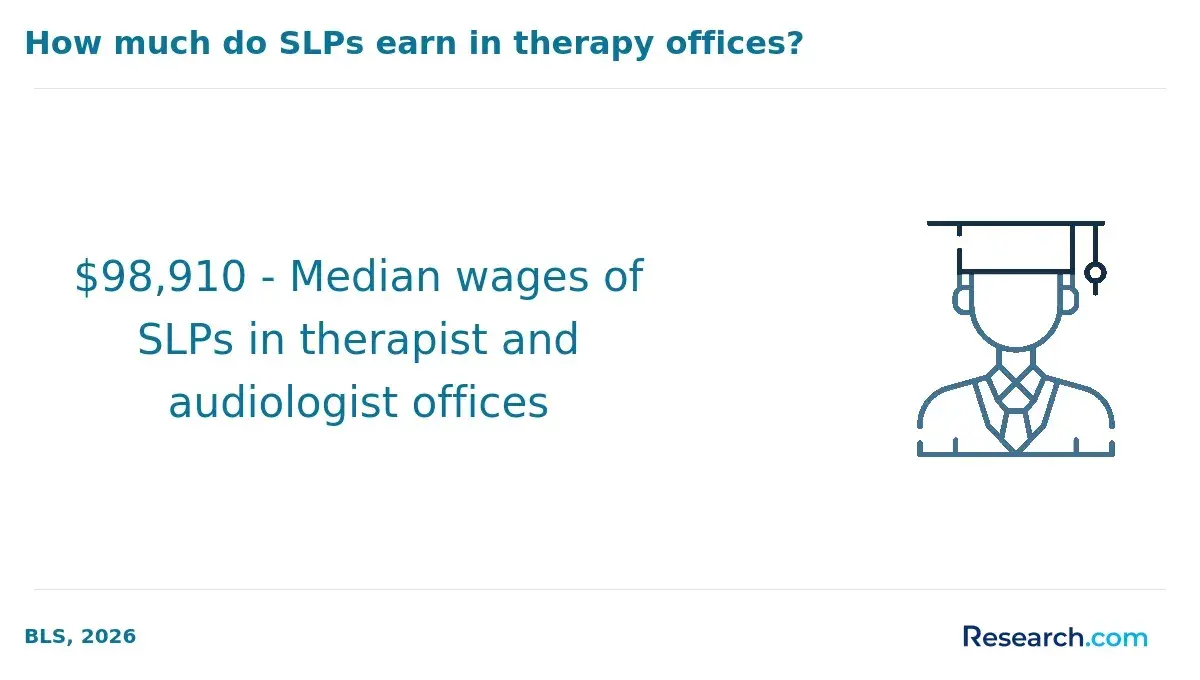
Career earnings can make training quality feel economically urgent. The BLS reported a median annual wage of $97,870 for speech-language pathologists in May 2025. That national median is not a starting salary forecast and varies by setting, location, experience, and work schedule, but it underscores why students should protect the quality of the supervised preparation required to enter the field. Readers can explore setting-related context in this guide to speech and language pathologist salary.
How do programs select, vet, and train off-site SLP clinical supervisors and placement sites?
Strong programs treat affiliation development as an ongoing quality-assurance process. They do not merely collect names of willing clinicians. Before sending students, the program should confirm that the site can provide appropriate services, qualified supervision, adequate workspace and privacy, required records access, and a learning environment consistent with university and accreditation expectations.
A well-managed off-site placement process usually includes formal affiliation agreements, verification of licenses and certifications, supervisor orientation, student readiness review, and periodic evaluation. The program should also monitor whether the site has the capacity to teach. A highly respected clinic may still be a poor student site if its clinicians are too overloaded to observe and coach.
Students can ask whether the program uses the following safeguards and how it documents them.
- Initial and renewal review of supervisor credentials, licensure, experience, and supervision training
- Written affiliation agreements defining responsibility for supervision, evaluation, privacy, safety, liability, and termination of the placement
- Site orientation covering program competencies, evaluation tools, hour tracking, communication expectations, and escalation procedures
- Periodic feedback from students, supervisors, and faculty rather than relying only on end-of-term evaluations
- Removal or remediation procedures when a site repeatedly fails to provide required supervision or a respectful learning environment
Online and distance programs deserve especially close scrutiny because placement coordination can be complex across state lines. Ask whether the program has active affiliations in your region, whether it requires students to help identify a site, and whether it can place students when a local partner declines. Do not assume that a program accepting residents of your state means it can secure every required clinical experience near your home.
Site training should address more than ASHA minimums. Effective supervisors benefit from guidance on culturally responsive feedback, disability accommodations, conflict management, student anxiety, telepractice procedures, documentation standards, and the difference between teaching a student and delegating staff work. Programs that invest in this training are better positioned to identify problems before they affect clients or delay graduation.
Which outcome and evaluation data should SLP students request about past clinical placements?
Programs may not publish every placement metric, and small cohorts can make some data sensitive or unstable. Still, applicants can request aggregate, de-identified information that shows whether the placement system works in practice. If a school cannot provide exact figures, ask for a clear qualitative explanation and examples of how it measures placement success.
The following evidence is more decision-useful than a generic claim that students receive "excellent hands-on experience."
| Data or document to request | Why it matters | Useful follow-up question |
| On-time placement completion information | Shows whether students can begin required rotations without repeated delays | How many students needed a delayed, replacement, or additional placement in the most recent cohorts? |
| Site-type distribution | Reveals whether students receive variety or are concentrated in one setting | Which settings are most available and which are hardest to secure? |
| Typical travel and relocation expectations | Clarifies the practical and financial burden of clinical education | What is the usual travel range, and how often have students needed temporary housing? |
| Supervisor and student evaluation summaries | Shows recurring strengths and problems in the placement network | What themes emerged, and what changes were made as a result? |
| Competency evaluation process | Explains how the program judges readiness rather than merely accumulates hours | Who reviews evaluations and what support follows an unsatisfactory rating? |
| Completion and certification-exam outcomes | Provides broader context about program progression and preparation | Are results reported separately for all students, distance students, and students who needed remediation? |
Interpret outcomes carefully. A high completion rate is encouraging, but it does not prove that every student had a strong mentoring experience. Likewise, an occasional placement change is not automatically a warning sign; clinical sites can close, reorganize, or lose staff. The key issue is whether the program identifies problems early and has a credible backup plan.
Also ask how the program collects student feedback without risking retaliation. Anonymous end-of-term surveys are useful, but mid-placement check-ins and private access to a faculty clinical coordinator are stronger protections because they allow intervention while the experience is still underway.
How do state authorization, institutional accreditation, and ASHA CAA standards protect SLP interns?
These protections address different risks, so students should verify all three. CAA accreditation evaluates whether an academic program meets standards for curriculum, faculty, resources, student outcomes, and clinical education. Institutional accreditation concerns the college or university as a whole. State authorization addresses whether an institution may provide education to students in a particular state, especially relevant for distance learning.
CAA accreditation is particularly important for students seeking the typical pathway toward ASHA certification and state SLP licensure. Enrollment in a program that is not appropriately accredited or in candidacy status can create major barriers to certification, licensure, financial aid, transferability, and employer recognition. Confirm the program's current status directly through official ASHA CAA resources, and ask whether any status change or public disclosure affects enrolled students.
State authorization is not the same as professional licensure eligibility. A university may be authorized to enroll residents of a state while the program's curriculum, practicum model, or disclosures do not fully satisfy that state's professional licensure requirements. This distinction is especially important for online students completing placements outside the university's home state.
Use this checklist before paying an enrollment deposit:
- Verify the program's current CAA accreditation or candidacy status and review any required disclosures.
- Confirm that the institution is authorized to deliver the program to residents of your state.
- Review the program's professional licensure disclosure for the state where you expect to seek initial licensure.
- Contact the relevant state licensing board if the disclosure is unclear, particularly if you expect to move, use telepractice, or work in schools.
- Get written clarification about who coordinates placements and whether clinical experiences can be completed in your state.
Accreditation and authorization reduce risk but do not eliminate the need for personal due diligence. They do not promise a preferred placement, a specific supervisor, a job, or a salary. They do, however, give students formal standards, disclosure expectations, and institutional channels for addressing serious concerns.
What red flags in SLP clinical placements signal potential exploitation, under-supervision, or low quality?
Students are learners, not supplemental labor. Clinical work can be demanding and still be educational, but a placement becomes concerning when service volume consistently displaces observation, instruction, ethical oversight, or access to qualified supervision.
One isolated difficult day is not necessarily a red flag. Repeated patterns, vague answers, missing documentation, and pressure to continue despite safety concerns deserve immediate attention. Watch for the following warning signs.
- You are asked to provide assessment or treatment without a qualified supervisor available as required by program and professional standards.
- Your supervisor rarely observes sessions, does not review documentation, or gives only vague end-of-term feedback.
- You are assigned a full staff-level caseload before demonstrating readiness or are expected to cover services when an employee is absent.
- The site discourages questions, punishes students for reporting concerns, or tells you not to contact the university.
- You cannot identify who is responsible for supervising you on a given day or how your supervision is being documented.
- The site's client assignment creates safety, scope-of-practice, privacy, or cultural-competence concerns that are dismissed rather than addressed.
- The program repeatedly delays your placement but cannot provide a written remediation or contingency plan.
Do not confuse normal performance feedback with mistreatment. Constructive feedback should be specific, timely, connected to learning goals, and accompanied by a chance to improve. In contrast, humiliating comments, retaliation, discriminatory behavior, or demands to falsify records are not valid teaching methods and should be reported promptly.
Before accepting a placement, ask whether students have ever been reassigned and what protections applied to their clinical hours, tuition, graduation timeline, and evaluation record. A transparent program will acknowledge that problems can occur and explain how it protects students and clients when they do.
How should SLP students document concerns and escalate problems with a clinical supervisor or site?
Address urgent client-safety, privacy, discrimination, harassment, or unlicensed-practice concerns immediately through the program's designated emergency or clinical education channels. Do not wait for a routine meeting if a client may be at risk. For nonemergency concerns, document facts early and follow the program's escalation policy.
A factual record is more useful than a narrative built from memory. Keep documentation secure and protect client confidentiality: do not store identifiable health information in personal notes, messages, or unapproved cloud tools.
- Record the date, setting, people present, objective description of the event, supervision available, and steps you took. Do not include unnecessary client identifiers.
- Save relevant nonconfidential communications, schedules, feedback forms, and hour logs according to university policy.
- Review the placement handbook, grievance policy, and chain of command before confronting the issue unless there is an immediate safety concern.
- Raise a specific, lower-level concern with the supervisor when it is safe and appropriate, such as requesting scheduled feedback or clarification of observation expectations.
- Notify the university clinical coordinator or faculty supervisor in writing if the concern persists, affects client care, involves retaliation, or cannot safely be addressed at the site.
- Ask for a written follow-up plan stating who will investigate, what interim supervision will occur, whether hours remain valid, and when you will receive an update.
- Escalate through the university's formal grievance, compliance, Title IX, disability-services, or ethics channels when the issue falls within those areas or is not resolved appropriately.
Keep your communication professional and specific. For example: "On three scheduled treatment sessions, my supervisor was unavailable and no alternate supervisor was identified. I need confirmation of the supervision plan before my next client session." This focuses the program on an observable compliance and learning issue rather than assumptions about intent.
Students should not be penalized for raising good-faith concerns. Still, outcomes depend on institutional policy, the facts, and the urgency of the situation. Ask for confirmation of how a placement change could affect clinical hours, graduation timing, financial aid, and any required remediation. A quality program will prioritize client welfare and student learning over preserving a troubled affiliation.
Other Things You Should Know About Speech Language Pathology
Not necessarily. Even programs designed for distance learners may require travel, temporary relocation, or placement outside a preferred radius when local sites lack capacity, affiliation agreements, or an appropriate supervisor. Ask for the program's written travel expectations and whether it guarantees placement coordination in your state.
Many graduate practicum and externship experiences are unpaid because they are academic requirements. Policies vary by site and state. Students should ask whether any placement is paid, whether payment changes supervision expectations, and how working hours could affect academic progress or financial aid.
It may, when the experience meets program, ASHA, privacy, payer, and applicable state requirements. Confirm how direct observation occurs, how client consent and confidentiality are handled, and whether your intended state of licensure places limits on telepractice training or practice.
No. Placement quality is essential, but compare it with CAA status, state eligibility, total cost, schedule, prerequisite support, graduation outcomes, and career fit. The strongest choice is a program that provides credible placement transparency while also matching your financial and licensure plan.
References
- Clinical Placements - SLP | University of Cincinnati https://www.cahs.uc.edu/academic-programs/graduate-programs/slp/clinical.html
- SLP Work Settings: How to Choose the Right Career Path https://speechpathologymastersprograms.com/speech-pathology-careers/slp-work-settings/
- Calling all Clinical Supervisors: r/slp https://www.reddit.com/r/slp/comments/1m7cpq2/calling_all_clinical_supervisors/