2027 Combined Bachelor's and Master's SLP Programs vs Separate Degrees: Time and Admission Trade-Offs

Co-Founder and Chief Data Scientist

Reviewed by Rhea Paul, PhD
SLP Education & Research Expert
A combined bachelor's-master's speech-language pathology pathway can shorten the route to graduate study, but it can also require an earlier commitment and leave less room to change schools or majors. This guide is for high school students, undergraduates, and career planners deciding whether an integrated 4+1 or five-year route is worth the trade-offs. Learn how program structure, admissions, costs, clinical preparation, accreditation, and outcomes affect the choice between an accelerated pathway and separate degrees.
Key Things You Should Know
- Combined SLP pathways commonly reduce the academic timeline from about six years for separate bachelor's and master's degrees to about five years, but the exact savings depend on summer study, course sequencing, and whether graduate admission is guaranteed.
- Early or reserved graduate admission is not the same as unconditional admission: students may need to meet GPA, prerequisite, conduct, and progression standards before entering the master's phase.
- For clinical SLP practice, the decisive credential is a qualifying graduate degree from a CAA-accredited program, followed by supervised clinical fellowship and state-specific licensing requirements; an accelerated undergraduate route alone does not shorten every postdegree requirement.
How do combined bachelor's and master's SLP programs differ structurally from separate degrees?
Combined SLP pathways integrate undergraduate coursework with a master's-level speech-language pathology curriculum. Schools may call them 4+1, five-year, accelerated, early assurance, dual-degree, or reserved-seat programs. The label matters less than the actual progression rules: some allow students to take graduate classes as seniors, while others award a bachelor's degree after four years and begin a distinct master's cohort in year five.
Separate degrees follow the more flexible sequence: complete a bachelor's degree, satisfy communication sciences and disorders prerequisites, then apply competitively to one or more graduate SLP programs. A student can major in communication sciences and disorders, but may also enter graduate school after another major by completing prerequisite or leveling courses.
The following comparison identifies the structural differences that most affect an applicant's options.
| Decision factor | Combined bachelor's-master's pathway | Separate bachelor's and master's degrees |
| Academic design | Lockstep or partially integrated curriculum with planned graduate progression | Two independently selected degrees, often at different institutions |
| Graduate admission | May offer early assurance, conditional reservation, or an internal application process | Competitive application after undergraduate study |
| Typical duration | Often about five years | Often about four undergraduate years plus two graduate years |
| School choice | Usually commits the student to one institution unless they leave the track | Allows applicants to choose graduate schools based on later goals and offers |
| Course flexibility | Lower, because prerequisites and graduate courses must follow a fixed order | Higher, especially during the undergraduate degree |
| Best fit | Students certain about SLP early and comfortable with the institution's graduate program | Students who need exploration time, want broader graduate-school options, or may change fields |
A combined program is not automatically a "combined degree" in the credentialing sense. Confirm whether students earn two distinct degrees, how many credits double-count, and whether graduate credits remain valid if the student exits before completing the master's degree.
What time savings do accelerated SLP programs offer compared with traditional sequential degrees?
The central advantage is time. A conventional route often takes roughly six academic years: four for a bachelor's degree and two for a clinical master's degree. A well-designed 4+1 or five-year pathway can reduce that to about five years by using summers, heavier course loads, early graduate coursework, or a compressed undergraduate schedule.
That one-year difference can matter because graduate SLP education is required for most clinical practice roles. The Bureau of Labor Statistics projects 17% employment growth for speech-language pathologists from 2025 to 2035, with about 12,500 openings annually on average. Entering the workforce sooner may improve earning timing, but it should not outweigh program quality, affordability, or licensure eligibility.
Applicants should distinguish advertised duration from the time they personally need. This timeline shows where acceleration is usually created.
| Route | Typical academic sequence | Where time may be saved | Common limitation |
| Separate degrees | Four-year bachelor's plus two-year master's | Little built-in acceleration | Graduate admissions cycle may add time if a student is not admitted or lacks prerequisites |
| 4+1 pathway | Four undergraduate years plus one graduate year | Graduate classes, summer terms, or reduced undergraduate electives | Usually requires continuous full-time enrollment and precise sequencing |
| Five-year integrated pathway | Five years in a planned undergraduate-to-graduate curriculum | Shared or advanced coursework and year-round study | May leave limited room for a minor, study abroad, or repeated courses |
| Separate degree with transfer or AP credit | Variable | Undergraduate graduation may occur sooner | Graduate program length and clinical requirements generally remain substantial |
An accelerated SLP master's program can also use a faster schedule, but online delivery does not eliminate required clinical education. Before assuming a five-year timeline, ask whether clinical placements, capstone requirements, and any campus visits fit the stated completion schedule.
Do not count the clinical fellowship as part of the master's degree timeline. For ASHA certification and many state licensing pathways, graduates generally complete a supervised postdegree clinical fellowship after their qualifying graduate program. Acceleration ends when the academic degree ends, not necessarily when independent practice begins.
How do admissions standards and selectivity compare between combined SLP tracks and separate programs?
Combined pathways move selection earlier. Applicants may apply as high school seniors, during their first undergraduate year, or before the junior year. Admission can be selective because the institution is reserving limited graduate capacity, yet the standards may emphasize high school preparation, early college performance, interviews, writing, or evidence of interest rather than the complete undergraduate record used in a traditional graduate application.
Separate graduate admissions occur later and let applicants present a fuller academic and clinical profile. Requirements vary, but graduate programs commonly assess cumulative and prerequisite GPA, foundational CSD coursework, recommendations, a statement of purpose, observation or relevant experience where requested, and program-specific application materials. Some schools use CSDCAS, while others use their own systems.
Early assurance changes when competition occurs; it does not necessarily remove it. Review the exact language in the institutional catalog and admissions agreement.
- Guaranteed admission should state the conditions clearly, including the required GPA, courses, deadlines, and behavior or professionalism standards.
- Reserved or preferred admission may provide an advantage but still require an internal review, interview, available seats, or faculty approval.
- Accelerated eligibility may only permit students to apply early; it may not reserve a graduate seat at all.
A separate-degree applicant can apply broadly and compare offers, costs, clinical placement models, and geographic fit. That flexibility is valuable when a student's grades improve over time, develops a specialty interest, or decides to relocate. Conversely, a student with a strong academic record and clear commitment to one university may value the reduced uncertainty of a conditional internal route.
A common mistake is assuming that a stated minimum GPA is the same as a competitive profile or that internal students cannot be displaced by external applicants. Ask admissions whether internal candidates are evaluated against each other, against the general applicant pool, or against a fixed number of reserved seats.
How does choosing an integrated SLP program affect prerequisites, clinical hours, and ASHA certification timelines?
Integrated programs can simplify prerequisite planning because the undergraduate curriculum is designed to feed directly into graduate study. Students typically complete core communication sciences and disorders content - such as phonetics, speech and hearing science, language development, anatomy and physiology, and research methods - on a prescribed schedule. Separate-degree students can reach the same destination, but those without a CSD major may need postbaccalaureate leveling coursework.
Coursework is only one part of professional preparation. A qualifying graduate program provides the supervised clinical education needed for entry into the profession, and its structure must meet accreditation standards. Undergraduate observation or volunteer experiences can be useful for career exploration, but they are not interchangeable with graduate clinical practicum requirements.
Use this sequence to evaluate whether an accelerated design preserves the milestones needed for certification and licensing.
- Confirm that the graduate SLP program is accredited by the Council on Academic Accreditation in Audiology and Speech-Language Pathology or has an accreditation status appropriate to your enrollment date.
- Verify that the curriculum includes the required academic and clinical components for the credentialing path you intend to pursue.
- Ask how the program assigns, supervises, and documents clinical practicum experiences, including pediatric and adult exposure where available.
- Plan for the Praxis examination, postdegree clinical fellowship, ASHA certification requirements, and the separate rules of the state where you expect to practice.
The American Speech-Language-Hearing Association's Certificate of Clinical Competence and state licensure are related but not identical. State boards set their own rules, and school-based employment can involve additional educator credential requirements. Students considering a speech pathologist online degree should obtain written confirmation about state eligibility, required travel, and placement expectations before enrolling.
The key trade-off is sequencing: a lockstep track reduces the risk of missing a prerequisite but makes a failed or withdrawn course more consequential. Ask whether courses can be repeated, whether an alternate sequence exists, and how a delayed practicum affects graduation.
What are the advantages and trade-offs in financial cost between combined and separate SLP degrees?
A five-year pathway may reduce the number of semesters billed, but it is not automatically less expensive. Total cost depends on institutional tuition, mandatory fees, housing, transportation, summer enrollment, clinical expenses, books, health requirements, and whether undergraduate or graduate tuition applies to shared courses.
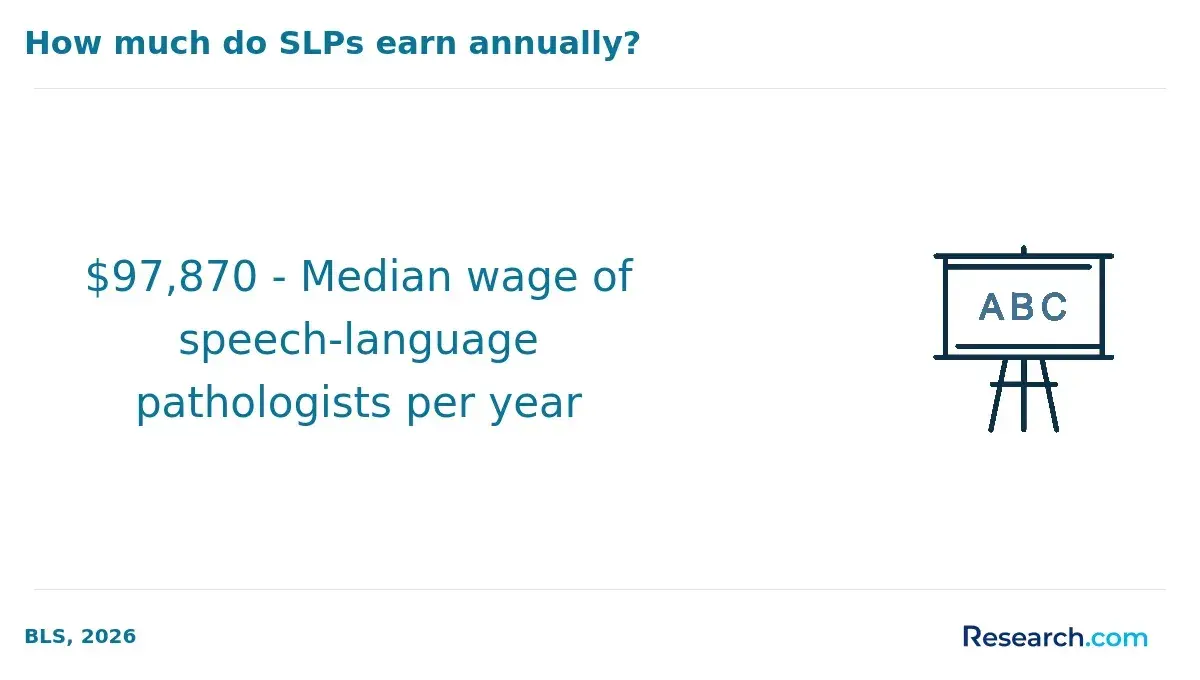
The economic value of finishing sooner is primarily an earlier opportunity to earn professional income, not a guaranteed salary outcome. The Bureau of Labor Statistics reports a May 2025 median annual wage of $97,870 for speech-language pathologists. That national figure varies by setting, experience, location, and hours worked, so use it as labor-market context rather than as a personal earnings forecast.
This comparison helps applicants avoid treating a shorter calendar as proof of a lower-price degree.
| Cost consideration | Combined pathway | Separate degrees |
| Years of tuition | May involve about five years, though graduate-rate tuition can begin early | Often about six years across two programs |
| Ability to compare offers | Limited if progression is tied to one institution | Greater ability to compare graduate aid packages and resident tuition options |
| Scholarship planning | Undergraduate aid may not continue into the graduate year | Can pursue aid separately for each degree and institution |
| Living costs | One fewer year may reduce housing and related expenses if completion stays on schedule | May rise if the graduate program is in a higher-cost location or takes longer |
| Financial risk of changing plans | Potentially higher if specialized credits do not transfer cleanly | Lower institutional lock-in, though leveling courses can add expense |
Request a written, multi-year estimate rather than relying on a single annual tuition figure. It should identify credit counts at undergraduate and graduate rates, anticipated fee changes, summer requirements, insurance, clinical travel, and whether merit awards extend into the master's phase.
Students should also compare debt exposure with realistic borrowing limits and aid availability. A lower tuition rate can be offset by an extra year of living expenses, while an expensive accelerated option can remain difficult to justify if its graduate outcomes and accreditation status do not support the added cost.
How do accreditation, institutional oversight, and program approval work for 4+1 and 5-year SLP routes?
Institutional accreditation and programmatic accreditation answer different questions. Institutional accreditation concerns the college or university as a whole. For a clinical SLP master's degree, applicants should focus especially on programmatic accreditation by ASHA's Council on Academic Accreditation (CAA), because graduation from an appropriately accredited program is central to the usual certification and licensure pathway.
In an integrated route, the undergraduate CSD major itself may not carry CAA accreditation; the graduate professional program is the critical component. However, the undergraduate curriculum must still supply the courses and progression structure the master's phase requires.
Verify these facts directly before accepting a place, particularly when a program is new, expanding, online, or described as accelerated.
- The graduate program's current CAA status and the dates relevant to your anticipated enrollment and graduation.
- Whether students in the accelerated track receive the same graduate degree and clinical education as students in the standard master's route.
- The school's state authorization and professional licensure disclosures for the state where you live and intend to practice.
- Whether the program has written policies for clinical placement availability, background checks, immunizations, travel, and remediation.
Do not rely on broad claims that a school is "accredited" without identifying the accreditor and the specific graduate SLP program. Also, candidacy and initial accreditation statuses can carry enrollment-date implications. Ask the program to explain, in writing, how its status applies to students entering your cohort.
Institutional approval does not override state licensing rules. Graduates moving to another state should contact the destination licensing board early, especially if they expect to work in schools, telepractice, or settings with additional credential requirements.
In what ways do combined SLP programs reshape undergraduate major choice, flexibility, and transfer options?
Combined tracks reward early commitment. Many students major in communication sciences and disorders because it is the cleanest route into an institution's graduate sequence. That can be efficient, but it may narrow electives, double majors, minors, study abroad, or the ability to explore another helping profession.
Separate degrees are usually more forgiving of major choice. Graduate SLP programs often accept applicants from varied academic backgrounds if they complete required prerequisites, although the added leveling work can extend time and cost. This route can be a better fit for students deciding between SLP, education, psychology, linguistics, public health, or another field.
Transfer students should be especially cautious. An accelerated plan may accept general education transfer credit while refusing to substitute core CSD courses because cohort-based sequences depend on exact content and timing. The comparison below highlights the practical consequences.
| Student situation | Combined pathway implication | Separate-degree advantage or limitation |
| Changing majors | May delay progression or cause loss of the reserved graduate seat | Allows more time to pivot, but may require later prerequisites |
| Transferring colleges | Specialized credits may not fit the receiving school's sequence | Can complete a bachelor's elsewhere and apply broadly later |
| Adding a minor or second major | Possible only if course load and sequence permit | Usually easier during a traditional four-year undergraduate degree |
| Considering online study | Must verify program-specific residency and clinical requirements | More options, but each graduate program has its own prerequisites and state restrictions |
Students comparing flexible routes can explore SLP programs online, but "online" should not be treated as synonymous with transferable, self-paced, or available in every state. Clinical placements, live classes, campus visits, and state authorization can materially affect flexibility.
Before transferring or leaving a track, obtain a degree audit and ask which credits apply to the general bachelor's degree, which are graduate-only, and whether any advanced credits can transfer to another institution. This step can prevent a seemingly quick switch from adding unexpected semesters.
How do program completion risks and dismissal policies differ in lockstep SLP tracks versus separate entry?
Lockstep programs concentrate risk because one delayed course, unmet benchmark, or failed clinical requirement can interrupt a tightly sequenced plan. Students may need to pause for a year if a required course is offered only once annually or if a clinical placement cannot be repeated immediately. In contrast, separate-degree students face a later admissions risk but can often change schools or complete prerequisites at another institution.
Progression policies commonly address academic performance, professional conduct, clinical competence, attendance, background-check eligibility, and health or safety requirements. The details vary widely, so applicants should read the graduate handbook rather than relying on verbal assurances.
Before committing, ask the program for direct answers to these completion-risk questions.
- What GPA must students maintain overall, in CSD courses, and in graduate coursework?
- Is a student removed from the accelerated track after one low grade, and can they continue toward a standalone bachelor's degree?
- How many times can a course, practicum, or competency assessment be repeated?
- What happens if a clinical site withdraws, a student cannot meet placement requirements, or a background check limits placement eligibility?
- Can students apply to the standard graduate program or other universities if internal progression is denied?
The strongest safety net is a clear exit plan. A student should know exactly which bachelor's degree they can complete, how long it will take, and whether their transcript will contain transferable credits if they decide that SLP is no longer the right career.
A common red flag is a school that promotes an accelerated timeline but does not publish continuation standards, remediation procedures, or dismissal appeal processes. Predictability matters more than a marketing label when a pathway has little scheduling slack.
How should applicants assess fit using outcome data such as Praxis pass rates and employment in SLP programs?
Outcome data is most useful when it is comparable, current, and interpreted alongside admissions and completion information. Look for a program's published Praxis examination pass rate, on-time completion rate, employment rate, cohort size, and attrition information. These measures can reveal whether a program supports students through graduation and entry into the field, but they should not be read as guarantees for an individual student.
Ask for the reporting period and denominator behind every result. A high pass rate based on a small graduating cohort is informative but less stable than results across several larger cohorts. Likewise, employment data should specify the time frame after graduation and whether roles are in speech-language pathology or a broader category.
The following evidence is particularly useful when comparing an integrated route with separate graduate options.
| Outcome measure | What it can show | Question to ask |
| Praxis pass rate | How graduates performed on a professional examination | Which test period and graduating cohorts are included? |
| Program completion rate | Whether students generally finish within the expected period | Does the rate include students who left the accelerated track before graduate entry? |
| Employment rate | Whether graduates obtain relevant work after graduation | How soon after graduation is employment measured, and what counts as employment? |
| Attrition rate | Whether students leave or are dismissed from the program | Are academic, financial, personal, and clinical-placement reasons separated? |
| Clinical placement information | How the program manages required hands-on training | Who secures sites, how far may students travel, and what support is available? |
Also compare outcomes with your intended setting. A student seeking medical SLP, schools, early intervention, or rural practice should ask about relevant clinical exposure and alumni placement patterns rather than choosing solely on a single examination metric. Current labor demand is favorable, but fit still depends on academic support, placement logistics, affordability, and the state where you intend to work.
Who is best served by combined bachelor's-master's SLP pathways, and who should prefer separate degrees?
A combined pathway is usually best for a student who is confident in pursuing speech-language pathology, has investigated the profession through observation or informed conversations, meets the school's academic benchmarks, and is comfortable with a prescribed full-time schedule. It can be particularly compelling when the institution's graduate program is CAA-accredited, the total five-year cost is transparent, and the student would be happy attending that same graduate program even if other options later become available.
Separate degrees are often the stronger choice for students who are still exploring careers, want to transfer, need part-time or flexible undergraduate study, expect to compare graduate financial aid packages, or may relocate. They also give applicants more time to develop their GPA, relevant experience, and professional interests before choosing a master's program.
Use this final decision check before applying.
- Confirm that you want the clinical SLP path rather than a related field such as audiology, counseling, occupational therapy, special education, or linguistics.
- Compare the full expected cost and calendar for the integrated route against a four-year bachelor's degree plus realistic graduate-school options.
- Read the exact progression, dismissal, course-repeat, and exit policies for the combined track.
- Verify CAA status, clinical placement structure, and licensure compatibility for your intended state.
- Choose the faster route only if it still provides the academic support, flexibility, and professional preparation you need.
For students committed to the field, becoming a speech language pathologist typically requires more than completing a fast degree sequence. The best investment is the route that supports successful graduate preparation, supervised transition into practice, manageable debt, and the type of career flexibility you want over the long term.
Other Things You Should Know About Speech Language Pathology
Yes, many graduate programs accept students with other majors. You will usually need to complete specified prerequisite courses before or during graduate preparation. Review each program's prerequisite list early because requirements and accepted course equivalents vary.
Not necessarily. A five-year pathway may cover the bachelor's and master's degrees, but graduates generally still need to meet examination, clinical fellowship, certification, and state licensing requirements. The exact sequence depends on the state and employer setting.
Usually not. A separate bachelor's degree provides more time to explore related fields and apply to different graduate programs later. A combined route is most valuable when your interest in SLP is well established and the school's progression rules fit your plans.
Ask whether graduate progression is guaranteed or conditional, the GPA and course-grade thresholds, total tuition and fees for all years, CAA accreditation status, clinical placement responsibilities, course-repeat rules, and what bachelor's degree you can complete if you leave the track.
References
- Bachelor's-MS in Speech-Language Pathology https://www.sacredheart.edu/majors--programs/bachelors-master-of-science-in-speech-language-pathology-dual-degree-program/
- FAQs - UW Speech-Language Pathology Master's Degree https://www.speech-pathology-masters.uw.edu/admissions/faqs
- How To Choose an SLP Program: Seven Factors To... https://www.usa.edu/blog/how-to-choose-a-slp-program/
- Accelerated SLP Programs: Get Your Master's in 16-20 Months https://www.speechpathologygraduateprograms.org/blog/accelerated-slp-programs/