2027 Speech Pathology vs Audiology: Education and Career Differences

Co-Founder and Chief Data Scientist

Reviewed by Rhea Paul, PhD
SLP Education & Research Expert
Choosing between speech-language pathology and audiology is a choice between two closely related but distinct careers in communication care. Both professions help people participate more fully in school, work, relationships, and daily life, but they solve different problems: speech-language pathologists focus on speech, language, communication, cognition, voice, fluency, and swallowing, while audiologists focus on hearing, tinnitus, auditory technology, and balance.
The decision matters because the training paths, clinical work, licensure requirements, and work settings are not the same. According to the Bureau of Labor Statistics (BLS), employment for speech-language pathologists is expected to grow 17% from 2025 to 2035, much faster than the average for all occupations. Audiologists are also in high demand due to the aging population and early hearing loss detection in children.
This guide compares speech pathology and audiology side by side so you can understand what each profession does, what education is required, where graduates work, how salaries and job outlook compare, and which path may better match your strengths and career goals.
Key Things You Should Know About Speech Pathology and Audiology
- Both careers require graduate-level education, but audiologists need a Doctor of Audiology (Au.D.) degree, while SLPs typically hold a master’s.
- SLPs often work in schools, hospitals, or private practice, while audiologists specialize in diagnosing and treating hearing and balance disorders.
- As of 2024, the median annual speech and language pathologist salary is around $89,290, while audiologists earn about $87,630
How do speech pathology and audiology differ in focus?
Speech pathology and audiology both support communication, but they begin from different clinical questions. A speech-language pathologist asks, “How can this person communicate, understand, speak, think, swallow, or use language more effectively?” An audiologist asks, “How well can this person hear, process sound, manage hearing technology, or maintain balance?”
Speech-language pathologists, often called SLPs, evaluate and treat communication and swallowing disorders. Their work may involve helping a toddler develop language, supporting a student with a speech sound disorder, helping an adult regain communication after a stroke, or treating swallowing difficulties in a medical setting.
Audiologists evaluate and manage hearing and balance concerns. Their work may include diagnostic hearing tests, hearing aid fittings, cochlear implant support, tinnitus management, and care for patients with dizziness or vestibular disorders.
| Area | Speech-language pathology | Audiology |
| Primary focus | Speech, language, communication, cognition, voice, fluency, and swallowing | Hearing, auditory processing, tinnitus, hearing devices, and balance |
| Core question | Can the person communicate or swallow effectively? | Can the person hear, interpret sound, or maintain balance effectively? |
| Common interventions | Therapy, communication strategies, swallowing treatment, family or caregiver coaching | Diagnostic testing, hearing technology, auditory rehabilitation, tinnitus or balance care |
| Typical collaboration | Teachers, physicians, occupational therapists, psychologists, families, and caregivers | ENT physicians, primary care providers, SLPs, hearing technology specialists, and families |
The simplest distinction is this: SLPs help people use and understand communication; audiologists help people access and manage sound. Many clients need both, especially children with hearing loss, adults with neurological conditions, and older adults whose hearing changes affect communication.
What does each professional do on a daily basis?
Daily work differs because the tools, appointments, and treatment goals differ. SLPs spend much of their time assessing communication or swallowing needs, delivering therapy, documenting progress, and coordinating with families or care teams. Audiologists spend much of their time testing hearing and balance, interpreting results, fitting hearing technology, counseling patients, and providing follow-up care.
Speech-language pathologists:
- Assessment and diagnosis: Evaluate speech sounds, receptive and expressive language, voice, fluency, social communication, cognitive-communication skills, and swallowing.
- Therapy sessions: Build individualized treatment plans and work with clients over time to improve measurable communication or swallowing outcomes.
- Documentation and progress monitoring: Record goals, session results, clinical observations, and changes in performance.
- Collaboration: Work with teachers, physicians, nurses, rehabilitation teams, caregivers, and families so treatment carries over into everyday life.
- Client and caregiver coaching: Teach strategies that clients can use outside the therapy room, such as communication supports, swallowing precautions, or language-building routines.
Audiologists:
- Hearing testing: Use specialized equipment to measure hearing thresholds, speech understanding, middle-ear function, and other aspects of auditory health.
- Device management: Select, fit, program, adjust, and maintain hearing aids or cochlear implant systems based on a patient’s hearing profile and daily needs.
- Balance and tinnitus care: Help patients manage dizziness, vestibular symptoms, or ringing in the ears through evaluation, counseling, referrals, and treatment planning.
- Patient counseling: Explain test results, hearing changes, device expectations, communication strategies, and follow-up needs in clear language.
- Clinical coordination: Refer to or collaborate with ENT physicians, SLPs, educators, and other healthcare professionals when hearing or balance concerns affect broader functioning.
Both roles require strong communication, patience, ethical judgment, and comfort working with people who may be frustrated, anxious, or fatigued. The difference is the clinical rhythm: SLP work is often therapy-intensive and goal-based over repeated sessions, while audiology work is often diagnostic, technology-driven, and follow-up focused.
What are the educational requirements for each career?
The educational paths are one of the clearest differences between speech pathology and audiology. Speech-language pathologists generally need a master’s degree, while audiologists must complete a doctoral degree.
- Speech-language pathologists need a master’s degree in communication sciences and disorders (CSD) or a related field. Many students begin with undergraduate 5-year speech pathology programs, which combine bachelor’s and master’s coursework for a faster route to certification.
- Audiologists must complete a Doctor of Audiology (Au.D.) degree, which typically requires four years of post-bachelor’s study, including supervised clinical hours. Some universities offer accelerated entry-level programs for academically advanced students.
Both routes include science-based coursework, clinical training, and preparation for licensure, but the academic emphasis differs. SLP programs place more weight on language development, speech production, communication disorders, therapy planning, and swallowing. Audiology programs go deeper into auditory anatomy, hearing science, diagnostic testing, amplification, cochlear implants, tinnitus, and vestibular assessment.
| Requirement | Speech-language pathology | Audiology |
| Entry-level professional degree | Master’s degree | Doctor of Audiology (Au.D.) degree |
| Common undergraduate preparation | Communication sciences and disorders, linguistics, psychology, education, or related coursework | Communication sciences and disorders, biology, psychology, physics, hearing science, or related coursework |
| Clinical emphasis | Assessment and therapy for communication and swallowing disorders | Diagnostic testing, hearing technology, auditory rehabilitation, tinnitus, and balance care |
| Best fit for students who prefer | Therapy, language, developmental communication, and rehabilitation | Diagnostics, auditory science, medical collaboration, and technology-based care |
Before enrolling, students should verify that a program supports the credentialing and licensure path for the state where they plan to practice. Admissions requirements, clinical placement options, and state rules can affect how smoothly graduates move from school into supervised practice or employment.
How do training and licensure compare?
Both careers require supervised clinical training and state licensure, but the sequence differs because audiology is a doctoral-level profession and speech-language pathology is typically a master’s-level profession.
SLP graduate students complete at least 400 supervised clinical hours, often through campus clinics, externships, internships, schools, hospitals, rehabilitation facilities, or private practices. After graduation, they complete a Clinical Fellowship Year (CFY) before obtaining full licensure. Many also pursue certification from the American Speech-Language-Hearing Association (ASHA), depending on their career goals and employer expectations.
Audiologists complete extensive supervised practice as part of the Au.D. pathway and pass the Praxis Audiology exam. Licensure requirements vary by state but generally require the Au.D. and ongoing continuing education. Because audiology training involves advanced diagnostic equipment and hearing technology, students should pay close attention to the quality and variety of clinical placements offered by a program.
| Category | Speech-language pathology | Audiology |
| Clinical training level | Graduate clinical practica, externships, or internships during a master’s program | Doctoral-level clinical training during the Au.D. program |
| Supervised hours | At least 400 supervised clinical hours | Extensive supervised practice as part of doctoral preparation |
| Post-graduation step | Clinical Fellowship Year (CFY) | Licensure process after completing Au.D. and exam requirements |
| Exam or certification note | Certification from the American Speech-Language-Hearing Association (ASHA) after required training and clinical practice | Praxis Audiology exam |
| Continuing obligations | State licensure requirements and continuing education | State licensure requirements and continuing education |
A common mistake is choosing a program based only on convenience or cost without checking clinical placement support. In both fields, supervised experience is not optional; it is central to becoming employable and license-ready. Prospective students should ask where clinical placements occur, how they are assigned, what populations students serve, and whether online or hybrid programs provide placement assistance.
Where can SLPs and audiologists work after graduation?
SLPs and audiologists can work in healthcare, education, community, and private practice settings. Their options overlap in hospitals, clinics, and rehabilitation environments, but SLPs are more common in schools and therapy-centered settings, while audiologists are more common in hearing clinics, ENT practices, and diagnostic care.
Speech-language pathologists often find employment in:
- Schools: Supporting children with language delays, speech sound disorders, fluency concerns, social communication needs, and communication challenges that affect learning.
- Hospitals and rehabilitation centers: Helping patients recover communication, cognition, or swallowing skills after stroke, injury, surgery, or illness.
- Private practice and telepractice: Providing individualized therapy in person or through digital platforms. Students comparing cost and flexibility may also research affordable online master’s in speech pathology programs when planning their education.
- Early intervention programs: Working with infants, toddlers, and families during critical developmental years.
- Skilled nursing or long-term care settings: Supporting adults with swallowing, cognition, voice, and communication needs.
Audiologists, meanwhile, work in:
- Clinics and hospitals: Conducting hearing evaluations, counseling patients, and fitting or managing hearing devices.
- ENT practices: Collaborating with physicians to evaluate and treat ear, hearing, tinnitus, and balance-related conditions.
- Private practice: Managing independent hearing care centers and providing long-term device follow-up.
- Pediatric audiology settings: Testing children and supporting families after hearing loss is identified.
- Academic, research, or industry roles: Contributing to hearing science, device development, education, or clinical leadership.
Work setting affects schedule, pay structure, caseload, paperwork, and career growth. School-based SLPs may follow an academic calendar but manage large caseloads and eligibility documentation. Medical SLPs may handle more complex swallowing or neurological cases. Audiologists in private practice may combine clinical care with business responsibilities, while hospital-based audiologists may work more closely with medical teams.
How do client populations and treatment goals differ?
Both professions serve people across the lifespan, but they usually enter a client’s life for different reasons. SLPs focus on functional communication and swallowing outcomes. Audiologists focus on hearing access, sound perception, auditory technology, tinnitus, and balance-related needs.
- Speech Pathology Clients: Children with language delays, students with speech sound or fluency disorders, adults recovering from stroke or brain injury, people with voice disorders, and individuals with swallowing difficulties. Therapy focuses on enhancing communication, comprehension, speech intelligibility, participation, safety, and independence.
- Audiology Clients: Patients with hearing loss, tinnitus, auditory concerns, or balance disorders. Treatment emphasizes accurate diagnosis, sound perception, amplification devices, cochlear implant support, auditory training, tinnitus counseling, and follow-up care.
The treatment timeline can also feel different. SLPs often meet clients repeatedly for therapy over weeks, months, or longer, with progress measured against communication or swallowing goals. Audiologists may see patients for testing, fitting, adjustment, counseling, and periodic follow-up, especially when hearing technology is involved.
| Client need | Likely lead professional | Primary goal |
| A child has difficulty producing certain speech sounds | Speech-language pathologist | Improve speech clarity and intelligibility |
| An adult has trouble hearing conversations | Audiologist | Evaluate hearing and consider treatment or technology options |
| A stroke survivor has trouble finding words | Speech-language pathologist | Rebuild communication strategies and functional language use |
| A patient reports ringing in the ears | Audiologist | Assess tinnitus and develop a management plan |
| A child with hearing loss needs language support | Both may collaborate | Improve hearing access and support communication development |
In multidisciplinary care, the line between the two fields is collaborative rather than competitive. For example, an audiologist may identify and manage a child’s hearing loss, while an SLP supports speech and language development. The best outcomes often come when both professionals share information and align goals.
Which profession offers higher salaries in 2027?
Salary potential depends on setting, region, experience, credentials, and whether the professional works in schools, healthcare, private practice, administration, or specialized care. According to the BLS (2025), speech-language pathologists earn a median annual speech and language pathologist salary of around $97,870. Audiologists have a median salary near $87,500, though specialized or private practice roles can exceed six figures.
| Profession | Median annual salary cited | Factors that can affect earnings |
| Speech-language pathologist | Around $89,290 | Work setting, geographic location, school versus medical employment, specialization, experience, and leadership roles |
| Audiologist | Near $87,500 | Private practice, specialization, hearing technology services, clinical leadership, geography, and experience |
The salary difference should not be the only deciding factor. A higher-paying role may require a more demanding setting, more documentation, business responsibilities, or a schedule that does not fit your lifestyle. For example, school-based SLP roles may appeal to professionals who value working with children and an academic calendar, while private practice audiology may appeal to professionals who enjoy technology, patient relationships, and business operations.
Geography also plays a role: metropolitan areas and healthcare facilities tend to offer higher pay than schools or outpatient centers. Advanced certifications or leadership positions—such as clinic directors or rehabilitation coordinators—can further raise earnings for both SLPs and audiologists.
What does the job outlook look like for both careers?
Employment prospects are strong across both disciplines. The BLS projects a 17% growth in SLP employment from 2025 to 2035, driven by aging populations, early childhood interventions, and telehealth expansion. Audiology jobs are expected to grow 10% over the same period, fueled by rising awareness of hearing loss and advancements in hearing aid technology.
Several long-term trends support demand in both fields. More children are being identified earlier for communication or hearing needs. Older adults are living longer and may need support for hearing loss, swallowing, cognition, or neurological recovery. Schools continue to need SLPs for students with communication-related educational needs, while healthcare systems and clinics need professionals who can diagnose, treat, counsel, and coordinate care.
| Profession | Projected employment growth | Demand drivers |
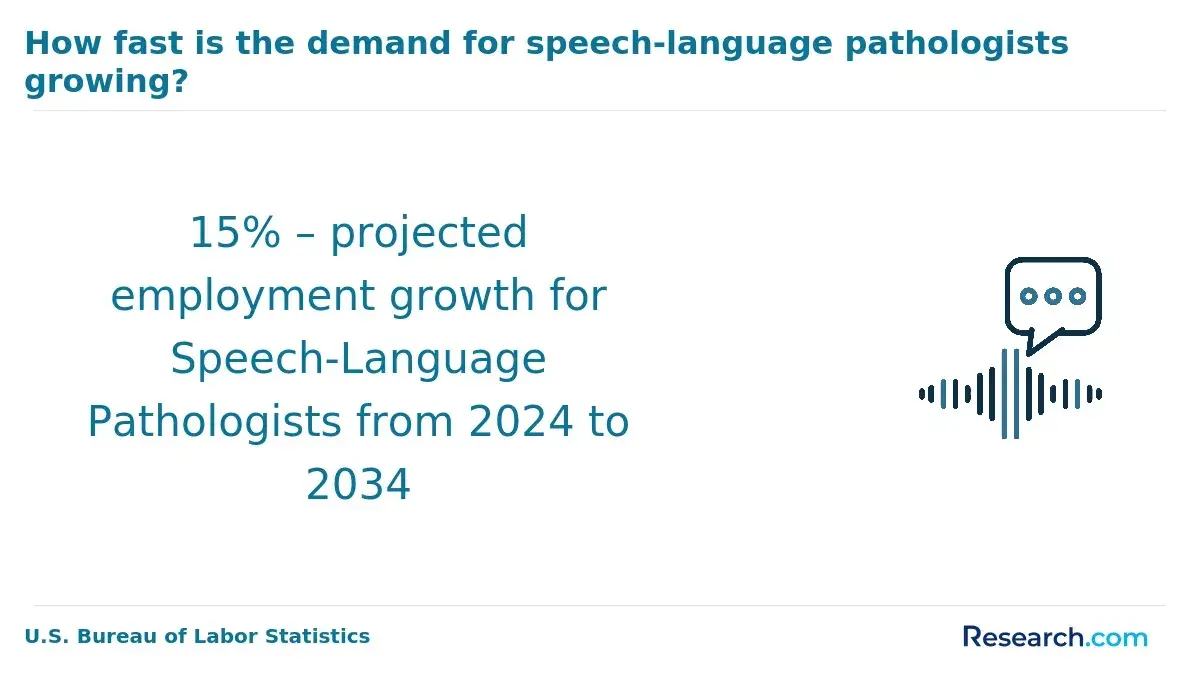
| Speech-language pathologist | 15% from 2024 to 2034 | Aging populations, early childhood interventions, school needs, rehabilitation demand, and telehealth expansion |
| Audiologist | 10% over the same period | Aging population, hearing loss awareness, pediatric detection, tinnitus and balance needs, and hearing aid technology advances |
Telepractice and digital diagnostic tools are also changing how care is delivered, although not every service can be performed remotely and state rules may apply. Graduates from accredited programs—particularly those comparing flexible options such as the easiest SLP master’s programs to get into—should still evaluate program quality, clinical placement support, licensure alignment, and outcomes rather than admissions accessibility alone.
Which career path best fits your personality and skills?
Your best fit depends less on which profession sounds more prestigious and more on the type of problem-solving you want to do every day. Speech pathology may suit you if you enjoy therapy, language, coaching, and watching gradual progress. Audiology may suit you if you enjoy diagnostics, technology, data interpretation, and helping patients use devices or treatment strategies effectively.
Choose speech pathology if you:
- Enjoy language and human connection. You find meaning in helping others express themselves, from teaching a child to say their first words to helping a stroke survivor regain speech.
- Value empathy and patience. SLPs often guide clients through long, emotional progressions—celebrating small wins that lead to life-changing breakthroughs.
- Thrive in educational and therapeutic settings. You may work closely with teachers, families, or medical staff to design interventions that improve communication outcomes.
- Like building skills over time. Many SLP goals require repeated practice, careful cueing, progress tracking, and adjustment when a strategy is not working.
- Can handle documentation and caseload management. SLPs often balance therapy time with reports, treatment plans, progress notes, meetings, and eligibility requirements.
Choose audiology if you:
- Prefer technology and problem-solving. You enjoy working with diagnostic equipment, hearing aids, and cochlear implant systems to restore sound perception.
- Excel in analytical precision. Audiologists rely on testing data and calibration accuracy to make informed clinical decisions.
- Enjoy long-term care relationships. Hearing management often involves ongoing follow-up and technological adjustment, allowing you to build deep patient trust.
- Are comfortable explaining technical information. Patients often need help understanding test results, device options, realistic expectations, and communication strategies.
- Like a clinical workflow that blends science and counseling. Audiology requires both precise measurement and patient-centered guidance.
| If you prefer... | Consider... |
| Language, therapy, developmental communication, and rehabilitation | Speech-language pathology |
| Hearing science, diagnostics, devices, and auditory technology | Audiology |
| Working often with children in schools or early intervention | Speech-language pathology |
| Working often with hearing loss, tinnitus, or balance concerns | Audiology |
| Repeated therapy sessions focused on communication goals | Speech-language pathology |
| Testing, fitting, counseling, and follow-up care | Audiology |
Both paths require compassion, scientific curiosity, cultural awareness, ethical practice, and lifelong learning. The practical difference is focus: SLPs use therapy and communication strategies to improve participation, while audiologists use hearing science and technology to improve access to sound.
How can you decide which path aligns with your goals?
To decide between speech pathology and audiology, compare the work you want to do, the degree you are willing to complete, the populations you want to serve, and the settings where you can see yourself long term. Both careers are meaningful, but they require different training investments and lead to different daily responsibilities.
Ask yourself these key questions:
- Do I want to work on improving communication or restoring hearing? If you are motivated by helping people express thoughts, emotions, identity, and needs, speech pathology may be a stronger fit. If you are fascinated by how the ear perceives sound and want to improve auditory access, audiology may be the better path.
- Am I drawn to therapy or diagnostics? Speech-language pathologists guide clients through structured therapy to achieve measurable progress. Audiologists perform diagnostic tests, interpret hearing data, and fine-tune hearing technology with scientific precision.
- Do I prefer working with children, adults, or both? SLPs often support children developing language or adults recovering communication skills, while audiologists typically see a higher proportion of adults and older clients managing hearing loss.
- How much graduate education am I prepared to complete? Speech-language pathology generally requires a master’s degree, while audiology requires the Doctor of Audiology (Au.D.) degree.
- Which work setting fits my lifestyle? Schools, hospitals, rehabilitation centers, private practices, ENT clinics, and telepractice environments can differ significantly in schedule, caseload, documentation, and pace.
- What kind of progress feels rewarding to me? SLP progress may appear through improved speech clarity, language use, swallowing safety, or communication confidence. Audiology progress may appear through better hearing access, improved device use, reduced listening strain, or stronger patient understanding of hearing needs.
A practical next step is to observe both professions before committing. Shadow an SLP and an audiologist if possible, review graduate program curricula, speak with current students, and compare licensure requirements in the state where you plan to work. If you are still early in college, courses in communication sciences and disorders, anatomy, psychology, linguistics, biology, or hearing science can help you test your interests.
Either path can lead to a stable, service-oriented healthcare career. Choose speech pathology if you want to help people build communication and swallowing skills through therapy. Choose audiology if you want to diagnose and manage hearing, tinnitus, technology, and balance-related concerns. The better choice is the one that matches the problems you want to solve every day.
Other Things You Should Know About Speech Pathology and Audiology
Most U.S. master’s programs in speech-language pathology require the GRE only if a school still lists it, while audiology doctoral programs may also waive it. Admissions committees usually require a bachelor’s degree, minimum GPA near 3.0, and prerequisite science or communication coursework.
Yes. Professionals with an SLP background can pursue an Au.D. if they meet prerequisites. The transition often involves additional coursework in auditory physiology and clinical audiology practice.
In 2027, both speech pathology and audiology offer online education options, particularly for foundational coursework. Many programs now incorporate hybrid models, combining online classes with in-person clinical experiences, providing flexibility while ensuring essential hands-on training.
Audiology programs typically require a clinical residency, often lasting a year, whereas speech pathology students must complete supervised clinical practice during their graduate studies. Both programs involve hands-on experience to meet credentialing requirements by professional bodies in 2027.
References
- U.S. Bureau of Labor Statistics - Speech-Language Pathologists https://www.bls.gov/ooh/healthcare/speech-language-pathologists.htm
- ASHA EdFind - Accredited Speech-Language Pathology Programs https://find.asha.org/ed/
- ETS Praxis - Speech-Language Pathology (5331) https://praxis.ets.org/test/speech-language-pathology-5331.html
- California State University-Northridge - Master of Science in Communicative Disorders (Online) https://tsengcollege.csun.edu/programs/CDS
- University of Wisconsin-Eau Claire - Master of Science in Speech-Language Pathology (Online) https://www.uwec.edu/speech-language-and-hearing-sciences-department/graduate-program/speech-language-pathology-online
- New England Institute of Technology - Master of Science in Speech Language Pathology https://www.neit.edu/academics/graduate-degrees/speech-language-pathology-ms
- Abilene Christian University - Master of Science in Speech-Language Pathology (Online) https://acu.edu/academics/graduate/master-of-science-in-speech-language-pathology/
- California State University-San Marcos - Online MS in Speech-Language Pathology https://www.csusm.edu/slp/programs/mastersonline/index.html