An online counseling degree can make graduate study possible without relocating, but the wrong program may leave you short of Pennsylvania's licensure requirements. This guide is for prospective students and working professionals comparing marriage, couple, and family counseling programs. It explains credentials, clinical training, costs, timelines, and career prospects so you can judge whether the investment fits your goal. It also features the 2027 Best Online Marriage, Couple, And Family Counseling Degree Programs Ranking in Pennsylvania, created by the Research.com team of data scientists to help students make an informed choice about programs worth considering.
Key findings about online Marriage, Couple, and Family Counseling degrees in Pennsylvania
Start with the intended credential: Pennsylvania licenses marriage and family therapists and professional counselors under distinct requirements, so verify the degree, coursework, and supervised-training pathway before enrolling.
A clinical counseling master's commonly takes about 2-3 years of full-time study; part-time enrollment can take longer, and online students still need supervised, in-person clinical experience.
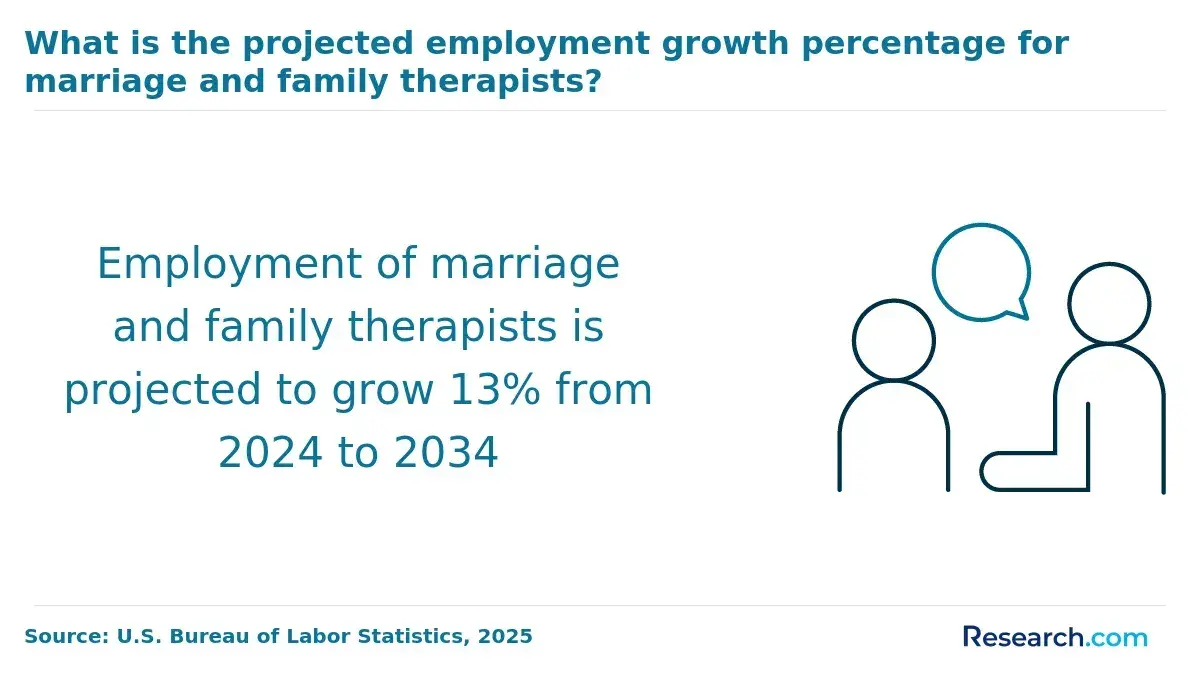
The U.S. median annual wage for marriage and family therapists was $66,940 in May 2025, with employment projected to grow 14% from 2025 to 2035 (U.S. Bureau of Labor Statistics). Neither figure predicts a Pennsylvania graduate's pay or job offer.
What can I expect from an online Marriage, Couple, and Family Counseling degree in Pennsylvania?
Marriage, couple, and family counseling focuses on relationships and family systems: how a person's difficulties interact with partners, caregivers, and other close relationships. An online program typically delivers lectures and coursework remotely, while requiring live skills practice and supervised clinical work. The degree does not itself confer a license.
Program titles matter less than their documented pathway. A marriage-and-family-focused counseling track may be designed for professional counselor licensure, while a marriage and family therapy degree may target the licensed marriage and family therapist (LMFT) credential. Pennsylvania's State Board of Social Workers, Marriage and Family Therapists and Professional Counselors regulates both LMFT and licensed professional counselor (LPC) pathways. Ask which credential the school intends its curriculum to support and request a requirement-by-requirement explanation.
This path suits applicants who want to provide relationship-focused clinical care and can make time for supervised training. Someone seeking only general advice-giving skills, or a credential that requires no clinical placement or post-degree supervision, should consider a different educational path.
Where can I work with an online Marriage, Couple, and Family Counseling degree in Pennsylvania?
Depending on licensure and employer requirements, relationship-focused clinicians may work in community mental health agencies, hospitals and health systems, group practices, family-service organizations, or private practice. Pennsylvania's large health systems and urban service networks can offer different placement options from smaller communities, where finding a qualified supervisor may take more planning. That distinction matters while choosing an online program: a remote classroom does not supply a local placement automatically.
Before committing, ask whether the school has previously approved clinical sites near your home, who finds and approves supervisors, and whether you may change sites if a placement closes. Employment settings and permitted activities depend on your credential and stage of licensure, not simply the degree title (Pennsylvania State Board of Social Workers, Marriage and Family Therapists and Professional Counselors).
The U.S. Bureau of Labor Statistics reports a $66,940 national median annual wage for marriage and family therapists in May 2025. This is an occupational figure, not a starting salary, a Pennsylvania-specific wage, or an earnings outcome for a particular school. An LPC working in another counseling occupation may be represented by a different BLS category.
For an investment decision, compare potential earnings with what you make now, expected debt payments, time spent in school, and the period of supervised work before independent practice. Ask programs for recent, program-specific employment information; do not treat the national median as a promised return.
These two Pennsylvania options are worth comparing by their documented degree and track structure, not by assuming that every graduate counseling program leads to the same license. Confirm the current catalog, delivery requirements, and Pennsylvania licensure alignment directly with each school.
Geneva College: Geneva presents its option through a broader graduate counseling program rather than a page devoted solely to marriage, couple, and family counseling (Geneva College). This may suit someone comparing relationship-focused study with other counseling directions; ask the program to identify the exact degree and track on your transcript and how that curriculum maps to the Pennsylvania credential you want.
Messiah University: Messiah identifies marriage, couple, and family counseling as a specific graduate program (Messiah University). That clearer program identity can help an applicant seeking a relationship-focused curriculum, but the name alone does not establish LMFT eligibility; request written confirmation of the intended license, required clinical experiences, and any campus attendance.
Neither a broad counseling label nor a specialized one substitutes for a course-by-course licensure check. In particular, distinguish CACREP accreditation of a counseling program from any other programmatic accreditation or state approval relevant to the credential you intend to pursue (Council for Accreditation of Counseling and Related Educational Programs; Pennsylvania State Board of Social Workers, Marriage and Family Therapists and Professional Counselors).
Plan on roughly 2-3 years of full-time study for a clinical counseling master's, or longer if you enroll part time. Your actual schedule depends on course sequencing, clinical-site availability, and whether a program offers summer terms. Post-degree supervised experience and examinations add time before independent licensure; they are not part of the advertised degree-completion timeline.
An accelerated calendar is worthwhile only if you can complete its clinical requirements without reducing work to an unsustainable level. Compare the fastest marriage, couple, and family counseling programs by asking for a term-by-term plan that includes placement start dates - not just coursework end dates.
Online study changes where you take academic courses, not whether you must demonstrate clinical skills or complete supervised practice. For someone outside a major campus area, it may reduce commuting or relocation costs; for someone who needs predictable access to training sites and face-to-face faculty support, a campus-based option may be easier to coordinate.
Compare formats on required live class times, any in-person intensives, placement support, and the location of clinical training. A program advertised as online can still require travel. Most importantly, confirm that its specific curriculum and placements can support the Pennsylvania license you seek, rather than assuming delivery format determines eligibility (Pennsylvania State Board of Social Workers, Marriage and Family Therapists and Professional Counselors).
There is no single useful statewide average for this narrowly defined online graduate pathway: institutions set different per-credit charges, fees, and clinical-training requirements. A quoted tuition rate is therefore not the total price of becoming licensed. Graduate tuition figures from NCES/IPEDS can provide institutional context, but they may combine programs with different credit requirements and do not measure this pathway's full cost.
Request each school's written estimate for the entire degree, including required credits, mandatory fees, books, travel for any campus visits, and likely placement-related expenses. Check whether a public institution applies different resident and nonresident rates to its online graduate students; do not assume online enrollment removes residency rules. The most affordable marriage, couple, and family counseling programs can help build a shortlist, but compare complete budgets rather than tuition alone.
Eligible graduate students may use federal Direct Unsubsidized Loans; schools may also offer assistantships, scholarships, or payment plans. Federal eligibility depends on factors including the student, institution, and program, so confirm your options through the school's aid office and Federal Student Aid. Do not assume an undergraduate state grant will fund a graduate counseling degree; check Pennsylvania Higher Education Assistance Agency rules for the particular award.
Submit the FAFSA, obtain each school's aid offer, and compare net borrowing after grants or employer assistance. Ask when clinical hours could limit paid work. That opportunity cost may outweigh a modest tuition difference, particularly for a student changing careers.
View the chart data as a table
Projected job growth 2025-2035 - Marriage & Family Therapists (U.S.) (Source: BLS)
Category
Value
Marriage & Family Therapists
14
All occupations
3
Applicants generally need a bachelor's degree; individual programs set their own transcript, recommendation, statement, interview, and prerequisite-course requirements (Geneva College; Messiah University). A psychology major may be helpful but should not be assumed mandatory. Clinical placements can introduce additional screening or documentation requirements.
If you are changing fields, send an unofficial transcript to admissions and ask which prerequisites, if any, remain. Also ask whether prior graduate coursework can transfer and whether accepted credits replace courses required for licensure. An apparently easy admission process is not a substitute for checking clinical-placement access and credential fit; use the easiest marriage, couple, and family counseling programs as an admissions comparison, not a measure of licensing readiness.
Expect study in counseling theories, assessment, ethics, human development, research, and supervised clinical practice, alongside relationship-focused subjects such as family systems and couple counseling. Exact course titles and required clinical hours vary by program. Pennsylvania licensure decisions depend on the applicable education and experience rules, not on whether a brochure uses familiar course names (Pennsylvania State Board of Social Workers, Marriage and Family Therapists and Professional Counselors).
Request the current degree audit and syllabi for courses that the school says satisfy licensure requirements. If you might seek licensure outside Pennsylvania, check that state's board separately before choosing electives or a placement.
Some programs offer a distinct marriage, couple, and family counseling track; others place family-systems courses within a broader clinical counseling degree. Electives or clinical placements may provide additional focus on topics such as children and families, trauma, or substance use, but availability depends on the school and its approved sites.
Choose a specialization by working backward from the intended credential and clients. A named track is useful when its required courses and placements match your goal; a flexible general counseling degree may be preferable if you are still deciding among clinical settings. Neither arrangement should be assumed to qualify you for an additional license.
The best fit is the program that offers a viable route to your intended work at a cost and pace you can sustain. Use the ranking to narrow options, then verify these decision-critical details with admissions, the clinical-placement office, and the relevant licensing board:
Name the intended credential - LMFT, LPC, or another role - and ask the school for a written explanation of how its curriculum addresses Pennsylvania's requirements.
Check institutional accreditation and the current status and scope of any claimed programmatic accreditation with the accreditor; do not assume accreditation by one body is identical to approval for every license.
Ask who secures and approves placements near you, what happens if a site falls through, and whether online students must visit campus.
Compare full degree cost, likely borrowing, completion time, forgone earnings, and any available program-specific outcomes over a realistic repayment horizon.
A common mistake is to rank schools by sticker price alone. The most valuable marriage, couple, and family counseling programs offer another comparison lens, but personal return on investment also depends on aid, completion probability, existing earnings, future earnings, and when those costs and benefits occur.
View the chart data as a table
Best score by program (Source: Research.com)
Category
Value
Messiah University
91.26
Geneva College
92.66
A relationship-focused graduate degree can be a step toward LMFT or LPC practice when the program and subsequent training satisfy the relevant Pennsylvania requirements. Graduates may also pursue supervised clinical roles before independent licensure or work in family-service settings where duties do not require an independent clinical license. Employers and the state board determine what a person may do at each stage (Pennsylvania State Board of Social Workers, Marriage and Family Therapists and Professional Counselors).
If your goal is independent couples or family therapy, investigate the complete credential pathway before enrolling: qualifying education, supervised experience, examination, and application are separate steps. If you want a nonclinical support role, compare its actual job requirements with the time and expense of a clinical master's; the degree may be more training than that goal requires.
View the chart data as a table
Wage range - Marriage & Family Therapists in Pennsylvania (BLS OEWS, May 2025) (Source: BLS)
Category
Value
10th percentile
47,050
25th percentile
56,120
Median
66,040
75th percentile
80,200
90th percentile
91,980
The U.S. Bureau of Labor Statistics projects 14% growth in marriage and family therapist employment from 2025 to 2035. This national projection signals demand for the occupation, but it is not a Pennsylvania forecast or a measure of openings for new graduates. Local hiring will also depend on credential, supervised-experience status, and the services an employer provides.
Test the market where you plan to live: review current postings for LMFTs, LPCs, and supervised clinicians, noting required licenses and whether employers provide supervision. Do this before selecting a placement. A site that builds relevant skills and professional contacts may be more useful than a convenient site unrelated to the roles you ultimately want.
2027 Best Online Marriage, Couple, And Family Counseling Degree Programs Ranking in Pennsylvania
Investing in graduate education is a consequential decision. Research.com's team designed the ranking to help readers compare programs using documented outcomes, accreditation, and cost rather than promotional claims. The team draws on multiple education datasets and applies the same scoring approach to online and on-campus programs.
The Best ranking first combines program completion (40%), employment or doctoral admission (20%), applicable licensure exam pass rates (20%), CACREP programmatic accreditation (16%), and institutional Title IV eligibility (4%). Weights are adjusted when a criterion does not apply. Program cost then contributes about 7% of the final score. Other Research.com rankings order programs by the individual dimension named in their titles.
These sources were used to create the ranking; readers can also consult them when checking a school's claims:
IPEDS database - institutional enrollment, completion, and cost data.
A ranking can narrow a search, but it cannot establish that a particular curriculum meets every licensure requirement or that a student can secure a local clinical placement. Use it as a starting point, then confirm those details with the program and Pennsylvania licensing board. Read more about Research.com's methodology.
# 1 position
Geneva College
Master
M.A. in Counseling - Marriage, Couple, and Family Counseling
Delivery mode: hybrid
92.66
/ 100
Final score
Program length
two years for a full-time student
Specialization
Marriage, Couple, and Family Counseling
Required credits
60 semester credits
GPA range
3.00 - 4.00
Application process
direct
GRE
no
Prerequisites
Bachelor's degree with GPA of 3.0+ expected (provisional admission possible below 3.0); basic statistics competency via CNS 504, an approved statistics course (B- or better within 5 years), or 80%+ on a statistics exam.
Additional requirements
Official transcripts from all colleges/universities attended, a typed academic essay describing career goals and reasons for applying, three professional recommendations, and a resume
Accreditation
Accredited by the Council for Accreditation of Counseling and Related Educational Programs (CACREP), with institutional accreditation from the Middle States Commission on Higher Education (MSCHE).
Geneva College earned a Research.com Counseling Program Score of 92.66/100. The program is CACREP-accredited, valid through 2033-04-30.
# 2 position
Messiah University
Master
M.A. in Counseling – Marriage, Couple and Family Counseling
Delivery mode: online
91.26
/ 100
Final score
Program length
2-year completion
Specialization
Marriage, Couple, and Family Counseling
Required credits
60 semester credits
GPA range
3.00 - 4.00
Program completion rate
72.6% (2024-25)
Employment or doctoral admission
100% (2024-25)
Licensure exam pass rate
100% (2024-25)
Application deadline
rolling
Application process
direct
Prerequisites
At least 6 credits in social, behavioral, applied, or life sciences courses (e.g., psychology, sociology, social work) with a grade of C or higher
Additional requirements
Messiah application; official transcripts; cumulative GPA 3.0 or higher (below 3.0 reviewed case by case); 300–500 word statement of purpose; one reference contact; resume/CV; interview with faculty via Zoom
Accreditation
Accredited by the Council for Accreditation of Counseling and Related Educational Programs (CACREP), with institutional accreditation from the Middle States Commission on Higher Education (MSCHE).
Messiah University earned a Research.com Counseling Program Score of 91.26/100, supported by 100% licensure exam pass rate and 72.6% program completion rate. The program is CACREP-accredited, valid through 2028-10-31.
Frequently asked questions about online Marriage, Couple, and Family Counseling degree in Pennsylvania
Can I become a therapist with an online degree?
Potentially. Pennsylvania evaluates the applicable education, supervised experience, examination, and other licensing requirements; online delivery alone does not grant or rule out a license. Confirm the specific program's fit with the state board.
Is marriage and family counseling the same as marriage and family therapy?
Not necessarily. Program names vary, while Pennsylvania's LMFT and LPC licenses have distinct requirements. Ask which license a program is designed to support.
Can I complete all clinical training online?
Do not assume so. Online coursework commonly sits alongside supervised clinical experience at an approved site. Ask where you can complete training and whether any campus visits are required.
How long will it take to become independently licensed?
The degree commonly takes about 2-3 years full time, but independent licensure also requires post-degree steps. Ask the school and Pennsylvania board for the current requirements relevant to your intended credential.
Is this degree worth it if I already work in human services?
It may be if clinical licensure is necessary for the work you want. Compare total cost, reduced work hours, borrowing, and likely career options against remaining in your current role or pursuing a different credential.
See What Experts Have To Say About Studying Counseling
CACREP - Directory of Accredited Programs Used to verify CACREP accreditation status of specific programs. https://www.cacrep.org/directory/
Counseling Compact - Participating States Verified professional/licensure/career reference. https://counselingcompact.org/
Geneva College - M.A. in Counseling - Marriage, Couple, and Family Counseling Official program page (curriculum, tuition, admissions). https://www.geneva.edu/graduate/counseling/