Choosing a marriage and family counseling degree in Tennessee means looking beyond a school's name: the program must fit your budget, clinical training needs, and intended license. This guide explains those trade-offs for prospective students and working professionals. It also features the 2027 Best Marriage, Couple, And Family Counseling Degree Programs Ranking in Tennessee, created by the Research.com team of data scientists to help students make an informed choice about programs worth considering. Use the ranking alongside the practical checks below to build a shortlist you can trust.
Key findings about Marriage, Couple, and Family Counseling degrees in Tennessee
For Tennessee licensure as a licensed marital and family therapist, choose a graduate program for its documented fit with state education and clinical-training requirements - not its ranking position alone (Tennessee Board for Licensed Professional Counselors, Licensed Marital and Family Therapists and Licensed Clinical Pastoral Therapists).
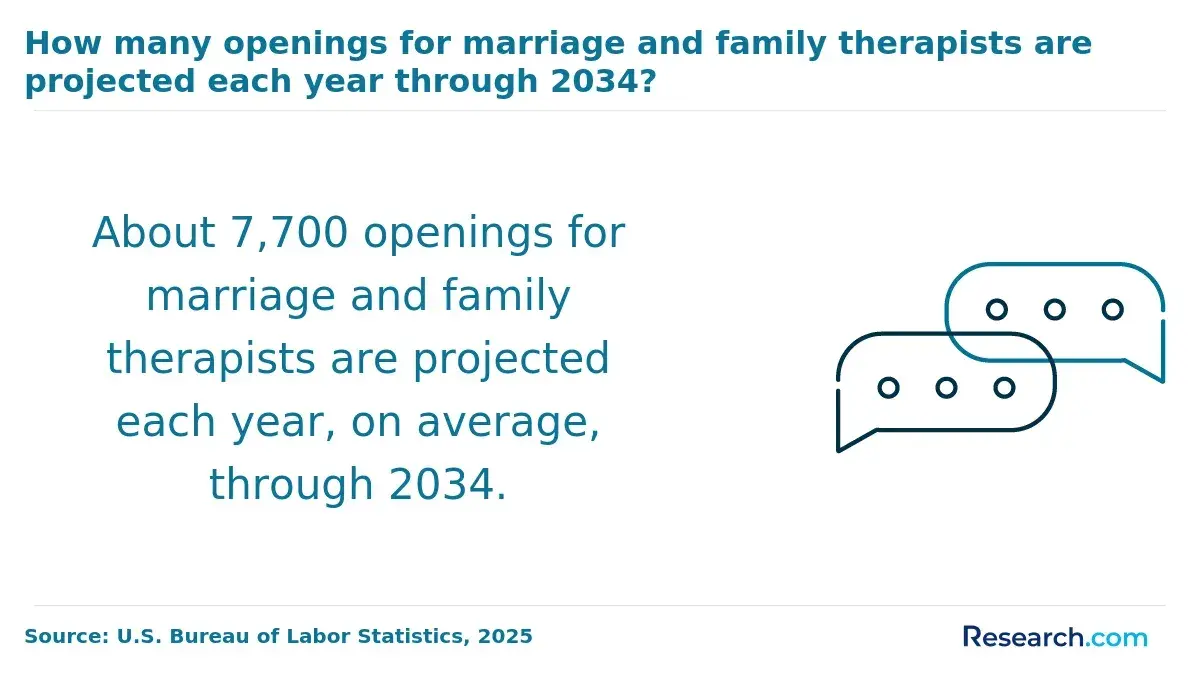
The U.S. median annual wage for marriage and family therapists was $66,940 in May 2025; national employment is projected to grow 14% from 2025 to 2035. Neither figure predicts an individual graduate's Tennessee earnings or job offer (U.S. Bureau of Labor Statistics).
Compare total tuition, fees, clinical-placement logistics, and time away from work before deciding that a faster or lower-priced program is the better investment.
What can I expect from a Marriage, Couple, and Family Counseling degree in Tennessee?
Marriage, couple, and family counseling studies how relationships and family systems affect well-being. Students learn assessment, ethics, treatment planning, and approaches to working with individuals, couples, and families. If your goal is independent clinical practice in Tennessee, focus on a master's-level pathway that can satisfy the state's licensed marital and family therapist, or LMFT, education requirements. A bachelor's degree can prepare you to apply for graduate study, but it is not the clinical credential itself (Tennessee licensing board).
Program labels are not interchangeable. The comparison below shows why the credential and curriculum matter more than a broad subject match.
Option
Best fit
Check before applying
Marriage and family therapy master's
Students targeting LMFT practice
State-required coursework and supervised clinical training
Counseling master's with a couples or family emphasis
Students who may prefer a professional counseling pathway
Which license the full degree - not just the emphasis - supports
Certificate or continuing education
Already-qualified professionals adding skills
Whether it changes any licensing eligibility; do not assume it does
A popularity ranking can show which programs attract attention, but it cannot answer the licensing question. Use the most popular marriage, couple, and family counseling programs as a discovery tool, then examine each degree's current catalog and clinical requirements.
Where can I work with a Marriage, Couple, and Family Counseling degree in Tennessee?
Depending on credentials and employer requirements, graduates may pursue roles in behavioral-health agencies, hospitals, community organizations, group practices, or private practice. Work involving independent diagnosis and treatment requires the appropriate state license; holding a degree alone does not confer it (Tennessee licensing board).
Location affects training as well as employment. Ask a Nashville-area program where students complete clinical placements, and ask the same question of an online program if you intend to train in a smaller Tennessee community. A placement near home may make a program workable while you remain employed; an unconfirmed placement can delay graduation even when coursework is remote.
The national median annual wage for marriage and family therapists was $66,940 in May 2025, according to the U.S. Bureau of Labor Statistics. This occupational median is a benchmark, not a Tennessee starting salary or a forecast for someone who has not yet obtained licensure. Pay can differ by setting, experience, hours worked, and whether a clinician is an employee or operates a practice.
For a personal return-on-investment estimate, compare the cost of attendance and expected borrowing with your current earnings and the earnings of jobs you could realistically pursue after graduation. Include the time and expense of supervised post-degree practice. A national median by itself cannot establish whether a particular program will pay off for you.
Trevecca Nazarene University and Belmont University give applicants different starting points for evaluating fit. Their program materials are most useful when read against your preferred training environment and Tennessee's licensing requirements, rather than treated as proof of a licensing outcome.
Trevecca Nazarene University: Trevecca presents its marriage and family program within a Christian university setting, making its educational approach a substantive consideration for applicants who want to examine how faith and clinical preparation intersect. Ask the program how that approach appears in coursework and supervision, and request its current degree plan and clinical-placement policies before deciding whether it fits your practice goals (Trevecca Nazarene University).
Belmont University: Belmont's academic catalog provides a formal program record that applicants can use to check the required curriculum rather than relying on a brief description of couples-and-family interests. For a student comparing clinical credentials, the decisive follow-up is to obtain Belmont's current catalog requirements and written guidance on which Tennessee license the complete program is designed to support (Belmont University academic catalog).
Neither an institutional setting nor a catalog listing replaces confirmation from the program and the Tennessee licensing board. Ask both schools for current completion, placement, and licensure-exam information if those outcomes are important to your comparison.
A full-time clinical master's commonly takes about two to three years; part-time study may take longer. Your actual timeline depends on course sequencing and when you can complete supervised clinical work. Separately, Tennessee licensure requires steps beyond earning the degree, including supervised experience and examination requirements (Tennessee licensing board).
If speed matters, ask when the first placement begins, whether courses are offered every term, and what happens if a placement falls through. An accelerated classroom schedule is not necessarily an accelerated path to licensure.
Online delivery can reduce travel for lectures and scheduled discussions, but clinical training still requires suitable supervised work with clients. Campus study may make regular face-to-face contact with faculty and local training sites easier. Neither format is automatically more appropriate for Tennessee licensure; the curriculum and supervised experience must meet applicable requirements (Tennessee licensing board).
For an online option, get written answers about where Tennessee residents may complete placements, who finds and approves supervisors, and whether any campus visits are required. For a campus option, compare commuting and lost work hours against any scheduling or placement advantages. Treat "online" as a delivery description, not a promise that every requirement can be completed from home.
There is no single reliable Tennessee-wide price for this degree: schools vary in required credits, tuition structure, fees, and clinical-training expenses. Published institutional graduate tuition figures also may not represent the total cost of a particular counseling program. Use the current program-specific price and your expected enrollment schedule for a meaningful comparison (National Center for Education Statistics, IPEDS; institutional tuition schedules).
Request an estimate covering tuition for all required credits, mandatory fees, books, travel to clinical sites, and any additional terms needed to finish placements. At a public institution, check your actual residency classification rather than assuming an in-state rate. The most affordable marriage, couple, and family counseling programs can help identify candidates, but verify their current full-program costs before borrowing.
Graduate students should ask about institutional scholarships, assistantships, employer tuition benefits, and federal Direct Unsubsidized Loans, subject to eligibility. Submit the FAFSA and ask each school which assistance applies specifically to its graduate counseling program; undergraduate-focused awards should not be assumed available at the master's level (Federal Student Aid; institutional financial aid offices).
Graduate PLUS rules now require particular attention. Under the rules effective July 1, 2026, new graduate and professional student borrowers generally cannot obtain new Grad PLUS loans. Certain students who were already enrolled in, and had borrowed a Direct Loan for, their program before that date may qualify for transitional access, subject to limits. Verify your own eligibility with Federal Student Aid and the school before building a funding plan around Grad PLUS (Federal Student Aid). Borrow only after comparing the program's full cost with available nonloan support.
View the chart data as a table
Best score by program (Source: Research.com)
Category
Value
Belmont University
92.66
Trevecca Nazarene Univer
94.65
A bachelor's degree is the usual starting credential for a master's application. Schools may also request transcripts, recommendations, a statement of purpose, interviews, or relevant preparation; the exact requirements belong to the program's current admissions policy, not to a statewide admissions rule (institutional admissions offices).
Before paying an application fee, ask whether prerequisite courses are required, whether previously completed graduate credits can transfer, and whether transferred courses can satisfy the clinical degree plan. Admission, transfer approval, and eventual licensure eligibility are separate decisions.
Expect study in family systems, couples and family assessment, therapeutic methods, ethics, human development, and clinical practice. The precise course titles matter less than whether the complete curriculum documents the content and supervised training Tennessee requires for the license you want (Tennessee licensing board; institutional catalogs).
Ask an advisor for a course-by-course licensure worksheet and a current catalog. A family-focused elective inside a general counseling degree may be useful professionally, but it does not, by itself, establish that the degree meets LMFT education requirements.
Programs may let students focus coursework or placements on areas such as child and adolescent family work, trauma, or substance-use issues. Availability varies, and an interest area is not necessarily a formally designated concentration. Compare the actual electives, approved placement settings, and faculty supervision available in the year you would enroll (institutional catalogs).
Choose a specialization after confirming the foundational licensure pathway. If you want to work primarily as a school counselor or professional counselor, compare degrees built for those credentials instead of assuming a marriage and family therapy emphasis provides the same preparation.
Start with the credential you want, then compare programs on the requirements most likely to affect whether you finish and can use the degree. A ranking can organize choices; it cannot substitute for a written licensing and cost check.
Use these steps to turn a shortlist into an enrollment decision:
Ask the Tennessee licensing board which education, supervised-experience, and examination requirements apply to your intended license; ask each school to document how its current degree addresses the education portion.
Verify institutional accreditation and any claimed programmatic accreditation directly with the accreditor. CACREP recognizes counseling programs, while COAMFTE accredits marriage and family therapy programs; do not treat the two designations as interchangeable (CACREP; COAMFTE).
Get a full-program cost estimate, financial-aid offer, course schedule, and written clinical-placement policy for the location where you plan to train.
Ask for program-specific completion and licensure-exam outcomes, including their reporting periods, and check how a transfer-credit decision would change your timeline.
Then assess value against your own baseline earnings, likely debt, aid, completion prospects, time out of the workforce, post-degree opportunities, and the time over which benefits might accrue. The most valuable marriage, couple, and family counseling programs offer another comparison lens, but a low sticker price or high rank alone is not a personal return-on-investment calculation.
View the chart data as a table
Median wage by U.S. state - Marriage & Family Therapists (BLS OEWS, May 2025) (Source: BLS)
State
Value
AK
60,010
AL
49,990
AR
64,340
AZ
65,290
CA
67,300
CO
60,700
CT
86,250
DE
76,580
FL
56,400
GA
91,550
HI
141,960
IA
67,180
ID
62,700
IL
60,970
IN
56,810
KS
68,710
KY
52,420
MA
67,370
MD
69,900
ME
71,680
MI
52,270
MN
72,470
MO
60,440
MS
51,440
MT
46,960
NC
48,100
NE
62,610
NH
60,030
NJ
92,150
NM
70,630
NY
64,430
OH
70,240
OK
57,670
OR
91,520
PA
66,040
SC
55,430
SD
44,870
TN
46,700
TX
46,300
UT
84,980
VA
79,900
VT
62,780
WA
60,000
WI
37,870
WV
55,700
The clearest clinical path is graduate education followed by the supervised experience, examination, and other steps required for Tennessee LMFT licensure. Graduates may also consider supervised clinical roles while progressing toward licensure, or positions whose duties and credential requirements differ by employer. Verify the job description before assuming a master's degree permits independent therapy practice (Tennessee licensing board).
This path is a stronger fit if you want sustained clinical work with couples and families and can plan for supervised training after graduation. If you want a nonclinical family-services role without pursuing a clinical license, compare its actual hiring requirements with the time and debt involved in a therapy master's.
View the chart data as a table
Wage range - Marriage & Family Therapists in Tennessee (BLS OEWS, May 2025) (Source: BLS)
Category
Value
10th percentile
34,690
25th percentile
40,350
Median
46,700
75th percentile
52,120
90th percentile
63,540
U.S. employment of marriage and family therapists is projected to grow 14% from 2025 to 2035, according to the U.S. Bureau of Labor Statistics. That national projection indicates potential occupational demand, but it is not a count of Tennessee openings and does not tell you how quickly you will find a supervised position.
Test the local market before enrolling: review current Tennessee postings for your intended setting, note the license or supervised status each requires, and ask programs where recent students obtained approved placements. A program that helps you reach suitable supervision in the community where you intend to work may be more useful than one whose schedule looks convenient but whose placement arrangements remain unclear.
2027 Best Marriage, Couple, And Family Counseling Degree Programs Ranking in Tennessee
Investing in graduate education is an important decision. Research.com evaluates counseling programs using outcomes, accreditation, licensure-exam results where applicable, and cost, rather than asking readers to rely on reputation alone. The team uses multiple education datasets to support the quality, credibility, and accuracy of its rankings.
The ranking draws on these sources:
IPEDS database - institutional enrollment, completions, and cost information.
For the Best ranking, the graduate-outcomes-and-accreditation score weights program completion at 40%, employment or doctoral admission at 20%, licensure-exam pass rate at 20% where applicable, CACREP programmatic accreditation at 16%, and federal Title IV eligibility at 4%. Weights are adjusted when a measure does not apply. Program cost contributes about 7% of the final score. The same approach applies to online and campus programs; rankings named for another dimension order programs by that dimension. These measures can narrow a shortlist, but they cannot establish that a particular curriculum meets your licensing goal. See Research.com's methodology for more detail.
# 1 position
Trevecca Nazarene University
Master
Master of Marriage and Family Counseling
Delivery mode: campus
94.65
/ 100
Final score
Specialization
Marriage, Couple, and Family Counseling
Required credits
60 semester credits
GPA range
2.70 - 4.00
Program completion rate
94% (2024-25)
Application deadline
Fall: May 1; Spring: October 1; Summer: February 15
Application process
direct
GRE
Conditional: GRE (minimum 290 verbal + quantitative) required if undergraduate GPA is below 3.0, unless the applicant holds an MA
Prerequisites
Bachelor's degree conferred from a regionally accredited college/university.
Additional requirements
Online application, official transcript(s) showing bachelor's degree conferred, GRE score (min 290 combined; typically waived for applicants who hold an MA or have an undergraduate GPA of 3.0 or higher), two reference assessment forms…
Accreditation
Accredited by the Council for Accreditation of Counseling and Related Educational Programs (CACREP), with institutional accreditation from the Southern Association of Colleges and Schools Commission on Colleges (SACSCOC).
Trevecca Nazarene University earned a Research.com Counseling Program Score of 94.65/100, with 94% program completion rate among the verified supporting factors. The program is CACREP-accredited, valid through 2032-10-31.
# 2 position
Belmont University
Master
M.A. in Mental Health Counseling
Delivery mode: campus
92.66
/ 100
Final score
Program length
6 consecutive semesters
Specialization
Marriage, Couple, and Family Counseling
Required credits
60 semester credits
GPA range
3.00 - 4.00
Prerequisites
Bachelor's degree from an accredited college or university; applicants should have a strong academic record with a GPA of at least 3.0 (on a 4.0 scale).
Accreditation
Accredited by the Council for Accreditation of Counseling and Related Educational Programs (CACREP), with institutional accreditation from the Southern Association of Colleges and Schools Commission on Colleges (SACSCOC).
Belmont University earned a Research.com Counseling Program Score of 92.66/100. The program is CACREP-accredited, valid through 2028-03-31.
Frequently asked questions about Marriage, Couple, and Family Counseling degree in Tennessee
Do I need a master's degree to become an LMFT in Tennessee?
Tennessee's LMFT pathway requires qualifying graduate education, along with other licensing steps. Confirm a prospective program's coursework and clinical training against the licensing board's current requirements before enrolling (Tennessee licensing board).
Does graduation automatically qualify me to practice independently?
No. Degree completion is distinct from the supervised experience, examination, and licensure steps required for independent practice (Tennessee licensing board).
Is CACREP accreditation the same as COAMFTE accreditation?
No. CACREP accredits counseling programs; COAMFTE accredits marriage and family therapy programs. Check the accreditation claimed by a specific degree and its relevance to your intended license (CACREP; COAMFTE; Tennessee licensing board).
Can I complete a Tennessee clinical degree entirely online?
Academic coursework may be online, but clinical training requires approved supervised practice. Ask where placements can occur and whether the program has any in-person requirements.
Is a marriage and family counseling master's worth the cost?
It may be if the degree fits your licensing goal and its full cost, training timeline, and likely career options work for your circumstances. Compare aid and borrowing with your current income and realistic post-degree roles; a national occupational salary is not a personal earnings guarantee.
See What Experts Have To Say About Studying Counseling