2027 Community Health Careers That Reward Strong Community-Building Skills

Co-Founder and Chief Data Scientist
Health outreach coordinators frequently confront an urgent dilemma: how to rapidly mobilize trust and cooperation within diverse neighborhoods facing chronic disease disparities, all while navigating staffing shortages and evolving policy demands. The U. S. Bureau of Labor Statistics projects a significant growth in community health roles as populations age and health equity gains prominence, yet many programs remain rigid-limiting access for working adults who must balance immediate employment with upskilling.
Recent studies from the National Center for Education Statistics reveal that 42% of adult learners prioritize flexible, competency-based education formats, reflecting a shift toward modular training that better aligns with workforce realities. This article examines community health careers that reward authentic community-building skills, focusing on paths that accommodate these structural challenges and enhance professional adaptability.
Key Things You Should Know
- Growing demand for community health roles-projected 15% job growth through 2032 by the U.S. Bureau of Labor Statistics-intensifies competition, pressuring candidates to balance advanced certifications against extended training costs.
- Employers prioritize candidates with proven coalition-building and cross-sector negotiation skills, often valuing 5+ years of field experience, shifting recruitment focus from academic credentials alone.
- Programs specializing in cultural competency and social determinants of health reduce onboarding times by 30%, but limited availability and higher tuition create access barriers, disproportionately impacting low-income prospective students.
What community health careers most rely on strong community-building and relationship skills?
Community health careers requiring strong community-building skills demand more than technical knowledge; success hinges on nuanced relationship development and cultural agility. For example, community health workers act as critical connectors between health services and marginalized groups, where trust-building directly affects intervention efficacy and employment growth-projected at 11% over the next decade. The median wage of $51,030 reflects this vital role's specialized interpersonal demands.
Jobs in community health focused on relationship development include outreach coordinators who coordinate multi-organizational programs to enhance public engagement. Their ability to sustain collaboration among diverse stakeholders often determines the impact of health campaigns. Patient advocates similarly rely on deep empathy and negotiation skills to help individuals navigate complex healthcare systems while addressing systemic barriers and misinformation.
Real-world challenges in these roles often involve overcoming cultural mistrust, requiring professionals who skillfully tailor communication strategies to community contexts. Strong relationship skills also facilitate accurate data gathering essential for designing responsive interventions. Choosing educational pathways that prioritize community immersion and communication training enhances readiness for these relational demands.
For those considering advanced credentials, options such as online clinical mental health counseling programs offer targeted skill-building aligned with community health practices focused on interpersonal dynamics and behavioral health, increasing practical employability in complex social environments.
What does a community health professional focused on community-building do day to day?
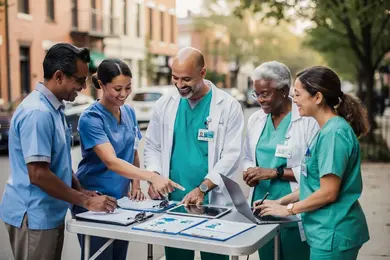
Community health professionals engaged in daily responsibilities in community outreach must navigate complex operational challenges that extend beyond clinical practice. Their success depends on balancing direct engagement-such as organizing vaccination drives in urban areas or coordinating mobile clinics in rural communities-with administrative duties like grant writing and data analysis. For example, addressing transportation barriers while implementing culturally appropriate interventions requires both strategic partnership development and adaptive problem-solving under resource constraints.
Effective community-building strategies for community health workers emphasize targeted use of health data to prioritize interventions with the highest impact in neighborhoods facing social determinants of health. This role demands strong communication skills to mobilize volunteers, negotiate among stakeholders with competing priorities, and overcome mistrust linked to healthcare disparities.
The median annual wage for healthcare practitioners involved in community outreach was $83,090 in May 2024, significantly higher than the $49,500 average for all occupations, reflecting market demand for integrated clinical and social service competencies. Prospective candidates should consider the necessity of technical proficiency in data management software and culturally sensitive program design to meet employer expectations for measurable health outcome improvements.
For those contemplating educational pathways that enable this career pivot or advancement, programs such as an accelerated healthcare management degree online provide relevant skills that align with workforce needs and practical realities.
Which degree programs best prepare you for community health careers with a community focus?
Degrees focusing on community health with an emphasis on community engagement deliver essential skills suited to navigating complex social environments and employer demands. A Bachelor of Science in public health or community health equips students with epidemiology, program planning, health communication, and cultural competency necessary to design targeted community interventions. However, those aiming for leadership roles or roles requiring advanced evaluation methods often pursue a Master's in Public Health (MPH) with a community health concentration, which enhances strategic stakeholder collaboration and program assessment capabilities.
Health education specialist positions demand accredited health education degrees certified by the National Commission for Health Education Credentialing (NCHEC), embedding behavior change models and health promotion strategies proven to influence local health outcomes. Social work degrees (BSW or MSW) that emphasize community health or policy prepare candidates to address systemic social determinants affecting vulnerable groups, a vital skill in many community health careers emphasizing community-building skills.
Employers heavily weigh hands-on experience with coalition building, community assessment, and multilingual outreach, commonly attained through practicums or internships. While online and hybrid options offer flexibility, they may hinder immersive community engagement essential for skill development. Employment of health education specialists and community health workers is expected to grow 8% from 2024 to 2034, with roughly 17,200 openings annually, which highlights practical training as a critical differentiator in this competitive field.
For working professionals exploring educational options, evaluation should carefully balance practical exposure with scheduling needs. More information on advanced healthcare administration options is available through programs offering masters in hospital administration.
How do online community health programs compare with on-campus options for this career path?
Choosing between online and on-campus community health education programs involves tradeoffs tied to employability and practical skill acquisition. Online community health education programs benefit students with flexibility, enabling working adults or caregivers to complete coursework asynchronously without relocating. However, these programs often fall short in delivering hands-on clinical experience, a critical factor for positions like home health aides where employers prioritize candidates with in-person training. The sector's projected growth of 681,000 new jobs by 2034 underscores the importance of demonstrable clinical competence.
On-campus programs, by contrast, provide direct access to supervised labs, clinical simulations, and face-to-face mentorship, accelerating practical skills needed for frontline roles. Hybrid models attempt to blend theory and practice but introduce logistical hurdles such as securing local clinical placements, which may not be feasible for all students.
When evaluating the differences between virtual and on-campus community health degrees, it is essential to weigh employer expectations for verified clinical exposure. Additionally, students considering accelerated pathways can explore specialized options such as the RN to BSN in 6 months, which cater to those prioritizing quick yet credible upskilling.
What core courses and skills develop strong community-building abilities in community health majors?
Effective community health programs hinge on foundational skills that employers value: precise communication, cultural competence, and systems navigation. Students trained in interpersonal communication, social determinants of health, and behavioral health interventions learn to engage varied populations and deploy evidence-based strategies that build trust and improve outcomes. These core competencies directly address common workforce challenges, such as resistance from mistrustful communities or bureaucratic hurdles in public agencies.
Mastering data collection and program evaluation is vital, especially when navigating fluctuating funding and staffing shortages. For instance, epidemiology and biostatistics courses prepare students to interpret health trends and allocate limited resources strategically-a capability crucial as HRSA projects a shortage of 87,000 mental health and substance use disorder counselors by 2036, intensifying workforce demands in behavioral health.
Practical skills like conflict resolution and motivational interviewing support bridging gaps between institutions and vulnerable populations, often experienced firsthand during internships or fieldwork. Technological proficiency in electronic health records and telehealth platforms complements these skills, expanding reach and operational efficiency.
Additionally, advanced collaboration abilities enable graduates to coordinate across disciplines, ensuring integrated care that addresses medical and social determinants simultaneously. This intersectional approach increases adaptability in dynamic community environments where roles frequently overlap.
What are the typical admission requirements for community health degrees and certificates?
Admission to community health programs reflects a balance between foundational academic preparation and the practical realities of workforce demand. Certificate pathways typically require a high school diploma or equivalent, aiming for flexibility-ideal for mid-career pivots-while associate and bachelor's degrees expect minimum GPAs around 2.5 to 3.0 and often prerequisite coursework in biology or social sciences. Applicants aiming for graduate-level credentials must hold a relevant bachelor's degree and navigate higher GPA thresholds, recommendation letters, and personal statements, with some still requiring GRE scores, though waivers are increasingly common.
Practical experience is a decisive factor in admissions and employability. For example, candidates for school mental health credentials need documented hours supporting youth, a necessity aligned with growing yet unmet demand for mental health professionals in public schools, where vacancies persist despite a 48% workforce increase from 2020 to 2023 (HRSA 2024 workforce report). This underscores the advantage of integrating volunteer or paid roles prior to applying.
Key tradeoffs involve choosing between short-term certificate flexibility versus longer degree programs that demand more upfront investment but yield broader clinical opportunities and employment stability. Early completion of prerequisite courses, preferably online, can mitigate barriers and accelerate entry into the field. Prospective students should critically evaluate how each pathway aligns with employment requirements and their own capacity for sustained academic and experiential commitments.
How long do community health programs take, and what do they typically cost?
Postsecondary credentials in community health vary widely in scope, cost, and career impact, making clear-eyed evaluation essential. Short-term certificates of 6 to 12 months can enable rapid entry into roles like community health workers or care coordinators, especially when focused on skills such as patient navigation. These programs, typically costing under $6,000, minimize opportunity costs but often limit upward mobility within organizations that increasingly favor degree credentials.
Associate degrees generally require about 2 years and combine foundational knowledge with occasional clinical practicums. Their costs span $6,000 to $20,000, reflecting regional and institutional differences. Bachelor's degrees, which take around 4 years and can exceed $40,000, open pathways to leadership, interdisciplinary team management, and policy roles-but demand a substantial investment of time and resources.
For example, a community health worker targeting urban care coordination might prioritize a targeted 12-month certificate with a sub-$5,000 cost to quickly meet workforce demand and deliver concrete outcomes. Conversely, professionals aiming to influence program design or supervise teams often cannot bypass baccalaureate credentials without significant tradeoffs in employer expectations and advancement potential.
Recent analyses indicate that roles emphasizing care coordination and patient navigation may cut avoidable hospitalizations by around 10% in underserved populations, reinforcing workforce demand for efficient yet focused training options aligned with budget constraints and practical impact.
What is the job outlook and demand for community health workers and related roles?
Employment in outpatient care centers, which increasingly serve as hubs for tech-enabled community care, grew 20.8% from early 2020 to 2024, significantly outstripping broader job market growth. This shift toward integrating telehealth and digital outreach demands workers who combine traditional community-building with digital fluency.
The evolving role often means managing hybrid workflows: a community health worker may need to coordinate remote patient monitoring while delivering in-person education. This dual competency introduces challenges such as continuous digital literacy development and balancing virtual and physical care environments.
Educational programs that blend public health fundamentals with applied technology skills-typically certificates or associate degrees-best position candidates to meet these employer expectations. In contrast, practitioners focused solely on outreach without tech skills face restricted career mobility within this digitizing sector.
Long-term success also depends on navigating healthcare policy shifts and reimbursement models that emphasize outcomes from community-based interventions. Key activities include screening for social determinants of health, facilitating referrals, and enabling telehealth adoption, all requiring cultural competence paired with tech adaptability. Prospective students should weigh these practical workforce demands and evolving employer criteria critically when selecting educational pathways in community health.
What is the salary range for community-focused community health careers in the U.S.?
The salary landscape for community health professionals in the U.S. presents a clear economic hierarchy tied closely to role complexity and experience. Entry-level outreach workers and educators typically earn between $40,000 and $65,000 annually, a range influenced heavily by location and employer type. Mid-level coordinators with a few years of experience can expect $65,000 to $90,000, with urban centers and major health institutions skewing higher.
Management roles, such as community health program managers, demand advanced organizational and leadership capabilities, reflected in their median annual wage of $114,980-a figure more than double the national median wage. This compensation premium aligns with responsibilities involving policy execution, partnership building, and program sustainability, all vital to securing and maintaining funding.
Advancement into these higher tiers generally requires at least a bachelor's degree in public health or related fields plus hands-on community experience. Pursuing advanced degrees or certifications can improve access to better resources and employers, but introduces tradeoffs in time and financial investment that prospective students must weigh against immediate income needs. Employers prioritize candidates with demonstrable impact in community engagement and program outcomes, as effectiveness directly influences funding potential and trust within communities.
How can you choose an accredited, reputable community health program that employers trust?
Accreditation from recognized bodies like the Council on Education for Public Health (CEPH) or the Commission on Accreditation of Allied Health Education Programs (CAAHEP) remains a critical marker of program quality in community health education. Employers in public health and nonprofit sectors-representing approximately 1 in 7 U.S. jobs-prioritize graduates from accredited programs due to their proven alignment with workforce standards. With the healthcare and social assistance sector expecting 1.9 million openings annually until 2034, the credential can substantively impact employability.
Beyond accreditation, closely analyzing graduation rates, job placement data specific to community health roles, and established employer partnerships offers a clearer picture of a program's practical value. Programs linked to local public health agencies or nonprofits often grant hands-on experience and networking avenues essential for community-focused positions.
Choosing between online or part-time delivery versus full-time, campus-based programs involves tradeoffs: flexibility frequently comes at the cost of reduced employer recognition and limited fieldwork opportunities, which are vital for skill mastery. Cost considerations also influence outcomes. Expedited certificates may enable quicker labor market entry but rarely replace the long-term benefits associated with accredited degrees, which better support progression within community health professions.
Other Things You Should Know About Community Health
Workload in community health roles with a community-building focus can vary widely depending on the employer, project scope, and community needs. These roles often require managing multiple stakeholders, coordinating events, and navigating shifting community dynamics, which means irregular hours and high emotional labor. Candidates should prioritize programs that offer strong practicum or field experience components to prepare for this fast-paced, multifaceted workload.
Diverse community settings bring real tradeoffs in communication style, cultural competence, and resource availability. Professionals must adapt quickly to varied expectations and barriers, such as language differences or distrust of institutions. Programs that emphasize experiential learning in diverse environments better prepare students to handle these challenges. Deciding to enter community health means committing to ongoing cultural learning rather than relying on initial training alone.
Employers increasingly expect graduates to have practical experience with community engagement and data-driven program evaluation, not just classroom knowledge. This shifts the value toward programs with robust internship, mentorship, or capstone projects directly involving community-building. When selecting a program, prioritize those with clear employer connections and outcomes data showing graduates succeed in community-centered roles.
References
- One moment, please... https://chwcentral.org/wp-content/uploads/Actualizing-the-Full-Potential-of-Public-Health-Community-Health-Workers.pdf
- Why Community Health Is Important for Public Health https://publichealth.tulane.edu/blog/why-community-health-is-important-for-public-health/
- What Are Community Health Centers, and What Do They Provide? - GoodRx https://www.goodrx.com/insurance/low-cost-free-healthcare/community-health-center
- CHW Career Paths: Good Skills, Roles, and Growth Opportunities - Community Health Worker Training https://chwtraining.org/chw-career-paths/
- What does a nursing assistant do? https://apexlearning.org.uk/online-health-and-social-care-courses-are-they-recognised-by-employers/
- Complete Job Description of a Community Health Worker - MPH Online https://www.mphonline.org/job-description-community-health-worker/
- Community Health Worker Program Accreditation - URAC https://www.urac.org/accreditation-cert/community-health-worker-program/
- Master of Public Health Online https://www.unthealth.edu/tcom/public-health/master-of-public-health-online.html
- Health and Human Services: Campus & Online Degrees and Careers https://www.publichealthonline.org/human-services/online-degree-programs/
- Public Health Needs People With Diverse Skills and Backgrounds—Here Are 9 Careers to Consider https://careercenter.emmanuel.edu/blog/2025/10/23/public-health-needs-people-with-diverse-skills-and-backgrounds-here-are-9-careers-to-consider/