
2027 Best Online Dual MBA Programs

Co-Founder and Chief Data Scientist
Choosing an online dual MBA is not the same as enrolling in two unrelated graduate programs at once. The best programs are intentionally designed so selected credits apply to both degrees, advising is coordinated across departments, and the curriculum connects business training with a second professional field such as public health, accounting, technology, law, social work, education, or policy.
That structure matters. A poorly matched dual degree can add tuition, delay graduation, or leave you with credentials that do not support your career plan. A well-chosen program can help you move into leadership roles that require both management judgment and specialized expertise.
Online delivery has also changed how professionals evaluate graduate education. Employers are generally more interested in accreditation, reputation, skills, experience, and outcomes than in whether every class was completed on campus. For 2027, interest in business graduate education remains strong: a GMAC report found that 52% of prospective business graduate students still prefer the MBA.
This guide explains how online dual MBA programs work, which degree combinations are most useful, what they cost, how long they take, how to evaluate accreditation and ROI, and how to decide whether a dual MBA is the right move for your career.
Quick Answer: Are Online Dual MBA Programs Worth Considering?
Online dual MBA programs can be worth considering if your target career requires both business leadership and specialized knowledge in another field. They are most useful for professionals who want to manage hospitals, lead technology teams, direct nonprofit programs, oversee finance functions, shape policy, or work at the intersection of law and business.
- A dual MBA can combine the MBA with degrees such as an MSML, MPAcc, MIS, JD, MPH, MSW, MD, education leadership degree, MPP, or environmental science degree.
- Because some credits may count toward both credentials, students can often finish faster than they would by earning two separate graduate degrees.
- The strongest programs are accredited, clearly structured, career-aligned, transparent about cost, and supported by advising, networking, and career services.
- What are the best online dual MBA programs for 2027?
- How do online dual MBA programs work?
- Can I complete both degrees in less time with a dual program?
- How do online dual MBA programs compare to on-campus ones?
- How much do online dual MBA programs cost?
- What are the admissions requirements for online dual MBA programs?
- Which dual MBA degrees lead to the highest salaries?
- How can I finance my online dual MBA program?
- Are online dual MBA programs accredited and recognized globally?
- What is the ROI of an online dual MBA program?
- What are the benefits and drawbacks of online dual MBA programs?
- How do you know if a dual MBA is right for you?
- How to choose the best online dual MBA program for you?
- How do dual MBA programs bolster career advancement through networking and support?
- What challenges can arise during your online dual MBA journey?
What are the best online dual MBA programs for 2027?
The best online dual MBA program is the one that matches your career direction, not simply the one with the most impressive title. A useful dual degree should connect the MBA’s broad business foundation with a second discipline that employers already value in your target field.
Most online dual MBA options fall into one of three categories: leadership-focused combinations, industry-specific combinations, and regulated or credential-sensitive combinations. The table below shows how common pairings differ.
| Dual MBA option | Best fit for | Career direction | Important consideration |
| MBA/MS in Management and Leadership | Managers preparing for senior leadership | Operations, administration, executive leadership | Look for strong leadership coaching, team projects, and organizational strategy coursework. |
| MBA/MPAcc | Accounting and finance professionals | CPA pathways, controllership, financial management | Confirm whether coursework supports CPA licensure requirements in your state. |
| MBA/MS in MIS | IT professionals moving into management | Technology leadership, systems strategy, analytics | Check whether the program includes current analytics, cybersecurity, and enterprise systems coursework. |
| MBA/JD | Students interested in law, compliance, and corporate strategy | Corporate law, compliance, governance, consulting | Verify bar eligibility and residency requirements because law programs may not be fully online. |
| MBA/MPH | Healthcare and public health professionals | Hospital leadership, health policy, public health administration | Make sure the MPH component meets field experience and accreditation expectations. |
| MBA/MSW | Social workers and nonprofit professionals | Human services leadership, nonprofit management, policy work | Review field placement requirements and state social work licensure rules. |
| MBA/MD | Medical students and physicians | Healthcare executive leadership, clinical operations, medical administration | Expect a demanding schedule and possible hybrid or campus-based requirements. |
| MBA/MA in Education Leadership | Teachers, administrators, and education professionals | School leadership, district administration, education consulting | Check whether the program supports principal or administrator licensure if required. |
| MBA/MPP | Policy, government, and advocacy professionals | Public affairs, policy analysis, government relations | Prioritize programs with policy labs, applied research, or public-sector employer connections. |
| MBA/MS in Environmental Science | Sustainability and environmental professionals | ESG, environmental consulting, sustainability leadership | Look for applied projects in compliance, reporting, climate risk, or corporate sustainability. |
MBA/MS in Management and Leadership
An MBA/MSML is designed for professionals who want to move from managing tasks to leading people, departments, and organizational change. The MBA side builds knowledge in finance, marketing, strategy, and operations, while the leadership degree typically emphasizes organizational behavior, ethical decision-making, communication, and change management.
This pairing makes the most sense if your goal is to become a project manager, operations director, department leader, or executive in a business, healthcare, education, or public-sector setting. It is less useful if you need a highly technical credential in a regulated field.
MBA/MPAcc
An MBA/MPAcc is a strong option for students who want advanced accounting knowledge along with broader business strategy training. Coursework may include auditing, taxation, financial reporting, business law, managerial finance, and analytics. For students pursuing CPA-related roles, the accounting component can be especially important.
Before applying, compare the program’s courses with your state’s CPA education rules. You may also want to review the difference between private vs public accounting so you can choose electives and internships that support the accounting career path you actually want.
MBA/MS in Management Information Systems
An MBA/MS in MIS helps technology professionals translate technical expertise into business leadership. Students usually study systems design, data analytics, cybersecurity, digital transformation, enterprise platforms, and IT governance while also completing MBA coursework in strategy, finance, and management.
This route is especially relevant for professionals targeting IT project manager, technology consultant, IT director, or CIO-track roles. It is a practical choice if you want to lead digital transformation projects and communicate effectively with both executives and technical teams.
MBA/JD
An MBA/JD combines business administration with legal training. Students may study contracts, corporate law, compliance, intellectual property, negotiation, finance, ethics, and strategic management. The combination can be valuable for people pursuing corporate law, regulatory compliance, business consulting, entrepreneurship, or governance roles.
Because legal education is highly regulated, applicants should be cautious. Not every online or hybrid MBA/JD pathway will satisfy bar eligibility requirements in every jurisdiction. Always check the law school’s accreditation, format, residency rules, and bar-related disclosures before enrolling.
MBA/MPH
An MBA/MPH is built for professionals who want to lead within health systems, public health agencies, community programs, health technology organizations, or healthcare nonprofits. The MPH side may include epidemiology, health policy, biostatistics, environmental health, and global health, while the MBA develops budgeting, operations, analytics, and leadership skills.
This degree can be especially useful for nurses, clinicians, administrators, and public-sector professionals who want to move into health leadership. If you are still building the foundation for a nursing career, you can compare the cheapest ADN nursing programs online before planning a longer path toward graduate study.
MBA/MSW
An MBA/MSW serves students who want to combine social work practice or policy knowledge with executive-level management skills. The curriculum may cover case management, community practice, social policy, nonprofit administration, finance, operations, and organizational strategy.
This pairing is best for future nonprofit executives, human services administrators, social impact leaders, and policy advocates. If your interests lean more toward counseling psychology than social work administration, you may also want to compare the cheapest counseling social psychology programs online.
MBA/MD
An MBA/MD is a specialized path for physicians and medical students who want to lead hospitals, health systems, biotech ventures, clinical operations, or healthcare innovation teams. The MBA adds training in finance, operations, strategy, and organizational leadership to medical education.
This option can be powerful but demanding. Students should expect intense scheduling, clinical responsibilities, and possible hybrid requirements. It is usually best for those with a clear interest in medical leadership rather than clinical practice alone.
MBA/MA in Education Leadership
An MBA/MA in Education Leadership can help educators move into administrative, consulting, nonprofit, or ed-tech leadership roles. The education side may cover curriculum, school law, instructional leadership, equity, assessment, and education finance, while the MBA provides business and operations training.
This pairing is most useful for teachers, school administrators, and education professionals who want to manage budgets, lead teams, improve systems, or work across education and business environments.
MBA/MPP
An MBA/MPP combines management training with policy analysis. Students often study public budgeting, economics, legislative processes, program evaluation, negotiation, and strategic management.
This option is well suited to people pursuing government relations, policy consulting, advocacy leadership, public affairs, or management roles in public agencies and NGOs. It can be especially useful when your work requires both analytical policy judgment and the ability to run programs effectively.
MBA/MS in Environmental Science
An MBA/MS in Environmental Science connects business strategy with environmental analysis, regulation, sustainability reporting, climate risk, and resource management. It prepares students for roles where organizations must balance financial performance, compliance, and environmental responsibility.
This degree can support work in energy, manufacturing, consulting, government, and corporate sustainability. If you are comparing a focused MBA pathway with a broader management degree, this type of pairing is useful context for a specialized MBA and general MBA degree program comparison.
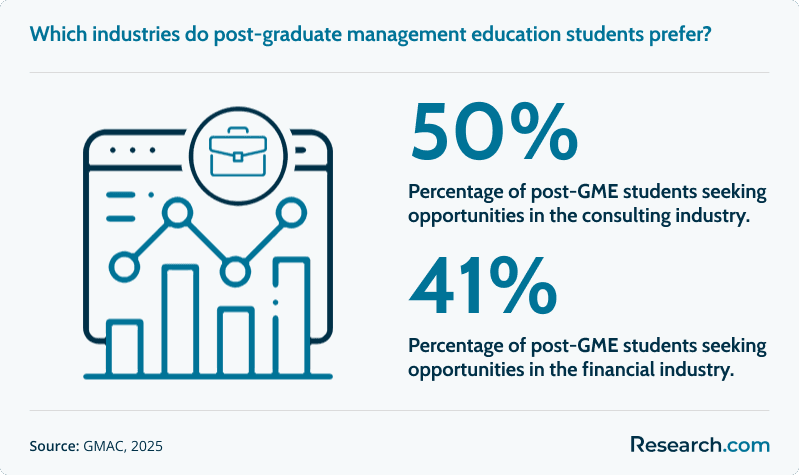
The chart below lists the top career goals of graduate business students, as reported by GMAC in 2025.
How do online dual MBA programs work?
Online dual MBA programs allow students to earn an MBA and a second graduate credential through a coordinated curriculum. Instead of completing two full programs separately, students follow a plan in which approved courses may satisfy requirements for both degrees.
The MBA portion usually covers core business areas such as leadership, finance, marketing, accounting, economics, operations, analytics, and strategy. The second degree adds discipline-specific preparation in areas such as law, public health, social work, information systems, accounting, education, or policy. Students exploring different MBA tracks can also compare business administration concentrations before choosing a dual pathway.
| Program feature | How it usually works | Why it matters |
| Shared credits | Approved courses count toward both degrees. | This can reduce the total number of credits and shorten the path to graduation. |
| Coordinated advising | Students work with advisors from the business school and the partner program. | Good advising helps prevent missed prerequisites, duplicate courses, and delayed graduation. |
| Sequenced curriculum | Some programs begin with MBA core courses, while others alternate between both degrees. | The sequence affects workload, pacing, and when you can take specialized courses. |
| Online delivery | Courses may be asynchronous, live online, or a blend of both. | Format determines how well the program fits a working professional’s schedule. |
| Applied requirement | Many programs include a capstone, practicum, internship, consulting project, or field placement. | Applied work can strengthen your resume but may require local placement planning. |
Admissions structures vary. Some schools require students to apply to both programs at the same time, while others allow students to begin the MBA and apply later to the second degree. In either case, students should confirm whether acceptance into one program guarantees admission to the other.
Demand for MBA talent remains part of the conversation. Data published in 2024 found that 36% of corporate recruiters want to hire more MBA graduates moving forward. For example, a student comparing the cheapest online MSW programs may decide that adding an MBA would strengthen preparation for nonprofit budgeting, program leadership, or executive administration.
Can I complete both degrees in less time with a dual program?
Yes. Many students can complete both degrees in a dual MBA program in about 2.5 to 3 years, depending on the school, second degree, transfer policies, course load, and whether the student enrolls full time or part time. That is often faster than earning the two credentials separately, which could take 4 years or more.
A typical full-time MBA alone takes 18 to 24 months. A specialized master’s degree, such as accounting or public health, usually adds another 12 to 18 months. Dual programs reduce duplication by allowing selected courses to satisfy requirements across both programs.
That overlap can reduce the total credit load by 12 to 20 credits, depending on the school. Some programs also use summer sessions, accelerated terms, or year-round course schedules to help students finish sooner.
| Study path | Typical time frame stated | Best for |
| Single full-time MBA | 18 to 24 months | Students who want broad business training without a second specialty degree. |
| Separate MBA plus specialized master’s | 4 years or more | Students who need two distinct degrees but cannot find a coordinated dual option. |
| Dual MBA program | About 2.5 to 3 years | Students with a clear goal that requires both business and specialized expertise. |
| Longer part-time dual MBA | 3–4 years | Working professionals balancing school with full-time employment or family responsibilities. |
The right pace depends on your second degree and your available time. 48% of full-time MBA candidates prefer programs that last 19 months or longer, while many accounting students aim to finish in a year or less. A dual program tries to balance depth, flexibility, and efficiency, but it should not remove essential field requirements just to shorten the calendar.
How do online dual MBA programs compare to on-campus ones?
Online and on-campus dual MBA programs can lead to the same types of credentials, but the learning experience is different. The better option depends on your schedule, learning style, career goals, need for in-person networking, and whether your second degree includes labs, practicums, residencies, or licensure-related requirements.
| Factor | Online dual MBA programs | On-campus dual MBA programs |
| Flexibility | Usually better for students working full time or living far from campus. | Less flexible but more structured around scheduled classes and campus activities. |
| Networking | Often includes virtual events, online groups, alumni platforms, and remote career coaching. | May offer easier access to recruiters, faculty, student clubs, and in-person events. |
| Skill development | Can build strong business, technical, and collaboration skills when courses are well designed. | May offer more immediate practice through live discussion, presentations, and group work. |
| Employer perception | Stronger when the school is accredited, reputable, and transparent about outcomes. | May still be preferred by some employers for certain networking-heavy or technical fields. |
| Field requirements | May require local placements, campus residencies, or hybrid components. | Can be simpler for programs with labs, clinical work, or frequent in-person activities. |
| Student experience | Requires self-discipline, independent planning, and comfort with digital platforms. | Provides more face-to-face accountability and informal peer interaction. |
Most US employers believe online programs can develop solid business and technical skills. However, about 44% still say that in-person programs do a better job teaching technical tools, like software and data systems. Around two-thirds of employers feel on-campus students build more decisive leadership and communication skills, often because of frequent face-to-face collaboration.
That does not mean online programs are weaker by default. Many online programs now include live sessions, team consulting projects, intensive residencies, and supervised fieldwork. For example, many of the best CEPH accredited MPH online programs include practicum work or guided field experience comparable to traditional formats.
How much do online dual MBA programs cost?
Online dual MBA programs usually cost between $70,000 and $110,000, depending on the institution, degree combination, tuition model, program length, and residency status. The price can be significant, but a coordinated dual degree may cost less than earning two graduate degrees separately.
According to Education Data Initiative, a single MBA program in 2024 costs about $60,410 on average. If a student added a second specialized master’s as a separate program, the combined total could reach $120,000 or more.
Some public universities offer online dual MBA programs starting at $35,000 to $50,000 for in-state students, while private schools or top-ranked programs can push costs closer to $100,000. When comparing options, do not rely on tuition alone. Ask for the full estimated cost of attendance.
| Cost item | What to check | Why it can affect your budget |
| Tuition | Per-credit, per-term, or flat-rate pricing | Dual programs can vary widely depending on whether both schools charge separate rates. |
| Technology fees | Usually $100–$500 per term | Online programs often charge platform, support, or digital learning fees. |
| Textbooks and materials | Up to $1,500 per year | Business cases, simulations, software, and specialized texts can add up. |
| Software and proctoring | Exam tools, analytics platforms, or course-specific licenses | These may not be included in advertised tuition. |
| Application and graduation fees | Fees charged by one or both programs | Dual degrees may involve separate administrative charges. |
| Internship or placement costs | Travel, background checks, insurance, or local placement expenses | Public health, social work, education, and healthcare tracks may require applied experiences. |
The chart below illustrates the average graduate tuition across different degree-granting institutions, as published by the NCES.
What are the admissions requirements for online dual MBA programs?
Admissions requirements for online dual MBA programs usually include the standard MBA application materials plus any requirements from the partner degree. Applicants should treat the process as two coordinated admissions reviews, not one simple MBA application.
- Bachelor’s degree: Applicants generally need an undergraduate degree from an accredited institution.
- Official transcripts: Many programs look for a GPA of 3.0 or higher, although some may consider applicants with lower GPAs when other strengths are present.
- GMAT or GRE scores: Some programs still request test scores, while others offer waivers for strong academic records or significant professional experience.
- Professional experience: Business-focused combinations such as MBA/MSML or MBA/MPAcc often prefer applicants with 2–5 years of work experience.
- Statement of purpose or essays: Applicants should explain why both degrees are necessary for their goals, not just why they want an MBA.
- Letters of recommendation: Most schools ask for two or three letters from supervisors, professors, or professional contacts.
- Resume: The resume should show leadership, career progression, quantitative skills, service experience, technical ability, or field-specific preparation.
- Interview: Selective, cohort-based, or executive-style programs may require a live or recorded interview.
Requirements can be more complex when the second degree is tied to licensure, field placement, or professional regulation. Law, public health, social work, education, and healthcare tracks may require prerequisites, separate applications, background checks, practicum planning, or state-specific disclosures.
| Question to ask before applying | Why it matters |
| Do I apply to both programs at once? | Some schools require simultaneous admission, while others add the second degree after MBA enrollment. |
| Are test scores required for both degrees? | A GMAT waiver for the MBA may not apply to the partner program. |
| Does the second degree require prerequisites? | Public health, accounting, education, or law tracks may require specific prior coursework. |
| Are field placements available near me? | Online does not always mean every requirement can be completed from home. |
| Will the program meet licensure requirements in my state? | This is essential for fields such as law, social work, education, and some healthcare roles. |
Which dual MBA degrees lead to the highest salaries?
Salary potential depends on industry, location, prior experience, employer size, job level, and the second degree paired with the MBA. A dual MBA can strengthen preparation for senior roles, but it does not guarantee a specific salary. The roles below are examples of higher-paying outcomes associated with common dual MBA combinations.
| Role | Associated dual degree | Salary range stated | Why the pairing can help |
| Chief Financial Officer | MBA/MPAcc | $150,000–$300,000 | The accounting degree supports technical financial expertise, while the MBA develops strategic and executive leadership skills. |
| Hospital Administrator | MBA/MD | $115,000–$250,000 | Clinical training helps leaders understand patient care realities, while the MBA supports staffing, operations, budgeting, and strategy. |
| Corporate Lawyer | MBA/JD | $140,000–$210,000 | Legal training supports contracts and compliance, while business coursework helps with transactions, governance, and executive decision-making. |
| IT Director | MBA/MS in MIS | $170,000–$190,000 | The MIS degree builds technical systems knowledge, while the MBA prepares graduates to lead teams, budgets, and technology strategy. |
| Public Health Executive | MBA/MPH | $110,000–$180,000 | The MPH adds health systems and policy knowledge, while the MBA supports finance, operations, and organizational leadership. |
Students comparing legal specializations may also research environmental lawyer education requirements when deciding whether an MBA/JD, environmental policy path, or another specialty best fits their goals.
How can I finance my online dual MBA program?
Financing an online dual MBA requires more planning than funding a single graduate degree because costs may be billed through more than one school or department. Start by asking each program for a full cost estimate, then compare scholarships, assistantships, employer tuition support, federal loans, private loans, payment plans, and military or public-service benefits if applicable.
Employer reimbursement can be especially relevant for working professionals. Before counting on it, confirm annual reimbursement caps, grade requirements, repayment obligations if you leave your employer, and whether both degrees qualify. You can also use the cheapest online MBAs as a benchmark when evaluating whether a dual MBA’s added cost is reasonable.
| Funding option | What to ask | Best for |
| Institutional scholarships | Are awards available through both the business school and partner department? | Applicants with strong academics, leadership, or field experience. |
| Employer tuition assistance | Does the employer cover graduate business programs, the second degree, or both? | Working professionals whose degree aligns with current or future responsibilities. |
| Federal student loans | What is the total borrowing limit and repayment obligation? | Students who need structured loan access and federal repayment protections. |
| Private loans | How do interest rates, cosigner rules, and repayment terms compare? | Students who have exhausted other options and understand the risks. |
| Payment plans | Can tuition be spread across the term or academic year? | Students trying to reduce large upfront payments. |
Are online dual MBA programs accredited and recognized globally?
Accreditation is one of the most important quality checks for an online dual MBA. For the business portion, applicants should look for recognized business school accreditation such as AACSB, ACBSP, or IACBE. For the second degree, the correct accreditor depends on the field. Public health, social work, law, education, and healthcare programs may each have separate expectations.
Do not assume that accreditation for the MBA automatically covers the second degree. Verify both sides of the dual program. This is especially important if you may need licensure, professional certification, employer reimbursement, transfer credit, doctoral admission, or international recognition. Students comparing executive-style options can also review a best value EMBA program to understand how affordability and quality indicators can be weighed together.
What is the ROI of an online dual MBA program?
The ROI of an online dual MBA depends on whether the credential helps you reach a role you could not realistically access with a single degree. A good ROI analysis compares total cost, time to completion, foregone income if you reduce work hours, employer support, likely career mobility, and the value of the second credential in your target field.
Students should avoid assuming that two degrees automatically produce double the career value. The return is strongest when both degrees are clearly connected to a specific career goal. For example, an MBA/MPH may make sense for a healthcare administrator, while an MBA/MS in MIS may be better for an IT professional seeking enterprise leadership. Foundational credentials, such as online finance bachelors degrees, can also affect how well prepared a student is for advanced business coursework.
| ROI factor | Positive sign | Warning sign |
| Career alignment | The degree combination maps directly to your target role. | You are choosing the second degree because it sounds impressive but lacks a clear purpose. |
| Cost | The dual format reduces credits or tuition compared with separate degrees. | The total price approaches or exceeds separate programs without meaningful time savings. |
| Employer value | Your target employers regularly hire or promote people with this combination. | Job postings rarely require or prefer the second degree. |
| Time commitment | The schedule fits your work and personal responsibilities. | You would need to reduce income significantly without a clear payoff. |
| Accreditation and licensure | Both degrees meet relevant professional and academic standards. | The program cannot clearly explain licensure, placement, or accreditation details. |
What are the benefits and drawbacks of online dual MBA programs?
Online dual MBA programs can be efficient and career-focused, but they are not the right choice for every student. The main trade-off is depth and opportunity versus cost, workload, and complexity.
Pros
- Two credentials through one coordinated pathway: Students can complete business training and specialized graduate study without fully duplicating requirements.
- Potential time savings: Shared coursework may reduce the total credits and months needed compared with separate degrees.
- Flexibility for working adults: Online formats can make graduate study possible for professionals balancing jobs, caregiving, or geographic limits.
- Stronger interdisciplinary profile: Graduates can speak both the language of business and the language of their specialized field.
- Possible cost advantages: Some dual pathways cost less than earning both credentials independently.
- Growing graduate enrollment context: As of 2025, graduate enrollment reached 3.2 million students, and online dual MBA programs are part of a broader market for flexible graduate education.
Cons
- More demanding workload: Two graduate curricula require sustained time management, writing, quantitative work, and project coordination.
- Complex advising: Students must track requirements from two academic units, which can create scheduling or prerequisite issues.
- Less spontaneous networking: Online programs may offer fewer informal conversations with classmates, faculty, and recruiters than campus programs.
- Possible in-person requirements: Law, healthcare, public health, education, and social work pathways may involve residencies, practicums, internships, or local placements.
- Not always faster: Some dual programs still take 3–4 years, especially for part-time students or regulated fields.
- Technology dependence: Students need reliable internet, current devices, and comfort with online learning systems.
How do you know if a dual MBA is right for you?
A dual MBA is most appropriate when your career goal genuinely sits between business and another professional field. If you want to lead within healthcare, technology, public policy, finance, education, law, social impact, or sustainability, a second degree may give you the field-specific knowledge that a standalone MBA does not provide.
It may also be a strong option if you already have experience in one area and want to move into leadership without abandoning your background. An IT professional may use an MBA/MS in MIS to move from technical delivery to enterprise strategy. A social worker may use an MBA/MSW to move into nonprofit leadership. A physician may use an MBA/MD to step into clinical operations or hospital administration.
However, a dual MBA is not a casual upgrade. It requires more money, more time, and more academic planning than a single degree. If you cannot clearly explain why both credentials are needed for your next role, a specialized MBA, graduate certificate, professional certification, or shorter master’s program may be a better fit.
| A dual MBA may be right if... | Consider another option if... |
| Your target job requires both management and specialized field knowledge. | You mainly want a promotion in general management. |
| You have researched roles where the second degree is valued. | You are unsure what career outcome the second degree supports. |
| You can handle a heavier academic workload for multiple years. | You need the shortest or least expensive credential possible. |
| Your program is accredited and fits licensure or field requirements. | The school cannot clearly explain accreditation, placement, or licensing implications. |
| You have a financing plan and realistic ROI expectations. | You would need to borrow heavily without a clear career benefit. |
The chart below lists the skills most valued by global employers of graduate business students, as reported by the GMAC in 2024.
How to choose the best online dual MBA program for you?
Choosing an online dual MBA should begin with your target role, not with rankings alone. A high-quality program for one student may be a poor fit for another if the second degree, schedule, cost, or accreditation does not match the student’s needs.
- Define the job you want after graduation. Identify job titles, industries, employers, and required qualifications. If public health is your focus, compare options such as the cheapest MPH programs alongside MBA/MPH pathways.
- Verify both degrees and both accreditations. The MBA should come from a properly accredited business school, and the partner degree should meet the standards of its field. For business accreditation, applicants often review AACSB, IACBE, or ACBSP accreditation.
- Map the curriculum to your goals. Look beyond course titles. Confirm that electives, capstones, fieldwork, and projects support your intended career.
- Calculate the total price. Include tuition, fees, books, technology costs, travel, placement expenses, and lost income if you must reduce work hours.
- Ask how shared credits work. Get the credit-sharing policy in writing so you understand exactly how the dual degree saves time or money.
- Review online learning format. Check whether classes are asynchronous, live, cohort-based, self-paced, full time, or part time.
- Evaluate career support. Strong programs provide coaching, employer connections, alumni access, interview preparation, and industry-relevant projects.
- Confirm licensure and field placement rules. This is essential for law, social work, education, public health, and some healthcare-related pathways.
Common Mistakes to Avoid
| Mistake | Better approach |
| Choosing a program only because it is online and convenient. | Confirm that the curriculum, accreditation, and career outcomes fit your goals. |
| Looking only at tuition. | Compare the full cost of attendance, including fees, materials, software, and placement costs. |
| Assuming every online program meets licensure rules. | Check state requirements before enrolling in law, social work, education, or healthcare-related tracks. |
| Relying only on rankings. | Use rankings as one input, but prioritize fit, cost, accreditation, and outcomes. |
| Ignoring transfer and shared-credit policies. | Ask exactly which courses count toward both degrees and how that affects graduation time. |
| Expecting guaranteed salary results. | Compare salary ranges with your experience, location, industry, and realistic job prospects. |
Here’s What Graduates Have to Say About Their Online Dual MBAs
-
: "
The online MBA/MPH helped me move from finance into public health without leaving my job. I could use the coursework immediately, and the combination now shapes how I handle budgets, programs, and strategy. — Frank
"
-
: "
I expected online study to feel isolating, but the group projects and live sessions kept me connected. As a new dad, I needed flexibility, but I still wanted classmates who would challenge me. — Joaquin
"
-
: "
Completing business and law coursework while working full time was intense. The payoff is that I now approach contracts with both legal caution and commercial confidence. — Lars
"
How do dual MBA programs bolster career advancement through networking and support?
The best dual MBA programs do more than deliver courses. They connect students with career coaches, faculty mentors, alumni, employers, practicum supervisors, and professional networks in both business and the second field.
This support can be especially valuable because dual MBA students often target cross-functional roles. A healthcare student may need access to hospital administrators and public health leaders. A technology student may need contact with product, cybersecurity, analytics, and operations employers. A nonprofit student may benefit from board governance, fundraising, and social impact networks.
When comparing programs, ask whether online students receive the same career services as campus students. Look for employer panels, alumni mentoring, virtual recruiting, resume support, mock interviews, consulting projects, and field-specific advising. Students interested in additional analytical or policy-oriented graduate options can also review the cheapest online masters economics.
What challenges can arise during your online dual MBA journey?
Online dual MBA students commonly face three challenges: workload, coordination, and isolation. The workload can be heavy because assignments may come from two departments with different expectations. Coordination can be difficult when course schedules, prerequisites, and field requirements do not align neatly. Isolation can occur if students do not actively participate in discussions, teams, advising, and networking opportunities.
The solution is to manage the degree like a long-term project. Build a course plan before the first term, confirm key milestones with both advisors, block weekly study time, schedule check-ins, and address problems early. Students who want stronger planning skills may find that concepts from a project management degree online program are useful for organizing deadlines, stakeholders, and deliverables.
Key Insights
- Online dual MBA programs are best for careers that require both business leadership and specialized expertise; they are not necessary for every management role.
- The average cost of an MBA in 2024 was $60,410, while online dual MBA programs usually cost between $70,000 and $110,000.
- Dual MBA programs can take 2.5 to 4 years, while earning two degrees separately could take five or more.
- 52% of prospective graduate students still prefer an MBA over other business master’s degrees, and 36% of corporate recruiters plan to hire more MBA graduates in the near future.
- Accreditation must be checked for both degrees, especially when the second credential connects to licensure or professional regulation.
- Graduates of online dual MBA programs can earn between $95,000 and $220,000 per year, depending on their specialization, but salary outcomes depend on role, industry, location, and experience.
- The strongest ROI comes from a clear match between the degree combination, your existing background, and a specific career path.
References:
- Bureau of Labor Statistics (BLS). (2024). Field of degree: Business. Occupational Outlook Handbook. BLS.
- Bureau of Labor Statistics (BLS). (2025). Industry: Cross-industry, Private, Federal, State, and Local Government. Occupational Employment and Wage Statistics Query System. BLS.
- Graduate Management Admission Council (GMAC). (2024). Corporate Recruiters Survey 2024. GMAC.
- Graduate Management Admission Council (GMAC). (2025). Prospective Students Survey 2025. GMAC.
- Hanson, M. (2024). Average Cost of a Master’s Degree. Education Data Initiative.
- National Center for Education Statistics (NCES). (2023). Average and percentiles of graduate tuition and required fees in degree-granting postsecondary institutions, by control of institution: Academic year 1989-90 through 2021-22. Digest of Education Statistics. NCES.
- National Student Clearinghouse Research Center. (2025). Current Term Enrollment Estimates: Fall 2024. National Student Clearinghouse Research Center.
Other Things You Should Know About Online Dual MBA Programs
To enroll in the best online dual MBA programs in 2027, prospective students typically need a bachelor's degree, a minimum GPA, professional experience, and possibly GMAT or GRE scores. Application materials often include essays, recommendation letters, and resumes. Specific requirements can vary by institution.
In 2027, most online dual MBA programs offer fully online coursework, but some may require occasional campus visits for orientations or networking events. Always check specific program details for any mandatory in-person requirements.
Most online dual MBA programs require about 48 to 60 total credit hours, with some schools asking for up to 72 credits when two degrees are combined. Students often complete them in 2.5 to 4 years, depending on transfer credits, course load, and the partner degrees involved.


