
2026 How to Become a School Counselor in Indiana

Co-Founder and Chief Data Scientist
Becoming a school counselor in Indiana is a graduate-level career path for people who want to support students academically, socially, emotionally, and in planning life after high school. The need is clear: 53.4% of school counselors in Indiana report that students' social-emotional needs are higher this school year than the previous year. At the same time, Indiana has 1,997 school counselors serving 1,036,108 students, which means many counselors work with large caseloads.
This guide explains how to become a school counselor in Indiana in practical terms: the degree you need, the license required, how long the process usually takes, whether alternative routes exist, what salaries look like, and how to decide if this career path fits your goals. It is written for college students, career changers, educators, counseling students, and professionals comparing school counseling with related mental health careers.
Quick Answer: Becoming a School Counselor in Indiana
- You generally need a bachelor’s degree followed by a master’s degree in school counseling or an approved related counseling program that meets Indiana school counseling licensure requirements.
- Indiana public school counselors must hold a School Services License with a School Counselor content area from the Indiana Department of Education.
- Most graduate programs take 2–3 years for full-time students and include supervised practicum and internship hours.
- The average annual salary for a school counselor in Indiana is $57,483, though pay varies by district, experience, credentials, and role.
- Indiana’s counselor-to-student ratio is approximately 1:519, and 15% of a counselor’s time is spent on non-counseling duties, both of which affect workload and direct student support.
- Required degrees for Indiana school counselors
- School counseling specialization options in Indiana
- Typical timeline to complete a school counseling degree
- Indiana school counselor certification requirements
- Moving an Indiana school counseling license to another state
- Indiana school counselor renewal requirements
- Fastest route into Indiana school counseling
- School counseling vs. school psychology in Indiana
- Whether LPC licensure helps school counselors
- Alternative pathways into Indiana school counseling
- Indiana school counselor salary expectations
- Job outlook for school counselors in Indiana
- Career growth options for Indiana school counselors
What degree do I need to become a school counselor in Indiana?
Indiana school counseling is not an entry-level role that can be entered with only a bachelor’s degree. A bachelor’s degree is the starting point, but the professional credential usually requires graduate study, supervised field experience, and state licensing through the Indiana Department of Education.
- Bachelor’s Degree: You need a four-year bachelor’s degree from a regionally accredited institution. Indiana does not require the undergraduate major to be counseling, psychology, education, or human services, although those majors can provide helpful preparation.
- Master’s Degree in School Counseling: The central academic requirement is a graduate degree that prepares students for K–12 school counseling practice. These programs typically take 2–3 years and include coursework in counseling methods, student development, ethics, assessment, career readiness, and school-based intervention. Some programs include extensive field experience, such as the 760 hours required by Indiana State University.
The best program for you is not simply the cheapest or shortest option. You should confirm that the curriculum supports Indiana’s School Services License with a School Counselor content area, that field placements are available in K–12 settings, and that the program prepares graduates for the required exam and state application process. Students comparing counseling careers can also review broader counselor requirements to understand how school counseling differs from clinical, rehabilitation, or mental health counseling.
| Education step | What it does | Decision point for students |
| Bachelor’s degree | Meets the baseline admission requirement for graduate study | Choose courses or experiences that build communication, youth development, research, and helping skills |
| Master’s in school counseling | Provides the required counseling preparation for school-based practice | Check whether the program aligns with Indiana licensure and includes supervised K–12 fieldwork |
| Practicum and internship | Builds supervised experience with students, families, teachers, and school teams | Ask how placements are assigned, when they begin, and whether working adults can complete them |
| State licensing application | Allows eligible graduates to work as school counselors in Indiana public schools | Verify exam, background check, documentation, and application requirements before graduation |
Are there school counseling specializations in Indiana?
School counseling programs in Indiana may offer formal tracks, electives, or field experiences that help students focus on particular student populations or professional goals. These options matter because the day-to-day work of an elementary counselor, a high school college-and-career counselor, and a counselor in a high-need district can look very different.
Common areas of emphasis include:
- K–12 School Counseling: Prepares counselors to support students across elementary, middle, and high school settings, with attention to academic planning, emotional development, family collaboration, and transitions between grade levels.
- Dual Licensure in School and Mental Health Counseling: May appeal to students who want broader training that can support both school-based work and future clinical credentialing pathways.
- Urban and Multicultural Counseling: Focuses on culturally responsive counseling, equity, advocacy, and support for students affected by poverty, discrimination, language barriers, or community stressors.
- College and Career Readiness Counseling: Helps counselors guide students through graduation planning, college applications, financial aid conversations, career exploration, and workforce pathways.
- Group Counseling and Consultation: Strengthens skills in leading small groups, coordinating with teachers, consulting with families, and building prevention-focused programs.
- Assessment and Evaluation: Develops the ability to use student data, screening tools, academic records, and referral information ethically and appropriately.
- Advocacy and Leadership in School Counseling: Prepares counselors to improve school counseling programs, communicate needs to administrators, and reduce barriers that limit student access to services.
If you are also considering therapy or clinical practice, compare school counseling training with therapist requirements. School counselors work in educational systems, while therapists typically follow different licensure rules and practice standards.
| Specialization | Best fit | What to ask before choosing it |
| K–12 School Counseling | Students who want the broadest school-based preparation | Does the program provide fieldwork at more than one grade level? |
| Dual Licensure in School and Mental Health Counseling | Students who may later pursue clinical counseling roles | Does the curriculum satisfy both school counseling and clinical licensure expectations? |
| Urban and Multicultural Counseling | Candidates interested in equity, advocacy, and diverse school communities | Are placements available in urban or high-need districts? |
| College and Career Readiness Counseling | Future high school counselors and postsecondary planning specialists | Does the program include training in admissions, career pathways, and workforce planning? |
| Assessment and Evaluation | Counselors who want stronger data and intervention planning skills | How does the program teach ethical use of student data and assessment tools? |
How long does it take to complete a school counseling degree in Indiana?
Most students should plan for several years from the start of graduate school to full professional practice. The exact timeline depends on whether you enroll full time or part time, how quickly you can complete field placements, and how long the state licensing process takes after graduation.
- Credit Hour Requirements: Many school counseling programs require 48–60 credit hours, often aligning their structure with CACREP standards. Full-time students commonly finish in two to three years, while part-time students may need three or four years.
- Practicum and Internship: Students should expect 700–760 hours of supervised field experience. These hours are not optional add-ons; they are essential preparation for working with real students in school environments.
- Licensing Process: After finishing the degree, the Indiana Department of Education licensing process can add weeks or months because of application review, exam scheduling, background checks, and documentation requirements.
| Path | Typical time commitment | Who it works best for | Main risk |
| Full-time graduate study | Usually two to three years | Students who can prioritize coursework and fieldwork | Field placement schedules may conflict with work or family responsibilities |
| Part-time graduate study | Often three or four years | Working adults and career changers who need flexibility | Longer completion time can delay licensure and salary growth |
| Accelerated or integrated program | May shorten the route when carefully structured | Students with clear goals and strong availability for intensive study | Speed should not come at the expense of licensure alignment or fieldwork quality |
Before enrolling, ask the program how many students finish on time, whether internship placements are guaranteed or student-arranged, and whether courses are offered in the sequence needed for timely graduation.
What certification is required to work as a school counselor in Indiana?
To work as a school counselor in Indiana public schools, you must obtain the School Services License with a School Counselor content area from the Indiana Department of Education. This license verifies that you completed approved preparation, passed required assessments, cleared background requirements, and met supervised experience expectations.
The basic certification process generally includes the following steps:
- Apply for the Initial Practitioner License: Eligible candidates apply through Indiana’s Licensing Verification and Information System for this two-year entry license.
- Pass the Praxis II Exam (Code 5422): The exam assesses school counseling knowledge, ethics, counseling practice, and student support competencies.
- Complete Background Checks: Candidates must meet fingerprinting and criminal history review requirements intended to protect student safety.
- Submit Practicum and Internship Documentation: Applicants must provide records showing completion of supervised school counseling field experience during graduate training.
- Move to the Proficient Practitioner License: After two years of verified counseling work and completion of the Indiana Mentoring and Assessment Program, counselors can move to a five-year license.
| Requirement | Why it matters | Common mistake to avoid |
| Approved graduate preparation | Shows that your coursework fits school counseling practice | Assuming any counseling master’s degree automatically qualifies |
| Praxis II Exam (Code 5422) | Demonstrates knowledge expected of school counselors | Waiting until after graduation to learn the exam requirement |
| Background checks | Supports student safety and district hiring requirements | Assuming an old background check will always be accepted |
| Documented field experience | Confirms supervised practice in real school settings | Not keeping placement records, supervisor forms, and hour logs |
Can I transfer my Indiana school counseling license between states?
An Indiana school counseling license does not automatically transfer to every other state. If you relocate, the new state typically reviews your education, license, exams, experience, and background check under its own rules. This is often called licensure by endorsement, but the process can still require additional steps.
- Submit an application to the new state’s education department or licensing agency.
- Request a formal review of your Indiana coursework, degree, supervised experience, and current license.
- Complete additional coursework if the new state identifies gaps, such as counseling theories, human growth and development, or practicum requirements.
- Take state-specific exams or Praxis tests if the receiving state requires them.
- Complete a new criminal background check because previous Indiana checks are often not enough.
- Provide employment verification, supervisor letters, internship records, or other documentation of professional experience.
- Work under a provisional license if the new state allows temporary practice while you finish outstanding requirements.
If you may move later, choose a graduate program with strong documentation practices and ask whether its curriculum is designed with national standards in mind. Portability is easier when you can clearly prove what you studied, where you completed fieldwork, how many hours you earned, and which assessments you passed.
How often do Indiana school counselors need to renew their credentials?
Indiana school counselor credentials must be renewed on a regular cycle. The Practitioner (P) license is renewed every five years, while the Initial Practitioner (IP) license is renewed every two years. Renewal is not just a paperwork deadline; it is how counselors document continued professional learning and readiness to serve students.
Indiana renewal requirements may include:
- Professional Growth Plan Points: Counselors can earn 90 points through approved professional development activities over five years, with one hour of participation counting as one point.
- Coursework Alternative: Instead of PGP points, counselors may complete 6 hours of relevant college coursework completed after the license was issued.
- Application Timing: Renewal applications should be submitted no earlier than 45 days before the license expires.
- PGP Submission: Professional growth activities must be documented in the Licensing Verification and Information System and approved before the renewal application is submitted.
- CPR Certification: A valid CPR certification from an IDOE-approved provider is required at the time of renewal.
- Renewal Fee: Applicants pay the fee required by the Indiana Department of Education when submitting the renewal application; the amount may vary.
- Background Checks: Renewal may not always require a new background check, but districts can require current checks for continued employment.
- Proof of Experience: To advance from Initial Practitioner to Practitioner status, counselors must document two years of full-time counseling experience or complete a mentorship program.
| Renewal task | Best practice | Why it matters |
| Track professional development | Save certificates, agendas, and dates throughout the five-year cycle | Reconstructing records at the last minute can delay renewal |
| Confirm CPR approval | Use an IDOE-approved provider | Not every CPR course may satisfy state expectations |
| Monitor expiration dates | Set reminders before the 45-day submission window | Late renewal can affect employment eligibility |
| Plan coursework early | Choose relevant graduate or continuing education courses if using the 6 hours option | Courses must support professional growth and meet timing rules |
What is the fastest way to enter the school counseling field in Indiana?
The fastest legitimate route is usually to complete an Indiana-aligned master’s program as efficiently as possible while meeting all fieldwork, exam, and licensing requirements. Shortcuts that skip supervised practice or do not lead to the School Services License can cost more time later.
Accelerated programs, carefully sequenced full-time enrollment, and integrated coursework with field placements can help reduce delays. However, speed should be evaluated against licensure fit, placement quality, faculty support, exam preparation, and graduate outcomes. If you are comparing streamlined options, review this guide to the fastest way to become a counselor in Indiana.
| Strategy | How it can save time | What to verify first |
| Enroll full time | Allows faster completion of the graduate course sequence | Can you complete daytime fieldwork if required? |
| Choose a licensure-aligned program | Reduces the risk of missing required coursework | Does the program explicitly prepare students for Indiana school counseling licensure? |
| Plan fieldwork early | Prevents practicum or internship delays | Who arranges placements, and are local school partnerships available? |
| Prepare for the Praxis early | Can avoid post-graduation testing delays | Does the program include exam preparation or advising? |
Should Indiana School Counselors Consider Specializing in School Psychology?
School counseling and school psychology overlap in student support, but they are not the same career. School counselors typically focus on academic planning, social-emotional counseling, career readiness, short-term interventions, and schoolwide prevention programs. School psychologists often receive deeper training in psychoeducational assessment, disability evaluation, behavioral intervention, and consultation related to special education services.
A school psychology specialization may make sense if you want stronger assessment and intervention skills or if you are considering a role that works closely with special education teams. It may not be the best fit if your main goal is college counseling, career planning, or broad K–12 counseling services. To compare the pathway in more detail, review how to become a school psychologist in Indiana.
Is pursuing LPC licensure beneficial for Indiana school counselors?
LPC licensure can be useful for school counselors who want broader clinical options, but it is not the same as school counseling licensure. A School Services License allows eligible professionals to work as school counselors in Indiana public schools. LPC licensure is typically tied to clinical counseling practice and may support work in mental health agencies, private practice, or specialized therapeutic settings.
Pursuing both credentials may be worthwhile if you want long-term flexibility, clinical supervision opportunities, or the ability to work outside a school district. It may be unnecessary if your goal is solely K–12 school counseling. Before committing to extra coursework or supervision, compare the LPC licensure requirements in Indiana with your school counseling program requirements so you understand the additional time and obligations.
What are the alternative pathways to become a school counselor in Indiana?
Career changers can become school counselors in Indiana, but they still need graduate-level counseling preparation and state licensure. Alternative pathways are best understood as flexible routes into the required preparation, not as ways to bypass the professional standards expected of school counselors.
- Post-Baccalaureate and Graduate Certificate Programs: These may help bachelor’s degree holders complete targeted coursework and supervised fieldwork, especially when designed for students who did not major in education or psychology.
- Mental Health Counseling Certificate: Current educators or counselors may use certificate study to build additional competencies related to mental health and school-based support, depending on the program structure and grade requirements.
- Alternative Certification Programs: Some alternative education programs can provide useful school-system knowledge, but school counseling licensure generally requires additional counseling-specific graduate preparation.
- Relevant Work Experience and Supervised Fieldwork: Experience with youth, families, social services, teaching, advising, or mentoring can strengthen an application, but supervised practicum and internship hours such as 760 hours of practicums remain central to professional preparation.
- Required Exams and State Training: Passing the Praxis and completing state-mandated trainings such as CPR and suicide prevention are part of the licensing pathway.
Professionals who eventually want research, leadership, faculty, or advanced counseling roles may also compare doctoral options, including the cheapest online PhD in counseling programs. A doctorate is not the standard entry requirement for school counseling, so it should be considered only when it matches your long-term goals.
What is the average salary of school counselors in Indiana?
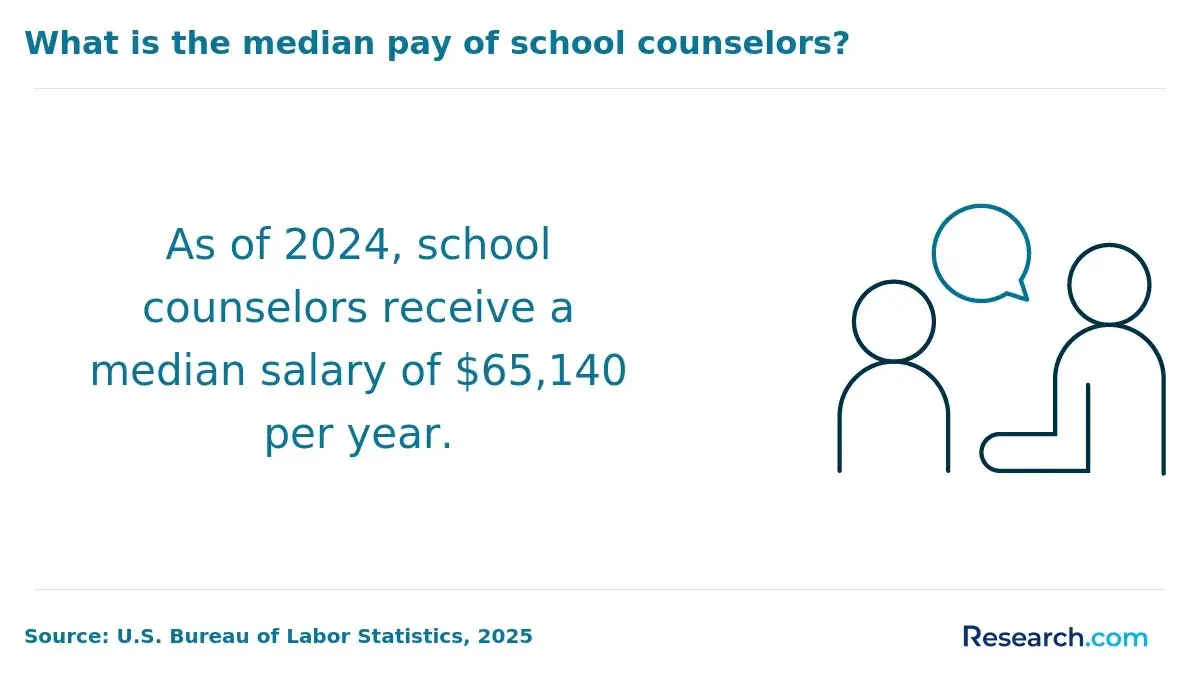
The average annual pay for school counselors in Indiana is approximately $57,483, equal to about $27.64 per hour, $1,105 per week, or $4,790 per month. This is slightly below the national median salary for school counselors, which often exceeds $65,000. Actual pay depends on district salary schedules, years of service, credentials, responsibilities, and local funding.
- Geographic Location: Urban districts may pay more when funding levels and cost of living are higher, while rural districts may have more limited salary schedules.
- Level of Education and Credentials: Additional graduate credits, advanced credentials, or dual licensure can improve eligibility for higher-paying roles in some districts.
- Years of Experience: Counselors generally move up salary schedules as they gain experience and demonstrate program leadership.
- School Setting and District Funding: Public, private, well-funded, and under-resourced schools can differ significantly in compensation and benefits.
- Job Responsibilities and Specializations: Specialized roles may pay differently. Online college counselors are listed at $60,906, online high school counselors at $59,124, and traditional high school guidance counselors at $56,273.
| Role or pay measure | Reported amount | What it means for planning |
| Average Indiana school counselor salary | $57,483 | Use this as a statewide benchmark, not a guaranteed offer |
| Hourly equivalent | $27.64 | Helpful for comparing counseling roles with other education or human services jobs |
| Weekly equivalent | $1,105 | Actual take-home pay will depend on contract length, benefits, deductions, and district policies |
| Monthly equivalent | $4,790 | Useful when estimating loan repayment and living costs |
| Online college counselor | $60,906 | May reflect specialized advising and remote student support responsibilities |
| Online high school counselor | $59,124 | May appeal to counselors with virtual advising and digital communication skills |
| Traditional high school guidance counselor | $56,273 | Can involve academic scheduling, graduation tracking, crisis response, and postsecondary planning |
When evaluating return on investment, compare tuition, fees, commuting costs, fieldwork requirements, and the salary schedule of districts where you want to work. A lower-cost program that meets licensure standards may be a stronger financial choice than a higher-cost program with similar outcomes.
What is the job outlook for school counselors in Indiana?
The employment outlook for school counselors in Indiana is supported by student mental health needs, college and career readiness priorities, and large counselor caseloads. National employment for school and career counselors is projected to grow 4% from 2023 to 2033, while Indiana’s projected growth is 8.7%.
- Student Enrollment Trends: Indiana has 1,997 school counselors for 1,036,108 students, producing a counselor-to-student ratio of approximately 1:519. High caseloads can increase demand for additional counseling staff where funding allows.
- Mental Health Needs: Schools increasingly rely on counselors to support social-emotional learning, crisis response, family referrals, attendance concerns, and student well-being.
- State Education Initiatives: Indiana’s attention to college and career readiness places counselors in important roles related to graduation planning, career pathways, and postsecondary decisions.
- Employment Projections: The 8.7% projected growth in Indiana is higher than the national 4% estimate, suggesting a stronger local growth outlook.
- Job Market Activity: Hiring still depends on district budgets, staffing priorities, retirements, enrollment shifts, and regional need. Candidates willing to work in underserved or growing areas may find more openings.
Students comparing related mental health careers may also want to understand the difference between LPC and LCSW degrees. These credentials can lead to different roles than school counseling and may involve separate state licensure requirements.
What are the career advancement opportunities for school counselors in Indiana?
Indiana school counselors can advance by building leadership, specialized counseling, data analysis, program development, and clinical skills. Advancement is especially important because counselors often manage duties outside direct student counseling; in Indiana, non-counseling tasks consume an average of 15% of their time. Moving into leadership can give counselors more influence over how counseling services are designed and protected.
- Lead or Senior School Counselor: Experienced counselors with a Proficient Practitioner License may coordinate counseling teams, mentor newer counselors, and guide program improvement.
- School Counseling Program Director/Coordinator: This role oversees district-level counseling initiatives and may require a master’s degree plus coursework or experience in educational leadership.
- School Administrator, Assistant Principal, or Principal: Counselors who complete an approved leadership program and earn an Indiana administrator license can move into school administration.
- College and Career Readiness Specialist: This path focuses on graduation planning, college access, workforce preparation, and student transition after high school.
- Career and Technical Education Counselor: Counselors in this area support vocational pathways, CTE programs, apprenticeships, and employer or community partnerships.
- Professional Development Facilitator or Trainer: Experienced counselors may train peers in counseling systems, student support practices, ethical documentation, or college and career readiness.
- Postsecondary Counselor or Academic Advisor: Some school counselors transition into colleges, universities, or student success offices, especially if they have strong advising experience.
- Clinical or Private Practice Counselor: This route usually requires additional licensure, clinical supervision, and experience beyond school counseling preparation.
If cost is a concern while planning graduate study or additional credentials, compare a list of affordable online masters in counseling degree programs. Make sure any program you consider fits your intended license, not just your budget.
| Advancement goal | Useful preparation | Best fit for counselors who want to |
| Lead counselor | Experience, strong program outcomes, mentoring skills | Stay in schools while guiding counseling practice |
| District coordinator | Leadership coursework, data skills, program evaluation | Influence counseling services across multiple schools |
| Administrator | Approved leadership program and administrator licensure | Move from counseling into school management |
| College and career specialist | Admissions, workforce, financial aid, and graduation planning expertise | Focus on postsecondary readiness and student transitions |
| Clinical counselor | Additional clinical licensure and supervised experience | Work beyond the K–12 school setting |
What do school counselors in Indiana say about their careers?
Individual experiences vary by district, caseload, leadership support, and community need. The reflections below highlight common themes reported by Indiana school counselors: meaningful student relationships, rising mental health concerns, the importance of professional development, and the challenge of serving diverse student needs.
- My school counseling preparation connected directly to the work I now do with students at Franklin Central High School. Working in an Indiana school has given me the chance to help students from many backgrounds manage academic pressure, family concerns, and personal challenges. The role feels stable, but the most rewarding part is the trust built over time with students and families. Local community resources also make a real difference when students need help beyond what the school can provide. - Carl
- Starting my career in Indiana showed me how much culture, income, family circumstances, and community context shape student needs. My experience with South Bend Community School helped me understand how important professional judgment and ongoing learning are in this field. Professional development has strengthened my confidence and helped me respond more effectively to students who need both academic and emotional support. - Aiah
- School counseling in Indiana has combined my interest in education with a strong sense of community service. After my time at Carmel High School, I wanted to work in a setting where relationships matter and students are known personally. Supporting rural student needs has also pushed me to become more creative, resourceful, and persistent as an advocate. The work is demanding, but helping students plan their futures makes it worthwhile. - Devon
Common mistakes to avoid when becoming a school counselor in Indiana
| Mistake | Why it causes problems | Better approach |
| Choosing a counseling program without checking Indiana licensure alignment | You may graduate without meeting all school counseling requirements | Ask the program directly whether graduates are prepared for the Indiana School Services License with a School Counselor content area |
| Looking only at tuition | Fees, travel, fieldwork time, exam costs, and delayed completion can change the real cost | Compare total cost, placement support, completion time, and licensing outcomes |
| Assuming online automatically means flexible | Field placements may still require daytime availability in schools | Ask when practicum and internship hours are completed and whether working adults can manage the schedule |
| Waiting to prepare for the Praxis | Testing delays can slow the licensing application | Build exam preparation into your final year of graduate study |
| Ignoring license portability | Moving states can trigger additional coursework, exams, or background checks | Keep detailed syllabi, hour logs, supervisor forms, and license documentation |
| Assuming salary outcomes are guaranteed | Pay differs by district, contract, experience, and role | Review salary schedules in districts where you plan to apply |
Questions to ask before enrolling in an Indiana school counseling program
- Does the program prepare graduates for the Indiana School Services License with a School Counselor content area?
- How many credit hours are required, and can the program be completed full time or part time?
- How are practicum and internship placements arranged?
- Will I be able to complete fieldwork if I work during regular school hours?
- What support does the program provide for the Praxis II Exam (Code 5422)?
- What percentage of graduates complete the program on time?
- Are graduates employed in Indiana K–12 schools after completion?
- What additional costs should I expect beyond tuition?
- Does the curriculum support future LPC licensure, or would that require additional coursework?
- How does the program teach crisis response, suicide prevention, cultural responsiveness, and college and career readiness?
Key Insights
- Indiana school counseling requires graduate-level preparation. A bachelor’s degree starts the path, but a master’s degree and supervised school-based fieldwork are the core professional requirements.
- The required public school credential is the School Services License with a School Counselor content area from the Indiana Department of Education.
- Most students should expect 2–3 years of full-time graduate study, plus time for exams, background checks, and licensing paperwork.
- Indiana’s counselor-to-student ratio of approximately 1:519 and the 53.4% increase in reported student social-emotional needs show why school counselors are important in K–12 education.
- The average Indiana school counselor salary is $57,483, but district salary schedules, credentials, geography, and specialization can affect pay.
- Alternative pathways can help career changers enter the field, but they do not remove the need for approved counseling preparation, fieldwork, exams, and state licensure.
- LPC licensure, school psychology training, or leadership credentials can expand career options, but each adds different requirements and should be chosen based on long-term goals.
- The best program is one that fits Indiana licensure, provides strong field placement support, prepares students for required exams, and offers a realistic total cost—not simply the fastest or cheapest option.
Related Articles for Nearby States
- 2026 How to Become a School Counselor in Ohio
- 2026 How to Become a School Counselor in Illinois
- 2026 How to Become a School Counselor in Kentucky
- 2026 How to Become a School Counselor in Michigan
- 2026 How to Become a School Counselor in Wisconsin
- 2026 How to Become a School Counselor in Missouri
- 2026 How to Become a School Counselor in Tennessee
- 2026 How to Become a School Counselor in Iowa
- 2026 How to Become a School Counselor in West Virginia
- 2026 How to Become a School Counselor in Minnesota
References:
- American School Counselor Association (2023). Student-to-School-Counselor Ratio 2022–2023. Retrieved from https://www.schoolcounselor.org/getmedia/a988972b-1faa-4b5f-8b9e-a73b5ac44476/ratios-22-23-alpha.pdf
- Indiana School Counselor Association (2024). 2024-25 Indiana School Counselor Survey. Retrieved from https://inspiresuccess.org/wp-content/uploads/2025/06/24-25-IN-SC-Survey-Results-Narrative-FINAL-11152024-1.pdf
- National Association for College Admission Counseling (2023). School Counseling: Caseloads and Responsibilities. Retrieved from https://www.nacacnet.org/school-counseling/#Footnotes
- US BLS (2025). School and Career Counselors and Advisors. Retrieved from https://www.bls.gov/ooh/community-and-social-service/school-and-career-counselors.htm
- Zippia (2025). School Counselor Demographics and Statistics in the US. Retrieved from https://www.zippia.com/school-counselor-jobs/demographics/
- ZipRecruiter (2025). School Counselor Salary in Indiana. Retrieved from https://www.ziprecruiter.com/Salaries/School-Counselor-Salary--in-Indiana
Other Things You Should Know About Being a School Counselor in Indiana
To become a licensed school counselor in Indiana by 2026, you must complete a master's degree in school counseling, pass the Indiana CORE Assessments for Educator Licensure, and apply for a license through the Indiana Department of Education. Additionally, you must meet any updated state-specific requirements.





