2027 Rasmussen vs. Keiser: Comparing Online Paralegal Associate Programs

Co-Founder and Chief Data Scientist
Rasmussen University and Keiser University both offer online paths toward a paralegal associate degree, but the word "online" does not tell you what you will pay, when you must attend class, or whether prior credits will count.
This comparison is for prospective students weighing those practical differences. It separates institutional accreditation from paralegal program approval, explains how to compare costs on equal terms, and identifies the questions to settle with each school before enrolling.
Key Things You Should Know
- Rasmussen advertises a paralegal associate program; Keiser advertises a paralegal studies, AA program. Confirm the exact degree award and current online requirements in each school's catalog.
- Rasmussen is institutionally accredited by the Higher Learning Commission; Keiser is institutionally accredited by the Southern Association of Colleges and Schools Commission on Colleges. Institutional accreditation does not establish ABA approval of a paralegal program.
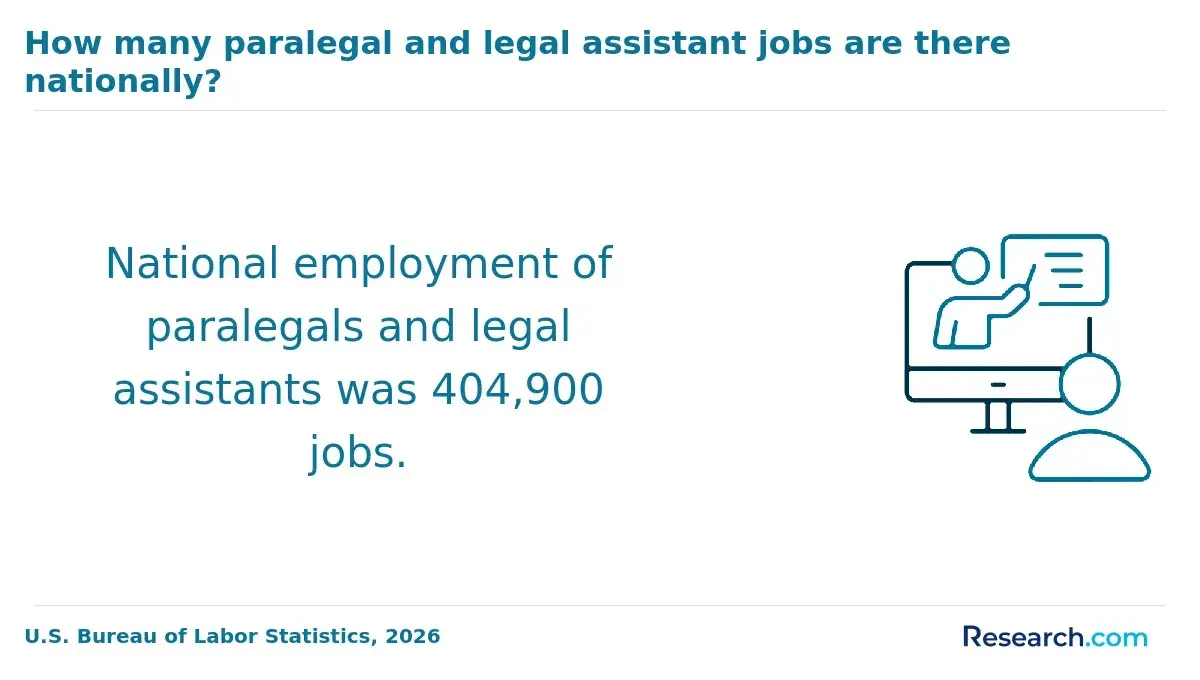
- The U.S. Bureau of Labor Statistics reports $62,890 median annual pay for paralegals and legal assistants in May 2025, with 0% projected growth for 2025-2035. Compare total cost and practical training carefully rather than assuming the degree will lead to a particular job or salary.
What are the main differences between Rasmussen and Keiser paralegal associate programs?
The clearest published distinction is the credential name: Rasmussen markets a paralegal associate degree, while Keiser identifies its program as Paralegal Studies, AA—an Associate of Arts. For a hiring decision, the degree title usually matters less than the coursework, practical assignments, schedule, and cost. For a future bachelor's degree, however, the courses attached to that award may matter considerably.
This comparison keeps the decision criteria the same for both schools. A catalog and a written enrollment estimate—not a general description of either university—should resolve the variables that can change by student or location.
| Decision point | Rasmussen University | Keiser University |
| Advertised program | Paralegal associate program | Paralegal Studies, AA |
| Institutional accreditor | Higher Learning Commission | Southern Association of Colleges and Schools Commission on Colleges |
| Most important item to confirm | Current degree designation, credit requirements, and cost for your enrollment plan | Current AA requirements, course availability, and cost for your enrollment plan |
A difference in accreditation agency does not, by itself, establish that either school offers stronger paralegal training. Compare the actual programs and ask the receiving college about credit transfer if further study is part of your plan.
Are Rasmussen and Keiser accredited for online paralegal studies?
Yes, both universities hold institutional accreditation: Rasmussen through the Higher Learning Commission and Keiser through the Southern Association of Colleges and Schools Commission on Colleges. That status applies to the institution; it should not be described as accreditation of an individual online paralegal program.
ABA approval is a separate question. The American Bar Association approves qualifying paralegal education programs; it does not institutionally accredit universities or certify individual graduates. Do not infer ABA approval from either university's accreditation or from the fact that a degree is offered online. If approval matters to an employer or to your plans, look up the exact program and location in the ABA's current directory and ask the school whether approval covers the delivery option in which you would enroll.
How do Rasmussen and Keiser online paralegal programs compare in cost and length?
Neither a per-credit price nor an advertised completion time is enough for a fair comparison. Your total depends on the credits you must take, the tuition rate applied to you, required fees, books and technology, accepted transfer credit, and how often the courses you need are available. A full-time timeline may not describe what a working student can complete.
Ask each school for a personalized, written degree plan and cost estimate covering the same enrollment scenario. Confirm whether credits are stated in quarter or semester units before comparing them; a semester credit is equivalent to 1.5 quarter credits for a basic unit comparison, but that conversion does not determine whether a course transfers. Ask separately about financial aid eligibility and your likely out-of-pocket cost rather than treating an advertised tuition figure as your final bill.
An associate degree is usually the nearer-term route into paralegal training. If your eventual goal is graduate legal study, factor in the undergraduate study needed first; a comparison of affordable legal studies master's degrees and career earnings addresses a different, later educational decision, not a substitute for comparing these associate-program costs.
What courses are included in each school's online paralegal associate program?
Review each school's current catalog for its exact required courses and electives; a program overview may not show which classes every student must take. For this decision, compare the coverage of legal research and writing, civil procedure, litigation documents, contracts, ethics, and general education. Then compare how students practice those skills—for example, through drafting, research assignments, or a supervised experience if one is required.
Do not assume that a course mentioning legal software provides hands-on access, or that a business-law topic amounts to a formal specialization. If business transactions are your main interest, compare the actual assignments with those in business law programs for working professionals; those programs may serve a different student and credential goal.
What online and campus learning options do Rasmussen and Keiser offer?
Both schools market online paralegal study, but an online program is not necessarily self-paced or entirely free of scheduled commitments. For either school, obtain the course schedule for the term you intend to start. Check for live class meetings, fixed exam windows, courses offered only in particular terms, and any required in-person activity.
If you are considering campus study instead, ask whether the complete paralegal associate curriculum is available at your preferred location; campus offerings can differ from an institution's overall program list. If a current degree plan includes an internship or practicum, get its requirements in writing—including placement responsibility, required hours, and whether your present legal-office job could qualify. Those details may decide which option works alongside your employment.
What are the admission requirements for each paralegal associate program?
Use each university's current associate-program admissions checklist rather than assuming the requirements are identical. Confirm the required education record, any placement or assessment steps, deadlines, and when official transcripts must arrive. If you have college credit, ask for an evaluation showing not merely how much credit is accepted, but which paralegal or general-education requirements it satisfies. The receiving school makes that decision.
Keep associate admissions separate from requirements for later degrees. For example, a guide to legal studies programs without application essays concerns another set of programs; it does not establish whether Rasmussen or Keiser requires an essay for this associate degree.
Which careers can you pursue with a Rasmussen or Keiser paralegal degree?
Either degree can support applications for paralegal and legal assistant roles, subject to employer preferences and the skills you can demonstrate. Typical work includes organizing case materials, researching under attorney supervision, preparing drafts, and managing deadlines. Law firms are one setting; corporate legal departments, government offices, and other organizations also employ legal-support staff.
A degree does not authorize its holder to practice law or independently give legal advice. For students who want more undergraduate study after the associate degree, paralegal bachelor's programs by time and cost can help frame the next decision. Check transfer treatment with the proposed bachelor's institution before counting on an associate degree to shorten that route.
What certifications can graduates pursue after earning a paralegal associate degree?
Professional certification is distinct from earning a college degree or completing a paralegal certificate program. Organizations including the National Association of Legal Assistants, which offers the Certified Paralegal credential, and the National Federation of Paralegal Associations, which offers the Registered Paralegal credential, set their own eligibility and examination rules. State-based credentials may have different conditions. An associate degree alone does not automatically confer any of them, and certification is not a universal requirement for paralegal employment.
Check a credentialing organization's current eligibility rules against your completed coursework and work history before paying to apply. If you later consider graduate legal education instead of a professional credential, choosing the right level of graduate legal studies is a separate decision; neither a graduate legal studies degree nor a paralegal certification qualifies someone to practice as an attorney.
What salary and job outlook can paralegal graduates expect?
The Bureau of Labor Statistics reports a $62,890 median annual wage in May 2025 for paralegals and legal assistants. That is an occupation-wide midpoint, not an entry-level offer or an earnings estimate for graduates of either university. Location, employer, experience, and responsibilities can affect an individual offer.
BLS projects 0% employment growth for 2025-2035, while projecting about 40,800 openings per year, largely as workers leave the occupation. Little net growth does not mean no hiring, but it makes demonstrable research, writing, document-management, and technology skills important when comparing programs. Neither school's degree guarantees a position.
How should you choose between Rasmussen and Keiser for paralegal studies?
Favor the program that gives you the stronger documented fit, not the one with the shorter advertised timeline. Rasmussen may be preferable if its degree plan accepts more of your prior coursework or fits your weekly schedule at a lower total cost. Keiser may be preferable if its AA requirements, available courses, and schedule better support your work obligations or later study. Those are conditional reasons to choose—not claims that either outcome applies to every applicant.
Before paying an enrollment deposit, request both current catalogs, an individual transfer evaluation, a term-by-term course plan, and a written estimate that includes required fees. Resolve any ABA-approval question using the exact program and delivery option. Treat an unexplained price difference, an unconfirmed internship arrangement, or a promise that credits "should transfer" as a reason to pause and get specifics in writing.
Other Things You Should Know About Law & Paralegal
It can be an early step, but it is not an attorney-qualifying degree. You would need to meet a law school's separate admissions requirements and complete the required law degree and licensing process.
Potentially, but remote work does not remove the need to follow applicable state rules and employer supervision requirements. Ask a prospective employer how it handles work across jurisdictions.
Yes, if the coursework would fill a skills gap or meet an employer's education preference. First ask whether your existing training earns credit and whether your employer offers tuition assistance.
Requirements vary by employer. It can help to retain permitted, nonconfidential samples of academic research or drafting assignments so you can discuss your skills without disclosing a client's information.
References
- Rule 3357:15-13-25 | Transfer and articulation. - Ohio Laws https://codes.ohio.gov/ohio-administrative-code/rule-3357:15-13-25
- Cost of Attendance (Budget) | 2025-2026 Federal Student Aid Handbook https://fsapartners.ed.gov/knowledge-center/fsa-handbook/2025-2026/vol3/ch2-cost-attendance-budget
- Programmatic Accrediting Agencies | U.S. Department of Education http://www.ed.gov/laws-and-policy/higher-education-laws-and-policy/college-accreditation/programmatic-accrediting-agencies
- Applying Experiential Learning to Career Development... - PMC https://pmc.ncbi.nlm.nih.gov/articles/PMC8711830/
- Do You Need ABA Approval for a Paralegal Program? | Bryan University Online© https://bryanuniversity.edu/faq/aba-approval-accreditation-paralegal-programs/
- What are Asynchronous Classes? | University of Bridgeport https://www.bridgeport.edu/news/what-are-asynchronous-classes/
- Instruction Modes - Office of the University Registrar https://registrar.unc.edu/instruction-modes/
- How To Become a Paralegal | Rasmussen University https://www.rasmussen.edu/degrees/justice-studies/blog/how-to-become-a-paralegal/