
2027 Legal Studies Master's Programs for Environmental Compliance Officers

Co-Founder and Chief Data Scientist
Environmental compliance officers must turn permits, regulations, and inspection findings into decisions their organizations can defend. A legal studies master's degree may strengthen that work, but it is not the only way to build the necessary skills.
This guide is for working officers and career changers weighing graduate study against technical training and professional credentials. It explains which degree pathways fit different roles, what to check in a program, and how to judge the time and cost before enrolling.
Key Things You Should Know
- A non-JD legal studies master's can help with regulatory interpretation, permitting, and enforcement response, but it is not required for every environmental compliance job and does not qualify graduates to practice law.
- Prioritize courses tied to the laws and tasks in your target role; a general legal studies degree with no environmental coursework may offer less value than a relevant technical degree or shorter credential.
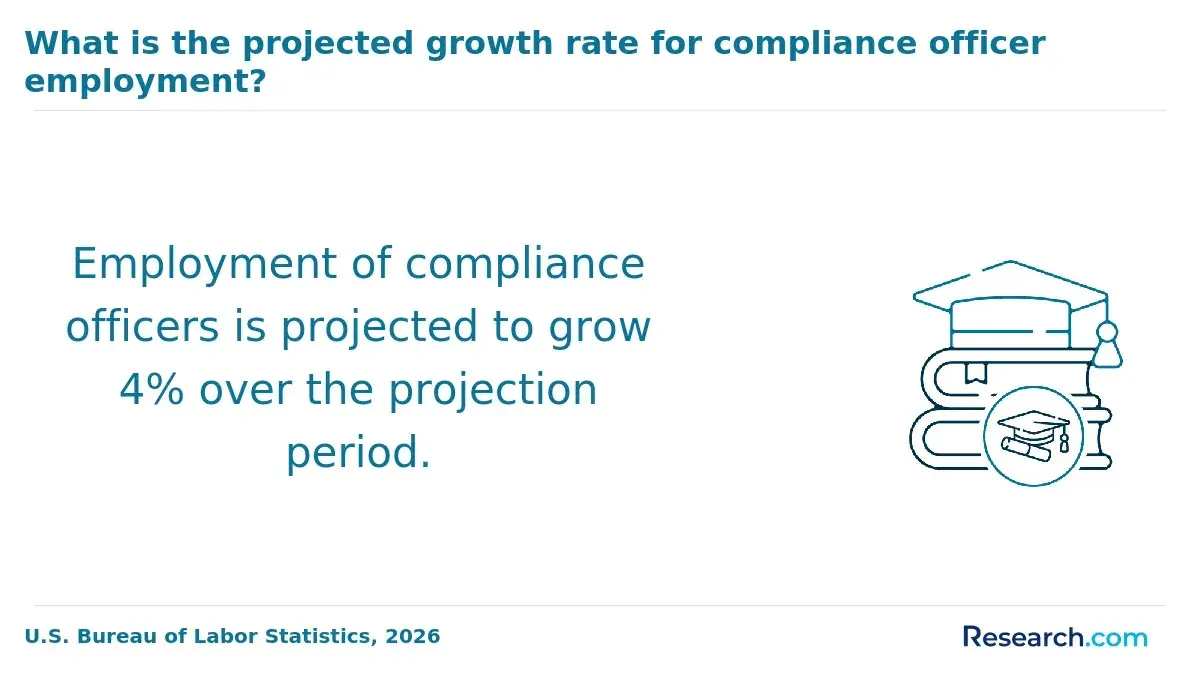
- The Bureau of Labor Statistics reports median pay of $80,730 in May 2025 for the broader compliance officer occupation, with 4% projected growth in 2025-2035, those figures do not measure outcomes for environmental legal studies graduates.
What are legal studies master's programs for environmental compliance officers?
Environmental compliance officers help organizations meet requirements governing activities such as emissions, wastewater, hazardous waste, and land use. Depending on the employer, they may track permit conditions, review operating records, coordinate inspections, investigate potential violations, and work with engineers and counsel on corrective action.
A Master of Legal Studies (MLS), Master of Studies in Law (MSL), or similarly named non-JD degree teaches law to professionals who do not intend to become attorneys. For an environmental officer, its value lies in learning to read statutes, regulations, permits, and agency guidance; document decisions; and recognize when a matter needs legal advice. These degrees do not authorize graduates to practice law or represent an employer as its attorney.
Program labels are less important than the actual curriculum. An advertised environmental concentration may be a defined sequence with its own requirements, while another school may offer only relevant electives. Check the catalog before assuming either provides sustained environmental law training.
What degree and accreditation requirements apply to environmental compliance officers?
There is no single nationwide degree or license required for every environmental compliance officer position. Employers set qualifications according to the work: a manufacturing facility may emphasize chemistry and operations, while a permitting or policy role may place more weight on regulatory analysis. Some jobs require a particular scientific background or experience with specific permits. A legal studies master's is generally an optional advanced qualification, not a substitute for technical competence.
For graduate study, check that the institution holds recognized institutional accreditation and that the credential is a graduate degree rather than a noncredit course. Institutional accreditation is distinct from American Bar Association approval of qualifying paralegal education programs; ABA paralegal approval is not the accreditation test for an MLS or MSL.
Applicants coming from legal support should also distinguish their existing education from environmental job requirements. Transfer-friendly online paralegal bachelor's programs may help someone complete the undergraduate degree needed for graduate admission, but the receiving school decides which credits transfer, and paralegal coursework alone does not establish environmental expertise.
Which master's degree pathways prepare students for environmental compliance careers?
The strongest pathway depends on the work you want to do. These options build different kinds of expertise; none should be chosen solely because its title includes "environmental."
| Pathway | Best fit | Limitation to check |
| MLS, MSL, or Master of Jurisprudence with environmental coursework | Professionals who interpret rules, manage permits, or coordinate regulatory responses | May offer limited science, sampling, or facility-operations training |
| Environmental science or engineering master's | Roles centered on technical assessment, pollution control, or remediation | May devote little time to legal research or enforcement procedure |
| Environmental management or public policy master's | Program leadership, agency policy, or organizational sustainability work | Depth of both technical and legal instruction varies |
| JD | People whose goal is to pursue attorney licensure and legal practice | Requires a substantially different educational and licensure commitment |
A science-trained officer who already understands facility operations may gain more from legal coursework than from another technical degree. Someone new to emissions or wastewater compliance may need technical instruction first. If the gap is narrow, compare which legal studies graduate credential fits your goals before committing to a full master's. A graduate certificate is an educational award, not a professional certification.
How do online and campus-based legal studies programs compare?
Online study can reduce travel and make it easier to keep working, but "online" does not mean self-paced. A program may require live classes, group projects, scheduled exams, or occasional campus visits. Campus programs may make in-person discussion and networking easier but can be harder to combine with shift work or site visits.
Compare the published schedule, not just the delivery label. Ask whether required environmental courses are offered online, how often they run, whether a capstone can use a workplace problem, and who arranges any required placement. If you are still exploring legal work rather than ready for graduate study, online accelerated paralegal learning pathways offer a different, legal-support-focused option; they do not replace training in environmental regulation or qualify you to practice law.
What courses do environmental compliance master's programs typically include?
Start with the compliance tasks in the jobs you want. A useful program should connect legal research and writing to the rules, records, and decisions those jobs involve. Relevant offerings may cover administrative law, environmental statutes, permitting, enforcement, risk management, and regulatory drafting. A capstone involving a permit analysis or compliance policy can be particularly useful if the school permits work with realistic documents.
Read course descriptions closely. A class that surveys environmental policy is not necessarily training in interpreting permit conditions or preparing an inspection response. Likewise, a formal concentration has defined requirements; a few electives do not automatically constitute one. Cross-functional roles may call for other law subjects - for example, our guide to HR law concentrations in legal studies degrees addresses a different regulatory focus - but those courses should not displace the environmental content you need.
What admission requirements do environmental legal studies programs have?
Non-JD legal studies master's programs generally require a bachelor's degree, but schools set their own rules for academic records, recommendations, statements of purpose, and professional experience. A JD is not normally the entry credential for an MLS or MSL designed for nonlawyers. Do not assume, however, that every program accepts every undergraduate major or that environmental science prerequisites are absent.
Career changers should explain how prior work connects to compliance: audits, recordkeeping, operations, safety, quality assurance, policy analysis, or agency interactions can all provide useful context. Before applying, confirm whether your target courses have prerequisites and whether applicants can enter without prior legal study. If the program offers transfer credit or a stackable certificate, obtain its current written policy; admission and credit acceptance are separate decisions.
How long do these master's programs take and how much do they cost?
Time to completion depends on required credits, course availability, and whether you study full- or part-time. An accelerated schedule may shorten enrollment but leave less time for paid work. A slower schedule may make tuition easier to manage while delaying completion. Ask for a course-by-course plan showing when every required environmental class is available.
Advertised tuition is only one part of the decision. Compare costs on the same basis - per credit or for the complete required program - and request a current estimate covering mandatory fees, books, technology, any campus travel, and expenses tied to a practicum. Choosing an affordable online legal studies master's program also means weighing price against relevant courses and scheduling, not treating the lowest advertised tuition as the best value.
Before accepting an offer, ask the school whether the specific graduate program qualifies for federal student aid and whether employer tuition assistance applies. Calculate what you would pay after confirmed assistance, then compare that amount and the time commitment with a graduate certificate, targeted professional training, or employer-supported experience. A higher salary is not an assured return on the degree.
What careers can an environmental compliance master's degree lead to?
Possible roles include environmental compliance specialist or officer, permitting coordinator, regulatory affairs specialist, environmental audit or compliance manager, and agency program analyst. The work differs: permitting roles focus on applications and conditions; audit roles test practices against requirements; management roles oversee systems, staff, and responses to findings.
A master's may help an experienced employee move toward regulatory analysis or leadership, but employers may value direct experience with their permits and operations more highly. For an entry-level applicant, internships or hands-on work with environmental records can matter more than adding another degree immediately. Review actual job postings for the sector and state you want, then compare their required qualifications with the courses and practical work a program provides.
How much do environmental compliance officers earn?
The Bureau of Labor Statistics reports $80,730 in median annual pay in May 2025 for the broader compliance officers occupation. It projects 4% job growth in 2025-2035 and about 32,700 openings per year. These figures describe compliance officers across specialties - not environmental officers specifically, and not people with a particular master's degree.
Pay for an individual environmental role can vary with industry, location, responsibility, and technical experience. Use the BLS figure as broad context, then examine current local postings for your target job and compare their qualifications with the full cost of study. The occupation-wide median cannot establish that an MLS or MSL will raise your pay.
Which certifications and professional standards support environmental compliance careers?
Professional credentials can complement a degree when they match the work. The Institute of Hazardous Materials Management's Certified Hazardous Materials Manager (CHMM) credential is relevant to some hazardous-materials roles; eligibility and assessment requirements belong to the certifying organization and should be checked before enrolling in preparation coursework. Employers may also value training in auditing or environmental management systems for particular positions.
ISO 14001 is an organizational environmental management system standard, not a personal license to practice environmental compliance. Training about a standard, a school-issued course certificate, and a professional certification are different things. Check a credential's issuer, current eligibility rules, renewal obligations, and recognition in your target job postings. Where a specific technical credential meets your goal, it may be a less extensive option than a master's.
Other Things You Should Know About Law & Paralegal
Possibly. Ask the program whether it accepts employer-based projects and what approval it requires. Obtain your employer's permission before using permit records, inspection findings, or other nonpublic information.
Some document review and reporting can be done remotely, but roles involving facility inspections, sampling, or agency visits require time on-site. Check the duties in each posting rather than assuming the degree's online format predicts the job's location.
Describe the problem, your responsibilities, and the process you improved without disclosing protected details. Use public documents or a clearly labeled fictional example for a writing sample, subject to your employer's policies.
No degree alone establishes expert-witness qualifications. Relevant knowledge, experience, methods, and the rules of the proceeding all matter; a court or other decision-maker determines whether proposed expert testimony is admissible.
References
- Requirements | The State Bar of California - CA.gov https://www.calbar.ca.gov/admissions/requirements
- Federal Laws - Environmental Law: A Beginner's Guide | Research Guides at Library of Congress https://guides.loc.gov/environmental-law/federal-laws
- Overview of Primary Environmental Regulations Pertinent to BRAC Cleanup Plan Development: Appendix A | US EPA https://www.epa.gov/fedfac/overview-primary-environmental-regulations-pertinent-brac-cleanup-plan-development-appendix
- Types of Financial Aid: Grants, Work-Study, and Loans | studentaid.gov https://studentaid.gov/understand-aid/types
- Compliance Program Guidance | ny.gov https://omig.ny.gov/media/80796/download
- Cost of Attendance (Budget) | 2025-2026 Federal Student Aid Handbook https://fsapartners.ed.gov/knowledge-center/fsa-handbook/2025-2026/vol3/ch2-cost-attendance-budget
- Environmental Compliance | fedcenter.gov https://www.fedcenter.gov/programs/compliance/
- Independent Study And Online Learning | Veterans Affairs https://www.va.gov/education/about-gi-bill-benefits/how-to-use-benefits/online-distance-learning/
- Curriculum - FSU College of Law - Florida State University https://law.fsu.edu/academics/academic-programs/juris-master-online-program/legal-risk-management-contracting-and-compliance-concentration/curriculum
- What Can You Do With a Master of Legal Studies? | WashU Law https://online.law.washu.edu/articles/what-can-you-do-with-master-of-legal-studies/


