
2027 Paralegal Certificate Programs That Evaluate Professional Experience: What Evidence to Prepare

Co-Founder and Chief Data Scientist
If you already draft documents, manage cases, or work with regulations, you may not need to start paralegal education from scratch. But programs use "experience" in different ways: it might strengthen an application, satisfy a prerequisite, or qualify for an assessment of academic credit. Those outcomes are not interchangeable.
This guide helps working adults identify what a program actually offers, assemble persuasive and confidentiality-safe evidence, and decide whether the time and cost of a certificate make sense before enrolling.
Key Things You Should Know
- Ask whether experience affects admission, a course waiver, or transcripted credit; a résumé alone does not establish eligibility for any of them.
- Prepare verifiable work history and redacted samples that show specific skills, then obtain the program's written assessment rules before paying a fee.
- Compare the certificate's cost with its likely use: the U.S. median pay for paralegals and legal assistants was $62,890 in May 2025, but that occupation-wide figure is not a starting-salary promise.
What are paralegal certificate programs that evaluate professional experience?
They are certificate programs whose admissions or academic policies allow staff or faculty to consider learning gained through work. A prior-learning assessment (PLA) is a formal review of whether documented knowledge meets a course's learning outcomes. Some programs evaluate experience only to decide whether to admit an applicant; others may assess it for a waiver or academic credit.
Do not assume that every program advertising an "experienced professionals" pathway awards credit. Start by identifying the credential. A college-credit certificate, a noncredit continuing-education certificate, and a post-baccalaureate certificate can have different entry requirements and different value if you later seek a degree.
If you do not yet meet a certificate's college prerequisites, online legal studies associate program comparisons may help you evaluate a longer route that includes foundational college coursework. A certificate documents completion of education. It is not the same as professional paralegal certification awarded by a credentialing organization, and neither credential authorizes someone to practice law as an attorney.
How does professional experience count toward paralegal certificate admission or credit?
The distinction to pin down is what changes after the evaluation. The table separates outcomes that can sound similar in admissions language but have different effects on your schedule and transcript.
| Possible outcome | What it means | What to confirm |
| Admission consideration | Experience helps establish readiness or satisfy an entry condition. | Whether all courses remain required. |
| Course waiver or substitution | A requirement changes, but no credit necessarily appears on the transcript. | Whether another course must replace it and whether completion time falls. |
| Academic credit through PLA | Documented learning is assessed against course outcomes under college policy. | Eligible courses, assessment fees, credit limits, and transcript notation. |
Work history does not automatically become college credit. An evaluator may require a portfolio, an exam, training records, or a faculty review, and may exclude courses that teach essential legal research, ethics, or practical skills. Even transcripted PLA credit may not transfer: the receiving institution decides whether and how it applies. Request a written explanation of the evaluation method and an individualized estimate of which requirements could change before treating an accelerated completion date as realistic.
What evidence should applicants prepare for prior-learning evaluation?
Strong evidence shows what you learned and did, not just how long you held a job. First obtain the school's portfolio rubric and course outcomes so you can match each document to the skills being assessed. A practical evidence file may include:
- A dated résumé and employment verification showing roles, responsibilities, supervisors, and relevant projects.
- A short skills narrative connecting specific work to course outcomes, such as legal research, document preparation, or matter management.
- Redacted writing or work samples, with a description of your contribution and the tools or procedures used.
- Records of relevant training, completed coursework, assessments, or employer evaluations that independently support your account.
Legal work can involve privileged, confidential, or protected information. Do not upload client files, internal investigations, or identifiable case materials without authorization. Ask whether the evaluator will accept redacted samples, a simulated document, or a supervisor's description instead. A sample you merely reviewed is weaker evidence than one you created and can explain.
Are online or campus-based paralegal certificate programs better for working adults?
Neither format is inherently better for experience-based applicants. Online delivery can remove commuting, but it does not necessarily remove fixed class times, proctored exams, or an in-person internship. Campus instruction may offer easier access to supervised exercises while requiring travel during work hours.
Compare the actual schedule rather than the format label. Before choosing, request the course sequence, meeting times, exam rules, and any internship policy - including who finds the placement and whether current employment can qualify. If speed is the priority, best accelerated online paralegal programs provides a starting point for comparing faster-paced options; confirm each program's current schedule and PLA policy directly. An accelerated course load may be a poor trade if it forces you to reduce paid work.
What accreditation should a reputable paralegal certificate program have?
Check the institution's accreditation and the paralegal program's approval separately. Institutional accreditation concerns the college or other educational institution. American Bar Association (ABA) approval applies to qualifying paralegal education programs, not to the institution as a whole or to individual graduates. A program can be legitimate without ABA approval, but approval may matter to particular employers or to your own selection criteria.
Verify institutional status through the school's recognized accreditor or U.S. Department of Education resources. If a school claims ABA approval, check the ABA's current directory for the specific program and confirm that the credential and location or delivery arrangement you are considering fall under the listed approval. Also ask who issues the certificate and whether the credits, if any, appear on an accredited institution's transcript. "ABA-certified paralegal" is not a credential the ABA awards.
What coursework do paralegal certificate programs typically require?
Common subjects include legal research and writing, civil litigation, contracts, legal ethics, and procedures for organizing and preparing legal documents. Some programs add electives, technology assignments, or an internship. Requirements vary, so compare the catalog's actual course descriptions - not just its subject labels - with the skills you need for the role you want.
Experienced applicants should pay particular attention to gaps their work may have left. Someone who manages litigation calendars may still need formal research and citation training; someone from compliance may need civil procedure and rules about attorney supervision. Where a program advertises legal software or AI tools, ask whether students complete hands-on assignments and receive access, rather than assuming that a course mention establishes proficiency. Paralegals support legal work under appropriate supervision; coursework does not authorize independent legal advice or representation.
What are the admission requirements for experience-based paralegal programs?
Requirements depend on the credential. Some certificates accept applicants with a high school diploma or equivalent; others require prior college coursework, an associate degree, or a bachelor's degree. Professional experience may supplement an application without replacing a published academic prerequisite. Check the current catalog for minimum education, transcripts, application materials, and any separate eligibility rules for PLA.
If your longer-term goal is a bachelor's degree, assess the certificate's credit value before enrolling. Associate-to-bachelor's pathways in legal studies can help you frame questions about degree progression, but only the receiving school can decide whether certificate, transfer, or PLA credits apply. A useful admissions question is: "Which requirements could my experience change, and can you identify the policy that governs that decision?" Treat a verbal estimate as provisional until the evaluator confirms it in writing.
How long do paralegal certificate programs take, and what do they cost?
Completion time depends on prerequisites, course sequencing, enrollment pace, and any internship - not simply on whether a program calls itself accelerated. An experience assessment can shorten a path only if it changes requirements that would otherwise delay completion. Compare each school's written plan for your circumstances rather than relying on an advertised minimum timeline.
For cost, request a full estimate covering tuition, mandatory and PLA assessment fees, books, research-platform or technology charges, travel, and any internship expenses. Ask whether a successful assessment reduces tuition or merely changes the courses you take. Federal aid is not automatic for certificates: eligibility depends on both the institution and the specific program, among other student requirements. Confirm eligibility with the financial aid office before budgeting around it.
If you are also considering graduate legal education for a different career goal, budgeting for an online master's in legal studies illustrates why credentials with different academic levels need separate cost and opportunity-cost calculations. Do not pay graduate-level prices when a certificate - or employer training - would meet your objective.
What careers and salaries can a paralegal certificate support?
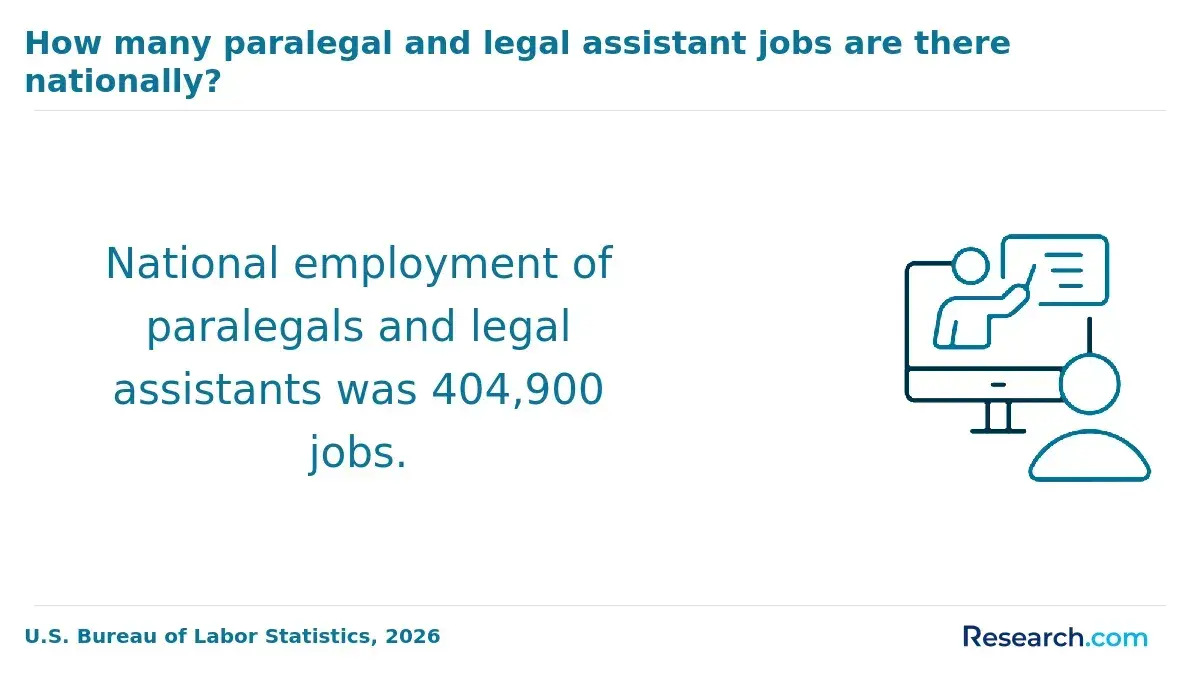
A certificate may help an applicant demonstrate legal research, writing, and procedural skills for paralegal or legal assistant positions, particularly when prior work is relevant. Employers still assess experience, writing ability, and the needs of a specific practice. The U.S. Bureau of Labor Statistics reports median annual pay of $62,890 in May 2025 for paralegals and legal assistants, with about 40,800 openings per year through 2035. That median covers workers at different career stages; openings do not mean a certificate guarantees a job.
If your aim is primarily regulatory work rather than attorney-supervised legal support, compare the certificate with employer training or a non-JD legal studies credential. Legal studies graduate degree options explained can help distinguish that broader route from paralegal training. Neither a certificate nor a non-JD legal studies degree qualifies its holder to practice law as an attorney.
Do paralegals need certification or a state license to work?
There is no single nationwide paralegal license or professional certification required for every job. State rules, job duties, and employer preferences vary, so check the rules where you intend to work - especially if a role involves direct contact with the public or a state-specific regulated title. A paralegal certificate is an educational award; optional professional certifications are separate credentials with their own eligibility and examination rules.
When comparing programs, ask whether their coursework supports your intended employer requirements or a specific certification's published eligibility criteria. Do not assume that graduation automatically confers certification, satisfies a state rule, or permits work outside an attorney-supervised role.
Other Things You Should Know About Law & Paralegal
Often, but the evaluator decides what it accepts. Contracts, invoices, project descriptions, and references may help verify the work. Ask which records can be submitted without disclosing a client's confidential information.
Potentially. Duties and training matter more than the job title. Provide official training records and descriptions of relevant work, then ask the program to compare them with its published course outcomes.
Not necessarily. Colleges may use different notations for assessed credit, and a later school may treat that credit differently. Request a sample transcript notation and confirm the receiving school's policy if transfer is important.
Ask for the reason and the program's reconsideration policy. Missing documentation may be fixable; a mismatch with required learning outcomes may mean taking the course. Confirm any appeal deadlines before paying for another assessment.
References
- Verification of Experience/Education - SF Careers - SF.gov https://careers.sf.gov/knowledge/experience-education/
- Direct Assessment (Competency-Based) Programs | ed.gov http://www.ed.gov/laws-and-policy/higher-education-laws-and-policy/higher-education-policy/direct-assessment-competency-based-programs
- School-Determined Requirements | 2024-2025 Federal Student Aid Handbook https://fsapartners.ed.gov/knowledge-center/fsa-handbook/2024-2025/vol1/ch1-school-determined-requirements
- Paralegal | Community College of Denver https://www.ccd.edu/program/paralegal
- Unaccredited vs. ABA-Accredited Law Schools | Cleveland State University Online https://onlinelearning.csuohio.edu/blog/jd/unaccredited-vs-aba-accredited-law-schools-whats-difference
- How to Become a Paralegal | Online Paralegal Studies Certificate Program https://paralegalonline.bu.edu/articles/become-a-paralegal/
- How to Turn Work and Life Experience Into College Credit | St. Thomas University https://www.stu.edu/news/how-to-turn-work-and-life-experience-into-college-credit/
- Credit for Prior Learning | Charter Oak State College https://www.charteroak.edu/cpl/
- Earning College Credit for Work Experience | Goodwin College of Professional Studies https://drexel.edu/soe/resources/community/college-credit-work-experience/
- Paralegal Certificate Colorado, Online Legal Assistant Certificate | MSU Denver https://www.msudenver.edu/innovative-lifelong-learning/professional-development/center-for-legal-studies/


