2027 MLIS Programs for Name Authority and Bibliographic Identity Work

Co-Founder and Chief Data Scientist
Choosing an MLIS for name authority work takes more than finding a cataloging elective. You need a program that lets you practice distinguishing people with similar names, connecting their publications, and maintaining reliable records across systems. The U.S. Bureau of Labor Statistics projects 2.6% employment growth for librarians and media collections specialists from 2025 to 2035; that broad outlook makes specialized skills and applied experience worth examining closely. This guide shows prospective students and career changers how to evaluate curricula, credentials, formats, costs, and career fit without mistaking a relevant course for a formal specialization.
Key Things You Should Know
- Look for applied cataloging and authority-control work, not a program title alone: a course listing does not establish that an elective will run when you need it.
- Check the specific master's program in the current ALA accreditation directory; institutional accreditation and ALA program accreditation are different.
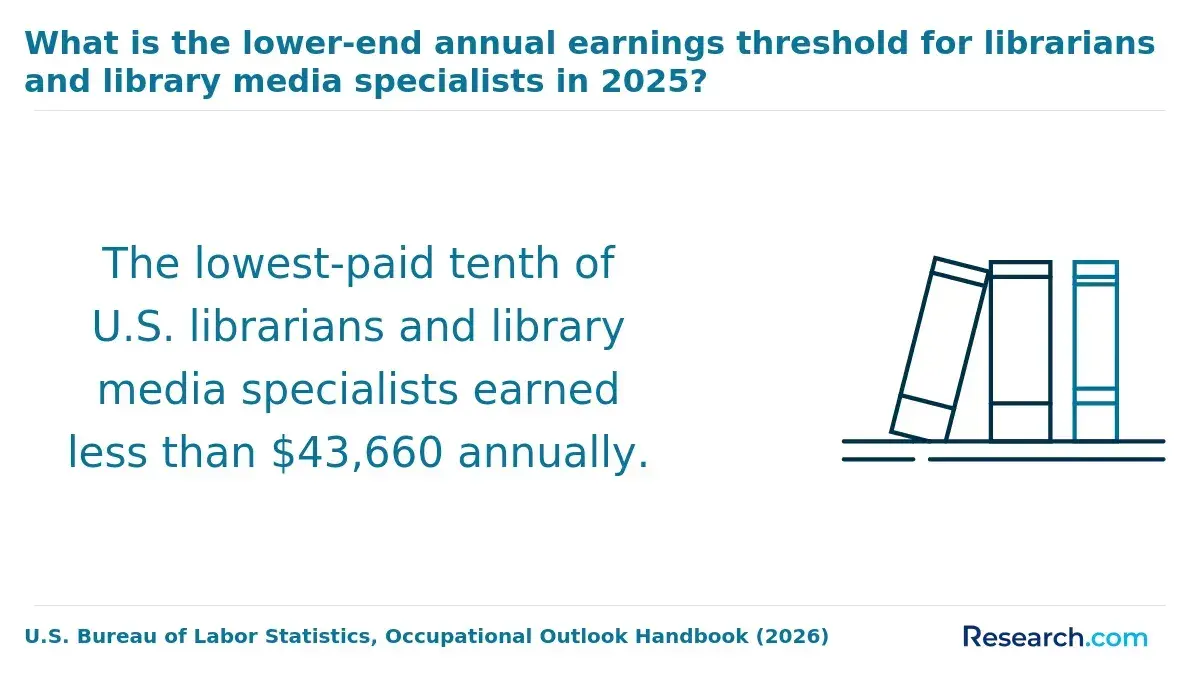
- The May 2025 median annual pay for the broad librarian and media collections specialist occupation was $68,270, not a salary estimate for new metadata librarians.
What are MLIS programs for name authority and bibliographic identity work?
These are library and information science master's programs whose coursework and projects can prepare students to establish, distinguish, and connect identities in catalogs and other discovery systems. Name authority control keeps references to a person or organization consistent despite name changes, pseudonyms, spelling variants, or shared names. Bibliographic identity work also connects an identity to its works and helps users find the right creator and materials.
The work calls for research judgment as well as technical fluency. A practitioner may compare publication histories, document evidence for a name choice, update an authority record, and check whether connected bibliographic records still point to the right entity. A library information studies program can provide the broader foundation, but applicants should examine its actual cataloging and metadata options before treating it as preparation for this specialty.
Which MLIS programs offer coursework in metadata and authority control?
There is no responsible shortlist based on the degree name alone: a relevant elective might be optional, infrequent, or unavailable to a particular student. Instead, compare current university catalogs and term schedules against the same evidence standards. An online librarian masters comparison can help identify programs to investigate, but the university's current course information should settle whether a program fits this goal.
The distinctions below help prevent a common mistake: treating general curriculum alignment as proof of a dedicated track or hands-on training.
| Evidence to look for | What it establishes | What to confirm |
| Officially named concentration or track | The program documents a structured pathway. | Whether its requirements include authority work, rather than metadata broadly. |
| Cataloging or metadata course description | Relevant coursework is listed. | Whether authority records and identity problems are taught and when the course next runs. |
| Practicum, capstone, or independent-study policy | An applied route may be possible. | Placement approval, supervision, eligibility, and whether the desired project can be completed. |
| General LIS curriculum | A foundation for information organization exists. | Whether specialized courses or projects can be added. |
Ask a program adviser for a recent syllabus and a tentative course schedule. Compare those answers across schools before applying; neither a catalog entry nor an adviser's example guarantees a future elective seat.
Why does ALA accreditation matter for authority and bibliographic metadata careers?
ALA accreditation applies to eligible master's programs, not automatically to every degree offered by an accredited university. Some librarian job postings specify an ALA-accredited master's, so choosing one can preserve access to those positions. Check the specific program and degree in the current ALA directory, particularly if a university offers several information-related master's degrees.
Accreditation does not certify that a program teaches name authority control, offers a particular elective online, or provides a cataloging placement. Evaluate those features separately. An employer hiring for an adjacent metadata or data-management role may also consider other degrees and experience, so read postings in your target setting rather than assuming every bibliographic identity job has the same credential requirement.
What degree pathways prepare students for bibliographic identity work?
An ALA-accredited MLIS, MLS, or differently titled LIS master's can be a suitable route when its curriculum includes substantive organization-of-information work. Degree labels alone do not establish either accreditation or specialization. Build a pathway that moves from descriptive cataloging to authority decisions, metadata interoperability, and an applied project in your intended setting.
For a prospective professional cataloging librarian, a master's plus supervised work with real records may align best with job requirements. Someone already employed in a library might instead test the field through cataloging duties or continuing education before committing to a degree. For identity resolution in a publisher, repository, or software company, relevant technical experience or another information-focused degree may be competitive; the MLIS is not universally required.
Where the degree permits it, a useful capstone might document how you investigated ambiguous creators, chose evidence, recorded variants, and checked downstream discovery results. That demonstrates judgment more clearly than a project that only names the standards used.
Do online MLIS programs provide training for name authority work?
They can, provided the relevant courses and supervised projects are accessible to online students. Delivery format does not tell you whether cataloging exercises use realistic records, whether a practicum can be arranged locally, or whether a needed elective fits your schedule. Ask which activities are asynchronous, which require live attendance, and whether any placement or campus visit is required.
Course sequencing matters as much as the advertised pace: if advanced metadata requires introductory cataloging first, missing one offering could delay your project. Use guidance on how many years for library science degree as a starting point, then request a term-by-term plan for your electives, workload, and enrollment status. Do not assume online study automatically means flexible deadlines or remote internships.
What courses cover cataloging, linked data, and identity management?
Prioritize courses by the decisions they let you practice. Introductory cataloging should teach descriptive records and access points; advanced work should let you investigate conflicting evidence, document identity decisions, and understand how records are shared. The following curriculum map distinguishes directly relevant skills from useful extensions.
| Course area | Relevant learning | Fit for this goal |
| Cataloging and classification | Bibliographic description, access points, and MARC records, a common format for exchanging library records. | Foundational for library authority work. |
| Authority control or advanced cataloging | Name variants, evidence, record maintenance, and relationships between identities and works. | Most directly aligned; inspect assignments, not just the title. |
| Metadata and linked data | Mapping descriptions between systems and connecting entities using structured identifiers; BIBFRAME may appear in library-focused courses. | Useful for systems and interoperability roles. |
| Digital collections or repositories | Creator metadata and discovery outside the traditional catalog. | Useful when targeting archives or scholarly outputs. |
RDA, a cataloging standard, and MARC proficiency remain useful where employers use them. Linked-data study adds perspective on how identity relationships travel between systems; it does not replace the careful source evaluation needed to distinguish two people with the same name.
What are the admission requirements for specialized MLIS programs?
Requirements depend on the institution and its specific degree, not on a universal "authority-control" admissions standard. Review the current application instructions for the required undergraduate credential, transcripts, statements, recommendations, and any language or testing policies that apply to you. A cataloging background may strengthen an application or help you choose courses, but it should not be assumed to waive published requirements.
Use your statement to connect a concrete experience - such as reconciling creator names in a collection - to the program's documented coursework. If you have an unusual academic history or need to complete a prerequisite, ask admissions for an individual review before paying an application fee. Ask the academic adviser separately whether your intended advanced courses have prerequisites and whether online students can take them.
How long do MLIS programs take and how much do they cost?
Duration depends on required credits, enrollment pace, prerequisites, and when electives are offered. Without a current school-specific tuition schedule and degree audit, a reliable total price is not possible. Compare programs using the same assumptions: required credits multiplied by the tuition rate that applies to you, then add mandatory fees and likely books, equipment, travel, and practicum expenses. Published tuition is not the full cost of attendance.
For a funding comparison, keep gross program cost separate from your out-of-pocket expense and any amount you would borrow. Scholarships and employer reimbursement can change the latter two, but eligibility is not guaranteed. Guidance on affordable library masters scholarships can help frame your search; confirm awards, enrollment conditions, and deadlines directly with each institution.
Ask financial aid staff which aid rules apply to your intended enrollment period before relying on loans. Also ask the program when your required cataloging sequence runs: an extra term caused by course availability can add living and fee costs even if the credit requirement stays the same.
What careers use name authority and bibliographic identity skills?
Cataloging and metadata librarians in academic, public, and special libraries use these skills to make creators and works findable. Authority-control specialists may focus more closely on reviewing identity evidence and maintaining records. Repository and digital-collections staff also reconcile creator information, although their roles can involve different metadata systems and may accept varied degrees.
Job titles are imperfect signals. Compare postings for record creation, authority maintenance, metadata cleanup, systems migration, and quality review. A library technician position may offer an entry point to these workflows without having the same degree expectations or responsibilities as a professional librarian role. Readers exploring broader options can compare library science jobs that pay well, while checking each posting's actual qualifications and duties.
To compete for specialized work, seek a supervised assignment that leaves evidence of your process: the sources checked, identity decisions made, errors corrected, and effects on retrieval. Keep confidential or employer-owned records out of a public portfolio unless you have permission.
What salaries and job outlook apply to metadata librarians?
The Bureau of Labor Statistics does not provide a separate national salary or growth projection for "metadata librarian." For the broader U.S. occupation of librarians and media collections specialists, median annual pay was $68,270 in May 2025, with projected employment growth of 2.6% from 2025 to 2035. These figures describe the occupation as a whole, not starting pay, a particular specialty, or outcomes from any MLIS program.
Use that benchmark cautiously when judging return on investment. Search current postings in your target region and setting, compare their pay ranges and degree requirements with your present earnings, and weigh the full education cost against the work you want to do. A relevant project can improve your evidence of skill, but it cannot guarantee a job or salary.
Other Things You Should Know About Library Science
No. An ORCID iD is a persistent researcher identifier; a library authority record supports controlled access and identity relationships in library systems. A workflow may connect them, but one does not automatically replace the other.
Show the evidence you used and explain the relationship without assuming every name belongs in one public identity. Follow the applicable cataloging policy and respect privacy where disclosure could cause harm.
Only if the program approves the placement under its practicum rules. Obtain approval, including any supervision and learning-objective requirements, before expecting volunteer hours to count.
Record the sources and the conflict, avoid merging identities on weak evidence, and follow the organization's review procedure. Careful uncertainty is preferable to a confident but incorrect match.
References
- BIBFRAME 2.0 Implementation Register | loc.gov https://www.loc.gov/bibframe/implementation/register.html
- Cost of Attendance (Budget) | 2025-2026 Federal Student Aid Handbook https://fsapartners.ed.gov/knowledge-center/fsa-handbook/2025-2026/vol3/ch2-cost-attendance-budget
- General Schedule Qualification Policies | U.S. Office of Personnel Management https://www.opm.gov/policy-data-oversight/classification-qualifications/general-schedule-qualification-policies/
- Metadata Remediation Student Assistant - UW Libraries https://lib.uw.edu/about/jobs/student-employment-in-the-libraries/metadata-remediation-student-assistant/
- Master of Library and Information Science | Wayne State University https://sis.wayne.edu/mlis
- CSUN Librarians Legacy Internship https://library.csun.edu/about/employment/csun-librarians-legacy-internship
- Library Science Master's - MLIS - UW Information School https://ischool.uw.edu/programs/mlis
- Authority Control - Yale Library https://web.library.yale.edu/book/export/html/676
- Cost of attendance | Twin Cities One Stop Student Services https://onestop.umn.edu/finances/costs/cost-attendance
- Internships, Capstones, and Practicums | uncg.edu https://library.uncg.edu/about-us/library-departments/special-collections-university-archives/scua-internships-capstones-and-practicums/