
2027 MLIS Programs for Public Sector Information Governance

Co-Founder and Chief Data Scientist
Choosing an MLIS for government records work takes more than finding a program with an archives elective. Public agencies need people who can manage retention, access, privacy, and digital records while working within agency rules.
The U.S. Bureau of Labor Statistics reports a May 2025 median annual salary of $68,270 for librarians and media collections specialists, but information governance jobs span several occupations. This guide helps prospective students identify relevant training, compare program formats and costs, and decide whether an MLIS fits their intended role.
Key Things You Should Know
- Look for documented records-management coursework and applied projects; an ALA-accredited MLIS does not automatically offer a public-sector information governance specialization.
- Public-sector roles include records manager, government archivist, and information governance analyst. BLS projects 2.6% employment growth for librarians and media collections specialists from 2025 to 2035, but that figure does not describe every governance job.
- Compare required credits, fees, elective scheduling, and agency-based experience before enrolling. An MLIS may be valuable for librarian or archivist positions, while some records roles accept other degrees and relevant experience.
What is an MLIS degree for public-sector information governance?
It is a library and information science master's degree used to prepare for managing information across its lifecycle in a public agency. That work can include creating records policies, organizing digital files, applying retention schedules, supporting lawful access, protecting restricted information, and documenting defensible disposal. The aim is to make information findable and accountable without treating every record as either permanently public or permanently confidential.
"Public-sector information governance" describes a career focus, not a standard degree title or a concentration that every MLIS offers. Schools may award an MLIS, MLS, Master of Science in Library Science, or another LIS degree. Evaluate the documented curriculum rather than assuming those names signal different levels of preparation.
The distinction between related fields matters. Records management governs records while agencies use and retain them; archives selects and preserves records of enduring value; and information governance coordinates these activities with access, privacy, security, and organizational policy. A student targeting operational records work may need a different elective mix from one seeking a government archives position.
Which accreditation should public-sector MLIS programs have?
For a professional librarian path, check whether the specific master's program appears in the current American Library Association directory of accredited programs. Institutional accreditation and ALA program accreditation are separate; one does not establish the other. Some government librarian postings may specify an ALA-accredited degree, so compare the credential language in jobs you would actually seek.
ALA accreditation evaluates the program, not whether it offers a records concentration, a particular elective, or a public-agency internship. Confirm those features separately in the catalog and with the department. If speed is a priority, use a shortest accredited library science degree comparison as a starting point, then verify current accreditation and whether the courses you need fit the proposed schedule.
For information governance positions that accept several graduate fields - or do not require a master's - ALA accreditation may be less decisive than relevant skills and experience. It should inform the decision, not substitute for checking employer requirements.
What career paths can an MLIS prepare you for in information governance?
An MLIS can support several public-sector paths, but job titles and degree requirements vary by agency. The comparison below shows where LIS preparation is most directly relevant and where experience or another degree may also be competitive.
| Path | Typical work | How an MLIS fits |
| Government librarian | Organizes agency information and helps staff or the public find it. | Often directly relevant; check postings for specific accreditation requirements. |
| Records manager | Maintains retention procedures, inventories, and disposition documentation. | Relevant when paired with records coursework and practice; other degrees may qualify. |
| Government archivist | Appraises, describes, preserves, and provides access to enduring records. | Useful with archival training and hands-on collections experience. |
| Information governance analyst | Coordinates information policies, inventories, access controls, and compliance workflows. | One possible route; employers may also value legal, IT, or risk-management experience. |
Entry-level applicants can strengthen their case through a supervised agency project, records inventory, metadata work, or a documented policy analysis. Advancement commonly requires explaining decisions to legal, technology, and program staff - not just knowing a cataloging system. Because hiring standards differ, research what makes a library career competitive alongside actual agency postings rather than assuming the degree alone will qualify you.
What do MLIS programs teach about records and information management?
Relevant MLIS study connects information organization to the decisions agencies make about keeping, finding, releasing, and protecting records. Look for published course descriptions covering appraisal, retention schedules, electronic records, metadata, digital preservation, privacy, and information policy. A catalog listing confirms a course exists, not that it runs often enough to fit your graduation plan.
Coursework should lead to usable evidence of your skills. For example, a project might document a sample records inventory and retention rationale, or design metadata and preservation steps for a digital collection. Work involving public-records requests should distinguish locating responsive material from making legal disclosure decisions; agency counsel or designated officials may control the latter.
Ask whether students can complete a practicum, capstone, or independent project with a public agency and whether remote placements are permitted. Also ask how the program assesses applied work. Readers comparing assessment based MLIS programs should check how demonstrated competencies translate into credit and whether records-focused projects can be assessed within the degree. No assessment model replaces the need to verify the actual curriculum.
Digital workflows increasingly involve automated classification or AI-assisted discovery. The useful skill is not accepting a tool's output uncritically: it is testing accuracy, documenting decisions, and applying human review where records, privacy, or access rights are affected.
Are online or campus-based MLIS programs better for public-sector careers?
Neither format is inherently better. An online program may let a working agency employee remain employed and use local experience for projects. A campus program may make nearby archives, agency partnerships, or supervised collections work easier to access. What matters is whether the format lets you complete the right courses and obtain relevant experience.
Online does not necessarily mean self-paced: classes may meet at fixed times, electives may rotate, and placements may require on-site work. Compare online library graduate programs by asking each department about live-session requirements, course sequencing, residency expectations, and who arranges internships. If you already work in government, also ask whether a current-employer project can satisfy any applied requirement.
What are the admission requirements for public-sector MLIS programs?
Applicants generally need a bachelor's degree and must submit the materials required by the individual graduate program, which may include transcripts, a statement of purpose, references, and a résumé. GPA policies, tests, deadlines, and prerequisite rules vary. A previous library job is not a universal requirement, and public-agency experience does not automatically waive academic eligibility rules.
Use the statement of purpose to name the work you hope to do - such as electronic records management or government archives - and connect it to documented courses or projects. Before applying, ask admissions staff how the program evaluates relevant professional experience and whether any previous graduate credits can transfer. Get the answer for your circumstances in writing; transfer-credit approval and admission are separate decisions.
How long do MLIS programs take and how much do they cost?
Completion time depends on required credits, enrollment pace, and when needed electives are offered. Published tuition alone cannot establish the total price: calculate required credits multiplied by the tuition rate applicable to you, then add mandatory fees and expected materials, travel, or placement costs. Ask whether a delayed elective could require an additional term.
When reviewing an online library degree with low tuition, compare the full program cost rather than one school's per-credit rate against another school's per-term rate. Do not assume online students receive in-state tuition. Employer reimbursement or aid may reduce your out-of-pocket cost, while borrowing changes the amount and timing of repayment; neither makes the underlying program free.
Before committing, request a current cost estimate based on your residency, planned course load, and expected completion schedule. For federal aid, confirm your eligibility and the rules for your enrollment period with the school's financial aid office. If your target jobs do not require an MLIS, compare the degree's cost and time with a focused certificate or relevant work experience.
What salaries can information governance professionals with an MLIS earn?
There is no single reliable salary figure for "MLIS information governance graduates." BLS reports a May 2025 median annual salary of $68,270 for librarians and media collections specialists and $64,550 for archivists. These are occupational medians across workers, not starting salaries, public-sector-only figures, or outcomes attributable to an MLIS.
A records manager or governance analyst may be classified under another occupation or agency pay system. For a realistic comparison, inspect current salary ranges for your target job titles and location, then consider required experience, benefits, and your present earnings. A higher occupational median does not by itself establish that the degree will pay for itself.
What is the job outlook for public-sector information governance careers?
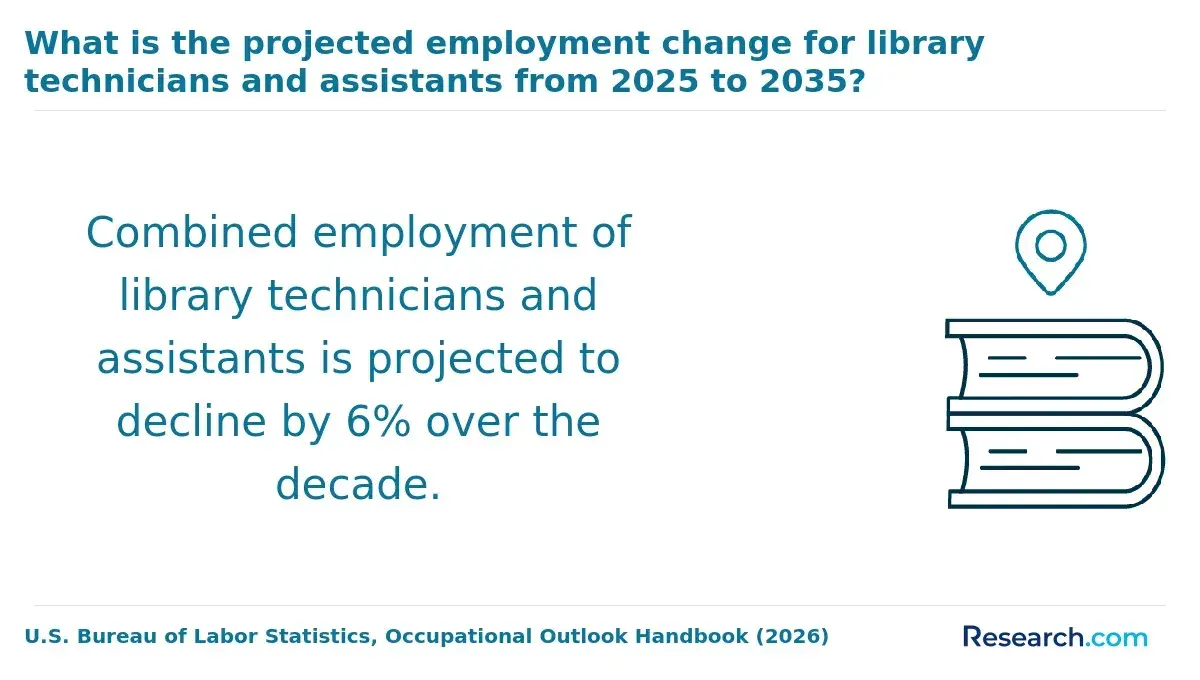
BLS projects 2.6% employment growth for librarians and media collections specialists and 3.4% for archivists from 2025 to 2035. These projections provide context for two related occupations, but they do not forecast openings for public-sector information governance as a distinct field or in a particular city.
Agencies still need to manage digital records, preservation, access, and privacy, but the responsibilities may sit in libraries, archives, records offices, legal teams, or IT units. Search across those departments and compare posting requirements before choosing electives. Local hiring budgets and competition can matter more to an individual job search than a national growth figure.
Which certifications complement an MLIS in information governance?
Certifications can demonstrate specialized knowledge, but none is a universal legal requirement for public-sector information governance work. The options below suit different responsibilities; check each issuing organization's current eligibility, examination, and renewal rules before planning around one.
- Certified Records Manager (CRM): A potential fit for professionals concentrating on records-management practice and policy.
- Information Governance Professional (IGP): A potential fit for work coordinating information policy across organizational functions.
- Certified Archivist (CA): More directly aligned with archival appraisal, description, preservation, and access work.
Choose a credential after reviewing target job postings and gaining enough relevant practice to make the material useful. An MLIS, a certification, and agency experience serve different purposes; one does not automatically replace the others.
Other Things You Should Know About Library Science
Requirements depend on the employer and position. Read the vacancy announcement and the relevant agency's application instructions rather than assuming every public-sector job uses the same hiring process.
No. An MLIS can prepare you to organize records and support access workflows, but legal interpretations and disclosure decisions belong to personnel authorized under the agency's procedures.
Not for every role. Some positions require a clearance or other screening; others do not. The vacancy announcement should identify position-specific conditions.
Only if sharing is permitted. Obtain approval where needed, remove sensitive information, or create a clearly labeled simulated example that demonstrates your method without exposing agency records.
References
- Students & Recent Graduates | U.S. Office of Personnel Management https://www.opm.gov/policy-data-oversight/hiring-information/students-recent-graduates/
- FOIA.gov - Freedom of Information Act: Frequently Asked Questions (FAQ) https://www.foia.gov/faq.html
- About the Digital Preservation Program | National Archives https://www.archives.gov/preservation/digital-preservation/about
- Privacy Laws, Policies and Guidance - Commerce.gov https://www.commerce.gov/opog/privacy/privacy-laws-policies-and-guidance
- 5 FAM 410 RECORDS AND INFORMATION MANAGEMENT PROGRAM | state.gov https://fam.state.gov/fam/05fam/05fam0410.html
- Retention and Disposition | New York State Archives - Nysed https://www.archives.nysed.gov/records/topic-retention-and-disposition
- Library and Information Science - MLIS - Kent State Online https://onlinedegrees.kent.edu/degrees/master-of-library-and-information-science
- Master of Library and Information Science (MLIS) | umd.edu https://info.umd.edu/academics/masters-programs/master-of-library-and-information-science/
- Records Management Primary Roles, Responsibilities, and Procedures | Records Management https://records.arizona.edu/roles-responsibilities-procedures
- Master of Library and Information Science (MLIS) | du.edu https://morgridge.du.edu/academics-advising/programs-gr/mlis-library-and-information-science


