2027 MLIS Programs for School Library Crisis and Emergency Preparedness

Co-Founder and Chief Data Scientist
Choosing an MLIS for school library work means checking more than the course catalog: a program must fit your state's credential rules and help you prepare for disruptions to students, services, and collections. The U.S. Bureau of Labor Statistics projects 2.6% employment growth for librarians and media collections specialists from 2025 to 2035, so a specialized skill set is worth evaluating alongside the degree's cost.
This guide shows prospective school librarians and current educators how to assess credentials, coursework, field experience, and career fit without mistaking a relevant elective for a dedicated crisis-preparedness program.
Key Things You Should Know
- Look for an MLIS or related LIS master's with school library preparation, then verify your intended state's certification or endorsement rules separately; ALA accreditation alone does not confer a school credential.
- The strongest preparation combines school library instruction with emergency planning, student privacy, accessible communication, collection recovery, and supervised practice, not merely a course with "crisis" in its title.
- The BLS reports a May 2025 median annual wage of $68,270 for librarians and media collections specialists; that broad occupational figure is not a school librarian starting salary or a program outcome.
What are MLIS programs for school library crisis and emergency preparedness?
These are library and information science master's pathways that prepare students to support a school library before, during, and after disruptions. The work can include maintaining access to learning materials during a closure, protecting student information, communicating within a school's incident procedures, and helping assess damaged collections. A school librarian participates in the district's response; the degree does not make the librarian the school's emergency commander or a mental health clinician.
"Crisis and emergency preparedness" should be treated as a learning goal, not an assumed concentration name. A program might document a school library track, offer a relevant elective, permit an applied project, or simply provide general LIS foundations. Those are different levels of evidence. Students considering one year library graduate program options should pay particular attention to whether the schedule leaves room for school-specific coursework and a suitable field placement.
Which accreditation and licensing requirements apply to school library MLIS programs?
ALA accreditation applies to a specific master's program, not automatically to every degree at an institution. Institutional accreditation is a separate consideration. Check the current American Library Association directory for the exact program and degree before treating it as ALA-accredited. Accreditation does not verify that a crisis elective is offered, that a school placement is available, or that the degree satisfies your state's school librarian requirements.
School librarian certification, licensure, or endorsement is governed by the state where you intend to work. Depending on that state and the applicant's prior teaching credentials, requirements may involve an approved preparation pathway, supervised school experience, assessments, or additional coursework. Consult the state education authority, then ask the university's school library preparation coordinator for a written explanation of how its pathway aligns with those rules. If you may move, check the destination state as well; an online degree is not automatically portable as a school credential.
What degree pathways prepare students for school library emergency management?
The right pathway depends first on whether you need a school librarian credential or want emergency-related skills for a role you already hold. The distinctions below help prevent an elective or short course from being mistaken for a complete certification route.
| Pathway | Best fit | Critical verification |
| LIS master's with documented school library preparation | Prospective school librarians | State credential alignment, school fieldwork, and relevant electives |
| General MLIS, MLS, Master of Science in Library Science, or Master of Information | Students seeking broader information careers | Whether the particular degree includes an approved school pathway |
| Post-master's endorsement or graduate certificate | Educators or librarians who already hold qualifying degrees | State eligibility and which prior requirements still apply |
| Employer training or emergency-management coursework | Credentialed staff adding a focused skill | Whether training supplements, rather than replaces, school librarian qualifications |
Degree titles vary by university; the title alone does not establish curriculum or eligibility. A comparison of the types of library science degrees can help you narrow the degree question, but the deciding evidence for school work remains the specific program's curriculum and your state's rules.
How do online and campus-based MLIS programs compare for crisis preparedness?
Delivery format affects how you practice coordination and complete school-based requirements, but neither format is inherently better preparation. Compare the actual schedule and placement rules rather than relying on an "online" or "campus" label.
| Consideration | Online study | Campus-based study |
| Course participation | May combine self-paced work with scheduled meetings | Typically requires travel for scheduled classes |
| School-based practice | May require an approved placement near the student | May use local school partnerships |
| Scenario exercises | Can use virtual collaboration, if offered | Can use in-person exercises, if offered |
| Access to specialized electives | Depends on the program's rotation and enrollment rules | Also depends on rotation and enrollment rules |
Ask whether emergency-planning projects can be completed with a school partner, whether fieldwork must occur during school hours, and who secures and approves placements. Online delivery does not guarantee asynchronous study or a remote practicum. Published competency based MLIS outcomes can offer another way to assess what students must demonstrate, but confirm how any program evaluates its school-based work.
What coursework covers school safety, disaster planning, and emergency response?
Start with the school library foundations: instruction, youth services, collection development, accessibility, and information privacy. Then examine syllabi or course descriptions for applied work in continuity of service, disaster planning, digital access, preservation, and communication. A catalog listing shows a possible course, not that it runs often enough to fit your degree plan.
A useful applied project would adapt a school-approved emergency procedure into a library service-continuity plan. It could identify who authorizes temporary access to digital resources, how students with disabilities can obtain materials, how circulation records remain protected, and how collection damage is documented for appropriate staff. Such a project should follow district policy rather than invent an independent library response system.
Ask the program whether you can complete that project through a practicum, capstone, or independent study, and who would supervise it. If a school placement is unavailable, a carefully scoped tabletop exercise may still develop planning skills, but it is not equivalent to supervised school experience where the state requires it.
What admission requirements do MLIS programs typically have?
Applicants generally need a bachelor's degree and must submit materials specified by the institution, commonly transcripts, an application, a statement of purpose, and recommendations. Schools set their own policies on grades, tests, deadlines, and prerequisites. Admission to a general LIS master's also may not mean admission to its school librarian preparation pathway.
In your statement, connect your experience to concrete responsibilities such as teaching students, maintaining access during closures, or handling sensitive information; do not suggest that crisis experience substitutes for a required credential. Before applying, ask whether the school track has separate eligibility rules and whether prior teaching licensure changes your course or fieldwork requirements. Request an individual review if your academic history or existing credentials do not fit the published route.
How long do these programs take and what do they cost?
Time to completion depends on required credits, enrollment pace, course rotation, and when school-based fieldwork can be scheduled. An accelerated timetable may reduce elapsed time without reducing the number of required credits or the need to meet state preparation requirements. Ask for a term-by-term plan that includes the school track and your intended crisis-related electives.
Because tuition and fees vary by institution, academic year, residency classification, and delivery format, no single price reliably represents this specialization. Calculate published tuition per credit × required credits, then add mandatory fees, materials, and any placement or travel costs. Compare that gross cost with your likely out-of-pocket cost after confirmed grants or employer support; borrowing changes when you pay, not what the program costs. A guide to a library science degree low cost and fast can help identify options to investigate, but verify current charges and school-credential fit directly before choosing one.
What careers can graduates pursue in school library crisis preparedness?
The most direct role is school librarian or school library media specialist, with the exact title and credential rules varying by state. These professionals teach information skills, develop collections, support educators, and help maintain equitable access when ordinary services are disrupted. Crisis preparation is usually one part of that job, not a separate entry-level occupation.
Experienced staff might take on district library coordination or contribute to continuity planning alongside administrators, technology teams, and safety personnel. Adjacent roles in public libraries, archives, or records management may value disaster planning, but their duties and hiring criteria differ.
A portfolio containing an anonymized service-continuity plan and a collection-recovery exercise can demonstrate relevant judgment without exposing student records or confidential school procedures. If your goal is solely a district-wide emergency-management position, compare that occupation's requirements before assuming an MLIS is the best route.
How much do school librarians and related specialists earn?
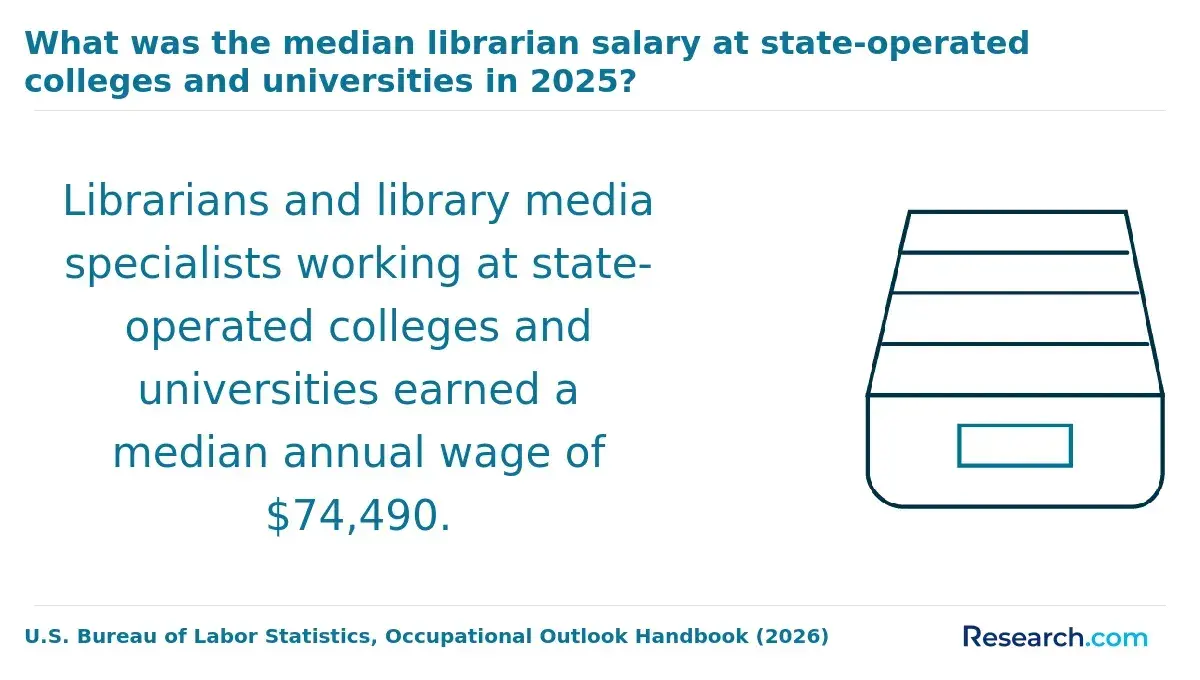
The BLS reports a May 2025 median annual wage of $68,270 for librarians and media collections specialists. Its projected employment growth for that occupation is 2.6% from 2025 to 2035. These figures cover a broader occupation than school librarians alone and do not predict a new graduate's pay or the benefit of a crisis-related elective.
For a personal estimate, check salary schedules and contract terms for the districts where you would actually work. Compare likely compensation with program costs, any income you would give up while studying, and whether the degree is necessary for the position you want. Specialized preparation may strengthen your work and applications, but it does not establish a separate salary premium.
How should students evaluate reputable MLIS programs and professional certifications?
Build a shortlist around evidence rather than a program's marketing language. Confirm the specific master's program's current ALA accreditation status, the state-approved school preparation route, required school fieldwork, and recent schedules for relevant electives. Ask for examples of permitted applied projects and clarify whether a local school must agree to supervise yours before you enroll.
Next, compare total charges under the same assumptions and confirm any residency rules; regional comparisons such as library science tuition South region are a starting point, not a substitute for an individual tuition quote. Finally, distinguish professional development from legal qualifications. Emergency-response training may be useful, but an optional course completion certificate does not replace state school librarian certification. Choose the pathway that meets your credential needs and offers practice you can realistically complete within your schedule and budget.
Other Things You Should Know About Library Science
Only if the district's approved plan assigns it that function. A librarian should clarify the space's role, accessibility needs, and who directs its use before an incident.
Follow district procedures for documenting affected materials, locations, and conditions. Coordinate with facilities staff before entering a damaged area, and avoid handling materials where safety has not been confirmed.
Use the district's approved translation and communication channels. Plan ahead for accessible formats and for families who cannot rely on a single digital platform.
Include only information the authorized response requires, following school privacy policy and applicable law. Ask the district's designated privacy or records contact when the appropriate disclosure is unclear.
References
- General and Program Specific Requirements for Library Media Specialist | nysed.gov https://www.nysed.gov/college-university-evaluation/general-and-program-specific-requirements-library-media-specialist
- Emergency Planning | schoolsafety.gov https://www.schoolsafety.gov/emergency-planning
- Individuals with Disabilities Education Act (IDEA) | ed.gov http://www.ed.gov/laws-and-policy/individuals-disabilities/individuals-disabilities-education-act-idea
- Cost of Attendance (Budget) | 2025-2026 Federal Student Aid Handbook https://fsapartners.ed.gov/knowledge-center/fsa-handbook/2025-2026/vol3/ch2-cost-attendance-budget
- LG-256569-OLS-24 | Institute of Museum and Library Services https://www.imls.gov/grants/awarded/lg-256569-ols-24
- How to Become a School Librarian: Your Complete Career Guide | Syracuse University https://ischool.syracuse.edu/how-to-become-a-school-librarian/
- School Library Media K-12 - MLIS - Kent State Online https://onlinedegrees.kent.edu/degrees/school-library-media-k12-mlis
- ALA-Accredited Programs https://www.ala.org/educationcareers/accreditedprograms/directory