2027 MLIS Programs for Automation and Workflow Design in Libraries

Co-Founder and Chief Data Scientist
Choosing an MLIS for library technology work means looking beyond a program's name: a degree may teach information organization yet offer little hands-on workflow design. The U.S. Bureau of Labor Statistics projects 2.6% employment growth for librarians and media collections specialists from 2025 to 2035, making specific technical preparation worth examining rather than assuming a degree alone will distinguish you. This guide helps prospective students identify relevant coursework and projects, compare study formats and costs, and decide whether an MLIS fits the work they want to do.
Key Things You Should Know
- Look for documented coursework in library systems, metadata, and service design, plus a project that lets you improve a real or realistic workflow; a relevant elective is not necessarily a formal specialization.
- Check the specific master's program in the current ALA accreditation directory, then confirm elective scheduling and project access directly with the school.
- The May 2025 median annual pay for librarians and media collections specialists was $68,270, but that occupation-wide figure is not a salary estimate for automation specialists or graduates of a particular program.
What are MLIS programs for library automation and workflow design?
These are library and information science master's programs through which students prepare to improve how library work moves between people, policies, and software. Examples include routing acquisitions records into a catalog, reducing duplicate metadata entry, managing access to digital collections, and testing whether a discovery interface works for patrons with disabilities.
"Automation and workflow design" describes a career focus, not a standard degree title or universally available concentration. A suitable program may award an MLIS, MLS, Master of Science in Library Science, or another institution-specific LIS degree. Its preparation might come from required courses, electives, and an applied project rather than a named track. The goal is not simply to operate software: it is to understand a service, map its steps, identify failures, and evaluate whether a change improves access without compromising privacy or staff judgment.
Which MLIS programs offer library automation and workflow design coursework?
No named program should be treated as an automation-focused option without checking its current catalog and schedule. Course titles, requirements, and availability vary, so an unsupported list of schools would be less useful than a way to distinguish documented preparation from a promising description.
The following distinctions help when comparing program pages. They describe the strength of the published evidence, not a ranking of schools.
| Published evidence | What it establishes | Important limit |
| Named concentration or track | The school formally identifies a course pathway | Individual courses may still have scheduling or admission constraints |
| Relevant catalog courses | Students may be able to study applicable subjects | A listing does not establish when an elective will run |
| Documented practicum, capstone, or independent project | There is a stated route to applied work | Its topic, supervision, and placement may require approval |
| Broad technology language | The program signals general alignment | It does not verify specialized coursework or experience |
Start with the current degree requirements and course descriptions. Then ask an adviser which relevant electives ran recently, whether they are open to MLIS students, and whether a student can complete a systems or workflow project. This matters more than finding the exact phrase "library automation" on a marketing page.
How does ALA accreditation affect automation-focused MLIS programs?
American Library Association accreditation applies to an evaluated master's program, not automatically to every degree offered by an accredited university. Check the specific program in the current ALA directory, including the credential named there. Accreditation is an important consideration for many professional librarian positions, but it does not certify that a program offers an automation concentration, a particular elective, or an online format.
Compare accredited MLIS degree outcomes alongside the program's own requirements and published career information; neither accreditation nor a reported outcome guarantees an individual job. If you may work in a school library, also check the applicable state education authority: state certification or endorsement requirements are separate from ALA accreditation, and an online degree does not automatically meet them.
What do students learn in an automation and workflow design MLIS curriculum?
A strong course combination connects information organization, systems, service needs, and evaluation. Students might learn how metadata moves between a library management system and a discovery tool, then document where staff must correct records by hand. MARC and RDA support library description; Dublin Core often appears in digital collections. The useful skill is choosing and applying standards consistently, not collecting acronyms.
These curriculum areas show how classroom learning can translate into evidence of practical ability. The examples are possible projects, not claims that every program offers them.
| Curriculum area | Workflow skill | Possible project evidence |
| Metadata and knowledge organization | Identify inconsistent records and map fields between systems | A documented metadata cleanup and quality-check plan |
| Library systems and data | Understand imports, exports, permissions, and error handling | A test workflow using sample records |
| User research and accessibility | Find barriers in discovery or service processes | A usability study with proposed revisions |
| Management and assessment | Define responsibilities and measure whether a change works | A workflow map with a feasible evaluation plan |
Ask whether you can revise a project in response to testing and faculty feedback. That opportunity can be more valuable than exposure to a tool you never use independently. Students comparing library degree mastery learning should likewise examine how a program assesses demonstrated skills, not assume its instructional model includes a particular automation project.
Are online or campus-based MLIS programs better for library technology careers?
Neither format is inherently better. What matters is access to relevant courses, timely feedback, collaborators, and a feasible applied project. Online study may allow a working library employee to examine processes at their own workplace; campus study may make local partnerships or in-person labs easier to use. Those advantages depend on the individual program.
Compare the format against your schedule and project needs before treating "online" as a promise of flexibility.
| Format | Potential advantage | Constraint to confirm |
| Online | May fit alongside employment and a workplace-based project | Live meeting times, group work, software access, and practicum rules |
| Campus-based | May ease access to local facilities and collaborators | Travel, class times, and whether relevant electives fit the timetable |
| Hybrid | May combine remote coursework with in-person work | Required visits and their timing and expense |
For any format, ask who helps arrange an applied placement and whether a remote or current-workplace project is permitted. Do not assume an internship can be completed remotely merely because classes are online.
What are the admission requirements for automation-focused MLIS programs?
Requirements are set by each university and program. Applicants should consult the current admissions page for degree eligibility, transcripts, statements, references, deadlines, and any program-specific expectations. Some schools may invite relevant work or technical projects in an application, but experience does not automatically replace a required prior degree or establish admission.
A statement of purpose can connect a concrete problem - such as repeated corrections to digital-collection records - to the courses and project opportunities you hope to use. Applicants changing careers can describe transferable experience in process mapping, data quality, accessibility testing, or staff training without claiming to have been a librarian. If your academic history or previous graduate coursework is unusual, request an individual review; transfer-credit decisions are school-specific and should not be assumed.
How long do MLIS programs take and how much do they cost?
Completion time depends on required credits, course sequencing, enrollment pace, and any project or practicum requirements. A program advertised as fast may take longer if an essential elective is offered infrequently or a student cannot take its prerequisites when needed. Use a term-by-term plan, not the shortest advertised duration, when comparing a short duration online library degree with other options.
Tuition alone is not a reliable cost comparison. Request a written estimate for your residency, delivery format, and intended enrollment pace that accounts for the following charges and expenses.
- Required credits multiplied by the applicable tuition per credit, or the school's stated term-based tuition
- Mandatory university, program, and technology fees
- Books, software, equipment, and any campus-travel or practicum expenses
- Extra terms or fees that could result from course sequencing
Published tuition is a gross program cost starting point; scholarships or employer support may lower personal out-of-pocket cost, while borrowing changes how much you ultimately repay. Do not assume online enrollment qualifies you for in-state rates or that funding is guaranteed. Confirm current aid eligibility and loan terms with the institution's financial aid office before accepting an offer. If your target job does not require an MLIS, compare this investment with a shorter certificate or supervised work experience.
What careers can an automation and workflow design MLIS prepare you for?
Relevant work appears under titles such as systems librarian, metadata librarian, electronic resources librarian, digital collections librarian, discovery services librarian, and library technology specialist. Responsibilities differ: one position may manage record loads and vendor troubleshooting, while another coordinates staff processes, tests patron-facing search, and documents changes. Public, academic, special, and government libraries may organize these duties differently.
An MLIS is commonly relevant to professional librarian positions, but a technology specialist or adjacent information-management job may accept other degrees and experience. Conversely, a paraprofessional systems role may offer useful entry experience without carrying a professional librarian requirement. If you are exploring a state-specific entry route, guidance on becoming a librarian in Illinois without experience can help frame questions about entry-level roles; individual employers still set hiring criteria.
To become a stronger applicant, document a bounded improvement: the original workflow, what you changed, how you checked for errors or access barriers, and what remains unresolved. Pair technical work with evidence that you can consult colleagues and train users. For software engineering-heavy roles, substantial programming experience or a different technical degree may be a more direct route than an MLIS alone.
How much do library automation professionals earn?
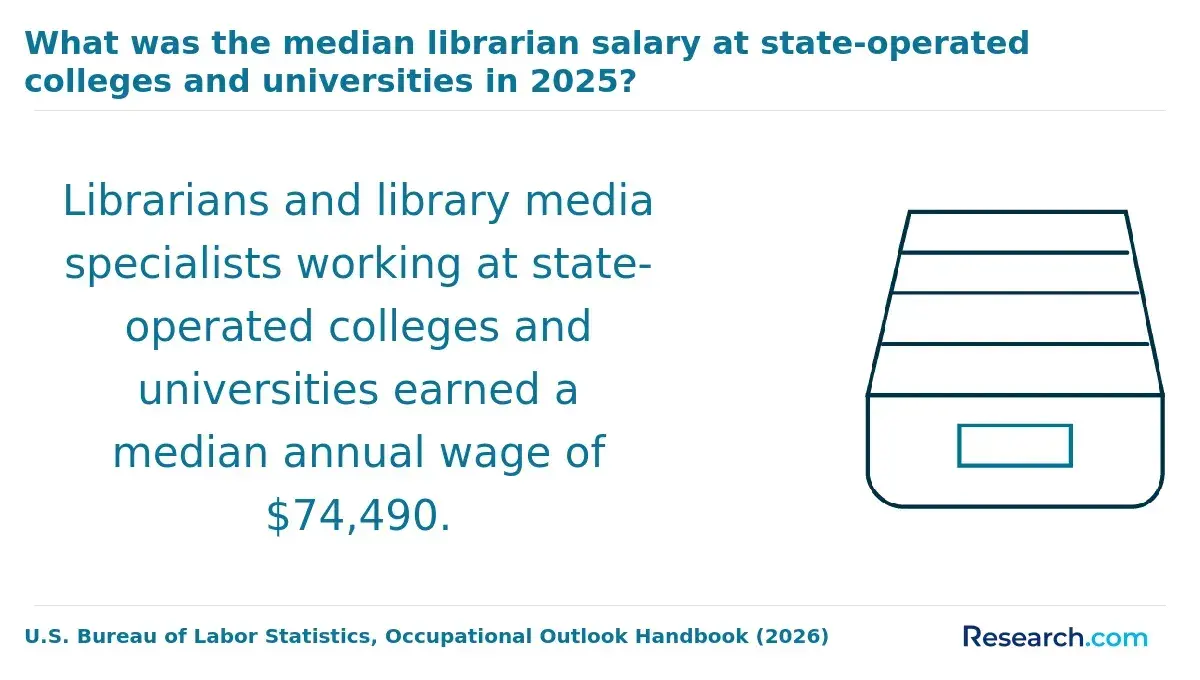
The Bureau of Labor Statistics reports a May 2025 median annual salary of $68,270 for librarians and media collections specialists. This is a broad U.S. occupational measure, not a separate wage figure for systems librarians or workflow designers. Pay for a particular opening depends on its duties, employer, location, and required experience.
Use the published salary range in relevant job postings when weighing a degree's cost against your current earnings. A guide to MLIS careers with highest salaries can provide broader career context, but an occupation-wide median or a high-paying job title should not be treated as a program-specific earnings outcome.
What is the job outlook for library automation and workflow specialists?
BLS projects 2.6% growth in employment for librarians and media collections specialists from 2025 to 2035. That projection covers the full occupation; it does not forecast openings specifically for automation or workflow specialists. Job titles may also conceal relevant duties inside broader librarian, metadata, or digital-services positions.
For a realistic view of your local market, review recent openings for the systems involved, the degree requirement, and whether the role involves designing processes or primarily maintaining an existing platform. Libraries' work with digital collections, metadata exchange, accessibility, privacy, and AI-assisted discovery makes sound workflow judgment relevant, but no single technology trend guarantees new positions. Choose projects that demonstrate adaptable methods rather than dependence on one vendor product.
Other Things You Should Know About Library Science
Yes. Use sample or openly available records to demonstrate a workflow map, a metadata transformation, or a usability test. Label the project as simulated and explain which assumptions would need validation in a working library.
Not as a universal requirement. Check postings for your target roles before paying for vendor training. Evidence that you can diagnose problems, document changes, and learn a new system may transfer more readily between employers.
Only after checking your employer's permissions and removing or replacing confidential information. Patron records, credentials, internal security details, and licensed vendor materials should not be included in a public portfolio without authorization.
Check institutional policy, data-handling terms, and whether records may be sent to the tool. Test outputs for incorrect descriptions, bias, and inconsistent metadata; keep a human review step and document how errors are corrected.
References
- Integrated Library System (ILS) | ky.gov https://kdla.ky.gov/Library-Support/directors-toolkit/Pages/IntegratedLibrarySystem.aspx
- Student/Intern LOCI Program | loc.gov https://www.loc.gov/item/internships/loci-program/
- Fast Facts: Tuition costs of colleges and universities (76) | ed.gov https://nces.ed.gov/fastfacts/display.asp
- Reskilling and Upskilling the Future-ready Workforce... - PMC https://pmc.ncbi.nlm.nih.gov/articles/PMC9278314/
- MLIS Internships - College of Information Science https://infosci.arizona.edu/ma-library-information-science/internships
- Skill analysis of library and information science professionals | sagepub.com https://journals.sagepub.com/doi/full/10.1177/09610006231207656
- Session 8: Batch Processes and Record Maintenance | illinois.edu https://www.carli.illinois.edu/resource-management-training-s8-20250408
- Tuition and Fees - Student Financial Services https://www.umaryland.edu/student-financial-services/tuition-and-fees/
- How AI is reshaping workflows and redefining jobs | MIT Sloan https://mitsloan.mit.edu/ideas-made-to-matter/how-ai-reshaping-workflows-and-redefining-jobs
- Internship Opportunities | Penn State University Libraries https://libraries.psu.edu/about/awards-scholarships-internships-and-graduate-assistantships/internship-opportunities