
2027 MLIS Programs for Nursing Library Instruction

Co-Founder and Chief Data Scientist
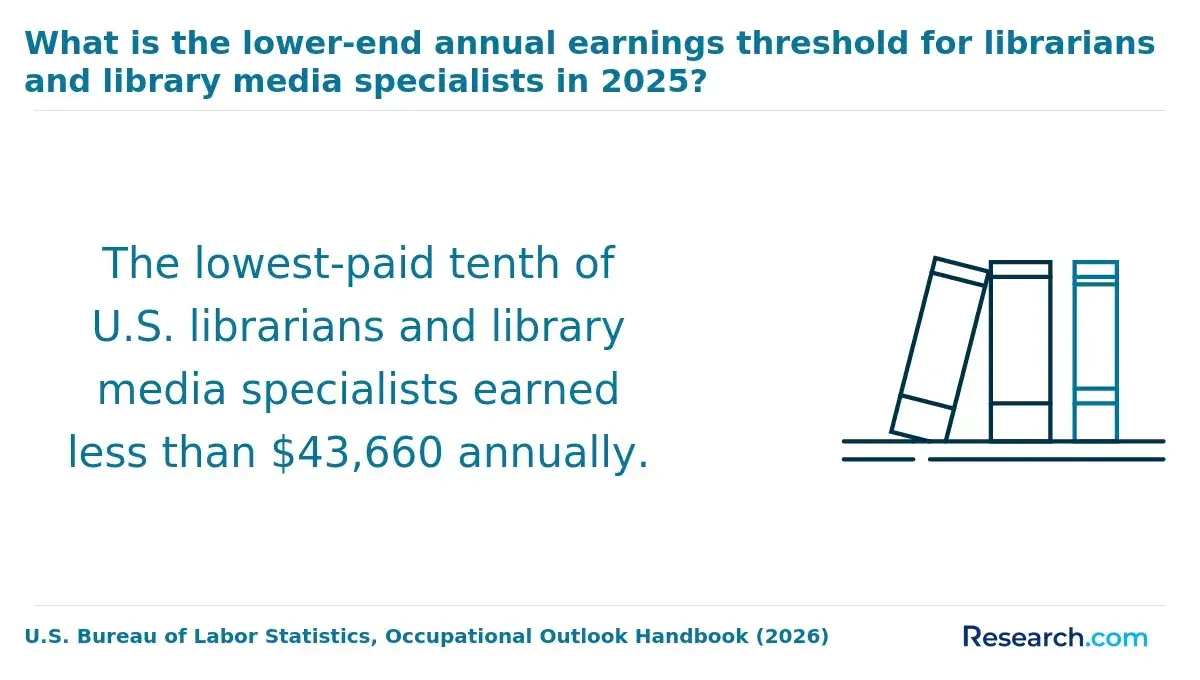
Preparing to teach nursing students how to find and evaluate research takes more than a general interest in libraries. Prospective students need an MLIS program that supports health information literacy, evidence-based practice, and real teaching experience. The U.S. Bureau of Labor Statistics reports a May 2025 median annual salary of $68,270 for librarians and media collections specialists, but that broad figure cannot predict earnings in a nursing-library role.
This guide shows aspiring and transitioning librarians which program features matter, what to verify before enrolling, and when another training route may fit better.
Key Things You Should Know
- Look for an ALA-accredited LIS master's program, then separately verify health-sciences coursework and opportunities to teach nursing learners; accreditation does not establish either feature.
- A strong preparation plan combines instruction design, PubMed and CINAHL searching, evidence appraisal, and supervised or documented teaching practice.
- BLS projects 2.6% employment growth for librarians and media collections specialists from 2025 to 2035; that projection covers a broad occupation, not nursing-library positions specifically.
What are MLIS programs for nursing library instruction?
These are library and information science master's programs that a student can use to prepare for teaching in nursing schools, academic health sciences libraries, hospitals, or other clinical education settings. An MLIS is one possible degree title; institutions may instead award an MLS, a Master of Science in Library Science, or another LIS master's degree. The relevant question is what the particular program teaches and whether its graduates can build the skills required by target employers - not whether its title contains "nursing."
Nursing library instructors teach learners to turn clinical questions into searchable concepts, use research databases, assess the quality of evidence, and manage citations. They may work with faculty on course-integrated sessions or offer individual research consultations. That differs from a nurse educator's responsibility for teaching clinical practice and assessing nursing competencies.
A formal nursing-library concentration should be treated as such only if the university names and documents it. Otherwise, a combination of electives, projects, and field experience may be the more accurate description. Readers still comparing degree types can use this overview of what is a library science degree before examining health-focused curricula.
Which accreditation should nursing library instruction programs have?
For U.S. professional librarian roles, an MLIS or equivalent master's degree accredited by the American Library Association is a useful program-selection benchmark. Check the specific degree program in the current ALA directory, including its accreditation status. A university's institutional accreditation is a separate matter and does not establish that its LIS master's program is ALA-accredited.
ALA accreditation evaluates the LIS program; it does not certify a nursing specialization, guarantee that a health-sciences elective will run, or approve a particular internship site. Compare the current catalog and course schedule with the accreditation listing. If a job posting accepts "ALA-accredited MLIS or equivalent," ask the employer what it considers equivalent rather than assuming every information-related master's degree qualifies.
What degree and training pathways prepare nursing library instructors?
An ALA-accredited LIS master's with instruction, reference, and health-information coursework is a direct route toward professional librarian positions. Nursing graduates and other health professionals can bring clinical vocabulary and familiarity with evidence-based practice, but they still need to learn library research services and teaching methods. Conversely, an MLIS student without a clinical background can develop subject expertise through coursework and supervised work with nursing learners.
The best pathway depends on the job sought. A librarian building a nursing liaison portfolio may need targeted continuing education and teaching experience rather than a second master's. A prospective nurse educator who wants to teach clinical skills may be better served by nursing education credentials; an MLIS does not replace nursing qualifications. Students weighing other specialized library science masters should prioritize the curriculum and placement opportunities relevant to their intended role, rather than the appeal of a track name alone.
What do MLIS programs teach about nursing research and information literacy?
Core LIS study commonly addresses information organization, research services, and users' information needs. Nursing-focused preparation adds the ability to teach evidence-based searching and explain why a study is - or is not - useful for a clinical or academic question. The table distinguishes skills worth seeking from the work that could demonstrate them; it does not imply that every program offers a course in each area.
| Preparation area | Relevance to nursing instruction | Possible portfolio evidence |
| Information literacy and instructional design | Plan accessible lessons and assess whether learners can search independently. | A lesson plan with learning objectives and an assessment. |
| Health sciences searching | Teach database selection, controlled vocabulary, keywords, and reproducible search strategies in tools such as PubMed and CINAHL. | An annotated search strategy adapted for nursing students. |
| Evidence appraisal and synthesis support | Help learners distinguish study designs and document searches without making clinical decisions for them. | A search consultation or evidence-appraisal teaching resource. |
| Reference and outreach | Work with faculty to embed instruction in assignments and support learners with different research experience. | A teaching reflection or faculty-collaboration project. |
Ask whether relevant electives have been offered recently and whether students can use an independent project, practicum, or capstone to address nursing instruction. For example, a student might design an accessible database lesson and assess learning with a short search exercise. Experience evaluating AI-generated citations is also useful: an instructor should teach learners to verify that sources exist and support the claims attributed to them.
Are online MLIS programs suitable for nursing library instruction careers?
Yes, an online MLIS can be suitable if the program is appropriately accredited and offers a workable route to both teaching practice and health-sciences research skills. Delivery format alone says little about how often relevant electives run or whether a student can complete an applied project with nursing learners.
Before choosing among the best library science graduate schools online, check whether classes meet live, whether required activities conflict with work hours, and whether a practicum can be arranged near home. Ask who approves sites and supervises students. A remote course does not mean that an internship is remote, and an asynchronous schedule does not eliminate deadlines or collaborative assignments.
Students employed in a hospital or university may be able to propose an instruction project at work, subject to program and employer approval. Those without access to nursing learners should find out how the program helps secure relevant experience before enrolling.
What are the admission requirements for nursing-focused MLIS programs?
Applicants should expect each university to publish its own graduate admission rules, typically addressing a bachelor's degree, transcripts, and application materials such as a statement of purpose. Requirements for recommendations, a résumé, minimum grades, or prerequisite study vary. A nursing degree or clinical employment may strengthen an application, but neither should be assumed to substitute for a stated academic requirement.
Use the statement of purpose to connect previous experience with a specific instructional goal - for example, helping nursing students search for evidence - without claiming expertise not yet developed. Applicants missing a published requirement should request an individual review from admissions rather than assuming work experience creates an exemption. This guide to a library degree without prior coursework can help frame questions, but the program's current policy controls.
How long do MLIS programs cost for nursing library instruction?
Time and price depend on the program's required credits, course sequencing, enrollment pace, residency-based tuition rules, and fees. A short advertised completion time may leave little room for a health-sciences elective or a practicum. Students considering one year accelerated library programs should confirm that the courses and applied experience they need fit the actual schedule.
Build a written estimate using the following cost categories, then ask the school which charges are mandatory for your enrollment status. Published tuition alone is not the full cost of attendance.
- Tuition: multiply the applicable per-credit rate by required credits, or use the published term rate and expected number of terms.
- Required fees and materials: add university or program charges, books, equipment, and any required software.
- Practical expenses: account for travel or reduced work hours if teaching experience or campus attendance requires them.
- Funding: subtract confirmed grants or employer support from the gross cost, and distinguish the remainder you pay from any amount you borrow.
Compare that estimate with your current earnings and the qualifications in jobs you would actually seek. Ask financial aid staff about aid eligibility for your planned enrollment pace and loan terms applicable to your enrollment period; do not assume a scholarship, assistantship, or employer reimbursement will be available. A less expensive program may be the better choice if it still permits credible health-information coursework and teaching practice.
What careers can nursing library instruction graduates pursue?
Potential titles include nursing liaison librarian, health sciences librarian, medical librarian, and instruction librarian. In an academic health sciences library, the work may center on curriculum-integrated teaching and faculty consultations. In a hospital library, it may combine staff education with research support for clinicians. Job titles overlap, so read each posting for its teaching duties, degree requirements, and expected clinical knowledge.
Employers may seek an ALA-accredited LIS master's for professional librarian appointments, while some related education or information roles accept other degrees and experience. Library technician positions are distinct from professional librarian roles and should not be treated as equivalent outcomes. To become a stronger applicant, assemble a portfolio showing a lesson plan, a documented search strategy, and evidence that you evaluated or improved your instruction. A supervised project with nursing faculty can demonstrate fit more clearly than a general claim of interest in health care.
What salaries and job outlook apply to nursing library instructors?
The BLS reports a May 2025 median annual salary of $68,270 for librarians and media collections specialists and projects 2.6% employment growth from 2025 to 2035. These figures provide a broad U.S. benchmark, not a nursing-library salary survey or a forecast of openings in a particular region.
Pay and opportunities can differ by employer, location, experience, and whether a position combines instruction with responsibilities such as evidence-synthesis support. Use current postings for the roles and locations you could pursue when weighing program cost. Do not treat the occupational median - or a program's general employment claims - as a prediction of your first salary or hiring prospects.
Which certifications and professional standards support nursing library instruction?
The Medical Library Association's Academy of Health Information Professionals provides a voluntary professional-development credential relevant to health information careers. It is not a universal legal requirement for teaching nursing learners. An employer may value it, but applicants should check the actual posting before paying for credential-related activities.
Two useful guides to practice are the Association of College and Research Libraries' information literacy framework and the Medical Library Association's health information competencies. They can help students plan lessons, reflect on teaching, and identify skills to develop. Neither replaces an employer's qualifications or the practical experience needed to teach effectively. If a role also involves school librarian duties, check the relevant state education authority for separate licensure or endorsement rules.
Other Things You Should Know About Library Science
A librarian can help someone locate and assess health information, but should not present research assistance as patient-specific clinical advice. Treatment decisions belong with an appropriately qualified clinician.
Yes. They may design and document searches, advise on database coverage, and help teams report methods transparently. The scope of their contribution and any authorship decision should be agreed with the research team.
Check the article's license, your institution's subscriptions, and applicable copyright guidance first. Linking students through an authorized library route may differ from uploading a copy; ask library copyright staff when permission is unclear.
Collect only the student information needed to evaluate learning, use institution-approved tools, and follow local retention and access policies. Anonymized search exercises may be sufficient when individual tracking is unnecessary.
References
- Integrity of Databases for Literature Searches in Nursing - PMC https://pmc.ncbi.nlm.nih.gov/articles/PMC8115732/
- Assessing Learning - Instruction in Libraries and Information Centers https://iopn.library.illinois.edu/pressbooks/instructioninlibraries/chapter/assessing-learning/
- Master of Library and Information Science | St. Catherine University https://www.stkate.edu/academics/academic-programs/gc-library-and-information-science
- Nursing Education Resources: Information Literacy - Libraries https://libguides.libraries.wsu.edu/c.php
- Nursing Resources: Evidence Based Practice | uams.edu https://libguides.uams.edu/c.php
- Selecting Databases - Health (Nursing, Medicine, Allied Health) - Research Guides at New York University https://guides.nyu.edu/health/selecting-databases
- Instructional design for single information literacy sessions | tandfonline.com https://www.tandfonline.com/doi/full/10.1080/15228959.2020.1775753


