2027 MLIS Programs for University Research Communications

Co-Founder and Chief Data Scientist
Choosing an MLIS for university research communications means looking beyond a program's name. The work can involve making scholarship discoverable, explaining research to wider audiences, and helping faculty share their findings responsibly.
The U.S. Bureau of Labor Statistics projects 2.6% employment growth for librarians and media collections specialists from 2025 to 2035 - a reminder to evaluate specific skills and opportunities, not just the degree. This guide helps prospective students compare curricula, practical experience, costs, and career paths before committing.
Key Things You Should Know
- Look for a combination of scholarly communication, repository or metadata work, and clear writing; a relevant elective is not necessarily a formal concentration.
- Check the individual master's program's ALA accreditation separately from the university's institutional accreditation.
- The May 2025 median pay for librarians and media collections specialists was $68,270, but that occupation-wide figure is not a salary estimate for research communications jobs.
What are MLIS programs for university research communications?
These are library and information science master's programs that students can use to prepare for work at the intersection of academic research, information access, and communication. "University research communications" is a career goal, not necessarily an official MLIS concentration. An institution may instead offer relevant electives, an independent project, or practical experience that a student combines into a pathway.
The work itself spans different offices. A library scholarly communications team might advise researchers on publishing agreements or manage an institutional repository, which stores and makes university research accessible. A research office might turn a study into a plain-language story for the public. Both settings require accuracy, audience awareness, and coordination with researchers, but a research-office writing role may favor journalism or science communication experience over an MLIS.
Degree titles also vary: an MLIS, MLS, Master of Science in Library Science, or Master of Information may contain relevant study. Compare the curriculum and career requirements rather than treating the title as proof of a specialization. Readers exploring broader library science masters degree options should identify which programs actually let them build the combination of research-support and communication skills they need.
Which accreditation should university research communications MLIS programs have?
For applicants targeting professional librarian positions in U.S. academic libraries, accreditation by the American Library Association (ALA) is an important screening criterion. Check the specific master's program in the current ALA directory, including its stated status; accreditation of the university as an institution is a separate matter. Also confirm that the accredited degree is the one you intend to earn if a school offers several information-related master's degrees.
ALA accreditation evaluates a program, not an individual research communications track. It does not establish that a particular elective runs regularly, that a repository practicum is available, or that graduates qualify for every job with "communications" in the title. Employers outside libraries may accept several degrees, so compare accreditation with the qualifications in actual postings for your preferred roles.
What career paths can an MLIS support in university research communications?
An MLIS is most directly relevant when communication is tied to organizing, preserving, licensing, or increasing access to scholarship. Job titles vary by university, and similar titles can describe different responsibilities. The table separates three paths so you can match a program to the work you want to do.
| Path | Typical work | What to check in job postings |
| Scholarly communications librarian | Support publishing decisions, open access, author rights, and research visibility | Whether an ALA-accredited degree is required and whether prior academic-library experience is expected |
| Repository or research information specialist | Describe, deposit, organize, and report on research outputs | Required metadata, repository, copyright, or research information system skills |
| Research communications writer or officer | Interview researchers and translate findings for nonexpert audiences | Writing samples, subject familiarity, and whether an MLIS is accepted or preferred |
Academic-library hiring can be competitive, particularly for roles combining subject expertise with professional library experience. When considering competitive archives and academic library jobs, distinguish minimum qualifications from the experience that makes an applicant credible. Someone primarily interested in university news writing may get a more direct return from communications experience or another graduate path than from an MLIS.
Are online or campus-based MLIS programs better for research communications?
Neither format is inherently better. The useful comparison is whether you can take the right courses, collaborate with researchers, and complete a substantial applied project within your schedule and budget. Online delivery can help a working student remain employed, while campus study may make it easier to pursue local library or research-office opportunities; neither outcome is automatic.
Ask whether courses are asynchronous or require live attendance, how often relevant electives run, and whether a practicum can be completed at an approved site near you. A catalog listing alone does not guarantee an elective will fit your graduation timeline. To choose the best online MLIS for this goal, compare those details with the work you can access locally - not just the program's delivery label.
What coursework prepares MLIS students for university research communications?
Start with the work product you hope to create. A public-facing research story demands interviewing and plain-language writing; a repository role demands reliable description and rights decisions. The strongest course plan connects both sides where possible, rather than treating a general communications elective as complete preparation.
Useful subjects include scholarly communication and copyright; metadata and digital repositories; research data management; information retrieval and evaluation; accessibility; and writing for nonexpert audiences. Metadata means structured information that helps people find and interpret a research output. Research data management concerns how data is organized, documented, shared, and retained. Course titles differ, so inspect descriptions, assignments, and prerequisites before assuming coverage.
An applied project can make that learning visible to employers: for example, a plain-language summary of a published study paired with a proposed repository record and an explanation of the permissions checked. Use material you are authorized to reuse, document your editorial decisions, and seek feedback from a researcher or supervisor. If a program advertises a concentration, verify its required courses separately from electives and independently arranged projects.
What are the admission requirements for university research communications MLIS programs?
Requirements are set by each institution, not by the career goal. Applicants should consult the current admissions page for the exact degree and entry term. Schools may request undergraduate transcripts, a statement of purpose, recommendations, a résumé, or writing samples; policies on tests, prerequisite study, and professional experience vary.
A useful statement of purpose links past experience to a feasible plan - for example, explaining how work in a lab, library, newsroom, or university office led to an interest in communicating research. A prior science degree is not a universal MLIS admission requirement. Applicants who already hold graduate credits and hope to accelerate an MLIS with transfer credits should ask whether those particular credits meet the school's graduate transfer rules and whether they replace required courses. Admission and transfer approval are separate decisions.
How long do MLIS programs take and how much do they cost?
Completion time depends on required credits, course load, elective scheduling, and any practicum or capstone. Full-time students may finish sooner than part-time students, but an advertised accelerated timeline is useful only if the courses you need are available in the right sequence. When comparing the quickest online MLIS completion options, ask for a term-by-term plan that includes your intended research communications electives.
There is no reliable single tuition figure for this specialization: programs set different credit requirements, rates, and fees, and residency or delivery rules may affect what a student pays. Compare the same cost categories for each school before judging affordability. The table identifies amounts to obtain from current university schedules, rather than assuming published tuition is the full cost.
| Cost category | Amount to confirm | Why it changes the comparison |
| Tuition | Rate per credit multiplied by required credits | Lower per-credit tuition may not mean a lower degree cost |
| Mandatory fees | Program, university, and technology charges | Fees may differ by enrollment or delivery format |
| Learning and placement expenses | Materials, equipment, and practicum travel | These may fall outside the tuition estimate |
| Extra enrollment terms | Charges caused by delayed or unavailable courses | Course sequencing can increase both time and cost |
Separate the gross program cost from what you expect to pay personally and what you would borrow. Confirm funding and current federal aid eligibility with the school's financial aid office; do not assume an assistantship, employer reimbursement, or a particular online tuition rate applies to you. For a realistic return-on-investment decision, compare those costs with your current earnings and the qualifications requested by your target employers - not with an occupation-wide median alone.
What jobs can MLIS graduates pursue in academic research communications?
Potential openings include scholarly communications librarian, open access specialist, institutional repository manager, research impact or bibliometrics specialist, and research data services librarian. Bibliometrics uses publication and citation information to analyze research activity; responsible work also explains what those measures cannot show. Some universities place these functions in libraries, while others distribute them across research administration and academic departments.
Entry points can include supervised repository work, a graduate assistantship, a library practicum, or communications work with a research group. Look closely at the distinction between a professional librarian post, a support position, and an adjacent communications job: duties and degree requirements can differ substantially. Advancement may involve managing services, advising on university publishing policy, or coordinating teams, but an MLIS alone does not substitute for demonstrated work with researchers and stakeholders.
How much do university research communications professionals earn?
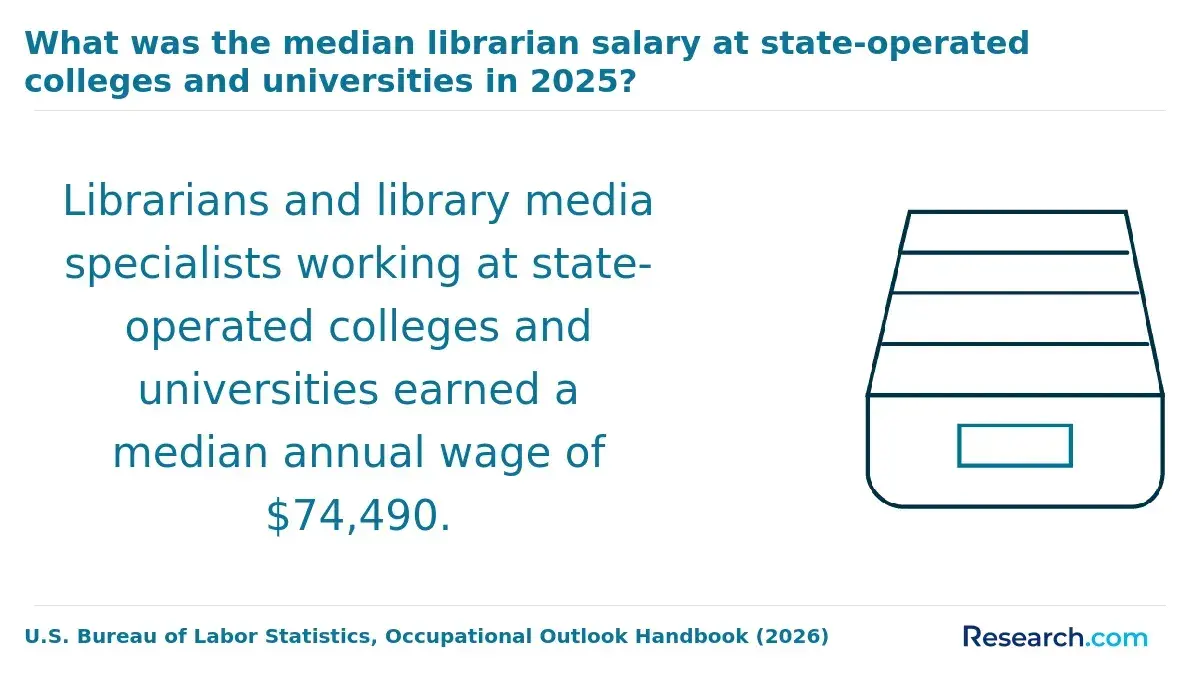
The Bureau of Labor Statistics reports a May 2025 median annual wage of $68,270 for librarians and media collections specialists. That is useful context for academic-library paths, but it combines settings and specialties; it is not the median for scholarly communications librarians or for university research writers. Pay for an individual opening also depends on its duties, location, employer, and experience requirements.
Use salary ranges in current postings for your target job titles to assess whether the degree's cost fits your circumstances. Compare roles on responsibilities and required qualifications as well as pay: a communications officer and a librarian may contribute to the same research campaign while following different hiring and advancement paths.
How should students choose a reputable MLIS program for research communications?
Build a shortlist around a specific intended job, then request evidence for the features that matter. A program with a named track may be a good fit, but a flexible ALA-accredited degree with accessible electives and an appropriate placement may fit better. Neither description establishes value without a workable course plan.
Use the following checks when speaking with program staff. They turn broad marketing claims into answers you can compare across schools.
- Verify the exact degree's current ALA accreditation status if your target jobs seek an ALA-accredited qualification.
- Request recent schedules for relevant electives and ask which are required, optional, or subject to enrollment.
- Ask how students obtain repository, scholarly communications, or research-office experience and who approves placements.
- Calculate total expected charges using your residency, study pace, required credits, and likely extra expenses.
- Review target job postings and ask how the program helps students produce credible work samples for those duties.
Choose the option that closes your largest skill gap without creating an unreasonable financial commitment. If your goal is primarily research news or public relations and postings emphasize reporting and writing rather than library expertise, test that path through relevant work experience before enrolling in an MLIS.
Other Things You Should Know About Library Science
Not necessarily. You do need to understand a study well enough to describe its methods, findings, and limits accurately. Some subject-specific positions may prefer relevant academic training, so check individual postings.
Not automatically. Check the figure's rights information, the article's license, and any third-party credits. When permission is unclear, ask the rights holder or create an original explanation that does not reproduce the figure.
No. An ORCID iD identifies a researcher; a digital object identifier, or DOI, identifies a particular research output or other registered object. Using both correctly can help readers connect a work with its creator.
Set a goal first, such as helping a defined audience understand a finding or locate the original paper. Then assess appropriate evidence - reader feedback, referral patterns, or requests for further information - without treating page views alone as proof of understanding or research impact.
References
- Copyright & data | University of Arizona Libraries https://lib.arizona.edu/research/data/data-management/best-practices/copyright
- Master of Library and Information Science (MS) | Simmons University https://www.simmons.edu/academics/programs/library-and-information-science-ms
- MLIS Curriculum, Specialties & Courses | University of Arizona College of Information Science https://infosci.arizona.edu/ma-library-information-science/curriculum-specialties-courses
- MLIS Curriculum - Morgridge College of Education Online | DEN-EDU https://morgridgeonline.du.edu/online-mlis-program/curriculum/
- Library and Information Science, MLIS (Online) | Southern Connecticut State University https://www.southernct.edu/academics/programs/library-and-information-science-mlis
- Introduction to Research Data Management | umbc.edu https://lib.guides.umbc.edu/Research_Data/Intro_to_Research_Data_Management
- Research Data Management Graduate Certificate | utk.edu https://cci.utk.edu/academics/graduate-certificates/research-data-management/
- MLIS Program Requirements and Curriculum | umd.edu https://info.umd.edu/academics/masters-programs/master-of-library-and-information-science/curriculum-specializations/
- Library and Information Science - MLIS - Kent State Online https://onlinedegrees.kent.edu/degrees/master-of-library-and-information-science
- Library Science Master's Online - UW Information School https://ischool.uw.edu/programs/mlis/degree-options/online