
2027 MLIS Programs for Juvenile Collection Curation

Co-Founder and Chief Data Scientist
Choosing an MLIS for juvenile collection curation means looking beyond a program's general library science curriculum. Children's and teen librarians must select materials, understand their communities, manage budgets, and defend access under collection policies.
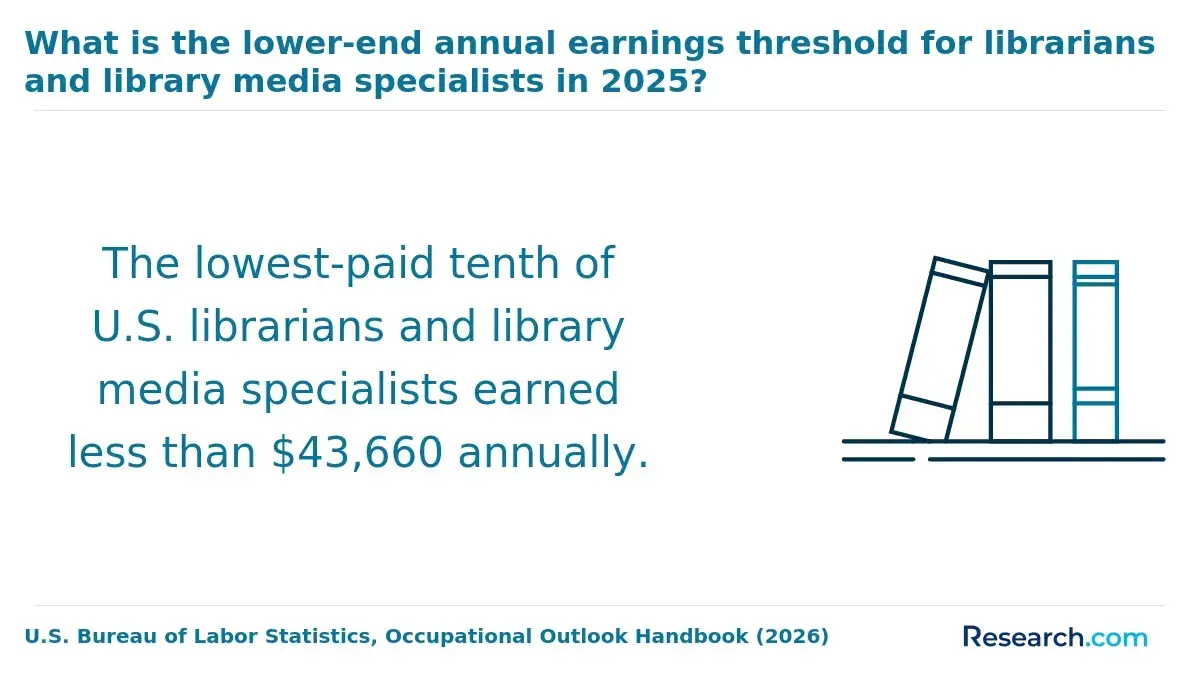
The U.S. Bureau of Labor Statistics reports a May 2025 median annual salary of $68,270 for librarians and media collections specialists, making program cost an important part of the decision. This guide shows prospective public and school librarians which coursework, practical experience, credentials, and costs to compare before applying.
Key Things You Should Know
- Look for an ALA-accredited master's program with relevant youth-services coursework and a feasible way to gain collection-development experience; a relevant elective is not necessarily a formal concentration.
- For school library jobs, verify your state's certification or endorsement rules separately from MLIS accreditation.
- Compare total program costs against your career goal: the broader librarian and media collections specialist occupation has projected U.S. employment growth of 2.6% from 2025 to 2035, not a guaranteed outcome for juvenile specialists.
What are MLIS programs for juvenile collection curation?
These are master's programs in library and information science that can prepare students to build, evaluate, and maintain collections for children and teens. The work goes beyond choosing appealing books: librarians use community needs, circulation evidence, reviews, budgets, accessibility considerations, and written selection policies to make decisions across print and digital formats.
A program may offer a named youth-services track, relevant electives without a formal track, or broader coursework that a student applies through an independent project. Those are different levels of preparation. Ask what is documented in the current catalog and what students can actually take during their expected enrollment period.
A useful starting point is to compare library science programs worth applying to, then check each program's current catalog for youth-focused courses and applied opportunities.
Which accreditation should juvenile collection curation programs have?
For U.S. professional librarian positions, an MLIS, MLS, or institution-specific LIS master's degree from a program accredited by the American Library Association (ALA) is a strong default to seek. Check the specific master's program in ALA's current accredited-program directory. A university's institutional accreditation does not establish that its library science degree is ALA-accredited.
Accreditation also does not verify that a school offers a juvenile collection concentration, a particular elective, or an internship near you. Confirm those features separately. If your goal is a school library position, check the relevant state education agency's certification or endorsement requirements before enrolling; an ALA-accredited online degree alone does not establish eligibility in every state.
What education and training prepare librarians for juvenile collection curation?
A relevant LIS master's degree provides a foundation in collection development, information organization, reference, and professional ethics. Preparation becomes more convincing when students apply those skills to young readers: identifying gaps in a children's collection, evaluating teen materials, assessing accessible formats, or making recommendations within a real budget.
Experience in a public library youth department, school library, or supervised practicum can show how selection decisions interact with circulation, outreach, and community needs. If you already work in a library, ask whether your role can support a supervised collection project. If you are new to the field, ask programs how students obtain placements and whether the work must be completed on site. A portfolio should explain the evidence and policy behind a decision, not merely display a reading list.
What coursework do MLIS programs offer for juvenile collection curation?
Course titles differ, so compare learning objectives and assignments rather than searching only for "juvenile collection curation." The table connects useful subject areas to the work they should help you practice; it does not imply that every program offers each course.
| Coursework to look for | Application to juvenile collections |
| Children's and young adult literature | Evaluate materials for different readers and purposes. |
| Collection development and management | Use policies, budgets, community evidence, and evaluation methods. |
| Cataloging and metadata | Improve how families and young readers discover materials. |
| Intellectual freedom and information policy | Apply established procedures to access and reconsideration issues. |
| Digital resources and accessibility | Assess formats and barriers affecting access to a collection. |
Review the broader library information science coursework alongside the program's current schedule. A catalog listing shows that a course exists, not that it will run before you graduate; ask when youth-focused electives were last taught and what alternatives are available.
Are online or campus-based MLIS programs better for juvenile collection curation?
Neither format is inherently better. An online program may let a working library employee study without relocating, while a campus-based program may make local placements and in-person collaboration easier. In either format, the deciding issue is whether you can complete relevant coursework and supervised work in a setting that serves young people.
Online does not necessarily mean asynchronous or fully remote. Confirm live-session times, elective sequencing, any campus attendance, and whether a practicum can be arranged near you. Campus students should make the same checks about placement availability and course schedules. For a realistic scheduling comparison, consider part time MLIS completion time rather than assuming that flexible delivery shortens the degree.
What are the admission requirements for juvenile-focused MLIS programs?
Requirements vary by institution, but applicants should expect to document a bachelor's degree and submit materials such as transcripts, a statement of purpose, and recommendations according to each program's published policy. Youth-services experience can strengthen an application or clarify a career goal, but it should not be assumed to replace a formal admission requirement.
Use the statement to connect your interests to specific preparation: for example, community-informed collection development, children's literature, or school library work. Before paying an application fee, confirm the current document requirements, any prerequisite or test policy, and whether the program offers the courses and field experience your goal requires.
How long do MLIS programs cost for juvenile collection curation?
Program length and price depend on required credits, enrollment pace, tuition rules, and course sequencing. There is no reliable specialization-wide price or completion time: a juvenile-focused pathway may consist of electives within a general LIS degree rather than a separate program. Compare each school's published requirements and ask whether the electives you need fit your planned schedule.
For a usable estimate, multiply the applicable tuition per credit by required credits, then add mandatory fees, materials, and any travel or placement expenses. Check whether online students qualify for the rate being advertised. Separate the gross program cost from what you expect to pay after confirmed aid or employer support and from any amount you would borrow.
Ask financial aid offices about your own eligibility and enrollment period rather than assuming a scholarship or loan amount applies to everyone. A scholarship friendly online MLIS may be worth investigating, but compare confirmed awards and full costs before treating it as the cheaper option.
What careers can graduates pursue in juvenile collection curation?
The closest roles include children's librarian, teen services librarian, youth services librarian, and collection development librarian with responsibility for youth materials. Duties vary: one position may emphasize purchasing and evaluation, while another combines collection work with reference, programs, and outreach. School librarians also develop student-facing collections, but their credential requirements follow state rules.
An MLIS or equivalent LIS master's degree is commonly relevant to professional librarian roles; qualifications for individual openings must be checked in the posting. Library assistant and technician roles can provide experience without necessarily requiring an MLIS. Candidates considering a different path can compare library information science career specializations before committing to a degree designed around youth services.
How much do juvenile services librarians earn?
The Bureau of Labor Statistics reports a May 2025 median annual salary of $68,270 for librarians and media collections specialists. This is a broad U.S. occupation, not a juvenile-services salary or an expected starting offer. Local public funding, employer type, responsibilities, and experience can affect a particular position's pay.
BLS projects 2.6% employment growth for that broader occupation from 2025 to 2035. Use the figure as market context, then examine actual vacancies in the places where you would work. Compare their pay and credential requirements with the full cost of your degree and your current earnings; the occupation-wide median cannot establish an individual return on investment.
What certifications and professional standards support juvenile collection curation?
Public library collection work should be grounded in the employer's selection, accessibility, privacy, and reconsideration policies. Professional guidance on intellectual freedom and services to young people can help librarians apply those policies consistently, but it does not replace local procedures or an employer's requirements.
There is no single juvenile collection curation certification that substitutes for an LIS master's degree where an employer requires one. For school library work, state-issued certification or endorsement is a separate question: verify the approved preparation pathway, assessments, and other conditions with the state education authority. Short courses and continuing education may deepen skills, but assess them as supplements, not automatic professional credentials.
Other Things You Should Know About Library Science
There is no universal boundary. Libraries commonly distinguish children's and teen materials, but local policies define age groupings and shelving. Check the library's definitions before designing a project around "juvenile" materials.
Not necessarily. Library ebook access depends on vendor licensing terms, which may differ from consumer purchases. Collection staff should review lending limits, accessibility, privacy terms, and renewal costs before selecting a platform or title.
Use credible reviews and bibliographic information, consult qualified colleagues or community partners, and follow the library's selection policy. Community input helps identify demand, but one person should not be expected to represent every reader of a language.
They can. Evaluate them using the same collection policy applied to other formats, including audience, content, quality, accessibility, and community interest. Format alone does not determine whether a title belongs in a particular age collection.
References
- Collection Management (Library Learning): Challenges | alaska.gov https://lam.alaska.gov/ce/collections/challenges
- Youth Services Manager | northfieldmn.gov https://www.northfieldmn.gov/DocumentCenter/View/18277/Youth-Services-Manager
- Internships | Library of Virginia https://www.lva.virginia.gov/about/careers/internships
- Accessible Educational Materials - MDE https://education.mn.gov/MDE/dse/sped/mat/058316
- College Internships & Library Practicum | nashville.gov https://library.nashville.gov/support/internships
- MLIS Curriculum, Specialties & Courses | University of Arizona College of Information Science https://infosci.arizona.edu/ma-library-information-science/curriculum-specialties-courses
- Master of Library and Information Science (MLIS) | umd.edu https://info.umd.edu/academics/masters-programs/master-of-library-and-information-science/
- Youth Services (MLIS) | missouri.edu https://cehd.missouri.edu/degree/youth-services-mlis/
- Getting Started with Digital Accessibility in Teaching and Learning - UCLA Teaching & Learning Center https://teaching.ucla.edu/resources/teaching-guides/getting-started-with-digital-accessibility-in-teaching-and-learning/
- Collection Development Policy | FAU Libraries https://library.fau.edu/policy/collection-development-policy


