
2027 Best Online Nursing Programs in Washington: Accredited RN to BSN Programs

Co-Founder and Chief Data Scientist
Registered nurses in Washington who already hold an ADN often face a practical career question: is earning a BSN worth the time, cost, and scheduling effort? For many working RNs, the answer depends on employer expectations, advancement goals, transfer credits, clinical format, and total out-of-pocket cost. Washington is preparing for a 20% decline in active registered nurses in 2029 because of retirements, which may create openings for experienced nurses who are ready for leadership, community health, informatics, education, and advanced-practice pathways.
This guide explains how online and hybrid RN to BSN programs in Washington work, what they cost, how long they take, what admissions requirements to expect, and how to compare programs before enrolling. It is designed for licensed RNs, ADN graduates, and near-graduates preparing for the NCLEX-RN who want a realistic view of BSN completion options in Washington.
Quick Answer: Are RN to BSN Online Programs in Washington Worth Considering?
Online RN to BSN programs in Washington can be a strong option for licensed RNs who want a flexible path to a bachelor’s degree while continuing to work. Most programs build on prior ADN-level nursing education and focus on leadership, evidence-based practice, population health, research, informatics, and professional nursing development rather than repeating entry-level clinical training.
The best choice is usually a CCNE- or ACEN-accredited program that fits your work schedule, accepts the maximum number of transfer credits, clearly explains practice or clinical expectations, and has tuition and fees you can afford without overborrowing.
What are the main benefits of getting an RN to BSN online nursing degree in Washington?
- Broader career options: Washington’s healthcare system includes hospitals, clinics, academic medical centers, public agencies, long-term care organizations, and community health employers that may prefer or require BSN-prepared nurses for certain roles.
- Potential for higher earnings: 2024 data from ZipRecruiter reports an average BSN salary in Washington of $126,428 a year, although individual earnings vary by employer, specialty, shift, location, and experience.
- Flexible study formats: Many Washington RN to BSN options use online or hybrid delivery, making them more realistic for nurses managing shifts, family responsibilities, and professional obligations.
- Preparation for graduate study: A BSN is commonly required before entering many MSN, DNP, nurse practitioner, nurse educator, and nurse leadership programs.
What can I expect from an RN to BSN online nursing degree in Washington?
An RN to BSN program is a bachelor’s completion pathway for registered nurses who already have foundational nursing preparation, usually through an ADN program. Instead of starting nursing school from the beginning, students complete upper-division coursework that expands their clinical judgment, leadership ability, population-health perspective, research literacy, and understanding of healthcare systems.
In Washington, many RN to BSN programs are not fully online in the strictest sense. Several are hybrid programs that combine online coursework with occasional in-person sessions, campus meetings, simulation activities, projects, or practice-based learning experiences. Before applying, confirm exactly how often you must appear on campus or at an approved site.
| What to Expect | How It Usually Works | Why It Matters |
| Course delivery | Online, hybrid, or mostly online formats with scheduled activities | Determines whether the program fits your work shifts and commute limits |
| Clinical or practice experiences | Often completed through community health, leadership, population health, or capstone projects | Helps you apply BSN-level concepts without repeating ADN clinical training |
| Student support | Academic advisors, faculty access, online libraries, technical help, and career resources | Important for working adults who need responsive guidance |
| Program pace | Full-time, part-time, accelerated, or extended plans depending on school policy | Affects graduation timeline, tuition planning, and workload |
| Career focus | Leadership, evidence-based practice, community health, informatics, and professional nursing | Supports advancement into higher-responsibility nursing roles |
Where can I work with an RN to BSN online nursing degree in Washington?
A BSN does not limit nurses to hospital bedside roles. In Washington, BSN-prepared RNs may work in acute care, ambulatory care, community health, public health, case management, long-term care, care coordination, quality improvement, education, informatics, and healthcare administration. The degree can also help nurses compete for charge nurse, nurse manager, clinical coordinator, and specialty practice positions.
Common employers and settings include hospitals, outpatient clinics, school and university health programs, public agencies, nonprofit health organizations, veterans’ health services, and long-term care providers.
Examples of Washington employers for BSN-prepared nurses
- Providence: A major healthcare provider in the state with opportunities across clinical and operational settings.
- MultiCare Health System: Offers hospital, emergency, urgent care, primary care, specialty care, and clinic-based roles across the region.
- Harborview Medical Center in Seattle: Known for trauma and burn care, neurosciences, eye care, patient outcomes, and specialty services.
- Virginia Mason Medical Center: A general medical and surgical facility recognized for patient experience and care in areas such as cancer, cardiology, endocrinology, and gastroenterology.
- U.S. Veterans Health Administration: Provides healthcare services for veterans, including primary care, specialty treatment, and support services.
How much can I make with an RN to BSN online nursing degree in Washington?
Salary outcomes for RN to BSN graduates vary widely. A BSN can strengthen your qualifications, but it does not guarantee a specific salary. Pay is shaped by employer type, location, union agreements, specialty, shift differentials, certifications, overtime, years of experience, and leadership responsibility.
A 2025 report from the U.S. Bureau of Labor Statistics shows that registered nurses in Washington earned a mean annual wage of $115,740 as of May 2024. This figure includes RNs across different education levels, specialties, credentials, and experience levels.
ZipRecruiter’s 2024 figures show that BSN-prepared registered nurses in Washington earned an average yearly salary of $126,428. The same source lists higher salaries up to $212,928 and lower-end wages starting at $47,469. The reported average pay range varies by as much as $57,800, which suggests that experience, specialty, training, and role level can substantially affect earnings.
| Salary Data Point | Reported Figure | How to Interpret It |
| Mean annual wage for registered nurses in Washington | $115,740 as of May 2024 | Reflects RNs across multiple education levels and job types |
| Average BSN nurse salary in Washington | $126,428 a year | Based on 2024 ZipRecruiter data for BSN-prepared nurses |
| Higher-end BSN nurse salary | Up to $212,928 | May reflect specialized, experienced, high-demand, or higher-responsibility roles |
| Lower-end BSN nurse salary | $47,469 | May reflect entry-level, part-time, lower-paying, or geographically different roles |
- List of RN to BSN Online Nursing Programs in Washington for 2027
- How long does it take to complete RN to BSN online nursing programs in Washington?
- How does an RN to BSN online nursing degree compare to an on-campus program in Washington?
- What is the average cost of RN to BSN online nursing programs in Washington?
- What are the financial aid options for students enrolling in RN to BSN online nursing programs in Washington?
- What are the prerequisites for enrolling in RN to BSN online nursing programs in Washington?
- How do RN to BSN online nursing students in Washington complete clinical requirements?
- What career paths are available for graduates of RN to BSN online nursing programs in Washington?
- What is the job market for graduates with an RN to BSN online nursing degree in Washington?
- Is there an application deadline for online RN to BSN programs?
- Are online RN to BSN programs in Washington accredited and recognized for professional practice?
- What steps should I take to secure my RN license in Washington after graduation?
- Can an RN to BSN Degree Accelerate My Transition to a Nurse Practitioner Role?
- How do online RN to BSN programs integrate innovative clinical simulation experiences?
- What should I consider when selecting the right online RN to BSN program in Washington?
- What challenges do online RN to BSN students encounter in Washington and how can they overcome them?
- Do Washington Employers Value Online RN to BSN Degrees?
- How can I assess the quality and long-term success of an online RN to BSN program in Washington?
- Can an RN to BSN Program Prepare Me for Careers in Digital Healthcare Administration?
- How Can RN to BSN Programs Support My Transition to Specialized Nursing Roles?
- How do online RN to BSN programs ensure academic rigor and integrity in Washington?
- Can I transfer credits from my previous nursing education to an online RN to BSN program in Washington?
- What support services are available to students of RN to BSN programs in Washington?
- What unique skills and competencies can I gain through an RN to BSN online program in Washington?
- Career Advancement and Graduate Opportunities with an RN to BSN Degree in Washington
List of RN to BSN Online Nursing Programs in Washington for 2027
How do we rank schools?
An RN to BSN program is both a time commitment and a financial decision, so the ranking process should help readers compare practical factors rather than simply recognize familiar school names. For this guide, Research.com reviewed Washington RN to BSN options using program structure, accreditation, cost information, delivery format, credit requirements, and publicly available institutional data. Sources used in the evaluation include the College Scorecard database, the IPEDS database, the National Center for Education Statistics, and Peterson’s database, including its Distance Learning Licensed Data Set. Readers can also review the broader Research.com ranking methodology.
| School | Program Format and Key Features | Program Length | Credits | Cost Information | Accreditation |
| Washington State University | Mostly online RN to BSN with practice experience through a community or population health project and capstone project; one required attendance day per semester | Approximately one year for full-time students | 30 credits | $592.30 per credit for residents; $1,420.20 per credit for non-residents | Commission on Collegiate Nursing Education (CCNE) |
| Western Washington University | Hybrid RN to BSN for ADN-prepared nurses with an RN license or those planning to pass the NCLEX-RN exam during the second quarter; students may choose Sociology or Biology minors | 4 quarters full-time or 8 quarters part-time | 48 upper division credits | $267 (<10 credits, in-state); $242 (<10 credits, in-state); $885 (<10 credits, out-of-state); $861 (>10 credits, out-of-state) | Commission on Collegiate Nursing Education (CCNE) |
| University of Washington Bothell | Hybrid RN to BSN through the School of Nursing & Health Studies, with most in-person classes scheduled every other week; offered at Bothell, Everett University Center, and Shoreline | One year full-time or two years part-time | 45 credits | Estimated $16,221 for in-state tuition and fees or $53,328 for out-of-state tuition and fees | Commission on Collegiate Nursing Education (CCNE) |
| Saint Martin’s University | Hybrid RN to BSN for working RNs, with classes one night per week and full-time or part-time enrollment options | One year | 62 upper division credits | Tuition cost estimate of $44,900 for two semesters | Commission on Collegiate Nursing Education (CCNE) |
| Olympic College | Online and hybrid RN-BSN options with full-time and part-time plans; students may request a unique schedule or adjust plans as circumstances change | One, two, or three years | 45 credits | Tuition starts from $227.39 per credit for residents and $674.70 per credit for non-residents | Commission on Collegiate Nursing Education (CCNE) |
How to use this list
Do not choose a program based only on rank or name recognition. Start by eliminating programs that do not fit your location, required in-person attendance, cost ceiling, transfer-credit situation, or preferred pace. Then compare accreditation, advisor responsiveness, course sequencing, and whether the school can explain exactly how your ADN credits apply toward the BSN.
Key Findings
- Tuition for several strong online RN to BSN programs in Washington ranges from approximately $227 per credit to $724 per credit for residents.
- Students may finish an online RN to BSN degree in Washington in about one to four years, depending on enrollment pace and transfer credits.
- Accredited online and hybrid RN to BSN programs are expected to meet the same academic quality standards as campus-based programs, although delivery formats differ.
- As of 2024, 68.31% of RNs in Washington have a BSN or higher degree as their highest level of education.
- Washington State awarded a total of $500.259 million in financial aid for college or career training.
How long does it take to complete RN to BSN online nursing programs in Washington?
Most RN to BSN online nursing programs in Washington take between one and four years. A nurse studying full time may finish in one to two years, while a part-time student balancing shift work, caregiving, and other obligations may need three to four years.
| Factor | How It Can Shorten or Extend the Timeline |
| Enrollment status | Full-time plans usually move faster; part-time plans reduce weekly workload but extend completion time |
| Course load | Taking more courses per term can accelerate progress, but may be difficult for nurses working demanding shifts |
| Program calendar | Accelerated terms, multiple start dates, and year-round scheduling can help students finish sooner |
| Transfer credits | More accepted ADN and general education credits can reduce the number of courses still required |
| Remaining general education requirements | Students missing prerequisites or bachelor’s-level general education courses may need extra terms |
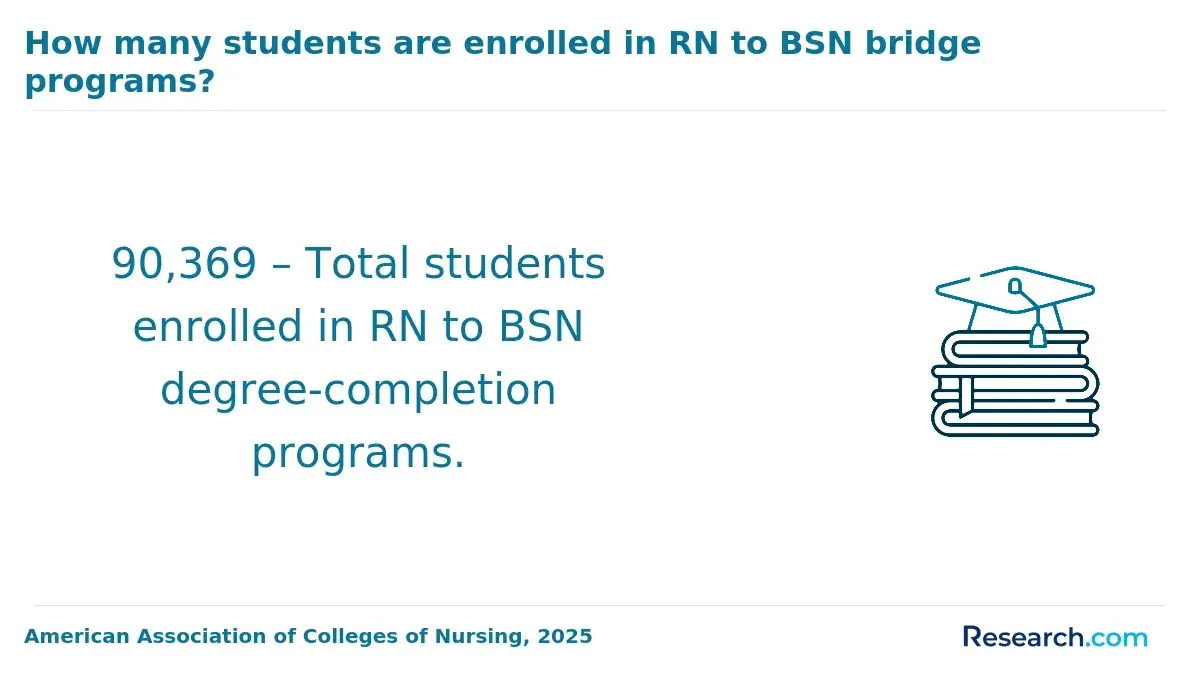
Washington has shown strong academic progression among nurses. The Washington Center for Nursing reported that approximately 78% of RNs in the state had a Bachelor’s Degree in Nursing or higher. By comparison, the American Association of Colleges of Nursing reported that 71.7% of the RN workforce have a baccalaureate degree or higher.
How does an RN to BSN online nursing degree compare to an on-campus program in Washington?
Online, hybrid, and campus-based RN to BSN programs generally cover the same upper-division nursing themes: leadership, health assessment, population health, research, evidence-based practice, quality improvement, informatics, ethics, and professional nursing. Accreditation standards, faculty expectations, and learning outcomes should be comparable when the programs are properly accredited.
The main difference is not the degree title. It is how you learn, interact, complete projects, and manage time.
| Comparison Point | Online or Hybrid RN to BSN | On-Campus RN to BSN |
| Best for | Working RNs who need schedule flexibility and limited commuting | Students who prefer regular face-to-face interaction and campus structure |
| Course access | Often asynchronous or partly scheduled online, with possible in-person sessions | Regular campus meetings at set times |
| Clinical or practice projects | May be completed locally or through approved community-based projects | Often coordinated near the campus or affiliated sites |
| Networking | Depends on online discussions, group work, faculty outreach, and occasional meetings | More direct interaction with classmates and faculty |
| Cost considerations | May reduce commuting and relocation costs, but fees still matter | May involve transportation, parking, and more time away from work |
Several programs reviewed for this guide use hybrid formats rather than fully online delivery. Some require a weekly evening class, a once-per-semester attendance day, or classes every other week. If you are comparing RN to BSN programs with an online masters program in nursing or another nursing pathway, check the in-person requirements carefully before applying.
What is the average cost of RN to BSN online nursing programs in Washington?
The average cost of some of the best online RN to BSN programs in Washington ranges from approximately $227 per credit to $724 per credit in tuition for residents. For non-residents, published figures range from $675 to $1,420 per credit.
Washington is among the top ten states for affordable in-state college education. A 2024 Education Data Initiative report listed the average cost for in-state tuition and fees in WA at $7,485. That can make Washington appealing for students searching for cheap RN to BSN programs, but tuition is only one part of the cost.
Western Washington University lists student fees of up to $672.09 per quarter for matriculated students, including charges such as technology, health services, and student recreation fees. Washington State University recommends budgeting $2,800 for books, $760 for equipment, $100 for a health fee, and about $2,500 for course and program fees, along with immunization and onboarding costs.
| Cost Category | Why You Should Check It Before Enrolling |
| Tuition per credit | Determines the largest direct academic cost, especially if many credits remain |
| Student and technology fees | Can add meaningful costs each term even in online or hybrid programs |
| Books and course materials | May be required in addition to tuition and fees |
| Equipment and software | Online coursework may require reliable technology, webcam access, and learning platforms |
| Health, onboarding, and immunization requirements | Can be required for practice experiences, projects, or site clearance |
| Travel and attendance costs | Hybrid programs may require campus visits, parking, transportation, or time away from work |
Costs differ across the different types of nursing degrees and levels. Before committing, request a full cost-of-attendance estimate from each school, not just the per-credit tuition rate.
What are the financial aid options for students enrolling in RN to BSN online nursing programs in Washington?
Financial aid for RN to BSN students in Washington may come from federal aid, state programs, institutional scholarships, employer benefits, loan repayment programs, community organizations, and professional nursing associations. Availability depends on residency, enrollment level, financial need, academic standing, employer policy, and service commitments.
- Washington State Nurses Foundation Scholarships: The Washington State Nurses Foundation offers scholarships for nursing students at different education levels, including RN to BSN students. Award criteria may include academic performance, financial need, and other foundation requirements.
- Washington State Opportunity Scholarship: WSOS supports low- and middle-income Washington residents in eligible high-demand fields, including nursing. It can also be relevant for students continuing into baccalaureate or graduate options such as online master nursing programs.
- Employer tuition assistance: Some healthcare employers provide tuition reimbursement or assistance for nurses advancing their education. Policies vary widely, so ask about annual caps, grade requirements, repayment obligations, and whether the school must be preapproved.
- Washington State Loan Repayment Programs: Nurses who work in underserved or shortage areas may qualify for Washington nursing education loan repayment programs, including the Washington Nurse Educator Loan Repayment (NELR) Program, the Nurse Corps Loan Repayment Program (NCLRP), the NHSC Rural Community Loan Repayment Program, and others.
- Community foundation scholarships: Local foundations and nonprofit organizations may fund nursing students based on location, academic profile, service goals, or financial need. Examples include the Lois Jean Roberts Nursing Scholarship Program and the Katie Moore Memorial Nursing Scholarship.
- Professional nursing organizations: Groups such as the Washington State Nurses Association (WSNA) and Washington State Nurses Foundation (WSNF) may offer scholarships, grants, or professional development funding.
Many schools also provide their own scholarships, grants, payment plans, tuition discounts, and loan options. Whether you are comparing RN to BSN, MSN, DNP, ADN, or LPN to BSN bridge programs online, ask each financial aid office for nursing-specific aid rather than relying only on general scholarship listings.
Washington is one of the leading states for financial aid for college or career training. An annual survey from the National Association of State Student Grant and Aid Programs reported that Washington State awarded a total of $500.259 million in financial aid for college or career training.
What are the prerequisites for enrolling in RN to BSN online nursing programs in Washington?
Admissions requirements vary by school, but Washington RN to BSN programs usually expect applicants to have completed, or be close to completing, ADN-level nursing preparation and RN licensure requirements. Some programs admit students who are preparing to take the NCLEX-RN, while others require an active RN license before the program begins.
- ADN or equivalent nursing preparation: Applicants are commonly expected to graduate from a regionally accredited Associate Degree in Nursing program.
- Active RN license: Many programs require an active, unencumbered RN license in Washington or eligibility for licensure by the start of the program.
- Prerequisite coursework: Schools may require completed courses such as Ethics, Human Anatomy, and Physiology, often with grades of C or better.
- Minimum GPA: Some programs set a minimum GPA, often around 3.0 or higher.
- Technology access: Online students need a reliable computer, high-speed internet, and the ability to use learning management systems.
- Letters of recommendation: Some schools request recommendations from healthcare supervisors, faculty members, or other professionals.
- Personal statement or essay: Applicants may need to explain their BSN goals, nursing experience, and professional plans.
- Background check and drug screening: These are common in nursing education and may be required for admission or practice experiences.
- Clinical or practice requirements: Programs may require documentation, immunizations, certifications, or site approval for practice-based projects.
- Admissions interview: Some programs include an interview before final admission.
Questions to ask before applying
- Can I apply before passing the NCLEX-RN, or must I already hold an RN license?
- How many ADN credits will transfer into the BSN plan?
- Which prerequisites are still missing from my transcript?
- Are there in-person meetings, labs, simulations, or campus visits?
- Can I complete required projects near my home or workplace?
- What happens if my work schedule changes during the program?
How do RN to BSN online nursing students in Washington complete clinical requirements?
RN to BSN programs are designed for students who already have entry-level clinical preparation as registered nurses, so their practice components often look different from ADN clinical rotations. Instead of repeating basic bedside clinical hours, BSN completion programs commonly use community health, population health, leadership, quality improvement, research, or capstone experiences.
Some Washington programs replace traditional precepted clinical hours with projects that require students to assess community needs, design interventions, analyze outcomes, or apply evidence-based practice in a real healthcare or community setting. Others may require site-based activities, documentation, faculty approval, or collaboration with local organizations.
If you plan to continue into advanced practice, the BSN can help build academic and professional readiness. However, nurse practitioner education requires separate graduate-level clinical training. Students considering that path can compare future options through nurse practitioner programs in Washington.
What career paths are available for graduates of RN to BSN online nursing programs in Washington?
A BSN can help registered nurses qualify for broader clinical, leadership, educational, and systems-focused roles. It is also a common stepping stone for graduate nursing degrees. Career outcomes depend on experience, certifications, employer requirements, and available openings.
| Career Path | Typical Focus | Why a BSN Helps |
| Nurse Educator | Teaching, staff development, patient education, or academic instruction | Builds a foundation for education-focused roles and later graduate study |
| Clinical Nurse Specialist | Specialized clinical expertise and care improvement | Supports progression toward advanced specialty preparation |
| Nurse Administrator | Unit operations, staffing, compliance, budgeting, and leadership | Strengthens management and systems-level nursing knowledge |
| Public Health Nurse | Community wellness, prevention, health education, and population health | BSN programs often include public and community health coursework |
| Research Nurse | Clinical trials, data collection, patient coordination, and protocol support | Develops research literacy and evidence-based practice skills |
| Case Manager | Care coordination across settings and providers | Improves understanding of healthcare systems and patient transitions |
| Nurse Informatics Specialist | Healthcare data, EHR workflows, and clinical technology | Introduces informatics and technology-supported care improvement |
A BSN is also a common prerequisite for nurses who want to pursue an MSN or DNP. For readers comparing long-term options, understanding MSN degree meaning can help clarify how graduate nursing education differs from BSN completion.
What is the job market for graduates with an RN to BSN online nursing degree in Washington?
The Washington nursing job market is shaped by retirements, population needs, employer preferences, specialty shortages, and the state’s large healthcare systems. The expected 20% drop in active RNs in 2029 because of retirement may increase the need for nurses who can move into leadership, education, care coordination, and specialized roles.
According to a survey conducted by AACN, 95% of BSN graduates find job placements within four to six months of graduation. This does not guarantee an individual job offer, but it does show that BSN-prepared nurses often enter a strong employment environment.
RN employment setting and specialty data
| Category | Reported Share |
| Hospital primary employment setting | 52.28% |
| Other primary employment setting | 14.29% |
| Ambulatory care primary employment setting | 11.94% |
| Acute Care/Critical Care primary specialty | 14.13% |
| Medical Surgical primary specialty | 10.54% |
| Other Clinical Specialties primary specialty | 9.28% |
Washington’s healthcare sector also emphasizes patient-centered care, population health, technology adoption, and interprofessional practice. These priorities can benefit BSN-prepared nurses who can contribute to quality improvement, informatics, care transitions, and leadership initiatives.
Advancement roles for BSN-educated nurses in Washington may include Charge Nurse, Director of Nursing, Chief Nursing Officer, Clinical Nurse Specialist, Nurse Manager, Clinical Research Nurse, and Nurse Supervisor. Salary.com reported that a nurse manager in Seattle can earn between $123,000 and $148,700. For many RNs, this type of advancement potential is one reason nursing school is worth it in the long run, provided the program cost and career goals align.
Is there an application deadline for online RN to BSN programs in Washington?
Application deadlines vary by institution. Some RN to BSN programs use rolling admissions and review applications throughout the year, while others set deadlines for fall, spring, summer, quarter-based, or semester-based starts.
Start earlier than you think you need to. Transcript evaluation, prerequisite checks, financial aid applications, employer tuition approval, immunization records, background screening, and RN license documentation can all take time. This is true whether you are applying to a BSN completion program, graduate nursing program, or LPN to RN online pathway.
Applicants should contact an RN-BSN advisor before submitting materials. A good advisor can confirm whether your license status is acceptable, explain missing prerequisites, estimate transfer credits, and recommend a realistic start date.
In 2024, 728,819 applications were received by nursing programs nationwide. However, 80,162 qualified applications were not accepted. That makes early preparation important, even for programs designed for working nurses.
Are online RN to BSN programs in Washington accredited and recognized for professional practice?
Yes, online and hybrid RN to BSN programs can be recognized by employers and professional organizations when they are properly accredited and offered by legitimate institutions. Accreditation helps confirm that the curriculum, faculty qualifications, student outcomes, and program resources meet recognized nursing education standards.
Look for programmatic accreditation from organizations such as the Commission on Collegiate Nursing Education (CCNE) or the Accreditation Commission for Education in Nursing (ACEN). Also confirm institutional accreditation and financial aid eligibility. Accreditation can affect transferability, graduate school admission, employer reimbursement, and professional credibility.
If you are still mapping the broader pathway into nursing practice, review how to become an RN in Washington to understand the relationship between education, licensure, and professional entry.
What steps should I take to secure my RN license in Washington after graduation?
An RN to BSN program is intended for licensed registered nurses or those eligible for RN licensure, so many students already hold an RN license before enrolling. If you are completing licensure steps, verify that your education, clinical history, exam status, background check, and documentation meet Washington requirements.
Prepare official transcripts, clinical documentation if required, proof of identity, required training records, and any additional materials requested by the state. Because requirements can change, use the state board’s instructions rather than relying only on a school checklist. Research.com’s guide to nursing license requirements in Washington can help you identify the major steps to review.
Can an RN to BSN Degree Accelerate My Transition to a Nurse Practitioner Role?
An RN to BSN degree can support the path to becoming a nurse practitioner, but it does not make someone an NP by itself. The BSN mainly helps by satisfying a common admission requirement for graduate nursing programs and by strengthening academic skills in research, leadership, population health, informatics, and evidence-based practice.
After the BSN, aspiring nurse practitioners typically need graduate-level preparation and supervised advanced clinical training. If that is your goal, compare admissions requirements, clinical placement policies, specialization tracks, and costs among nurse practitioner programs online.
How do online RN to BSN programs integrate innovative clinical simulation experiences?
Online RN to BSN programs may use virtual case studies, simulation software, telehealth scenarios, digital patient records, unfolding clinical cases, and group-based quality improvement projects. These tools are designed to test judgment, communication, prioritization, and systems thinking rather than replace all forms of real-world experience.
Some programs also connect nursing education with broader healthcare workforce training and interdisciplinary learning. Students interested in allied health training environments can compare related options such as medical assistant programs in Washington.
What should I consider when selecting the right online RN to BSN program in Washington?
The right RN to BSN program is the one that fits your license status, budget, work schedule, location, career plan, and academic needs. A low tuition rate is helpful, but it should not outweigh accreditation, transfer-credit policies, program clarity, or student support.
| Selection Factor | What to Ask | Red Flag |
| Accreditation | Is the program CCNE- or ACEN-accredited? | The school cannot clearly document programmatic nursing accreditation |
| Transfer credits | How many ADN and general education credits will apply? | You receive only vague estimates before enrollment |
| Format | How often must I attend in person? | The program is marketed as online but requires frequent campus attendance you cannot manage |
| Total cost | What are tuition, fees, books, equipment, and onboarding expenses? | Only tuition is disclosed, with little detail on mandatory fees |
| Clinical or practice requirements | Can I complete projects near my home or workplace? | Placement or project expectations are unclear |
| Graduate pathway | Does the BSN prepare me for MSN, DNP, or NP admission? | The program cannot explain how graduates transition to advanced study |
If your long-term plan is advanced practice, compare the BSN curriculum with future admission expectations for BSN to NP programs.
What challenges do online RN to BSN students encounter in Washington and how can they overcome them?
Working nurses often underestimate the demands of online study. Flexibility does not mean less work; it means more responsibility for planning, communication, and time management.
| Common Challenge | Better Strategy |
| Trying to study around unpredictable shifts | Choose a part-time plan or ask whether assignments are asynchronous |
| Assuming “online” means no in-person requirements | Confirm campus visits, simulations, and project expectations in writing |
| Waiting too long to request transfer evaluation | Send transcripts early and ask for a degree plan before enrolling |
| Ignoring technology requirements | Test the learning platform, webcam, internet speed, and software access before classes begin |
| Choosing by tuition alone | Compare total cost, accreditation, graduation support, and schedule fit |
Students who want a broader view of reputable nursing education options can review accredited nursing schools in Washington.
Do Washington Employers Value Online RN to BSN Degrees?
Employers generally care most about whether the degree came from an accredited institution, whether the nurse holds an active license, and whether the candidate can perform in the role. A properly accredited online or hybrid RN to BSN degree can be valued when it demonstrates leadership, evidence-based practice, informatics, communication, and population-health competencies.
Online learning may also signal that a nurse can manage technology, independent work, virtual collaboration, and competing responsibilities. Still, employer policies vary. If you are seeking tuition reimbursement or promotion eligibility, ask your HR or nursing leadership team whether the program you are considering meets their requirements.
Students comparing nursing entry points may also find it useful to explore how to become an LVN nurse in Washington when evaluating different levels of nursing practice.
How can I assess the quality and long-term success of an online RN to BSN program in Washington?
Program quality should be evaluated using evidence, not marketing language. Review accreditation, faculty credentials, graduation rates, student support, transfer-credit transparency, alumni outcomes, employer partnerships, and whether the curriculum reflects current nursing practice.
Ask schools for outcome data when available, including retention, graduation, employment, and student satisfaction information. If you plan to continue into advanced practice, check whether graduates have successfully moved into graduate nursing programs and whether the BSN curriculum supports prerequisites for that path. Readers considering that longer route can review how to become a nurse practitioner in Washington.
Can an RN to BSN Program Prepare Me for Careers in Digital Healthcare Administration?
An RN to BSN program can help nurses move toward digital healthcare administration by building knowledge in informatics, electronic health records, workflow improvement, data-informed decision-making, privacy, quality improvement, and interprofessional communication. These skills can be useful in roles connected to care coordination, clinical systems, utilization management, quality, and operations.
The BSN alone may not be enough for every health IT or administrative role, but it can provide a nursing foundation for later certificates, graduate study, or employer-based training. Nurses interested in revenue cycle, documentation, or coding-related operations may also compare guidance on how to become a medical biller and coder in Washington.
How Can RN to BSN Programs Support My Transition to Specialized Nursing Roles?
RN to BSN programs support specialization by improving the academic and professional skills that specialty roles often require: evidence-based decision-making, leadership, patient advocacy, cultural competence, population health, quality improvement, and interdisciplinary collaboration. Some programs also offer electives or capstone projects that let students focus on areas such as public health, informatics, leadership, or specialty care.
Specialized roles may still require experience, certification, graduate education, or state-specific credentials. For example, nurses interested in maternal and reproductive health pathways can review how to become a nurse midwife in Washington to understand the additional education required beyond the BSN.
How do online RN to BSN programs ensure academic rigor and integrity in Washington?
Reputable online RN to BSN programs use structured course design, faculty-led assessments, proctored or secured exams when required, plagiarism detection, discussion-based evaluation, applied projects, group work, and evidence-based assignments. The goal is to ensure that online students meet the same learning outcomes expected in comparable campus-based programs.
Faculty credentials, course review processes, accreditation standards, and student outcome monitoring are also important. Strong programs regularly assess student performance, retention, graduation, and curriculum relevance. Students exploring earlier nursing pathways can compare this with requirements described in how to become an LPN in Washington.
Can I transfer credits from my previous nursing education to an online RN to BSN program in Washington?
Yes. Many Washington RN to BSN programs accept transfer credits from accredited prior nursing education, including ADN coursework and completed general education classes. The number of credits accepted depends on the school’s policy, your transcript, grades, course equivalencies, accreditation of the prior institution, and how long ago certain courses were completed.
Request a formal or preliminary transcript evaluation before enrolling. Ask which credits count toward nursing requirements, which apply to general education, and which credits will not transfer. Also ask whether the school awards block credit for RN licensure or ADN completion.
What support services are available to students of RN to BSN programs in Washington?
Support services can make a major difference for working nurses. Before enrolling, confirm not only that services exist, but also that they are available during hours you can use.
- Academic advising: Helps students plan course sequences, track requirements, and adjust schedules when work or family demands change.
- Tutoring and writing support: Useful for research papers, APA formatting, evidence-based practice assignments, and academic writing improvement.
- Career services: May assist with resumes, interview preparation, job searches, graduate school planning, and advancement strategies.
- Technical support: Helps online students access learning platforms, troubleshoot login issues, and use required digital tools.
- Student success services: May provide coaching, time-management help, referrals, and persistence support.
- Library access: Online databases, research guides, and librarian support are important for BSN-level scholarly assignments.
- Disability support services: Eligible students may receive accommodations such as accessible course materials or alternative testing arrangements.
What unique skills and competencies can I gain through an RN to BSN online program in Washington?
An RN to BSN program is not just a credential upgrade. It is intended to move nurses from task-focused clinical practice toward broader professional judgment, leadership, systems thinking, and evidence-informed care.
| Competency | How It Applies in Practice |
| Evidence-Based Practice | Using current research and clinical evidence to improve decisions, policies, and patient outcomes |
| Leadership and Management | Coordinating teams, addressing conflict, supporting quality initiatives, and preparing for supervisory roles |
| Community and Public Health | Understanding prevention, population health, health education, and care needs beyond the hospital |
| Patient Advocacy | Communicating patient needs, supporting ethical care, and helping patients navigate complex systems |
| Interdisciplinary Collaboration | Working effectively with physicians, social workers, therapists, pharmacists, and other professionals |
| Healthcare Technology | Using informatics, data, and electronic health record systems to support safer and more efficient care |
| Cultural Competence | Providing respectful, inclusive care for Washington’s diverse communities |
What are the advantages of online RN programs for non-nurses in Washington?
RN to BSN programs are for people who are already registered nurses or are close to RN licensure. Non-nurses need a different pathway, such as an ADN, BSN, direct-entry nursing program, or another approved route that leads to RN eligibility.
Online RN programs for non-nurses may combine online coursework with in-person clinical experiences at approved healthcare sites. They can be useful for career changers who need flexibility, but students should be careful: any program leading to initial RN licensure must meet state clinical and educational requirements. Online coursework alone is not enough to become a registered nurse.
Prospective students who do not yet hold an RN license can review online RN programs for non nurses to compare appropriate entry-level nursing options before considering an RN to BSN bridge.
Career Advancement and Graduate Opportunities with an RN to BSN Degree in Washington
An RN to BSN degree can support both immediate advancement and long-term graduate education. The most direct benefits often come from becoming eligible for roles that prefer a BSN, strengthening your promotion profile, and preparing for MSN or DNP programs.
Advanced nursing roles for RN to BSN graduates
- Nurse Manager or Nurse Administrator: Oversees staffing, operations, budgets, compliance, and nursing team performance.
- Clinical Nurse Specialist: Builds expertise in a specialty area and supports evidence-based care improvement.
- Public Health Nurse: Works with communities on prevention, outreach, education, and population-level health needs.
- Informatics Nurse: Helps connect nursing practice with data, electronic systems, documentation, and workflow improvement.
- Nurse Educator: Teaches patients, staff, or nursing students depending on role requirements and education level.
Graduate-level opportunities after the BSN
A BSN is commonly used as the academic foundation for graduate nursing education. Possible next steps include a Master of Science in Nursing, Doctor of Nursing Practice, or nurse practitioner pathway. Graduate options may lead to roles such as Nurse Practitioner, Nurse Anesthetist, Nurse Midwife, nurse executive, faculty member, or advanced clinical specialist, depending on program type and licensure requirements.
If cost is a major concern, compare tuition, clinical placement support, employer reimbursement, and loan repayment options before applying to graduate school. Research.com’s guide to affordable online nursing master's programs can help nurses evaluate next-step options after completing the BSN.
Common Mistakes to Avoid When Choosing an RN to BSN Program in Washington
- Choosing without checking accreditation: Always verify programmatic nursing accreditation and institutional accreditation before applying.
- Looking only at tuition: Fees, books, equipment, immunization costs, onboarding requirements, and travel can change the real price.
- Assuming online means fully remote: Many Washington programs are hybrid and require campus attendance or approved practice experiences.
- Delaying transfer-credit review: A program that accepts more prior credits may save both time and money.
- Ignoring employer policies: If you need tuition reimbursement or promotion eligibility, confirm that your employer accepts the program.
- Overloading your schedule: Full-time study may be unrealistic for nurses working long or rotating shifts.
- Assuming salary increases are automatic: A BSN can improve qualifications, but pay depends on role, employer, specialty, and experience.
Key Insights
- An RN to BSN online or hybrid program in Washington is best for licensed RNs who want advancement, leadership preparation, graduate-school eligibility, or stronger competitiveness in BSN-preferred roles.
- Program format matters. Many Washington RN to BSN programs include in-person days, hybrid classes, practice projects, or capstone requirements, so confirm attendance expectations before applying.
- Cost comparisons should include tuition, fees, books, equipment, health requirements, onboarding, transportation, and lost work time—not just the advertised per-credit rate.
- Accreditation is non-negotiable. Choose a properly accredited program if you want employer recognition, financial aid eligibility, smoother graduate-school options, and long-term professional credibility.
- Transfer credits can significantly affect your timeline and ROI. Request a transcript review before enrolling so you know exactly how many credits remain.
- The BSN can support higher-responsibility roles and graduate study, but it does not guarantee a salary increase or promotion. Align the program with a specific career goal before committing.
Related Articles for Nearby States
- 2027 Best Online Nursing Programs in Oregon – Accredited RN to BSN Programs
- 2027 Best Online Nursing Programs in Idaho – Accredited RN to BSN Programs
- 2027 Best Online Nursing Programs in Montana – Accredited RN to BSN Programs
- 2027 Best Online Nursing Programs in California: Accredited RN to BSN Programs
- 2027 Best Online Nursing Programs in Nevada – Accredited RN to BSN Programs
- 2027 Best Online Nursing Programs in Utah: Accredited RN to BSN Programs
- 2027 Best Online Nursing Programs in Wyoming – Accredited RN to BSN Programs
- 2027 Best Online Nursing Programs in Arizona – Accredited RN to BSN Programs
- 2027 Best Online Nursing Programs in Colorado – Accredited RN to BSN Programs
- 2027 Best Online Nursing Programs in New Mexico – Accredited RN to BSN Programs
References:
- O*Net Online. (n.d.). Washington Employment Trends, 25-1072.00 - Nursing Instructors and Teachers, Postsecondary. Data Extracted on February 28, 2024. https://www.onetonline.org/link/localtrends/25-1072.00?st=WA
- O*Net Online. (n.d.). Washington Employment Trends, 29-1141.00 - Registered Nurses. Data Extracted on February 28, 2024. https://www.onetonline.org/link/localtrends/29-1141.00?st=WA
- O*Net Online. (n.d.). Washington Employment Trends, 29-1141.04 - Clinical Nurse Specialists. Data Extracted on February 28, 2024. https://www.onetonline.org/link/localtrends/29-1141.04?st=WA
- O*Net Online. (n.d.). Washington Employment Trends, 29-1171.00 - Nurse Practitioners. Data Extracted on February 28, 2024. https://www.onetonline.org/link/localtrends/29-1171.00?st=WA
- Salary.com (February 2024). Nursing Manager Salary in Seattle, Washington. https://www.salary.com/research/salary/alternate/nursing-manager-salary/seattle-wa
- Washington State Board of Nursing (n.d.). Education Data Dashboard. Data Extracted on February 28, 2024. https://nursing.wa.gov/research-and-data/data-dashboards/education-data-dashboard
- Western Washington University (n.d.). TUITION AND FEE SCHEDULE. https://sbo.wwu.edu/tuition-and-fees
- ZipRecruiter (February 2024). Bsn Nurse Salary in Washington. https://www.ziprecruiter.com/Salaries/BSN-Nurse-Salary--in-Washington
Other Things You Should Know About Online Nursing Degrees in Washington
Admission requirements for online RN to BSN programs in Washington in 2027 typically include an active RN license, an associate degree or diploma in nursing from an accredited institution, a minimum GPA (usually around 2.5 to 3.0), and completion of prerequisite courses. Specific requirements may vary by program.
Students interested in Washington’s online RN to BSN programs in 2027 can explore financial aid options by visiting the programs' official websites, contacting the financial aid offices directly, or using federal resources like the FAFSA website to identify potential grants, loans, and scholarships tailored to their needs.
Students need a reliable computer with internet access, compatible web browsers, and basic software like Microsoft Office. Some programs may require specific online learning platforms or tools such as Zoom for virtual classes and exams in 2027.
No. Many Washington RN to BSN programs use a mix of asynchronous coursework and scheduled online activities, such as live discussion sessions or proctored exams. Some programs also require limited in-person clinical or practicum hours tied to community health or leadership outcomes.


