2027 Hardest and Easiest Courses in an Exercise Science Degree Program

Co-Founder and Chief Data Scientist
An exercise science degree can feel very different from semester to semester. One term may focus on introductory wellness concepts and practical skills; the next may require anatomy labs, biomechanics calculations, research design, or clinical testing protocols. Knowing which courses tend to be hardest—and which are usually more manageable—helps students build a schedule that protects their GPA, supports learning, and leaves enough time for labs, work, athletics, internships, or family responsibilities.
This guide explains the common difficulty patterns in exercise science programs. It covers demanding core classes, lighter required courses, challenging electives, technical skill expectations, writing-heavy assignments, online versus on-campus formats, weekly study time, GPA effects, and the career value of rigorous coursework. Nearly 45% of exercise science students report difficulty managing workloads in advanced physiology and biomechanics courses, so planning ahead is not just helpful—it can shape academic performance and long-term readiness for health, fitness, rehabilitation, and sports-related careers.
Course difficulty varies by instructor, program design, lab access, prerequisites, and a student’s background in biology, math, or athletics. Still, common patterns appear across many curricula. Use this guide to identify pressure points before registration, balance demanding classes with manageable ones, and choose electives that fit your goals rather than simply chasing the easiest option.
Key Things to Know About the Hardest and Easiest Courses in a Exercise Science Degree Program
- Courses with complex anatomy and physiology content, like human biomechanics, are often hardest due to detailed memorization and critical application requirements.
- Workload-heavy courses involving extensive lab work and practical assessments increase difficulty, particularly for students lacking hands-on experience.
- Statistics and research methods are usually easier for students with prior math skills; online formats can ease learning through flexible pacing and resources.
What Are the Hardest Core Courses in a Exercise Science Degree Program?
The hardest core courses in an exercise science degree are usually the ones that combine dense scientific content, lab work, quantitative reasoning, and applied decision-making. These classes matter because they form the foundation for later study in clinical exercise physiology, rehabilitation, strength and conditioning, wellness programming, and graduate health programs.
Advanced physiology and biomechanics courses are especially demanding for many students. Nearly 45% of exercise science students report difficulty managing workloads in advanced physiology and biomechanics courses, which reflects how much time these subjects require outside scheduled class meetings.
Five core courses commonly considered among the most challenging include:
- Human Anatomy and Physiology: This course requires students to learn body systems in detail, connect structure with function, and often complete lab work that tests identification, terminology, and physiological processes. The challenge is not only memorization; students must understand how systems interact during movement, injury, fatigue, and adaptation.
- Kinesiology: Kinesiology connects anatomy, biomechanics, and movement analysis. Students must move beyond naming muscles and joints to explaining how force, leverage, posture, and coordination affect performance. It can be difficult for students who are comfortable with practical movement but less experienced with scientific analysis.
- Exercise Physiology: This course examines how the cardiovascular, respiratory, muscular, endocrine, and metabolic systems respond to acute and chronic exercise. Students often need to understand energy systems, adaptation, fatigue, training response, and lab-based testing methods.
- Statistics for Health Sciences: Statistics can be challenging because it requires a different kind of thinking from many movement-based classes. Students learn how to interpret research, choose statistical tests, evaluate results, and avoid unsupported conclusions. It is especially important for students interested in graduate study, clinical research, or evidence-based practice.
- Clinical Exercise Testing and Prescription: This course is demanding because mistakes can have safety implications. Students may need to assess fitness levels, interpret health information, apply contraindications, and design exercise plans that are appropriate for different populations.
A smart schedule usually avoids stacking several of these courses in the same term unless the student has strong preparation and enough weekly study time. If you must take two difficult science-heavy courses together, consider pairing them with a lighter elective or a project-based requirement.
Students comparing healthcare education pathways may also review an RN to BSN online option to understand how different health-related programs structure clinical expectations, flexibility, and workload.
What Are the Easiest Required Courses in a Exercise Science Degree Program?
The easiest required courses in an exercise science program are typically introductory, skills-based, or applied courses with clear expectations. “Easiest” does not mean unimportant. These courses often build professional habits, introduce terminology, and help students connect classroom learning with real-world health and fitness settings.
A recent national survey found that over 65% of exercise science students believed courses with hands-on projects and skill applications were less challenging. This helps explain why practical courses often feel more manageable than advanced physiology, statistics, or biomechanics.
Required courses that students often find more accessible include:
- Introduction to Exercise Science: This course usually surveys the field, including careers, professional standards, basic exercise concepts, and major areas of study. It is often manageable because it emphasizes orientation and broad understanding rather than advanced technical mastery.
- Health and Wellness: This class commonly focuses on personal health behaviors, wellness planning, prevention, stress, sleep, nutrition basics, and lifestyle change. Students often find it approachable because the content connects directly to everyday decisions.
- First Aid and CPR: This course is skill-driven and structured around clear procedures. Many students prefer its practical assessments because they know exactly what they must demonstrate.
- Fitness Assessment and Exercise Prescription: Although this course can become technical in some programs, introductory versions are often easier than clinical testing courses because students focus on basic measurements, client goals, and general programming principles.
Students should avoid treating these courses as automatic GPA boosters. Even manageable classes can become stressful when attendance, certifications, skills demonstrations, or group projects are required. The best use of lighter required courses is strategic: pair them with anatomy, physiology, statistics, or lab-heavy classes to create a balanced term.
Students exploring healthcare-adjacent programs with flexible formats may also compare medical billing and coding schools online with financial aid when evaluating workload, cost, and career alignment.

What Are the Hardest Elective Courses in a Exercise Science Degree?
The hardest electives in an exercise science degree are usually advanced courses that require students to apply scientific concepts independently. Unlike introductory electives, these classes may involve data analysis, research interpretation, lab testing, clinical reasoning, or detailed case work. They are often worthwhile for students pursuing graduate school, athletic performance roles, rehabilitation-related careers, or clinical exercise settings.
Electives commonly viewed as more demanding include:
- Biomechanics: Biomechanics can be difficult because it blends physics, anatomy, mathematics, and movement analysis. Students may analyze forces, torque, joint angles, gait, lifting mechanics, or sport technique. The course rewards students who can connect formulas to visible human movement.
- Exercise physiology: As an elective or advanced version of a required course, exercise physiology often goes deeper into metabolic pathways, cardiovascular response, thermoregulation, fatigue, and adaptation. Lab reports and data interpretation can add to the workload.
- Motor control and learning: This course asks students to understand how the nervous system organizes movement and how people acquire, refine, and retain motor skills. It can feel abstract because students must connect neuroscience, psychology, and practical coaching or rehabilitation examples.
- Research methods in exercise science: Research methods is demanding because it requires careful thinking rather than simple recall. Students may design studies, evaluate journal articles, apply statistical concepts, and explain limitations in evidence.
- Clinical exercise testing and prescription: When offered as an elective or advanced course, this class can be one of the most intensive options. Students may work with cardiovascular, respiratory, metabolic, or risk-screening concepts while learning how to make safe exercise recommendations.
These electives are best chosen for a reason. A student aiming for physical therapy, occupational therapy, athletic training, cardiac rehabilitation, strength and conditioning, or graduate research may benefit from the challenge. A student trying to protect GPA during a packed semester may want to delay these electives or take only one at a time.
What Are the Easiest Electives in a Exercise Science Degree Program?
The easiest electives in an exercise science program are usually the ones with practical topics, familiar concepts, and project-based assessments. They may still require effort, but the workload often feels more predictable than technical electives that depend on calculations, lab reports, or advanced physiology.
Electives often considered more manageable include:
- Introduction to Nutrition: This course typically covers macronutrients, micronutrients, hydration, energy balance, dietary guidelines, and basic health applications. It may be easier for students because many concepts connect to daily life, athletics, and wellness.
- Health and Wellness Promotion: Students often create wellness plans, campaigns, or behavior-change strategies. The course can be manageable because assessments may emphasize applied projects instead of high-stakes exams.
- Stress Management Techniques: This elective commonly includes practical tools such as relaxation methods, breathing strategies, mindfulness, and lifestyle planning. Students often find it less intimidating because learning is experiential.
- Exercise Programming for Special Populations: Difficulty varies by instructor, but many students find it approachable when assignments use case studies and programming plans rather than heavy theory. It is also useful for students interested in inclusive fitness, aging populations, or adaptive exercise.
- Community Health Education: This course often emphasizes outreach, communication, presentations, and program planning. Students who are comfortable with collaboration and public-facing projects may find it less stressful than lab-heavy science courses.
The best elective is not always the easiest one. Students should choose at least some electives that support their intended career path. A lighter elective can help balance a hard semester, but too many low-challenge electives may leave gaps in preparation for graduate school, certifications, or specialized employment.
A graduate of an exercise science program I spoke with described choosing electives based on how balanced the semester felt. He said no course was completely effortless, but electives with project-based work gave him “more control over pacing and creativity.” He felt especially relieved when assessments involved presentations or plans instead of high-stakes exams because those formats helped him manage stress while still applying what he learned.
Which Exercise Science Classes Require the Most Technical Skills?
The exercise science classes that require the most technical skills are usually those involving lab equipment, movement analysis, statistical software, physiological testing, or research design. These courses can be challenging because students must be accurate, safe, and analytical—not just knowledgeable.
Surveys show that about 65% of students in exercise science programs need strong software proficiency and laboratory expertise to excel, especially when dealing with biomechanical analysis and physiological data.
Three technically demanding classes include:
- Biomechanics: Students may use motion capture tools, video analysis, force plates, or specialized software to examine movement. They must understand mechanical principles and apply them to real bodies in motion, which requires precision and interpretation.
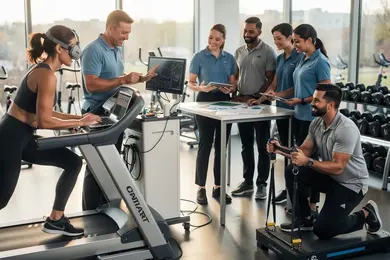
- Exercise Physiology Laboratory: This course may require students to use physiological monitoring equipment such as VO2 max machines and electromyography (EMG). Students must collect clean data, follow protocols, recognize errors, and explain results clearly.
- Research Methods and Statistics: Technical skill in this class often involves statistical software, dataset management, study design, hypothesis testing, and evidence interpretation. It is essential for students who want to read research critically or continue into graduate-level study.
Students can prepare by reviewing basic anatomy, practicing spreadsheet skills, becoming comfortable with graphs, and asking early for demonstrations of unfamiliar equipment. Technical courses are easier when students treat labs as skill-building sessions rather than isolated assignments.
Students who want broader healthcare management context may compare how a healthcare administration degree online emphasizes data, operations, and organizational decision-making rather than lab-based exercise testing.
Are Writing-Intensive Exercise Science Courses Easier or Harder?
Writing-intensive exercise science courses can be easier for students who are strong readers and writers, but harder for those who prefer practical demonstrations, labs, or exams. The challenge is that students must understand scientific content and communicate it clearly using evidence, citations, structure, and discipline-specific terminology.
A recent survey found that 65% of undergraduate students in this field identified writing assignments as their most time-consuming tasks. This does not mean writing-heavy courses are always the hardest, but it does mean they require steady time management.
Key factors that influence difficulty include:
- Research requirements: Students may need to read peer-reviewed articles, compare findings, evaluate methods, and synthesize evidence. This can be unfamiliar for students used to textbook-based studying.
- Time management: A strong paper usually requires planning, drafting, revising, editing, and formatting. Waiting until the final week often leads to weaker work and higher stress.
- Assessment style: Some students perform better on written reports, literature reviews, or research proposals than on timed exams. Others find open-ended writing harder because expectations feel less concrete.
- Prior student experience: Students who have already written lab reports, research summaries, or APA-style papers often adjust faster. Students new to academic writing may need extra support from writing centers, librarians, or instructors.
- Integration benefits: Writing can strengthen learning because students must explain mechanisms, evidence, and implications in their own words. Over time, this can improve retention and professional communication.
A practical approach is to start writing-intensive assignments as soon as the prompt is available. Create a research question, gather sources early, outline the paper, and schedule revision time. In exercise science, clear writing is not just an academic skill; professionals often need to document assessments, justify programs, explain evidence, and communicate with clients, patients, coaches, or healthcare teams.
Students comparing workload across health-related degrees may also examine an online nursing program to understand how writing, clinical expectations, exams, and online learning formats differ by field.
Are Online Exercise Science Courses Harder Than On-Campus Classes?
Online exercise science courses are not automatically harder than on-campus classes, but they can feel harder for students who need external structure, immediate feedback, or regular access to labs. They can feel easier for students who are disciplined, comfortable with technology, and benefit from flexible scheduling.
Research shows that around 70% of students express equal or greater satisfaction with online courses compared to campus-based ones, although online course completion rates tend to be modestly lower. That difference matters: satisfaction does not always translate into completion when students struggle with pacing, isolation, or time management.
Important factors include:
- Self-discipline demands: Online students often manage lectures, readings, discussions, quizzes, and assignments without fixed classroom routines. A weekly schedule is essential.
- Instructor engagement: Complex topics such as physiology, biomechanics, and statistics may take longer to clarify online if students wait to ask questions. Successful online learners use office hours, discussion boards, email, and tutoring early.
- Resource availability: On-campus students may have easier access to labs, testing equipment, and supervised practice. Online programs may use simulations, local proctors, recorded demonstrations, or arranged field experiences instead.
- Flexibility advantage: Flexibility can reduce stress for working students, parents, athletes, or military learners. It can also create procrastination risk if deadlines are not broken into smaller tasks.
- Assessment format: Online courses may rely more on open-book quizzes, recorded demonstrations, discussion posts, projects, or remote exams. The format can change how students prepare.
Students considering a fully online or hybrid pathway should review whether the program includes lab requirements, internships, local placements, proctored exams, or hands-on skill verification. Those comparing flexible options in this field may also want to research a sport and exercise science online degree to see how online programs structure applied learning.
When I spoke with a graduate of an online exercise science degree, she described both the freedom and the pressure of the format. “Managing my time was definitely the hardest part,” she said. “Since there wasn’t a fixed schedule, I had to create my own routine and stick to it, even when distractions were everywhere.”
She also said recorded lectures helped her revisit difficult material at her own pace. Her experience shows why online difficulty depends heavily on the student’s habits. The format can support deep learning, but only if the student builds structure before falling behind.
How Many Hours Per Week Do Students Spend on Exercise Science Courses?
Exercise science students commonly need about two to three hours of study time for every credit hour. Depending on course load and difficulty, that can result in 12 to 18 hours weekly for exercise science courses. Lab-heavy, writing-intensive, and upper-division classes may require more consistent time than introductory wellness or skills-based courses.
Weekly time commitment depends on several factors:
- Course level: Introductory classes usually require less outside preparation than upper-division courses involving physiology, biomechanics, research, or clinical application.
- Technical intensity: Labs, data analysis, practical testing, and equipment-based assignments add preparation and review time beyond scheduled class meetings.
- Writing requirements: Literature reviews, lab reports, research proposals, and case analyses can increase workload because they require source evaluation, drafting, and revision.
- Learning format: Online students may spend extra time organizing materials, watching recorded lectures, participating in discussion boards, and managing deadlines independently.
- Student background: Students with prior coursework in biology, anatomy, physics, statistics, or health sciences may move faster through foundational concepts. Students without that background may need more review time.
A practical planning method is to map each course by workload type before the semester begins. Identify which classes require labs, exams, weekly quizzes, papers, group projects, or field hours. Then reserve study blocks for the most demanding classes first rather than giving every course equal time.
| Course Type | Likely Weekly Demand | Planning Tip |
| Introductory or wellness-based courses | More predictable and often lighter | Use these to balance a semester with harder science courses. |
| Lab-based science courses | Higher due to preparation, lab time, and reports | Review procedures before lab and write results soon after. |
| Statistics or research courses | Steady practice required | Work problems weekly instead of cramming before exams. |
| Writing-intensive courses | Time-consuming near major deadlines | Start papers early and schedule revision time. |
Do Harder Exercise Science Courses Affect GPA Significantly?
Harder exercise science courses can affect GPA significantly, especially when students take multiple demanding classes in the same term or enter advanced courses without strong prerequisites. The GPA risk comes from stricter grading, complex assessments, lab performance, cumulative exams, and the time required to master technical content.
Students in upper-division exercise science courses face a 15% higher withdrawal rate compared to lower-division classes, highlighting the impact of difficult exercise science courses on GPA.
Factors that influence GPA include:
- Grading Rigor: Upper-level courses may use tougher exams, detailed rubrics, lab practicals, and higher expectations for scientific reasoning.
- Assessment Structure: Some classes combine written exams, practical demonstrations, lab reports, data interpretation, and case applications. This variety can help some students but overwhelm others.
- Course Sequencing: Anatomy, physiology, statistics, and kinesiology often build on each other. Weak performance in foundational courses can make advanced classes much harder.
- Student Preparation: Study habits, prior knowledge, attendance, and early use of support services can make a major difference. Students who wait until the first poor exam grade to adjust often have less room to recover.
- GPA Weighting Policies: Some programs apply different GPA weightings for advanced courses, which can either lessen or intensify their effects on a student’s overall GPA.
To protect GPA, students should avoid overloading one semester with anatomy and physiology, biomechanics, statistics, and clinical testing unless necessary. A balanced schedule might pair one high-difficulty science course with one applied course, one writing course, and one lighter elective.
Students thinking about cost, workload, and health-related career mobility may also compare the cheapest online RN to BSN programs to understand how different degree paths manage affordability and academic demands.
Do Harder Exercise Science Courses Lead to Better Job Opportunities?
Harder exercise science courses can support better job opportunities when they build skills employers recognize and when students can show those skills through experience, projects, internships, certifications, or graduate preparation. Difficulty alone does not guarantee employment. What matters is whether the course develops relevant competence.
A 2023 survey revealed that 62% of hiring managers in health and wellness fields value applicants who have completed challenging coursework or substantial projects. This suggests that rigorous coursework can strengthen a resume when paired with evidence of applied ability.
Harder courses may improve career readiness in several ways:
- Skill development: Courses in biomechanics, exercise physiology, clinical testing, statistics, and research methods build analytical and practical skills that can transfer to fitness assessment, rehabilitation support, performance analysis, and wellness programming.
- Employer perception: Completing difficult coursework can signal discipline and persistence, especially when students can explain what they learned and how they applied it.
- Internships and project exposure: Advanced courses may include case studies, lab projects, field experiences, or applied assignments that give students stronger examples for interviews.
- Specialization signaling: Electives in areas such as sports nutrition, rehabilitation, special populations, or strength and conditioning can show a clearer career direction.
- Long-term career growth: Rigorous coursework can help students prepare for certifications, graduate study, or specialized roles beyond entry-level fitness and wellness positions.
The best strategy is not to choose every hard class available. Instead, students should choose rigorous courses that align with their intended path. A future strength and conditioning coach may benefit from biomechanics and exercise programming. A student aiming for physical therapy may prioritize anatomy, physiology, motor control, and clinical testing. A student interested in research should take statistics and research methods seriously.
What Graduates Say About the Hardest and Easiest Courses in a Exercise Science Degree Program
- : "Balancing the challenging courses like human physiology with the easier electives really kept me engaged throughout my online exercise science degree. The investment was worthwhile considering the average cost of attendance was manageable, and it paid off by boosting my job prospects in physical therapy. I'm grateful for how the curriculum strengthened both my knowledge and practical skills. — Leanne"
- : "At times, juggling the rigorous classes in biomechanics alongside simpler general education courses felt overwhelming, but the flexibility of the online format made it doable. The cost, which aligned with typical tuition rates I've researched, was a significant factor in my choice, and it proved to be a smart investment as my qualifications opened new doors in wellness coaching. — Selma"
- : "The mix of difficult courses like exercise physiology with more straightforward ones was a good balance, especially since I could plan my workload online to fit my schedule. Considering the overall costs, which were reasonable compared to in-person programs, I found the degree empowered me greatly in my role as a strength and conditioning coach. Looking back, the degree truly advanced my career. — Martin"
Other Things You Should Know About Exercise Science Degrees
Yes, many advanced exercise science courses require students to complete foundational classes in anatomy, physiology, and basic kinesiology. These prerequisites ensure that students have the necessary background knowledge to grasp complex concepts and participate effectively in lab work. Skipping these can make advanced coursework significantly more challenging.
In 2027, course difficulty in exercise science often hinges on content complexity, teaching style, and assessment methods. Harder courses typically involve advanced scientific concepts and lab work, while easier ones might focus on general theories and practical applications. Faculty expertise and available resources also significantly impact course difficulty.
Effective strategies include consistent review of lecture material, active participation in labs, forming study groups, and utilizing campus resources like tutoring centers. Time management and breaking down material into manageable sections can make challenging content more approachable. Applying knowledge through practical exercises also enhances retention.
References
- How Hard Is Exercise Science Major https://likuyani.cdf.go.ke/Resources/3P8029/default.aspx/HowHardIsExerciseScienceMajor.pdf
- What Can You Do with an Exercise Science Degree? https://www.cune.edu/news/what-can-you-do-exercise-science-degree
- 11 Exercise Science Degree Jobs | The University of Olivet https://www.uolivet.edu/what-can-you-do-with-an-exercise-science-degree/
- A week in the life of a sport and exercise science student https://www.surrey.ac.uk/news/week-life-sport-and-exercise-science-student
- Exercise Science Degree Programs & Career Guide 2025 https://www.nutritioned.org/exercise-science-degree/
- Best Exercise Courses & Certificates [2025] | Coursera Learn Online https://www.coursera.org/courses
- Exercise Science Degree Careers: The complete list https://traineracademy.org/blog/exercise-science-careers/
- Major in Exercise Science https://catalog.towson.edu/undergraduate/health-professions/kinesiology/exercise-science/
- What does a career in Exercise Science look like? https://www.lmc.edu/about/news-center/articles/2025/what-does-a-career-in-exercise-science-look-like.htm